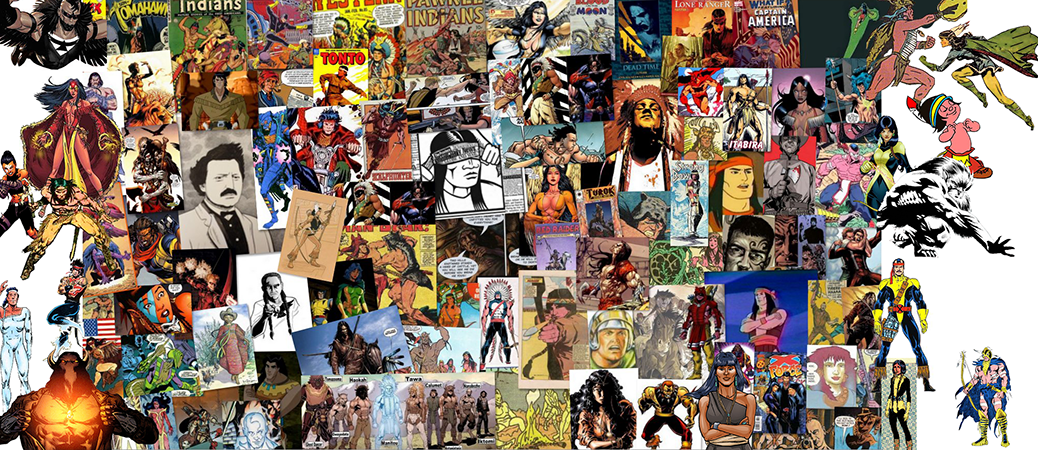
In a recent posting on DC Women Kicking Ass, sources have confirmed that comic artist Jeff Lemire has followed through on his projection from last year that he would be creating a new superhero based on deceased Indigenous teen activist Shannen Koostachin. They will be appearing in Justice League United #1, which comes out this May.
Who is Shannen Koostachin?
Shannen Koostachin was born in Attawapiskat First Nation on James Bay coast, Ontario, Canada. Most recently Attawapiskat has made headlines for its dire living conditions, from boiling orders to inadequate housing insulation, which has drawn increased attention nationally and internationally to the reality that the conditions of many Indigenous communities in Canada are more comparable to the Third World than an industrialized democracy like Canada.
She attended J.R. Nakogee elementary school, which had been housed in makeshift portables shipping containers since 2000, when it was condemned and closed due to a decades-old fuel leak. Then a teenager, Shannen learned that Canadian government was not giving proper funding to First Nation Aboriginal Schooling systems around Canada.
In 2007, the federal government had backed away from a third commitment to building a new school for Attawapiskat. Using the power of social media like Youtube and Facebook, Shannen and other Indigenous youth launched the Students Helping Students campaign for a school for Attawapiskat.Koostachin spoke out about the experiences of her community in newspapers, at conferences, and on the steps of Parliament Hill in 2008. In 2009, at the age of 14, in 2009 she was nominated for the International Children’s Peace Prize.
Tragically, Shannen died on May 30, 2010 in a car accident. Her legacy to improve the conditions of First Nations communities–particularly youth and students–lives on in a campaign called Shannen’s Dream.
As momentous as it sounds, no one could have known in 1979 that this self-published periodical based in New York City would become the longest-running anthology of political comics in the world–at least, that we’ve been able to find.
Left: Coretta Scott King Book Awards Symbol next to 2014 honourable mention, “MARCH: Book 1” by Congressman John Lewis, Andrew Aydin, and illustrator Nate Powell
The Coretta Scott King Book Awards are given annually to outstanding African American authors and illustrators of books for children and young adults that demonstrate an appreciation of African American culture and universal human values. The award commemorates the life and work of Dr. Martin Luther King, Jr., and honours his wife, Mrs. Coretta Scott King, for her courage and determination to continue the work for peace and world brotherhood. The Awards were founded in 1969 at the American Library Association (ALA) Annual Conference in Atlantic City, New Jersey.
“MARCH: Book One”, an autobiographical graphic novel by former Civil Rights leader and Congressman John Lewis, tells the complex, often troubling, often inspiring, story of freedom fighters launching a movement in the U.S. South that would change the entire country. The book is co-authored by Andrew Aydin, a member of Congressman Lewis’ staff, and by veteran comic illustrator and storyteller, Nate Powell.
A full list of award winners is below.
2014 Author Award Winner
Rita Williams-Garcia, author of“P.S. Be Eleven” published by Amistad, an imprint of HarperCollins Publishers. In this spirited stand-alone sequel to “One Crazy Summer,” the Gaither sisters return to Brooklyn after a summer spent with their mother in Oakland, California. Delphine, Vonetta and Fern thrive in the tumultuous era of the late 1960s, but Delphine is tasked by her mother to, “P.S. Be Eleven.”
Rita Williams-Garcia, the author of the Newbery Honor–winning novel “One Crazy Summer,” also a winner of the Coretta Scott King Award, a National Book Award finalist, and the Scott O’Dell Award for Historical Fiction. Residing in Jamaica, N.Y., she is on the faculty at the Vermont College of Fine Arts.
2014 Illustrator Award Winner
Bryan Collier, illustrator of “Knock knock: my dad’s dream for me” illustrated by Bryan Collier and published by Little, Brown and Company, Hachette Book Group. In “Knock knock: my dad’s dream for me,” Bryan Collier brings to life Daniel Beaty’s powerful narrative of a son’s longing for his absent father. With his distinctive watercolor and collage technique, Collier captures the nuances of the urban setting and the son’s journey to manhood.
2014 John Steptoe Award for New Talent
Theodore Taylor III, illustrator of for “When the beat was born: DJ Kool Herc and the creation of hip hop” written by Laban Carrick Hill and published by Roaring Brook Press, a division of Holtzbrinck Publishing Holdings Limited Partnership . Taylor’s stylish artwork shows young Clive Campbell’s transformation into the DJ who helped launch hip-hop in the early 70’s. Using retro cartoon-style illustrations rendered in a palette that emphasizes browns, greens, reds and greys he transforms words on a page into a rhythmic beat that brings the words alive.
2014 Author Honor
John Lewis and Andrew Aydin, authors of “March: Book One,” illustrated by Nate Powell, and published by Top Shelf Productions
Walter Dean Myers, authors of “Darius & Twig,” published by Amistad, an imprint of HarperCollins Publisher
Nikki Grimes, author of “Words with Wings,” published by WordSong, an imprint of Highlights
2014 Illustrator Honor
Kadir Nelson, illustrator and author of “Nelson Mandela,” published by Katherine Tegen Books, an imprint of HarperCollins Publishers.
The Coretta Scott King Book Awards seal images and award names are solely and exclusively owned by the American Library Association.
CARTOONISTS TO DIRECTOR OF ANGOULEME FESTIVAL: DROP SODASTREAM
Sacco, Siné, Katchor, Kerbaj, Coe, Drooker, Kuper, Madden, Tobocman, among dozens of others protest sponsorship by Israeli settlement manufacturer
FRIDAY, JANUARY 31, 2014– Over forty cartoonists and illustrators from a dozen countries around the world released an open letter today to Franck Bondoux, director of the International Festival of Comics at Angoulême, asking the festival to drop its relationship with the Israeli drink manufacturer SodaStream. Among those signing the letter were French cartoonists Siné, Baudoin, Carali, and Chimulus, Americans Joe Sacco, Eric Drooker, Ben Katchor, Peter Kuper, Matt Madden, Seth Tobocman and Sue Coe, as well as Palestinian cartoonist Mohammad Saba’aneh, Lebanese Mazen Kerbaj, Sudanese Khalid Albaih, Tunisian Willis From Tunis, Israeli Amitai Sandy, Brazilian Carlos Latuff, Spanish Elchicotriste, Italian Gianluca Costantini, and many more.
The letter comes as SodaStream increasingly is targeted by an international boycott due to the presence of its primary factory in the Israeli settlement of Ma’ale Adumim. The day before, headlines were made when actress Scarlett Johansson ended her seven-year relationship with the charity OxFam over disagreements stemming from her role as a paid spokesperson for SodaStream.
The Angoulême International Comics Festival is the largest in Europe, and the second-largest in the world. The announcement that it would be sponsored this year by SodaStream drew immediate condemnation from French activists.
The full text of the letter and list of signatories follows:
Lettre ouverte à / Open letter to:
Monsieur Franck Bondoux
Direction du Festival international de la bande dessinée
71 rue Hergé
16000 Angoulême
We, cartoonists and illustrators from all countries, are surprised, disappointed and angry to find out that SodaStream is an official sponsor of the Angoulême International Comics Festival.
As you must know, SodaStream is the target of an international boycott call for its contribution to the colonization of Palestinian land, due to its factory in the illegal settlement of Ma’ale Adumim, its exploitation of Palestinian workers, and its theft of Palestinian resources, in violation of international law and contravening international principles of human rights.
Angoulême has had an important role in the appreciation of comics as an art form for over 40 years. It would be sad if SodaStream were able to use this event to whitewash their crimes.
We ask you to cut all ties between the Festival and this shameful company.
Sincerely,
+++++++++++++++++
Khalid Albaih (Sudan)
Leila Abdelrazaq (USA)
Avoine (France)
Edd Baldry (UK/France)
Edmond Baudoin (France)
Steve Brodner (USA)
Berth (France)
Susie Cagle (USA)
Jennifer Camper (USA)
Carali (France)
Chimulus (France)
Jean-Luc Coudray (France)
Philippe Coudray (France)
Marguerite Dabaie (USA)
Eric Drooker (USA)
Elchicotriste (Spain)
Jenny Gonzalez-Blitz (USA)
Ethan Heitner (USA)
Paula Hewitt Amram (USA)
Hatem Imam (Lebanon)
Jiho (France)
Ben Katchor (USA)
Mazen Kerbaj (Lebanon)
Lolo Krokaga (France)
Nat Krokaga (France)
Peter Kuper (USA)
Carlos Latuff (Brazil)
Lasserpe (France)
Lerouge (France)
Matt Madden (USA/France)
Mric (France)
Barrack Rima (Lebanon/Belgium)
James Romberger (USA)
Puig Rosado (France)
Mohammad Saba’aneh (Palestine)
Joe Sacco (USA)
Malik Sajad (Kashmir)
Amitai Sandy (Israel)
Siné (France)
Seth Tobocman (USA)
Eli Valley (USA)
Willis From Tunis (Tunisie/France)
Jordan Worley (USA)
Si vous êtes dessinateur et que vous voulez vous associer à cette lettre ouverte, merci d’écrire à: lettertoangouleme@gmail.com
If you are a cartoonist and you want to endorse this open letter, please write to: lettertoangouleme@gmail.com
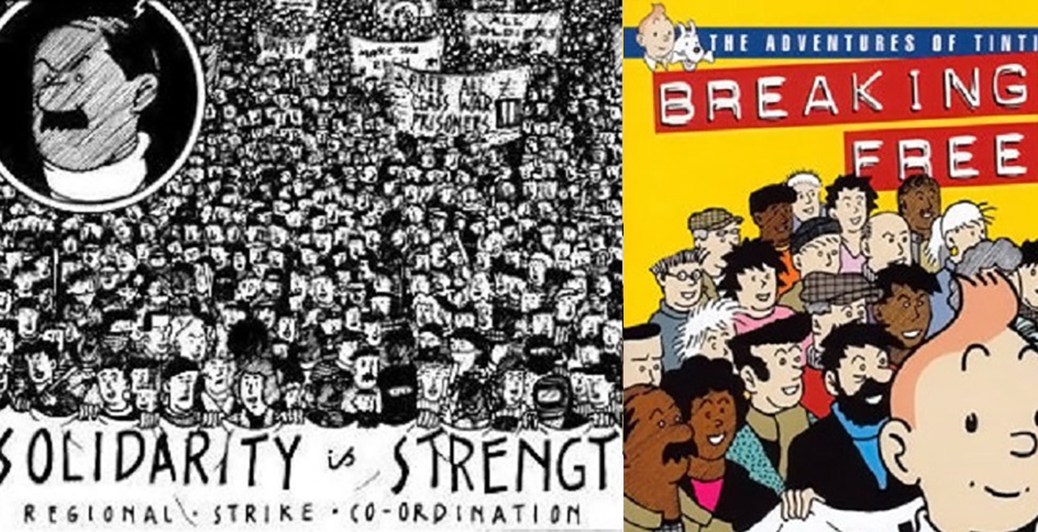
“The Adventures of Tintin: Breaking Free” is a comic about class war. If that doesn’t sound quite like Tintin’s typical adventures through Orientalist portrayals of the 1930s, there’s a reason why.
Published under the pseudonym J. Daniels, ‘Breaking Free’ expropriates Hergé’s classic images of the reporter turned adventurer and remakes him as the central protagonist of a general strike. Featuring a cast of familiar faces in entirely unfamiliar roles, ‘Breaking Free’ is as much a blueprint towards revolution as it is an exercise in wishful thinking.
Title: Breaking Free / The Adventures of Tintin Author: ‘J. Daniels’ Illustrator: ‘J. Daniels’ Original Release: February, 1992 Published: Attack Intl (UK) Other Spec’s: Softcover, 176 pages, black and white interior.
Of central interest is that, for a comic about class war, ‘Breaking Free’ has a lot to say about other struggles: the fighting proletariat are not all gruff blue-collar blokes in flat caps, though there’s no shortage of them here. But the story teems with the diversity of the systemically oppressed: housewives tired of devalued housework, lesbians running away from intolerant homes and elderly being driven out of their communities by gentrification. The idea that all our struggles are connected is intimately threaded through the narrative of the general strike, driving the strike on by recognizing that all are allies in the fight.
Before the strike begins, Tintin and his uncle (a transformed Captain Haddock) head out to take in a football match. In the crowd outside, a fascist is selling a newspaper. As this excerpt shows, this is no crude caricature of a fascist. Employing language about safety and economic security, the fascist organizer plays on the worst fears of the working class. But the Captain is no stranger to solidarity, and makes the left-wing argument very ably: black or white, it’s us against the bosses.
Click to enlarge.
The Captain aptly deconstructs the notion of a ‘white’ race in simple terms, demanding to know which sort of immigrant the fascist descends from. In the sincerity of its depiction of fascism and nuance of the Captain’s arguments, the comic treats the issue of race seriously. Certainly more can be said on the tendency of white men to dominate within even progressive social movements, but at least it addresses the issue seriously.
The question of women’s roles in the struggle also crops up, as in this excerpt, and gets a broader showing than race. Tintin treats Mary as little more than a domestic servant, prompting a well deserved dressing down.
Click to enlarge.
Mary emphasizes that she’s neither swayed by lesbians nor middle class feminists, debunking those chauvinistic myths about feminism by speaking from her own experience. Rather than be easily persuaded, Tintin flies off the handle, and needs time to cool off before coming around to understanding her point of view.
In just a few short pages, the comic covers domestic work, working class feminism and sexual assault. These are not abstract problems for academics to write endlessly on – they are issues affecting left-wing organizing in the 21st century. Tintin later puts in his time as a babysitter so that some of the women can get out to the strike meetings.
Click to enlarge.
Although Tintin wises up about feminism quick enough, he still has some internalized homophobia to deal with. Rather than coddling him, his squatter neighbour Nicky puts it to him very frankly. Tintin is just as guilty of breaking society’s rules, and all Nicky asks is that he live and let live. If his acceptance seems to come a little too easily when she forces him to admit that homophobia is one more way the rich divide us, Tintin is not completely reformed.
But Tintin learns, albeit slowly. When Nicky and the rest of a queer contingent at the strike are hassled by a protester who quickly resorts to homophobic slurs, Tintin turns up out of the crowd to tell him off.
The point the comic is making is twofold – first, that gay and lesbian people have as much of a stake in the class struggle as anyone else. Fairly elementary stuff, all told. But the more radical insistence is on visibility – not only are they welcome, but their banner demonstrates public support of the strike, reflecting both diversity and solidarity.
Granted that the origins of many liberation movements are in fact decades older, Breaking Free came out in 1992, at a time when intersectionality was still working to get a foothold in leftist organizing, particularly within the realm of labour. It is a great read for anyone involved or interested in progressive organizing.
It is with much sadness that the Toronto comic book community learned last weekend of the sudden and tragic passing of one of its brightest supporters.
Debra Jane Shelly was a comics fan, supporter, and self-described (and celebrated) nerd. She was known for her years of behind-the-scenes support at Comic Cons and other events celebrating comics and pop culture. With her partner Kevin, Debra opened the doors of The Comic Book Lounge and Gallery on College St at Clinton in early 2012. The Lounge was unique in serving both as a comic shop and a gathering space, hosting Life Drawing classes, book launches, award ceremonies and socials.
In 2013, she co-founded the Lounge’s Ladies Night, which met bi-monthly and became a gathering point for women comic book fans in a community still largely dominated by and catering to a male audience. It was a first for the Toronto comics community, and came at a time when the critical question of diversity in comics (readers as much as creators and characters) was gaining serious momentum internationally.
Yet Debra was known for her positivity, and did less to criticize the comic community’s shortcomings than to nurture the people, spaces, and ideas that were inspiring.
“To so many people she was the first person we told of our successes and failures & she always knew the best way to respond -how to congratulate and console us. That kind of contribution doesn’t fit on a resume but it was felt throughout the community.”
–Alice Quinn, Ladies’ Night co-founder
This remembrance has been assembled in conversation with others who knew Debra. The Comic Book Lounge and Gallery has notified its followers that they will be posting memorial service information as it becomes available.
January, 18, 2014
By Zachary Johnson-Dunlop | @ZJDSumo
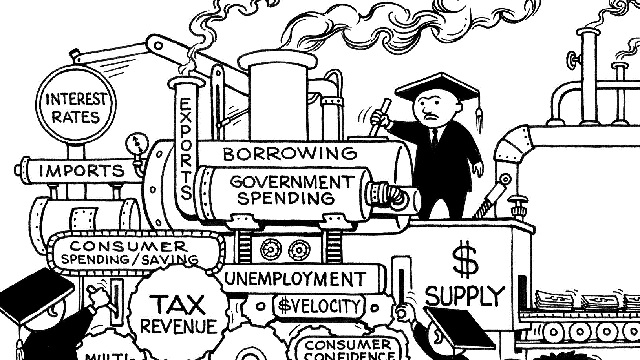
Economics is seen by most of us as one of the most boring academic disciplines: it’s all the computation of a Math degree, with the fevered opinion of a Poli-Sci degree, and most of the public understands it about half as well as they understand either of those. And so daunting and courageous it is to see artists and writers undertake the so-called “dismal science” to the pages of the graphic medium. There are a variety of “economic comics” to chose from out there and each one has a different approach to the field.
If you came to me asking for a starting point in this arena, my surefire response would be to go out and get a copy of Economix: How Our Economy Works and Doesn’t Work In Words and Pictures.
Authors: Michael Goodwin, David Bach, Joel Bakan
Illustrator: Dan E. Burr
Published: Abrams Comic Arts, 2012
More: www.economixcomix.com is the official website. Purchase the book in our store here.
Goodwin tells the story of the development of economics theory from its pre-Enlightenment nascent state, to the convoluted mess that we are left with today.
As the comic starts to venture into the present day, Goodwin admits his own political ideas and history. It is this author’s assumption that “…today’s justifications for extreme inequalities of wealth and power are horse-pucky, just like yesterday’s, and will completely fade away.” In other words, there’s absolutely no need for a 1% to make the system work for the other 99%.
Goodwin is totally unafraid of the controversy he might stir up, and backs that confidence with historical insight. He then proceeds to dissect, in detail, the revolt of the rich and powerful and the means by which they have solidified their hold on our economy and by extension, the future.
Economix was the first book I stumbled across when I delved into this topic, and it’s great. It’s a clear, factually accurate critique of how the development of economics as a science has left the real world out of its equations and how that lack of depth has brought us to a critically unstable tipping point (enter perennial economic depressions, repressions, slow-downs, melt-downs… and whatever else they’re going to call it next year).
Goodwin’s history is complete and in depth while Barr’s artwork presents a blend of historical personae and visual metaphor (corporations are presented throughout as giant anthropomorphic factories). Regardless of your politics or level of understanding, this book will leave you knowing more about economics. With regard to politics; it will either solidify your case against the continued concentration of power driven by unfettered market slavery or at least make you question your belief in laissez-faire capitalism.
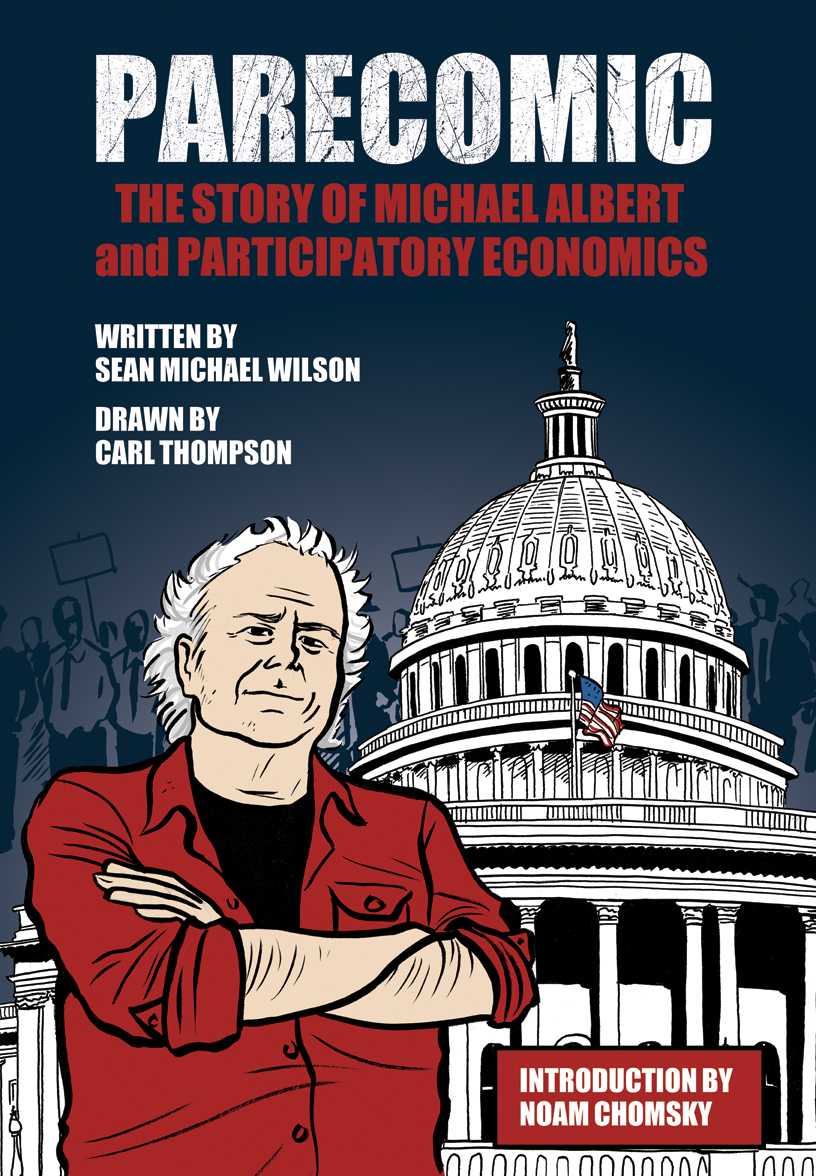
The next book in our trip down Economy Lane is Parecomic: the Story of Michael Albert and Participatory Economics
Author: Sean Michael Wilson
Illustrator: Carl Thompson
Published: Random house 2013
More: Available for purchase in the Ad Astra Shop
Parecomic is the story of how economist Michael Albert started out in economics and activism and ultimately merged the two by forming an innovative new system of organization that rejected the myopic view of mainstream Marxism and what is known as the “Economic Left”. The story really isn’t so much about economics as it is about the journey Albert went though in creating Participatory Economics, his theoretical replacement of the existing order. The book goes into to quite a bit of detail about Albert’s critique of main stream Marxism and how he adapted the class dichotomy into a more nuanced view of the class divide, a problem which he then set about solving. The result was a system similar to Syndicalism in which the workers collectively own and operate the means of production and compensation is determined, not by output, but by the burdensomeness of the tasks completed and the dedication with which a worker performs their appointed duties.
The political impact of the book is, for now, rather small. But it is valuable in that it goes beyond economics to lay out a vision for a more intricate view of the incentives and motivations of humanity. Like all other comics about economics, it also surely opens up discussion with readers who would never otherwise read anything by Michael Albert.
Of all the works I have looked through for this article, Parecomic has the strongest art. Thompson captures the development Albert and his colleagues and friends with a surprising subtlety given the black and white medium and that in most cases he is trying to accurately represent real people.
The last two books I read were parts one and two of The Cartoon Introduction to Economics by Yoram Bauman and illustrated by Grady Klein (published by Hill and Wang, 2012). This is a two-volume economic primer that probably is not much different than what you might learn in high school. While the basic information is technically accurate, it has about the same depth of analysis and understanding as that you might get watching cable news, and at times can be equally contradictory. By contradictory I mean that it essentially attempts to say, “The free market is the solution to all of our problems, except when it’s the cause of all of our problems–and even then, it’s probably still the solution to the problems in creates.”
This superficial analysis is matched by equally lack-luster art. The drawings are not bad per se, but they don’t really do much to grant life to the topic. Several characters are represented as children, superheroes and various other metaphors for the topics discussed, but they tend to fall flat to drawings that look like Sunday paper political cartoons, a style that’s great for a couple panels but doesn’t help to carry a book.
Lastly, for those of you looking to find more out there on the wonders of economics: you can, as always, turn to the web.
I found one site particularly enlightening that was devoted to Marxism and its critique of capitalism. The website does a great job dissecting the flaws and inherent unfairness in a capitalist system and suggesting the merits of Marxism through a series of political cartoons. The art is nothing to write home about (these appear to be scanned photocopies of an old publication), but the humour and information is of serious quality.
Other websites that might be of interest to readers:
Capital The Manga – Marx’s classic, now with a modern Japanese twist! Available through Red Quill Books
Who Were the Movers and Shakers in Comics for 2013?
In and out of the comics world, it’s been quite a year! For Ad Astra Comix, it was a year that we came to be. But how was our own growth reflective of the rise of political comics elsewhere? Listed below are the people, projects and titles that our contributors believe made the absolute best of the past twelve months, in many different ways. Follow the links to find out where you can purchase their work and learn more about them!
The Ladydrawers Comics Collective
Two Thousand and Thirteen was a big year for comics introspection. At the forefront of alternative comics, comics activism, and raising awareness about some of the deficiencies of the industry is the Ladydrawers Collective, who have gained a wider audience from their contributions to the progressive website Truthout.org.
“We are not just readers and fans of comics; we are also creators and active participants in comic book culture,” they explain in their Kickstarter project last summer, which successfully raised over $15,000 for a documentary film about diversity in the industry. “…[A]s a medium as well as a mass cultural instrument, comics should not only represent our society by mirroring genuine aspects of human thought of emotion, but also nurture critical thinking and creativity.”
In addition to creating original works on topics as wide-ranging as feminism and unfair labour practices, the collective has curated comic art exhibitions, interviews with others in the comic industry around these issues, and given much-needed fuel to the fire calling for nothing short of a revolution in comics and the way we use them.
Black Mask Studios
Although founded in 2012, Black Mask Studiosreally heated up this year with a full slate release of titles from this new indie/political/punk publisher. Primary titles of interest: Occupy Comics and Liberator.
Occupy Comics (with 3 issue releases this year) has done much more than just tell the story of Occupy Wall Street. The series captures the feel of the movement. By reaching out to artists and writers from around the genre (Frank Miller need not apply). Occupy Comics offered powerful stories of struggle from early labour history, to OWS, Occupy Sandy, and other elements of the world wide movement for economic and social justice. Liberator, written by Matt Miner in New York City, has taken an often marginalized sector of the activist community, the animal rights movement, and brought it into a powerful story that can be appreciated by both supporters of animal rights and everyday fans of good storytelling. This story from the political margins earned 4 out of 5 stars from Comicvine, and was described on the website Bleeding Cool is “A fiercely strong book that refuses to preach”. Speaking to the busy year he’s had in comics, (he and his family were still recovering from Hurricane Sandy when he launched his Kickstarter campaign for Liberator–since then, he’s released a first volume of four issues, and is collaborating on a project in the new year with the hardcore band Earth Crisis):
“The launch of Black Mask Studios has certainly helped bring political issues into comics in a bigger way. I feel that as comics continue to grow and expand we’ll continue to see new and different types of stories that are relevant to the society we live in.”
“…I mean, Liberator isn’t Batman but it’s out there being read and enjoyed by a bunch of people who read Batman. 10 years ago the idea of an animal vigilante justice book never woulda happened.”
Certainly there are “non-political” titles that Black Mask is investing in, such as Ghostface Killah’s and RZA’s Hip-hop crime drama 12 Ways to Die, or Ballistic, a futuristic adventure about a man and his pet gun. But perhaps one of the most innovative and notable actions of the studio is its distribution strategy. Actively seeking out an alternative audience as well as traditional comic fans, Black Mask has placement in record stores, alternative book stores and uses an online subscription model to reach their audience. Black Mask has brought a slate of avant guard and openly political offerings into the wider marketplace.
Imagine: any average kid walking in to pick up the latest X-men or Batman (let’s face it: Superman fans probably weren’t interested) could see titles that made no bone about their politics of Animal Liberation, punk rock anarchists or the 99% sitting proudly beside old favourites. The times, they are a-changin’!
But the evolution of political comics is certainly not limited to North America, or to the new issues rack at the local comic shop.
So Close, Faraway!
If you live homeless in 2013 Brazil, you face extreme risks. The country has an incredibly high murder rate for its most vulnerable citizens, and they aren’t getting a lot of help. A true case in point: last year, eight homeless people were poisoned when a passerby gave them a bottle of water spiked with rat poison.
Shedding light on this dark and treacherous life, Brazilian creators Augusto Paim, Bruno Ortiz & Maurício Piccini created an interactive webcomic that–for a day–puts you next to Jorge, a 43-year old homeless man from Porto Alegre, Brazil. So Close, Faraway! a self-described “interactive piece of comics journalism,” is a pioneering effort that stretches the capabilities of the comic medium while forcing us to look at a social issue we often ignore.
Vigorously researched by Paim, the SCF! combines the story of Jorge’s life with real statistics about homelessness in Brazil, like those mentioned above. Ortiz’s art reminds us of the tropics in that it seems almost two bright, yet startlingly accurate, even in the blur of the final page. There are also multiple photos that demonstrate that the artwork rarely takes any liberties, and the harsh conditions on each page accurately reflect the harsh reality of homeless life in Brazil.
Bringing the story of Jorge to the online space is computer science graduate Piccini, who creates each page in layers that let you add or remove statistical or story dialogue boxes to give you some freedom as to how you read the comic. There’s something empowering about having control over the text on a comic page, allowing you to appreciate the art, and giving you the chance to read as deeply into the details of the story as you like.
From left to right: Nate Powell, Congressman John Lewis, and Andrew Aikin standing on the bridge where police had beaten Lewis and his comrades decades before. The scene is depicted in March: Book One.
MARCH: Book One
John Lewis is perhaps one of the few members of American Congress who deserves to be there. As a leader of the Civil Rights Movement and the only person still alive to have spoken alongside Martin Luther King at the Washington Monument rally in 1963.
And so kudos to him, Andrew Aikin, and the rest of their team for recognizing that the way to pass on this important chapter of American history—a history so often white-washed and told to have a happy ending—is to tell it as children and young adults like to learn it: with comics (electronic orders of this title, available through Top Shelf Productions, even include an electronic copy of vintage comic Martin Luther King and the Montgomery Bus Boycott, a 1950’s-era title that inspired Lewis to re-visit the medium). March: Book One shows us that our history is beautiful, terrifying, and can be powerfully relevant to our own lives. And who else could illustrate this with more grace than comic artist and illustrator Nate Powell?
If a comparison is acceptable, Powell is also another hard-working person who uniquely deserves every ounce of credit for what he has achieved in his life. After self-publishing comics since he was 14, Powell completed a few critically acclaimed and award-winning works like Swallow Me Whole, The Sounds of Your Name, and recently more politically-charged work like The Silence of Their Friends, and Any Empire. In 2011, he appeared at the United Nations alongside the world’s foremost writers of young adult fiction, to present on his contribution to the anthology What You Wish For: A Book For Darfur.
As John Lewis, Andrew Aydin, and Nate Powell so eloquently show us in MARCH, the Civil Rights Movement was a bloody, uphill battle, and should be remembered that way. The struggle and its gains were not the results of a few actions by those now famous historical figures; the movement moved and shaped by thousands of committed activists, many of whom were students, and many of whom lost their lives.
Boxers and Saints
Gene Luen Yan’s Boxers and Saints is a hugely innovative and visionary dual graphic narrative for all ages, from First Second Books. Using cutting-edge creative technique, we can now begin to think about history (and comics) in a very different way.
They are in fact, two separate but complementary graphic novels, Boxers, and Saints, that challenge a traditional black & white world-view. They are also available together as a boxed set and share trade-dress (including connecting imagery on covers/spines), and the reading of both is highly recommended to fully appreciate the richness of the larger world and the historical backdrop of China’s Boxer Rebellion.
Even though Boxers is the heftier of the two physical volumes, both are balanced in substance. Yang has tackled the problem facing anyone trying to fairly depict two sides of a conflict, and finds a rather eloquent solution: each is given it’s own stand-alone (albeit interrelated) story, and it’s own protagonist.
Boxers tells the story of Little Bao, an ignorant farm boy turned rebel leader, while Saints follows a young Christian girl, whose lowly status does not merit a proper given name until she chooses her vocation. The two meet only briefly, but with significant repercussions on the lives and ultimate fates of both.
In addition to being a critically acclaimed and award winning Graphic Novelist (American Born Chinese won an Eisner and other honours in 2007), Yang is a high school teacher. He shows deftness and ease at breaking complex concepts and events into accessible, yet entertaining, ways for his primary audience of children and youth.
He crafts fictionalized version of very real events, using what we as adults might liken to “Magic Realism”. It’s not surprising that Yang also writes the graphic novel adventures of Avatar: The Last Airbender. He has essentially turned his protagonists into superheroes, while the very human reactions of his adolescent characters remain easily relatable to young readers.
Yang’s work pushes the boundaries and demonstrates the potential of the medium. Boxers and Saints highlights the complexities and ambiguities of political/social/economic conflicts, and illustrates to his readers that the world isn’t cleanly divided into “good guys” and “bad guys”.
Symbolia – A Periodical of Comics Journalism
Symbolia Magazine started out this year doing something that seemed very logical: an electronic periodical composed entirely of comics journalism. In fact, it seemed so logical that many of us forgot that this had never been done before. Celebrating the genre in and of itself and not merely as decoration for other more “legitimate” pieces of print journalism, the periodical format reminds us that this category of work is alive, kicking, and packs a healthy dose of diversity (and punch, in case anyone’s wondering). The latest instalment just came out on December 24. and the electronic-only format means that the editorial board can focus on quality content and not pinching pennies to make the next full-colour print run (electronic comics also mean interactive comics, of which the magazine takes full advantage!)
Tom Humberstone and Female Superheroes
For those unfamiliar, Tom Humberstone is an award-winning comic artist and illustrator based in London. This year, he launched the platform Female Superheroes on femalesuperheroes.nl (with access in English and Dutch), featuring inspiring stories about ordinary women from around the world, who face great adversity and overcame it to do extraordinary things with their lives. The platform is unique because, “it showcases how Comics Journalism can be combined with a game-like interface, 360-degree photography and video to create an immersive experience”. Pretty awesome.
Screenshot of the interactive Female Superheroes website, available in English and Dutch.
Tess Fowler, Mari Naomi, and the “Open Letters” to the Comics Community of 2013
Similar to this last project was some of the initial work released by Tess Fowler, who gained recognition for her modern remix of Disney heroines, called “Apocalypse Princesses.”
For better and for worse, Fowler arguably made less waves with her incredible artwork this year than for her calling sexist foul on Brian Wood, a leader in the mainstream comics industry for sexually harassing her during a comic convention social. Open letters such as hers and other women in comics (most recently comic artist Mari Naomi re-lived, in comic form, how she was repeatedly sexually harassed during a panel at a comic convention) are pointing to a deep and powerful undercurrent of male chauvinism in comics.
Certainly, these talented women would like to focus on what they love doing most, which is telling stories and drawing comics. But for the purpose of this post talking about who has had the most significant impact on comics from a political perspective, their public positions against harassment in the industry have been huge. The ripple effect of these public-yet-very-much-“inter-community” criticism is going to be felt for years to come, and has very likely changed the titanic course of the comics industry as we know it. The letters, each as they pop up, have obviously been constructed with great caution and forethought, but ultimately released for the betterment of the comics community, and are therefore courageous and worthy, more than any other buzz news or gossip, of our time to read.
Contributing Writers: Zachary Dunlop-Johnson José Gonzalez Raisha Karnani Sam Noir Nicole Marie Guiniling
Something significant and radical has occurred in the Georgia Ridley Salon at the Art Gallery of Ontario. Original comics artwork has steadily gained acceptance within the hallowed institutions of mainstream galleries and museums, but never in as bold a curatorial manner as this.
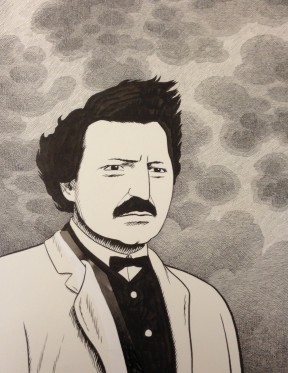
A stark black and white, inked, portrait of Louis Riel sticks out like a sore thumb. Surrounded by stacks of period specific, painted, (colour) artwork, in a setting that recreates the viewing context of a period spanning Canadian Confederation and the First World War.
A portrait of Riel would never have found its way into any English Canada salon of that time. A crusader for Métis rights, and charismatic leader of the 1869-1870 “Red River Rebellion”, Riel was branded a “traitor” by the federal government, and viewed as such in the province of Ontario, and particularly the city Toronto. How fitting then, that he should end up here of all places, today.
This decidedly contemporary juxtaposition provokes conversation, and challenges our traditional narrative as Canadians. The portrait incidentally, is the original cover art for the tenth anniversary edition of Chester Brown’s graphic novel Louis Riel: A Comic Strip Biography.
Riel remains controversial figure, and difficult to place within Canadian history. He’s a powerful symbol of Native and French Canadian rebellion against centralized English-speaking government powers. However, we now live in a society where Multiculturalism is espoused, and Bilingualism is national policy. Chester Brown’s graphic biography is a reflection of this current cultural paradigm, particularly since Riel is now viewed as a “Father of Manitoba”, in spite of his defeats. It is notable that the Canada Council, a government run funding agency for the arts, provided support to Brown in the creation of this work.
Tucked away in a small alcove in a corner of the salon, original artwork from Chester Brown’s Louis Riel graphic novel is displayed, revealing Brown’s process. Each frame showcases what are essentially small individual panels of the same dimensions, on separate small pieces of paper, a half dozen of each which were eventually grouped together to form a “page” of artwork. Imagine each of these panels to be a frame of film. In film editing terms, this allowed Brown the ability to “non linear edit” as he crafts the story… adding or deleting panels and moments from any point in the chosen narrative as he goes along creating the work as a whole.
We also need to note that Brown calls his biography a comic strip. Drawing from a more traditionally populist format, and defining itself away from the more literary pretentious term, graphic novel or even the more common place name of comic book. Both terms which come with a degree of cultural baggage in the current landscape.
During the process of creating this work, Brown adapted a large stylistic influence from cartoonist Harold Gray, the creator of the comic strip Little Orphan Annie. In fact, there are examples out there showing how Brown redrew panels he created earlier in the process to keep this aesthetic choice consistent. The choice of Gray is interesting in that Gray is largely considered a political artist himself during a tumultuous period of American history. Recall that the original Little Orphan Annie cartoon strip was a politically charged reaction to the changing times of the depression-era nineteen thirties – a fact largely forgotten in the shadow of the Broadway musical and cinematic adaptation that has taken popular root in its cultural stead.
Gray could originally be defined as a Republican during the pre-Depression years at the start of Little Orphan Annie (most historians cite the name of his character “Daddy” Warbucks as a suggestion about where the character’s initial fortunes came from), but many argue that the views expressed by his characters in later years were libertarian in nature. Brown became politicized during the creation of Louis Riel, and has run as a candidate for the Libertarian Party of Canada in the riding of Trinity-Spadina since the 2008 federal election.
The spine of Brown’s Louis Riel rests on the side of democratic process, with the elected leadership of the largely mixed francophone/aboriginal Red River Settlement majority (Métis), battling against the tyranny of an oppressive English Canada asserting its agenda and the machinations of The Hudson’s Bay Company, hoping to profit from this transfer of power and land rights. Though Riel’s methods and actions may not always be viewed sympathetically, you can understand his motivations of fairness. Particularly as the elected leader of the provisional government, negotiating its place in the developing country of Canada – and as an member of Canadian Parliament, elected multiple times, but never having sat in the House of Commons for fear of arrest.
Canada’s first Prime Minister John A. Macdonald is not painted in a flattering light, and his decisions shown here have far reaching implications. A political creature, choosing the expediency of arms over the complications of keeping his promises to Riel and the provisional government of Manitoba; a far cry from the Father of Canadian Confederation we learned about in our history books. More devious still were his manipulations around the negotiations with the Métis in Saskatchewan to incite rebellion, and justify the mounting expenses in construction of the Canadian Pacific railroad across Canada, by sending in troops.
Whereas his sympathies undoubtedly lie with Riel and the Métis, in the story he’s chosen to tell, Brown has selected moments that highlight a certain degree of ironic, even dark, humour to Riel’s story. Reminding us that this book is designed to entertain as much as it is to inform. Far from being a comprehensive volume on the life of Riel, Brown’s selection of vignettes within the allotted pages is equally fascinating.
Brown’s exploration of Riel’s years following Red River, institutionalized and gripped by “Divine Madness” is not surprising to those familiar with his earlier autobiographical work. Where his mother’s schizophrenia was not overtly stated, but often a strong subtext in the depiction Brown’s developing years. These visions and religious fervour haunt Riel, and follow him through the Métis uprising in Saskatchewan, leading up to his surrender to the Canadian authorities, and to the end of his life. The closing chapter, leading us to the final moments of Riel’s execution, depicts the courtroom where the question of his sanity is laid before those who knew and encountered him.
In some parts of the chronology, the narrative jumps years at a time, quickly through different characters and settings between panels on the same page. However, when Brown chooses to slow down the pace, utilizing what has commonly become known as “decompressed storytelling”, the quiet results are compelling and moving. Individual “moments” paced out in panels of the same size, six to a page stretching across multiple pages. Similar to Watchmen, which functioned similarly using a nine panel per page grid structure. With no variation in size and placement of panels, the panels become a singular viewing portal… a “window” into the world of Louis Riel.
The final sequence in Part One of the story, depicting Louis Riel alone in Fort Garry, and then leaving the Red River Settlement, stretches across a luxurious four pages. Dwelling on mundane, yet affecting moments of Riel rising from bed and eating a solitary meal, before being warned of the English troops descending upon him. Unlike the end of a traditional American cowboy movie, in this Canadian “Western”, Riel does not head triumphantly into the horizon and the sunset, but towards the reader, who is looking down above him as he walks in the rain.
You can view these particular pages of original art for yourself, showcased in the salon’s alcove at the Art Gallery of Ontario until September 2014.
Honours bestowed on Louis Riel: A Comic Strip Biography include 2 Harvey Awards, and its placement as a semifinalist in CBC’s prestigious Canada Reads program. It was the first Canadian Graphic Novel to become a best-seller, and on its heels has spawned a renaissance in the genre of graphic novel/comic book biography and similar non fiction illustrated work.
During an earlier regeneration, the author of this article found himself living as an academic. He held three degrees from Queen’s University in Fine Art, Art History and Film Studies in a death-like vice grip, describing himself at the time as an Installation Artist, Pop Culture Junkie and Film Maker.
Sam Noir is currently a rabble rouser, and maker of comix and toys. He claims Toronto, Canada–the most culturally diverse city on the whole damn planet–as his home.


















 adastracomix.com