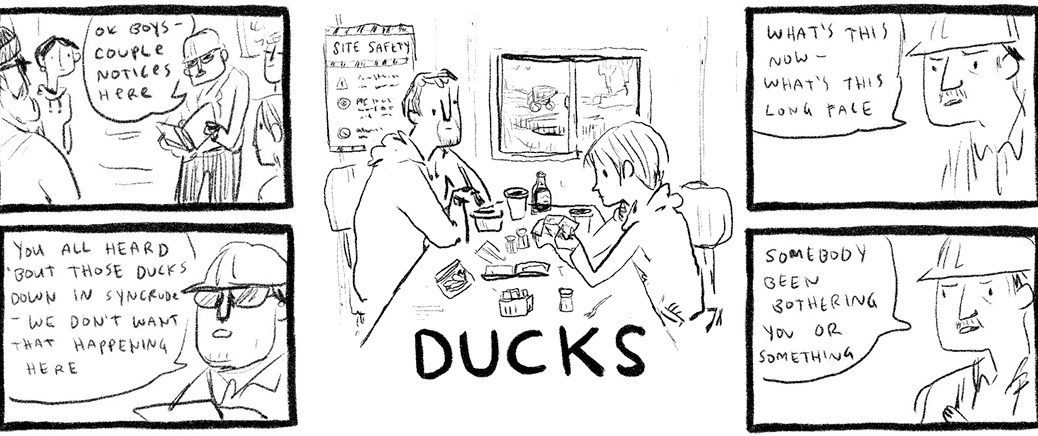
Duck, Duck, Profundity: Kate Beaton’s Time in the Tar Sands

It is a simple thing for the analytical mind to pry open the panel of oppression and see the whizzing cogs and grumbling gears of race, class and gender working mechanically to produce social relations.  How neatly our familiar intellectual frameworks structure our understanding of human life!  There is a reassuring consistency with which these lenses are employed, reducing the world’s complexities to a comfortable, mechanical pattern. Useful as it is, the cold-blooded methodology that sees the operation of capitalism, patriarchy and racism in all things fails to capture the essential ambiguity of our humanity.

ducks
Cause they’re dead! DEAAAAAD!

It is this ambiguity of the human experience that Kate Beaton has captured in her recent series, Ducks.  Threaded beautifully into starkly political themes of environmental destruction, corporate recklessness and workplace safety are more explicitly human experiences: isolation, camaraderie and the moral complexity of survival in one of the world’s deepest wounds.  The essential humanity of surviving in such a profoundly dehumanizing environment defines this painfully nuanced piece.
hateithere1
The Red Shoe Pub, it ain’t.

Humanity is a dangerous concept, but an important one.  It is too often emphasized by exclusion, used to demonize some people to serve the ends of others.  Still, it is too important an idea to abandon. When the easy tautologies of political analysis fail us, it is the idea of our shared humanity that helps to explain what makes people hang together.  For students of struggle, insights into this frustratingly elusive element of history are precious.

Like generations of easterners, Kate Beaton left her home town of Mabou, Nova Scotia to make a living in the scabrous sprawl of the tar sands.  With few economic prospects at home and the promise of good pay, thousands have followed its siren call into the maw of destruction.  ‘Ducks’ recounts Beaton’s experiences working on one of these sites, centred around the deaths of hundreds of ducks in a tailings pond near Fort MacMurray, Alberta.

shitintheair
I think Stan Rogers covered this in “The Idiot”

There are no easy truths framed by these panels.  An action by Greenepeace that clogs a tailing pipe endangers the lives of workers on site.  A sex worker finds herself frightened and cornered in a work site bathroom.  Kate Beaton discovers that working in the tar sands comes with a persistent skin rash.  Her equipment is covered in dirt, even indoors.  Workers die on the job.
crane
There’s nothing funny to say about this.

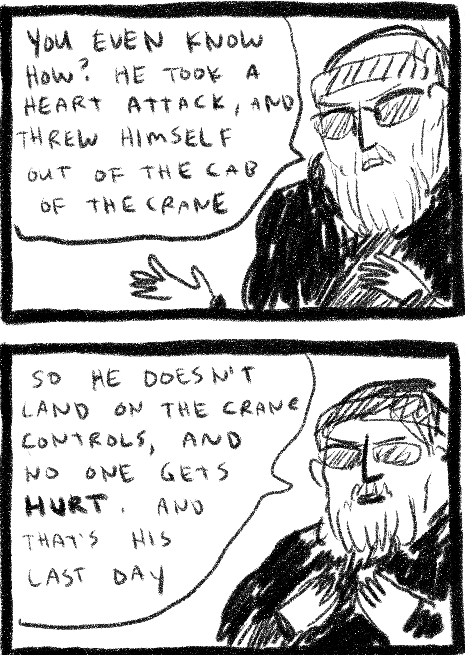
The comic is shot through with death: the ducks, a man falling from a construction crane, others killed in an accident on the highway.  In the last case, Beaton hears the dead men were Cape Bretoners and seeks out another islander to see if she knew them.  Even halfway across the country, the threat to home is real.

Beaton exposes a vein of callous indifference in her subjects.  Men grumble about traffic on the highway on the day of the accident.  Workers joke through an announcement on the death of the crane operator.  The corporate response to the duck deaths is a scarecrow and some noisemakers.  But for every example of inhuman indifference there is a counterpoint of dignity or sorrow.

newfs
Delicious

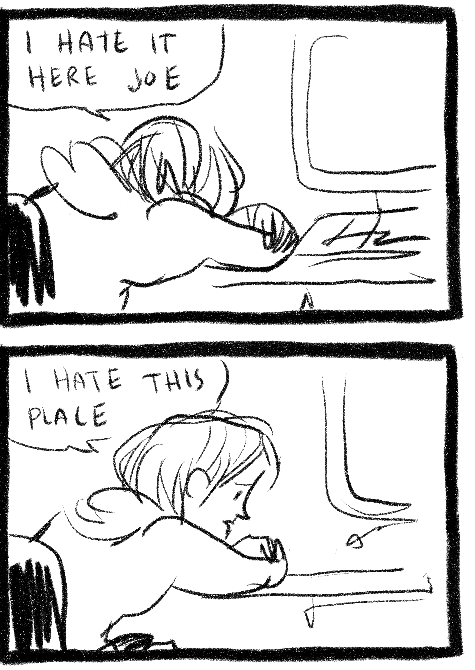
There is the memory of home, too, in gentle jibes about Newfie Roundsteaks – a teasing nickname for baloney.  A man shares photos of his children at home.  The lethal crash is framed in terms of the phone call to the families.  When Beaton confesses she hates it there, her coworker response captures the essential truth of the situation, and the strip.  No one wants to be in the tar sands, watching the planet die.  But they don’t have much of a choice.

hateithere2
In response to “hating it here”

Kate Beaton is not always a political artist – she is not even always serious.  But in framing a part of her own experience, she has given expression to an often difficult truth.  We survive in the little acts of kindness, in shared experiences and frustrations that complicate our day.  Though we may grow numb or compromised, at the end of it all we are bound together by our common humanity and our ability to find beauty – and absurdity – in even the most trying situations.  That is a political lesson than captures an intangible truth outside the reach of cold analysis.  How we apply the lesson is up to us.
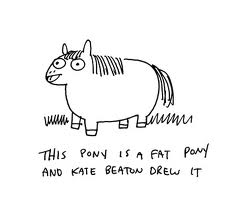
It isn't an article about KB without this little bastard stuck in somewhere.
It isn’t an article about KB without this little bastard stuck in somewhere.

Heroes in a Halfpipe! #TMNT Skate Night and Film Screening

It’s pretty simple, kids. We threw an amazing skate party and screened the 1990  version of Teenage Mutant Ninja Turtles.

If you feel like you missed out (and you’re right!), here are the next THREE events we have scheduled:

Facebook_CitywideWW3_banner140511GraphicActivism

Rebranding Canada with Comics and the Continuing Co-optation of Tecumseh

We are joined by a guest piece this week for Indigenous Comix Month – Sean Carlton is a PhD Candidate at the Frost Centre for Canadian Studies & Indigenous Studies at Trent University. Please follow the links for more on this in-depth piece!

Rebranding Canada with Comics: Canada 1812: Forged in Fire and the Continuing Co-optation of Tecumseh


Introduction

In the current age of austerity, the Harper Government allocated over $28 million to commemorate the 200th anniversary of the War of 1812. For many historians this proved to be an unpopular decision. It even drew the ire of the much-maligned Jack Granatstein, who pointed out, “This is also a government that’s slashing the national archives dramatically and killing the national library by cuts. On the one hand they’re good for history and on the other hand they’re bad for history—you sometimes wonder if they really know what they are doing.”[1]

While historians are right to critique the controversial costs of the bicentennial celebrations in light of cuts to crucial public services, it is important to understand the government’s commemorative project as part of a more pernicious strategy of nation-building that historians Ian McKay and Jamie Swift identify as the “rebranding” of Canada as a “warrior nation.”[2] In short, McKay and Swift contend that today there is a concerted right-wing effort to use the power of the state to “change how we think about our country and its history.”[3] More specifically, they argue that “new warriors” are trying to rebrand Canada as a country “created by wars, defended by soldiers, and kept free by patriotic support of military virtues.”[4] Canada’s history wars, then, are far from over.

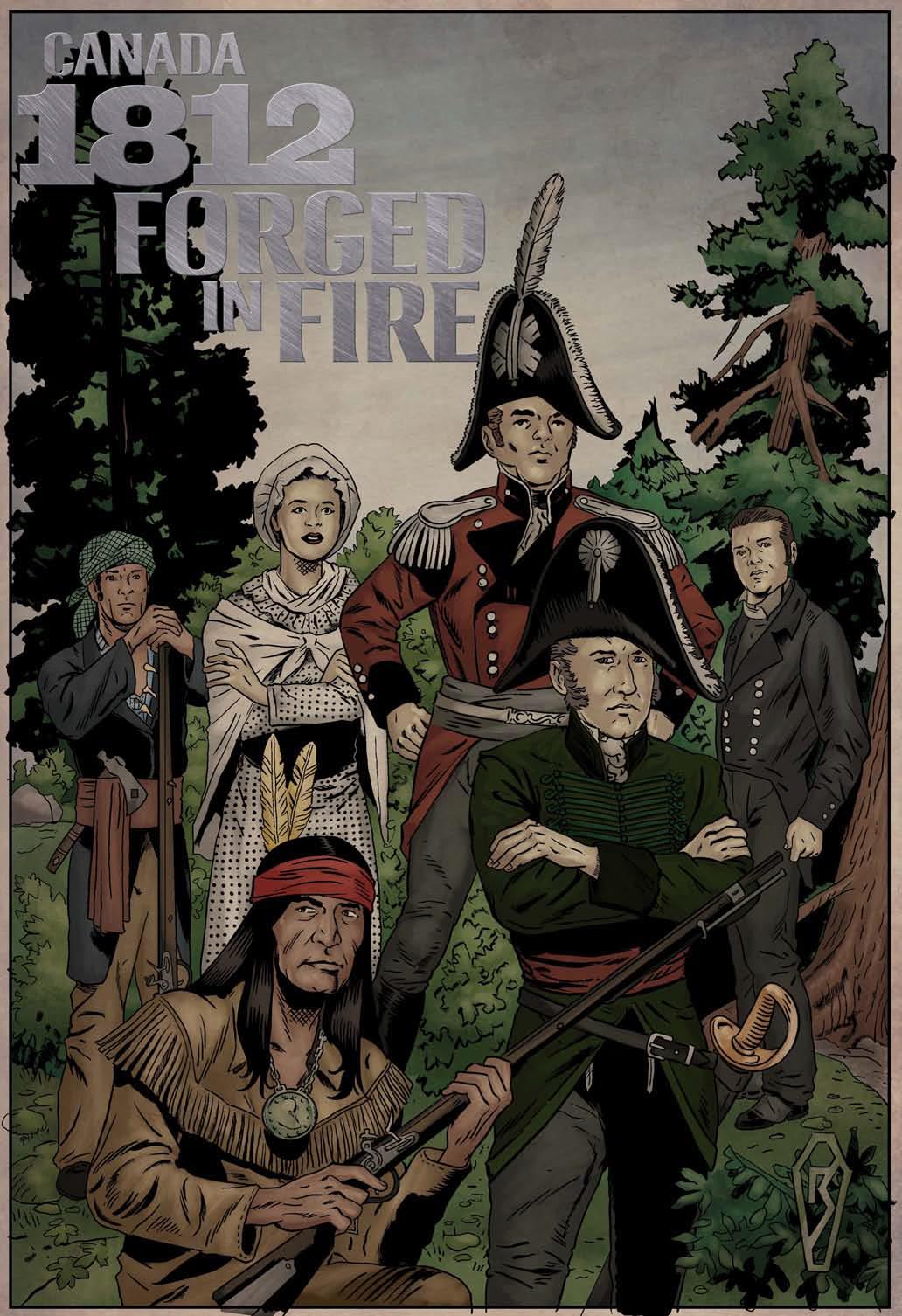
In the case of the War of 1812’s bicentennial, the Harper Government pulled out all the stops to use the celebration as a rebranding opportunity. The commemorative project included a new national monument, a television commercial, and even a cell phone application, all showcasing the War of 1812 as a “defining moment” in what the Prime Minister called the “Fight for Canada.” Yet, this paper focuses on one aspect of the commemoration that received no critical attention: the representations of Indigenous peoples, and specifically of Tecumseh, in a free comic book called Canada 1812: Forged in Fire. The comic book was funded by the federal government and produced by High Fidelity HDTV in partnership with Parks Canada, Zeroes 2 Heroes Media, Bell Canada, and the Smithsonian Channel as part of a multi-media project.[5] Canada 1812 will appeal to a broad public audience that will no doubt enjoy digging through the free comic book. However, like the other War of 1812 commemorative initiatives, Canada 1812, and especially its portrayal of Tecumseh, is a problematic “rebranding” of history to serve a nation-building agenda that must be critiqued and challenged.

The 142 page comic book traces the stories of six individuals—Isaac Brock, Charles de Salaberry, Laura Secord, John Norton, Enos Collins, and Tecumseh—who are all portrayed as distinctly Canadian heroes because of the pivotal roles they played in forging “Canada” out of the flames of the War of 1812.[6] Canada 1812 memorializes these individuals in six separate stories, extoling each figure’s various virtues such as courage, bravery, and patriotism. The comic book opens with a hero-worshiping story of British military general Isaac Brock and the first panel of the first page depicts him as simplistically stating, “War is coming. Good.”[7] Similarly, the story of Laura Secord is full of stereotypical tropes about gender, race, and the nation, the likes of which have been expertly examined by Colin M. Coates and Cecilia Morgan.[8] As the work of Coates and Morgan suggests, it is important for historians to spark critical conversations about the ways in which past figures are used by different groups to reinforce troubling narratives that legitimize colonialism and Canadian nation-building. In hopes of sparking such a conversation about Canada 1812, I will more closely examine the representations of Indigenous peoples in the comic book, specifically the depiction of Shawnee chief Tecumseh.

In this article, I argue that Canada 1812 is a prime example of how people manufacture and manipulate the image of Tecumseh for the purposes of Canadian nation-building, a process that historian Robin Jarvis Brownlie has recently labelled the “co-optation” of Tecumseh.[9] Despite his inclusion in the comic book to show a sort of multi-cultural coming together to defend Canada, I contend that the representations of Tecumseh in Canada 1812 ultimately conform to racist stereotypes of Indigenous peoples that rationalize colonialism and Canadian nation-building as benevolent, even natural and inevitable. The way we are taught to see the past shapes our understandings of, and actions in, the present and future. Thus, the representations of Tecumseh in Canada 1812 are problematic not only because of their racist underpinnings, but also because they play important roles in forming perceptions of Indigenous peoples that continue to justify Canada’s colonial policies of coercion, displacement, and assimilation.

Read on at ActiveHistory.ca:

The Continuing Co-optation of Tecumseh
“My name is Tecumseh”: Race and Representation in Canada 1812
Conclusions: Comics, Colonialism, and Canadian History


Indigenous Comix Month: An Interview with the INC’s Lee IV


As part of our ongoing Indigenous Comix Month feature, we’re looking at how Indigenous comics creators are doing their work and supporting each other. We’re honoured to be joined by Lee IV of the Indigenous Narratives Collective for a discussion on culture, diversity, stereotypes, and supporting one another in the industry.

INClogo

 How did the INC come to be, and what is the goal of the collective?

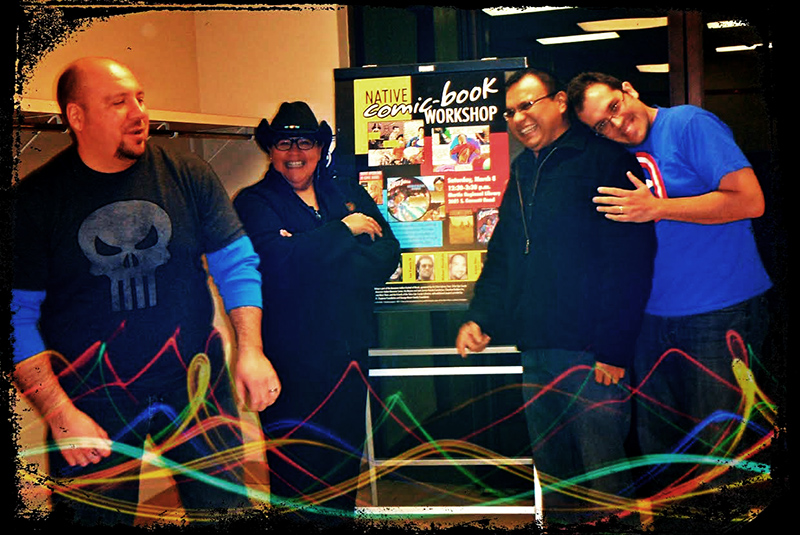
Lee: “Originally pitched as an idea by Arigon Starr, Jacques La Grange (San Carlos Apache) and Theo “Teddy” Tso (Las Vegas Paiute) at the 2011 San Diego Comic Con, a group of Native American comic book writers, artists, designers and creators convened at the annual Phoenix Comic Con in June 2012. The goal was to bring together Native American and Indigenous comic book artists and writers to create comic books that were representational of Native peoples in an authentic and meaningful way.

INC_GroupPhoto
The Indigenous Narratives Collective – Tulsa Public Library, March 2014.

“The collective released its first teaser comic book in September 2012 and we will be releasing several titles this year (2014). We wanted to have an organization that would promote the work of Native comic book artists/writers and give them a chance to develop their professional skills to 1) change the stereotypical imagery associated with Native peoples, especially in comic book representations, and 2) allow Native folks the chance to hone their skills so they would be able to find employment within the comic book industry.”

comics_code_logo

How do INC folks help to support each other in an industry that continues to resist diversity in many ways?

“We try and build community and support the work. Right now, our artists and writers aren’t getting paid for their work (not yet, anyways), but they are dedicated to the cause, if you will. They are dedicated to promoting Natives as more than just historicized caricatures. We trade ideas and we get each other gigs when we can. Part of our efforts include working with Native students to access comic books and graphic novels, so we find ways to get into the schools and do that work.”

 Were there any quintessential comic book characters that you were inspired by, growing up? Indigenous or non-Indigenous…

“I was always an Iron Man fan. Loved the technology. I am still enamored by technology, though as I have gotten older, I find myself drawn less to characters and more to the story or the way the characters are used in service of a compelling narrative.”

 Indigenous people deal with stereotypes so much–in large part because they are so sparsely represented in conventional media.. What do you think comics (and Indigenous comics creators) can do to help with this?

“First, by being the creators. We have unique perspective of Indigenous culture, our own backgrounds of growing up Native in the dominant society. This comes out in our stories, our art.”

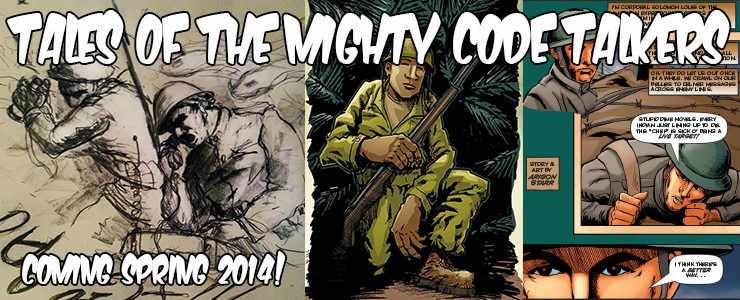
TalesofTheMightyCodeTalkers“Second, comics are part of the mainstream collective consciousness and if we can begin to change that, we can at least provide alternatives to the stereotypical narratives of Native people. For example, we can put our characters in space, give them superpowers (not derived from some mystical/Native/earth powered origin), have them fight zombies, or giants, or whatnot. We can tell fun stories that are not a rehash of something in a history book, but imagine a what if (what if Geronimo had access to teleportation technology which is why he could not be caught for so many years?). We can use the medium to tell more accurate and authentic stories in a way that captivates a reader and helps to break the stereotypes by putting Native people squarely in the mainstream of popular culture.”

For more from the INC, check out their website: INCOMICS.COM!

Indigenous Comix: Taking a Critical Look at Vertigo’s Adult Series “Scalped”

By Sam Noir | Edited by Hugh Goldring and NM Guiniling

Go into any mainstream comic shop or bookseller chain, and the graphic novel series you are most likely to find starring a cast of native characters is “Scalped”.  The 10 volume series (collecting all 60 issues of the comic book) is published by Vertigo Comics, a mature readers imprint of DC (one of the ‘Big Two’ comic publishers). Its high profile can also be attributed to writer Jason Aaron, who currently scribes popular superhero titles for Marvel Comics such as “Wolverine”, “The X-Men”, “Thor”, “Captain America”, and “The Avengers”.
Continue reading Indigenous Comix: Taking a Critical Look at Vertigo’s Adult Series “Scalped”

Arctic Dreams and Nightmares: Into the Art of Alootook Ipellie

Note: While this is a review of the book “Arctic Dreams and Nightmares,” a collection of art and accompanying short stories by the late Inuk artist, Alootook Ipellie, we are also taking a look at Ipellie’s larger body of work, and the significance of his contribution to Inuit art and political comics in general.

Arctic-Dreams-and-Nightmares_theytustitlemain
“Arctic Dreams and Nightmares” originally published by Theytus Books, was Ipellie’s largest collection of published political cartoons outside of Arctic newspapers and magazines. The book is currently out of print.

The title “Arctic Dreams and Nightmares” is a woeful summation of this haunting journey through the imagination of a man who seems to have been, as the title suggests, a dreamer. But within modern memory, it is an easy thing to understand how any Inuk’s dreams might turn to nightmares.

“Self-Portrait: Inverse Ten Commandments” by Alootook Ipellie

Writing as a qallunaat from the privileged perspective of the south, it is outside my role to interpret these dreams for the world. But as a sometime-student of Canadian colonialism and its violence against the indigenous people of the Arctic, I can help to shed some midnight sun on the darkness of this genocidal history.

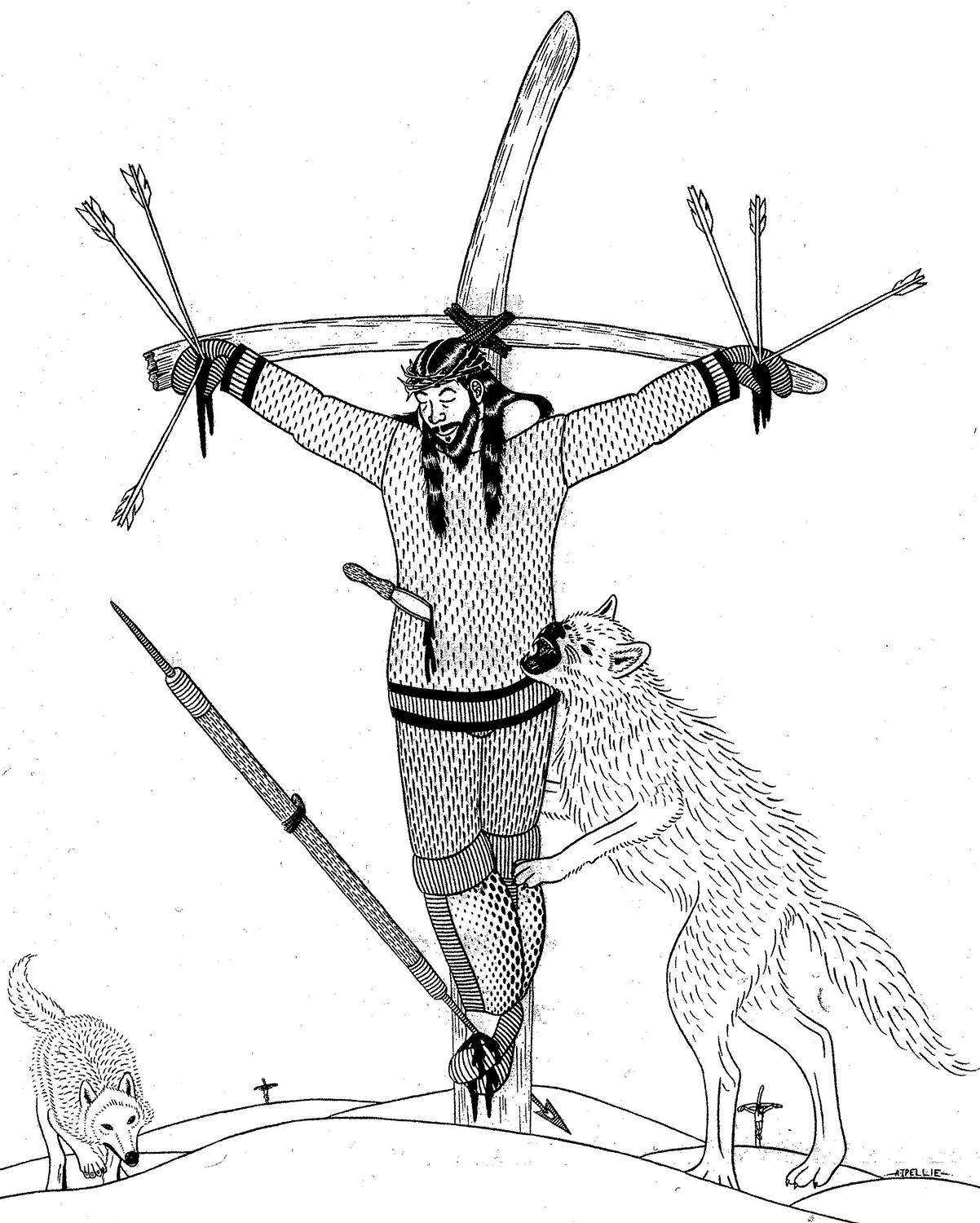
“I, Crucified” by Alootook Ipellie

Rachel Attituq Qitsualik wrote in Nunatsiaq that “The Inuit cosmos is ruled by no one. There are no divine mother and father figures. There are no wind gods and solar creators. There are no eternal punishments in the hereafter, as there are no punishments for children or adults in the here and now.” This Inuk hunter on the cross, pierced by the arrows and harpoons of his people, is a curious expression of the impact of Christianity on indigenous spirituality. For several hundred years,  missionaries were among the only European people in the north. The legacy of the Christian churches in the Arctic is inextricable from the legacy of the residential schools system, which saw many Inuit taken from their communities. The choice of wolves, harpoons and arrows to pierce the Inuk Jesus is difficult to interpret; is it intended to convey that the Inuit have done harm to themselves by adopting Christianity?

“When God Sings the Blues” by Alootook Ipellie

The Inuit have not so much adopted Christianity as adapted it, as they have done with so many things from the south. In the 1950s, when the government imposed a program to settle the Inuit into stationary townships, social workers would complain of bathtubs being used to butcher seals or dining room tables turned into workbenches. But as their success in the extreme conditions of the Arctic shows, Inuit culture is nothing if not adaptive. So there is perhaps an echo of this in the image of a 3-piece Inuit blues group like the one above. It is likely not a coincidence that blues, a music with its roots in articulating experiences of oppression and resistance, is the music played by the band.

“The Dogteam Family” by Alootook Ipellie

There is something viscerally disturbing about a woman being drawn along like a sled by a team of babies, still tethered to her womb by umbilical cords. Casual familiarity with the Inuit is enough to understand the historic importance of dog sleds to their lives, and some may know that snowmobiles have overwhelmingly replaced dog sleds as the main mode of tundra transit. But what goes woefully unacknowledged is the vicious extermination of hundreds of sled dogs by the Royal Canadian Mounted Police, who traveled the Arctic in the 1950s and 1960s, murdering whole teams of sled dogs. This systematic slaughter left a collective trauma shared by many Inuit, a violent break with traditional lifeways enforced by agents of colonial administration. It is difficult to discern the meaning of the children in place of the dogs – is it meant to convey that the Inuit continue regardless?

“After Brigitte Bardot” by Alootook Ipellie

The broader ethics of animal rights aside, there is a particularly sinister clash between traditional indigenous practices and glamorous celebrities who care more for seals than human life. The famed French film starlet Brigitte Bardot has had a long career as an animal rights activist, and at one point took the Inuit to task for their continuation of the seal hunt. Here she is re-imagined as an Inuk’s wife, stalked by the very creature she once sought to protect. Unchecked by the seal hunt, the creatures now turn on their former predators, seeking to club them in turn. If starvation would not be the literal outcome of ending the seal hunt, the scene is suggestive of the damage to Inuit culture if this long practice would be discontinued.
What is more, the damage may not only be cultural. In addition to it being a major component of Inuit culture, what is called ‘country food’ is in fact healthy to the Inuit diet, which has adapted to this nutritional intake from centuries of continuous habitation in the region. Adverse health trends in the north have been linked to the adoption of southern diets, encouraged by well-intentioned southern doctors.

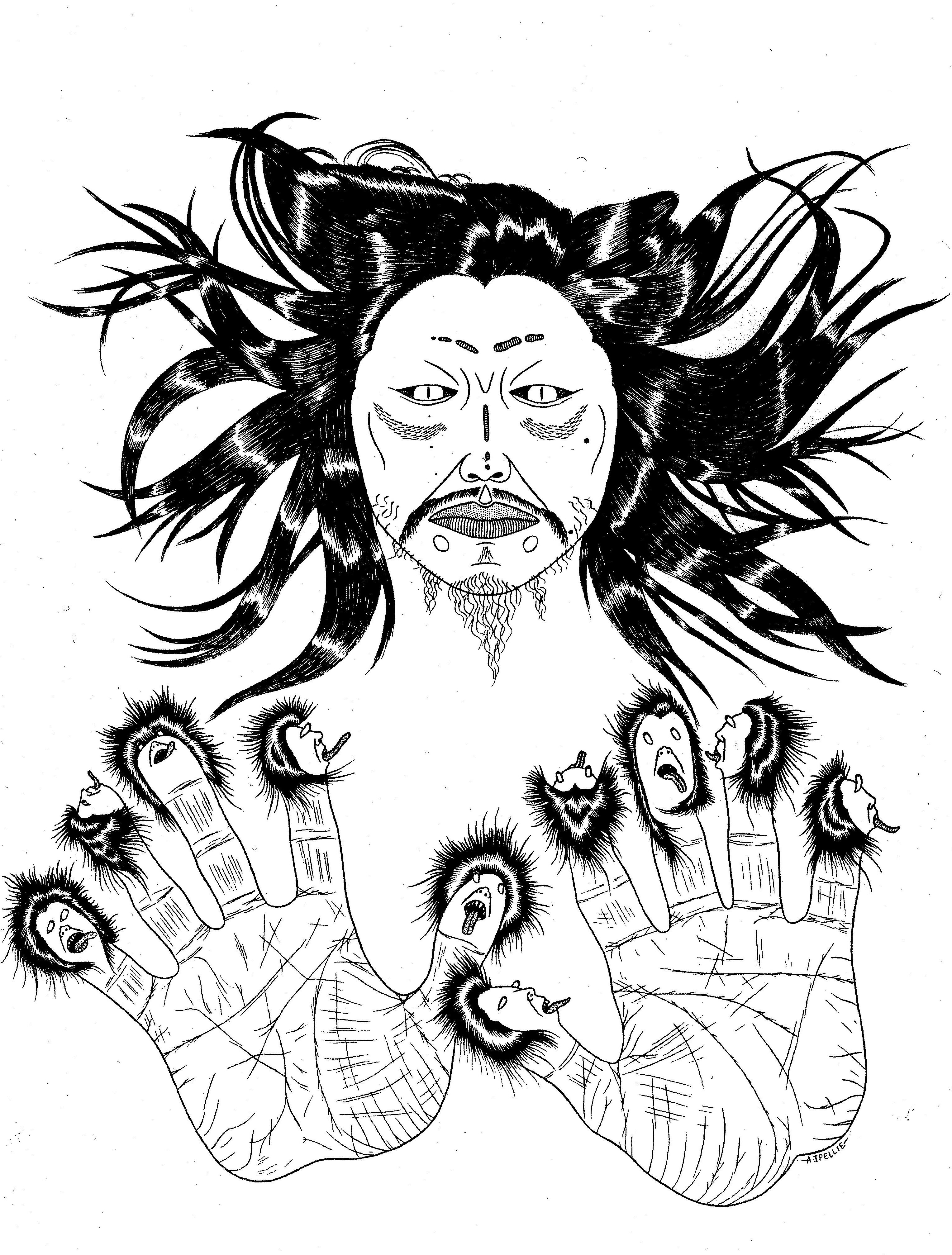
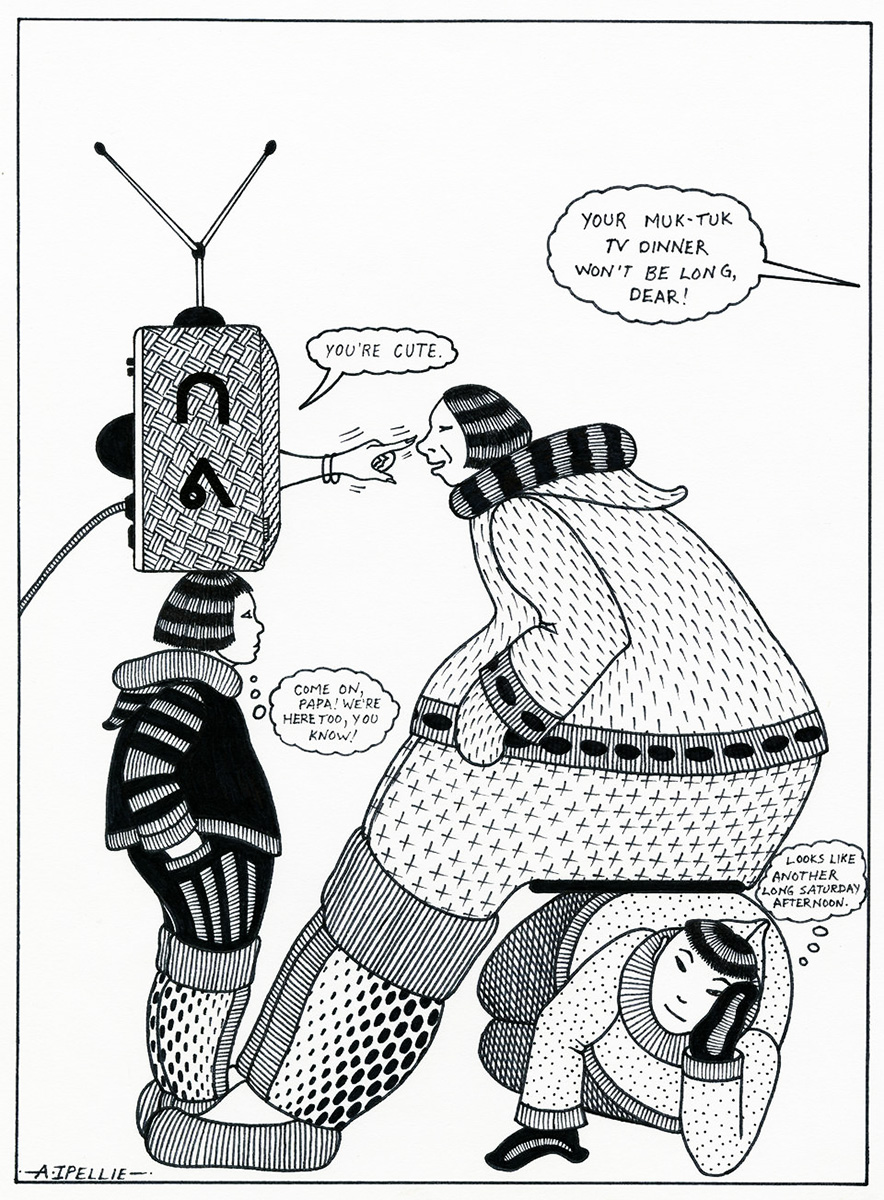
InukTVRegardless of the historical context in which these works are placed, there is a critical meta-narrative at play.  Primitivism, an artistic movement that appropriates indigenous aesthetics for European audiences, has become an acceptable form of art – a kind of cultural erasure. Traditional indigenous art is permissible in the iconography of official Canadian cultures, because it is “historic”. Indigenous peoples are permitted in the canon because they are presumed to have assimilated, (AKA disappeared). Inukshuks, totem poles, soapstone carvings and bead-work are all relatively traditional indigenous crafts, co-opted by the Canadian state to suggest a continuity between historic indigenous peoples and modern Canadian settlers–use of indigenous culture by the colonial apparatus suggests a cooperation, or at least a submission by the former to the latter. Symbols of pre-contact Inuit spirituality are acceptable as well – traditional tales and legendary creatures that preserve the image of the Inuk as an unchanging “primitive” without the complex legacy of Christianity. This is effectively a denial of the violent rupture that occurred.

“The Woman Who Married a Goose”

Ipellie’s style seems to stand outside of this. His art is by turns haunting, erotic and grotesque, but always political. By deviating from southern expectations that Inuit art produces a pre-contact fantasy of seal hunting, igloos and polar bears, his art challenges white expectations of indigenous art. By smearing sex, violence and modernity across southern stereotypes of Inuit culture, Ipellie defaces the museum-exhibit sterility of the “noble savage” trope with the viscera of human vulgarity.

CdnGovtLabThe Inuit are not simply figures in the past, a culture to borrow as part of some settler narrative. They are figures in our present, affected by us, and, as is best represented by Ipellie and his work, affecting us in turn.

Ad Astra Comix Hosts NYC Protest Artist Seth Tobocman for #TCAF2014

Please share widely!

FOR IMMEDIATE RELEASE:

World-Renowned Protest Artist Seth Tobocman Speaking in Toronto

Cartoonist to Discuss New Book and 35 Years of Grassroots Comic Activism at Toronto Comic Arts Festival (TCAF 2014)

Press Contact: Nicole Marie Burton
Phone: (647) 863-4994
E-mail: adastracomix@gmail.com
RSVP via Facebook: Saturday May 10, 6PM-10PM (city-wide event social & fundraiser), Sunday May 11, 1:30PM-2:30PM (TCAF workshop)
Purchase tickets online: HERE.

WeAreTheCity2As comic lovers gear up for the Toronto Comic Arts Festival (May 10 & 11, 2014), it has been announced that world-renowned protest artist and cartoonist Seth Tobocman will be in town. Seth will speak on over 35 years of experience making political comics, presenting his new upcoming book and sharing his experience on comics as a tool for social change. Tobocman will be giving one talk during the Toronto Comic Arts Festival, and a city-wide talk outside of the comics community between May 7th and 10th.

Tobocman is most well-known for his role as a founding editor of World War 3 Illustrated, a quarterly self-published journal of political comics, based out of New York City. Since the magazine’s inception in 1979, World War 3 Illustrated has served as a launch pad for both emerging artists and radical ideas. The artist’s work appears regularly in its pages.

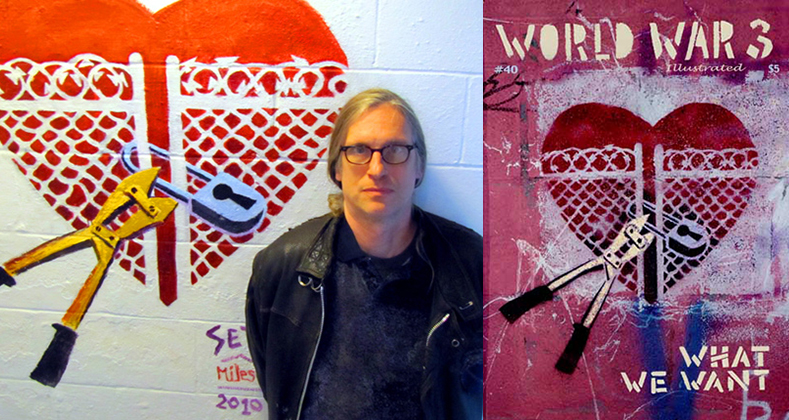
Seth Tobocman posing in front of his original graffiti art, which served as the cover for World War 3 Illustrated's Issue #40: "What We Want"
Seth Tobocman posing in front of his original graffiti art, which served as the cover for World War 3 Illustrated’s Issue #40: “What We Want”

Tobocman is also notable for his comic documentations of a number of political struggles in New York City. His book, War in the Neighborhood, details the affordable housing movement of the late 1980s which led to a series of occupations of abandoned buildings at a time of intense gentrification.

Cover of Seth's book "War in the Neighborhood," a graphic novel about the struggles over homelessness, gentrification, police brutality and human rights that raged in NYC during the 1980s and 90s. Published by Autonomedia.
Cover of Seth’s book “War in the Neighborhood,” a graphic novel about the struggles over homelessness, gentrification, police brutality and human rights that raged in NYC during the 1980s and 90s. Published by Autonomedia.

“There were events that made big impressions, and effected the direction of my art,” Seth explained in a recent interview with the Toronto-based political comics website, Ad Astra Comix. “The invasion of Grenada (1983) led me to do my first stencil graffiti… The housing movement in my neighborhood offered me a vast area of subject material to explore. More recently, the Occupy movement showed up to confirm that we had been on the right track all along.”

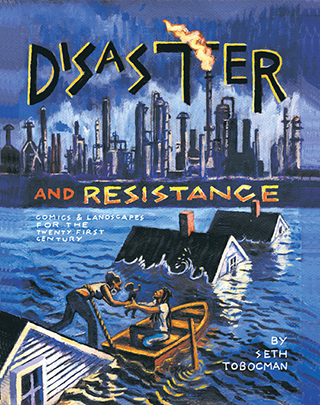
Tobocman has explored some of the larger contextual issues communicated by the Occupy Movement in two recent full-length graphic books: Disaster and Resistance: Comics and Landscapes for the 21st Century (AK PRESS, 2008); and Understanding the Crash with Eric Larsen and Jessica Wehrle (Soft Skull Press, 2010). A collection of his earlier graffiti and stencil art is compiled in You Don’t Have to Fuck People Over to Survive (Soft Skull Press, 1999).

City-wide tickets are now on sale for $5 each to cover the costs of Seth’s visit. Interviews with media can be arranged by appointment. More information available shortly!

For more in-depth on Seth and his work, check out our interview we did for the 35th Anniversary of World War 3:

Books by Seth Tobocman available for sale at the event:

DisasterAndResistance2 UnderstandingTheCrash

World War 3
Publishing Date: May 14, 2014. Pre-ordering will be made available if we cannot secure an advanced shipment.

1999_youdont

#ISA2014 Mixer and Launch of Journal for Narrative Politics

For the second time in a week, Ad Astra Comix was out and about meeting and discussing the power of political comics.

Here in Toronto the International Studies Association is wrapping up there annual convention, with hundreds of academics visiting internationally to deliver talks and share ideas on everything from global economic migration to the homogenization of Indigenous cultures and practices worldwide.  And we’re here to hell you… #TheresAComic4That .
Continue reading #ISA2014 Mixer and Launch of Journal for Narrative Politics

Event Report: The Ad Astra EQUINOX of COMIX

Friday, March 21
Ad Astra Comix / Soybomb HQ – Toronto

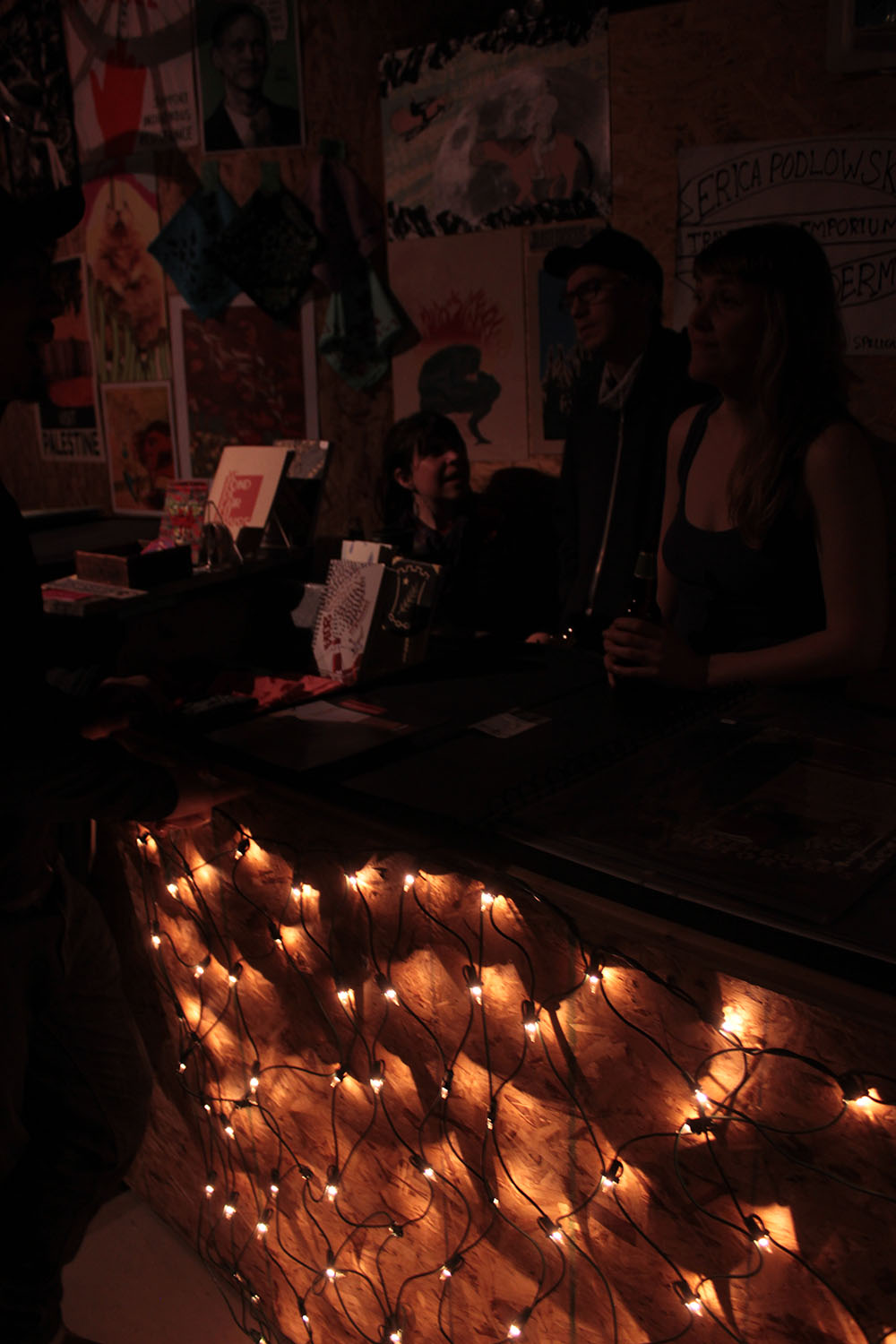
Amidst the clinking of glasses and the honking of Mario Karts, Ad Astra had its second seasonal shindig, aimed at building the radical comics community in Toronto.  The spread of comics available for acquisition was second only to the one on the kitchen island – a delicious selection of vegan and vegetarian delights made with love by Erica Podlowski (of Podlowski’s Traveling Emporium) and Emma Palumbo, author of the zine “CAN IT: A Collection of Stories, Recipes, and DIY Food Politics“)  Other vendors plying their exciting wares included Ohhh Canada, the JustSeeds Art Collective, and the poster campaign “Imaging Apartheid“.
140321_1
The literary fortune telling booth was a a true highlight of the evening, with all kinds of people packing in behind a screen of diaphanous silk to hear Melina and Yasmine prophesize their book-loving prospects with tomes and tarot alike! Some eager fortune-seekers were so taken by the proceedings that they sat in on additional tellings just to take it all in.
140321_013
Ad Astra Comix contributor and Comic Book Embassy ambassador Sam Noir made an appearance with his newly-crafted “Crack Smokin'” Mayoral action figure! Also to be available in a PG “Publically Inebriated” model… We hope he will be making many more, as it was incredibly popular!
140321_014
If Mario Kart came to a crashing close when someone stumbled over the controller cords and sent the whole thing into scattered disarray, the circles of conversation that formed in the half-pipe were an ample substitute.  Several attendees discovered to their delight that the slick surface of the half-pipe is perfect for group sliding…
140321_slide_banner
All in all it was an exciting night – food was served, perspectives were exchanged and a good time was had by all.  If we sold a few comics along the way, well, it’s in the service of expanding the city’s political horizons through the medium of the graphic narrative.  A big thank you to the 70+ people that came out to make the event a truly memorable one, and an extra special cheer of appreciation to everyone who poured their energy into putting it all together.
See you at the solstice!
With love,
The Ad Astra gang.
140321_022
140321_007
140321_009

the panel is political.