The Struggle Continues: Kamala Khan and the Fight for Diversification in Comics

KamalaKhanThis week the comics industry juggernaut Marvel announced a new superhero stepping into their circulation.

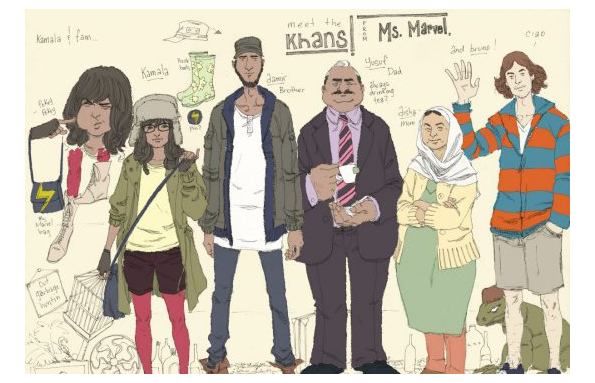
Kamala Khan is a young Muslim woman of Pakistani heritage, growing up in New Jersey. In an article this week in the New York Times about the new character, author G. Willow Wilson explains that she wanted the comic to be about a few things: “…about the universal experience of all American teenagers, feeling kind of isolated and finding what they are.” Wilson explains that this comes through the lens of Kamala being a young Muslim in America who struggles with her faith.
KhanFamily

The prospect of a new comic about this kind of character feels really promising. Even the art displays something new and comforting about it. I feel like Kamala could actually be a real person that I know. But aside from pointing out how Kamala will be different than previous Marvel superheroes, very little is discussed of her.

About a quarter of the article is taken up with examples of Marvel’s shoddy history of attempting to introduce minority characters. Thus if we are not already familiar, readers begin to introduce themselves to the battle against sexism and racism in the comic book world. Navigating the gauntlet of narrow editorial mindsets and penny-pinching fans… is seeing the underlying reality that most positions in the comic business are still inhabited by white men, and that this environment has often embarrassing and ugly consequences.

There are so many incredible examples of how working mostly with white men to create a comic universe comprised mostly of white men and male-idealized women can take its tole on your ability to even imagine diversification.

Mark_DanSome fun examples of this are instances such as DC Comics’ Dan DiDio in his outburst, now famous in the comic book world, at the San Diego Comic Con in 2011. When a member of the audience suggested that DC hire more women, DiDio emphatically responds, “WHO? Who should we hire? Tell me right now!” Let’s keep in mind that the suggestion came as a result of DiDio literally asking the audience what DC Comics should be doing to boost readership and reader confidence. As has been noted by many, if you actually listen to the exchange (an MP3 is conveniently available), you’ll note that DiDio’s response sounds less like a question and more like a challenge. DiDio continues to embarrass himself as an editor at America’s #2 comic publisher with actions like forbidding Batwoman authors from allowing the character, who is currently portrayed as a lesbian, to marry her partner. Superheroes are about self-sacrifice; they “shouldn’t have happy personal lives,” he explained to fans at the Baltimore Comic Con.

In August, 2013, comics creator Mark Millar was in the spotlight, particularly for his comments about the subject of rape in comics. “The ultimate [act] that would be the taboo, to show how bad some villain is, was to have somebody being raped, you know?” he said. “I don’t really think it matters. It’s the same as, like, a decapitation. It’s just a horrible act to show that somebody’s a bad guy.” Millar went on to boast that he “always likes to push it and see something [he’s] never seen before.” Monika Bartyzel’s response in The Week:

But Millar is wrong. We have seen rape in comics before, and we’ve seen it a lot. In fact, rape shows up repeatedly in Millar’s work (Wanted, The Authority, Kick-Ass 2), which echoes a longer tradition of rape suffered by superheroines like Black Cat, Ms. Marvel, and Rogue. Rape is no more an unspeakable taboo in comics culture, where the industry is overrun with continual sexual harassment and rape threats, than it is in real life.

Are we seeing a pattern yet?

Honestly, so much has been said about sexism in comics in recent years, comic creators have gone from ignoring it to denying it, to then claim it’s not their responsibility to change it.

Despite it being less of a publicly heated debate (perhaps because it’s more embarrassing?) we see this trend not only around gender, but around race. Brandon M. Easton, an African American animation writer, layed out the numbers in a Bleeding Cool article last year:

Clearly, breaking into Marvel or DC is insanely difficult and few people of any background manage to get close; but the fact that there are less than 3.0% of Blacks credited on all Marvel and DC titles as of June 2012 illustrates a serious problem that requires greater exploration.

Without necessarily trying to, Easton sums up a large part of the attitude problem facing society and the microcosm of the comic book industry. It is about racism specifically, but we can extract important lessons about all forms of systemic oppression:

In the U.S., it becomes a situation where some White people feel personally indicted as a racist and the burden rests on Black people to 1) prove racism still exists and impacts all of us, 2) explain the difference between a White person living their daily lives vs. the institutionalized system of racism, and 3) defend yourself against claims of “reverse” racism as the very mention of the issue means that you hate White people. Almost every online discussion of race boils down to these three arguments before it’s all said and done. And ultimately, nothing changes because some folks refuse to separate the system from their personal identity.

…So what does this all have to do with the fresh young Kamala Khan? Well, it could tell us that the mainstream comic book industry, despite some very old habits and mindsets, is trying to move forward.
Miles_MsMarvel…And yet.

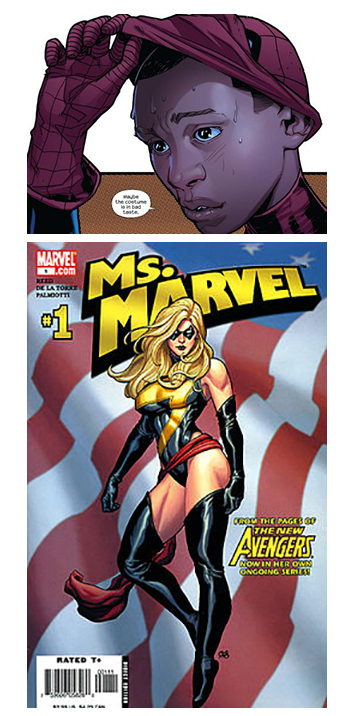
Khan appears to be her own superhero, when she is, in fact, going to become the new Ms. Marvel…Oh dear. Marvel and D.C. both have an embarrassing record of stuffing minorities–African Americans, women, and LGBT folk–into superhero characters that are already molded and defined as the characters of white men. Why is this a problem? To me, it boils race and gender down to pigment and body parts, and ignores the basic understandings of systemic oppression: that of a categorically different life experience. The idea that a Black Spiderman or a Ms. Marvel would carry on with the same missions and objectives as their white male counterparts, in essence, tells us what the comic creation establishment means when they huff and haw at accusations of racism and sexism: beyond pigment and body parts, we’re all the same. So why go out of our way to hire/include/portray minorities in comics?

Relatively speaking, I don’t think we are all the same. Perhaps a Pakistani Muslim superheroine like Kamala Khan would be concerned with American military drone strikes killing hundreds of civilians back home… Perhaps superheroes of colour would be more in tune with criminal behavior that has negatively impacted their communities or countries of origin, as opposed to some generic gangsters or bad men in suits?  And I can’t speak for all women, especially women superheroes, but perhaps a feminist perspective would *completely* change a superhero’s take on the world–its problems and its solutions.

What’s also enlightening, in the end, is the attitude of introducing diversity. “Fans respond with their dollars,” said Axel Alonso, the editor in chief of Marvel Entertainment, In the sense of margins and numbers, there is the logical fear that minority issues won’t connect with the majority and their wallets. As some of the most POWERFUL comics creators in the world said, “The comics follow society. They don’t lead.”

comicsPanel
Some leaders who apparently “don’t lead.”

I find that to be an interestingly defeated attitude for an industry’s top dogs. Any industry–but especially one with creativity at its core. And especially one so capable that it can put out a press release about the Muslim superheroine Kamala Khan on Monday, and have it picked up by two dozen major newspapers by Wednesday.

It seems to me that the biggest news the comic world can make these days is news of change.

Ultimately, the comic industry giants have yet to be able to overcome the major hurdles of sexism and racism, because they genuinely do not know how. Don’t worry guys, you’re not alone on that one. But until there is a comprehensive examination of racism and sexism, not as topics of sensitivity training, but as pervading systems of oppression in our society (with histories. with context) then we have little hope for the new characters being born, no matter how diverse they appear to be.

“Oil and Water” by Steve Duin and Shannon Wheeler


Title: Oil and Water
Written by: Steve Duin
Illustrated by: Shannon Wheeler
Introduction by: Bill McKibben
Published by: Fantagraphics (2011)

cover

Oil and Water is a work of comics journalism exploring the impact of the 2011 BP oil spill on the coastal communities and ecosystems of Louisiana, through the eyes of a delegation of activists from Oregon.

Most of us probably know some about the disaster that led to the largest oil spill in human history. The deaths of 11 BP workers aboard the Deepwater Horizon and the following 87 days of petroleum gushing unabated into the Gulf was, to a group of progressives from Oregan, the calling they needed to visit Louisiana and bear witness–to the spill, yes, but perhaps moreso the larger and deeply troubling questions it posed: What are the real effects of ecological disasters? Are these disasters avoidable? Ultimately, in a world that is quickly running out of fossil fuels, is the disaster even the root problem?

deepwater horizonEven those of us who have looked at the greater implications may find it hard to fully understand the impact of the BP oil spill without a visit to the Gulf coast. This was, at least in part, the viewpoint of the Oregon delegation, which included writer Steve Duin and artist Shannon Wheeler.

Profiles are drawn of the different personalities, from their flight into Louisiana until their last day, which certainly gives Oil and Water a ‘documentary’ feel. Scenes are intermissioned by small, 4-paragraph pages detailing some of the many troubling aspects of the spill, including BP’s record of cutting corners to save costs, or the devastation of the Gulf’s sea turtle populations.

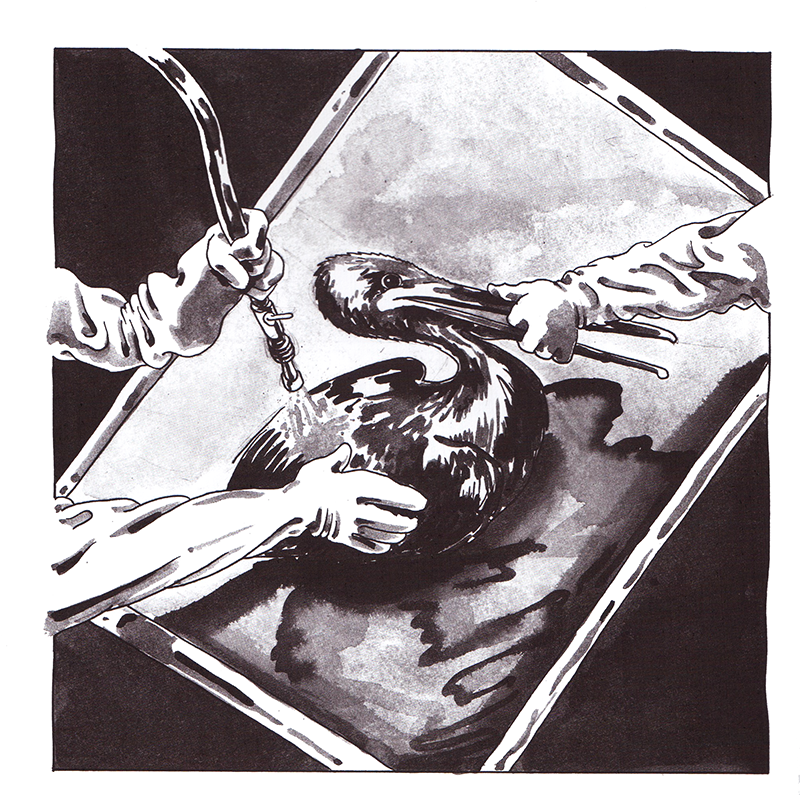
The artwork is black and white, with sketches filled in with a patchy, dark watercolour stain, certainly intended to mimic the appearance of oil. For Shannon Wheeler, an artist who is arguably known more around the world for his series Too Much Coffee Man, it struck me a bit by surprise. The art overall has a sense of haste, giving me the impression that they were rendered not from photographs but from on-the-scene sketching–something that may or may not be true.

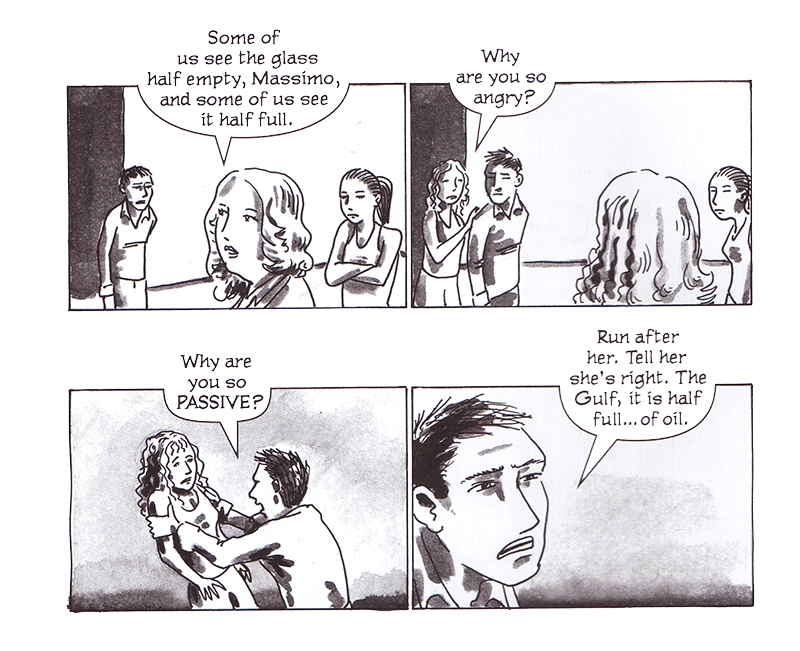
I am impressed with the changing of perspectives throughout the book. Duin seems to have really captured the thoughts and expressions of a number of trip participants and Louisiana locals, who voice their fair share of cynicism towards activists and outsiders parachuting into their neighborhood–seemingly a deja vu of the Katrina aftermath. In these sequences, we see members of the delegation change their way of seeing the world–and change their minds as to how they will act.Half_full


“Oil and Water” is a masterful collage of stories that, none to its detriment, only begins to scratch the surface of this tragedy. It would be a useful map of topics for someone looking for a starting point to the Deepwater Horizon disaster.

brown pelican

(Don’t) Join the Army, by Darren Cullen

North America: Why Aren’t you familiar with Darren Cullen? I think he’s right up your alley.

While his previous art, available for viewing on his site, http://www.spellingmistakescostlives.com covers other subject matter, his first published book, out October 17, is (Don’t) Join the Military – an absolute assault on the eyes that blends incredible artwork, political satire, and a dark sense of humour that had me thinking all through it that he must be a veteran.

jointhearmy_cover
Title: (Don’t) Join the Military
Author & Illustrator: Darren Cullen
Self-Published: October 2013
More Info: Darren Cullen’s Website: Spelling Mistakes Cost Lives

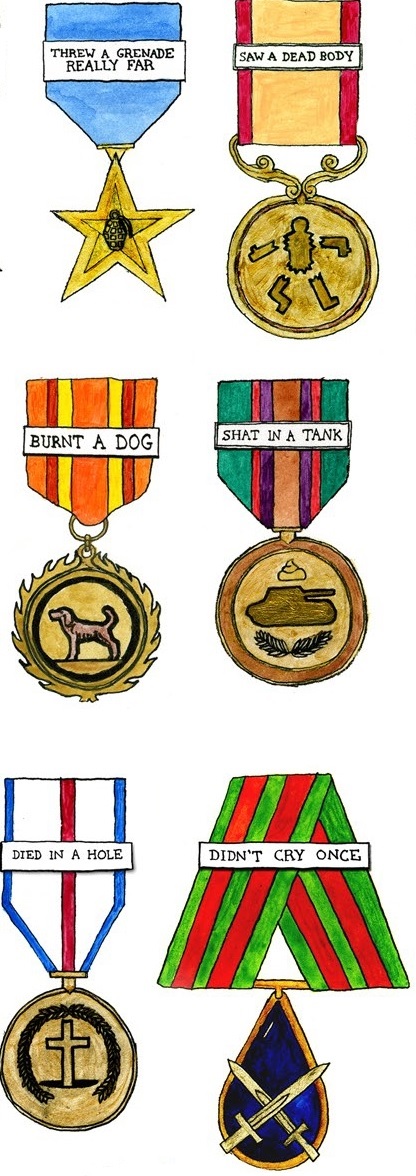
As the U.S. struggles with its ongoing war machine, here is a document that nips the syphoning of soldiers in the bud: at recruitment. Largely composed of content that mimics and mocks the recruitment-style propaganda, familiar to those of us on both sides of the Atlantic, Cullen juxtaposes biting humour (that will make you laugh out loud, as dumb as that sounds in a review) against images of war that can barely be reconciled: dismembered bodies, civilians being murdered, and soldiers having breakdowns.

The over-arching theme remains the lunacy of war, the ignorance needed to carry one out, and the level of lying and manipulation that must take place to market them.

burn down the sea

“I’m really interested in advertising and the gulf between the advert and the reality,” says Cullen.  “…and there doesn’t seem to be a starker example of that than when it comes to army recruitment. The adverts makes it look like a kayaking and abseiling holiday but if you join up you’re thrown into an actual hell on earth, forced to kill and be killed. It’s horrific.”

military_forces

If this were not all enough, there are lots of goodies stuffed into the booklet itself. Most notably, in my opinion, is the fold-out at the end–a jaw-dropping 3-4 ft insert that reminds me of a Mayan Codex… a fold-out expanse of war in its various dimensions, from recruitment to death.

scroll_selection
Just a small selection of Darren Cullen’s fold-out in (Don’t) Join the Army.

It need not be said that this kind of work doesn’t speak to everyone. Cullen has weathered quite a bit of difficulty just in finding a printer who would help him publish, due to the content–which I think is saying something in this day and age. But the offence is not so much to the violence, in my opinion. We see depictions of violence and war frequently. But this cuts into the insanity of advertising violence and war being sold to us as something other than what it is, and mocks it ruthlessly for being so blatant a contradiction.  It seems quite natural, in this context, that Cullen would point out, “I think the expectation and the reality [of the military] are so different, it’s a perfect subject for satire.”

medals_of_honour

Understanding Comics: The Invisible Art

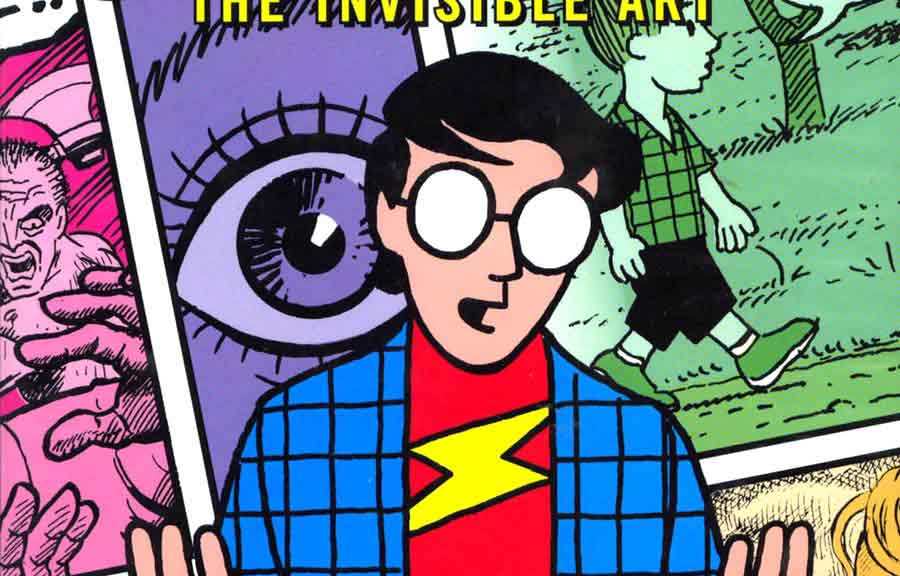
 Understanding-Comics_00

Understanding Comics – The Invisible Art is quintessential reading for those who appreciate comic books as a legitimate art form. It explores, with great authority, the method underlying the form of combining words and pictures in sequential art storytelling.

So what does all that mean to folks who don’t fall under the Art Nerd category?

Well, the ideas covered in this book can tackle some of the following subjects:

– Why comics, cartoons, and “sequential” art has been used for thousands of years
– Why the medium is accessible as a popular art form, as well as being capable of great sophistication
– Why film isn’t just “like comics, but better” – a favorite point raised by many comics afficionados including Alan Moore

Scott McCloud, who is creator of the both the book’s works and graphics, actually illustrates his theory and methodology as you’re reading about it–which is great for visual learners, and definitely drives home the points he is trying to make. What is more, the research is intensely thorough. Check out the chart on page 52-53 where he maps out the geography of the comic art universe, in which comics are located based on their varying gravity towards Reality, Meaning, and the Picture Plane.

mccloud-uc-triangle

symbolsDrawn images, McCloud points out, are all symbols, including the visual depictions of our languages. Yet written language is received, and is the process of training and education… whereas a drawing of a woman or a boat is perceived–that is, instantaneously understood as a representation of that thing. Comic arts, among other things, is a practice of reconciliation between these two distance cousins–an attempt to harmonize them in a way that only uses one sense–sight–to take it in, and yet professes all of our senses, and all perceived dimensions–including time.

So what does the typical comic reader get from reading Understanding Comics?

Aside from getting your mind blown about the abilities of the medium, Understanding Comics will truly help you to further appreciate decent comic art. It will help you to recognizing quality; it will help you to differentiate style, including cultural influences that you may not have previously noticed (Japanese comics, for example, are notably different in method than American or European comics, and this can be linked quite conclusively to a difference in values, philosophies, and methods of thinking.)

You may wish to pick it up as a map of what kinds of styles are out there, in terms of culture, style, time period. Or you may find it empowering to more deeply understand the comics you already know and love. Whatever the case may be, the book is a must-read for comics aficionados… and, arguably, those looking to understand why comics are once again on the rise.

For those who read and like Understanding Comics – you will probably want to check out McCloud’s next installment – Reinventing Comics, which takes the theory and method to the next level, and explores some of the new realms comics are tackling.

Scott McCloud also has a wonderful Ted Talk that combines the fundamentals of both of these books. Click on the image below to check it out in a new window.

scott mccloud

Re-Writing History: Review of A Graphic History of the Vietnam War

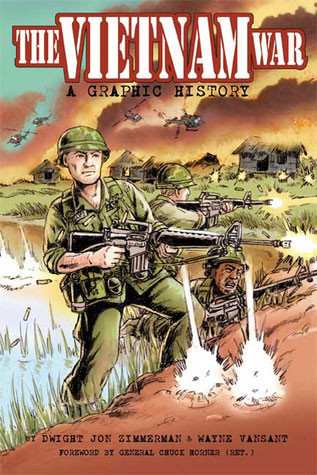
Some discussion has come up around Ad Astra Comix and a recent addition to our stock list– a graphic history of the Vietnam War. Not only does the book gloss over major historical events, like the Gulf of Tonkin incident (and the fact that it never happened, yet was a major cause for the war to escalate). The historical narrative, which has had 40 years of time for reflection, comes to some very troubling conclusions. As a new generation looks back on Vietnam as the war of their Grandmothers and Grandfathers, and as a generation that has been raised far too comfortably around operations in Iraq and Afghanistan being “business as usual, there is a serious need to dispel this re-write of history in the comic record. -NMG.

by Allen Ruff, guest contributor

A Little Background

As the U.S. aggression in Vietnam escalated in the mid-1960s, the liberal Cold Warrior Walter Rostow, an advisor to John Kennedy and Lyndon Johnson, spoke of the need of “winning hearts and minds” of the Vietnamese, at least those under the control of the US client regime in Saigon, if US force was going to prevail. As the barbarity of the venture — the toll in lives destroyed and the devastation exacted — spread, the invaders not only failed on that front in Vietnam, but also lost the campaign for political support, the battle for hearts and minds back in the States.
By the time this photograph was taken, public support for the Vietnam War had plummeted.

The war makers, of course, suffered a humiliating defeat despite their firepower. Failing to defeat militarily what was primarily a peasant-based anti-colonial and nationalist movement already decades old, it also lost the war on the political, ideological and cultural levels. Never having them in the first place, it never won the bulk of the Vietnamese people. The war machine murdered, maimed and debased too many and destroyed too much for that ever to happen. Those that survived, after all, were not about to buy the nonsense about “freedom” and “liberty” churned out by US propaganda specialists and parroted by a succession of corrupt, murderous regimes in Saigon. All the claims of the American “Free World” mission to save the country from “Communist Peril” rang hollow as that tiny land was scorched by what amounted to in a massive fly-by shooting.

Trang Bang, June 8th, 1972. A U.S.-Allied South Vietnamese air force plane dropped a napalm bomb on the village 26 miles outside of Saigon.
 Defeat in some sense became inevitable, a done deal, when the Washington war makers simultaneously lost large swaths of political support at home. They lost the battle of ideas, the claims and justifications, and explanations of what the war was about as the body counts and war costs mounted.
That loss of domestic political support for the war has never been forgotten, especially by those intent on winning future wars abroad who have come to view that home front defeat as a significant “lesson” of the conflict, not to be repeated.
In their ongoing efforts those still imagining that Vietnam could have been won and those already invested in current and future interventions have utilized every available means at their disposal to revise and reframe the  story. At that level, the portrayals and accounts in the popular culture – television and film, in music, art and print media, even the comic book press – have long been been utilized in the campaign to mold “hearts and minds”, especially among the young and the impressionable, the potential recruits and fodder for future imperial campaigns.
Few recent examples illustrate that fact better than Zimmerman and Vansant’s graphic rewrite of the Vietnam war’s history. Well-illustrated by the clearly talented Vansant and shrewdly scripted by Zimmerman to include the actual words of participants, the book in some ways has more to do with the present than it does with some approximately accurate portrayal of what the US did to Southeast Asia.

the-vietnam-war-a-graphic-history_1024x1024
Title: The Vietnam War – A Graphic History
Written by: Dwight Zimmerman
Illustrated by: Wayne Vansant
Published: New York: Hill & Wang, 2009. 143pp

Now, of course, it can be rightly argued that the writing and depictions of history are always selective and that all historians make choices and have an agenda, an axe to grind. and that a graphic history could not possibly be comprehensive in any sense of the term. That all remains true since the agenda of this rightward revision of the war on ‘Nam comes clear right in the opener, in the foreword written by the retired Air Force General, Chuck Horner.
A combat pilot during Vietnam, Horner later commanded the U.S. and allied air assets during Desert Shield and Desert Storm. According to the publisher’s boilerplate accompanying his account of the Gulf War co-authored with fiction writer Tom Clancy, he, Horner “was responsible for the design and execution of one of the most devastating air campaigns in history.”

Horner, in one page, casts Vietnam in terms clearly pitched to the novice, the young high-schooler or working class kid, perhaps.

“Like other wars,” he tells us, America’s war in Vietnam, “began with a premise of good versus bad and which was which depended on whom you side with.” Well, okay for the obvious, war as some shape shifting morality play.
He then proceeds to explain that, “As the conflict dragged on, those views changed into the reality of a dedicated, committed North Vietnamese enemy and the committed-but-not dedicated US led-coalition.” The implication is simple (and simplistic): The US and its junior “coalition” partners (Who they were, he doesn’t say) lost because they weren’t dedicated enough, didn’t have the endurance or the will to win. Or, by implication, one running throughout the book, that their determination was undermined not so much by the tenacity of the Vietnamese adversary but by the falling away of support at home.
He goes on: “President Kennedy had committed our nation, but then President Johnson instituted polices that lacked dedication.” Here, immediately, one of the main themes of the conservative accounts creeps in: the war came to be lost because the civilian leadership, especially the politicians back home lacked the guts and the determination to see it through.
Following Johnson, “President Nixon became dedicated to getting us out of our commitment (to whom or what, Horner doesn’t say), but at “great cost to our honor.” Apparently even Nixon, known during the height of the war as the “Mad Bomber,” is viewed by this former Air Force lifer as aiding and abetting the commission of that sin of sins among the military, dishonor. (In some sense Nixon ended up getting a dishonorable discharge, but not for the major war crimes for which he should have been tried.)
What might be drawn from all that? Horner lays it out: “Years later, in Desert Storm, our politicians and our military, remembering the lessons of Vietnam, set goals and conducted operations that deserved our unqualified commitment and dedication.” That matter of dedication and steadfastness, once again.
Horner then raises a second read on the history commonly forwarded by the right: “In the case of the Vietnam War, the divergence of political will and goals resulted in constraints on our military operations.”  Disregarding or not knowing that war is the extension of politics, he seems to suggest that the whole thing could have been “winnable.” If only the military didn’t have to fight with “one hand tied behind its back” and they weren’t “stabbed in the back” by the peace movement and their allies in the “liberal” media.
The old canards die hard.
Horner tells us, as well, that “our South Vietnamese ally’s leadership could not rally the dedication of its own people.” As venal, repressive and as illegitimate as the US-bolstered Saigon sham of a government was, could it have been any different?  Horner may think so, but few others versed in the history appear to hold that peculiar line.
The Good General asserts, in closing, that Zimmerman and Vansant have come together to present the history, “in a clear and comprehensible way.” He concludes his foreword by describing the work’s present day purpose: “It serves to enlighten those for whom Vietnam is only academic history, so that we may be armed against making the same mistakes in the future.”
Interspersed with occasional accounts of heroic efforts by troops on the ground, the bulk of the narrative is loaded with half truths and craftily retooled tellings.  Parts of it read as if it was selectively scripted by someone with the suppressed memory of a sleepwalking amnesiac.
This tale — an illustrated comic after all — might seem “comprehensible” to the novice, those unfamiliar. After all, if Vietnam was nothing but a series of mistakes made mainly by a civilian leadership at home, unwilling to fight to win, then a further mistake, perhaps, might be made by one looking to this work for some understanding, today, of what that criminal enterprise perpetrated against the people of Southeast Asia actually was about.

allen ruffAllen Ruff is a U.S. Historian, Social & Political Activist; Host, Thursday’s “A Public Affair” – WORT, 89.9fm, Madison, Wisconsin; & Writer of Non-Fiction and an Occasional Novel. You can find more of his writings on his blog, Ruff Talk.
Battle of the Graphic Biographies: Hill and Wang

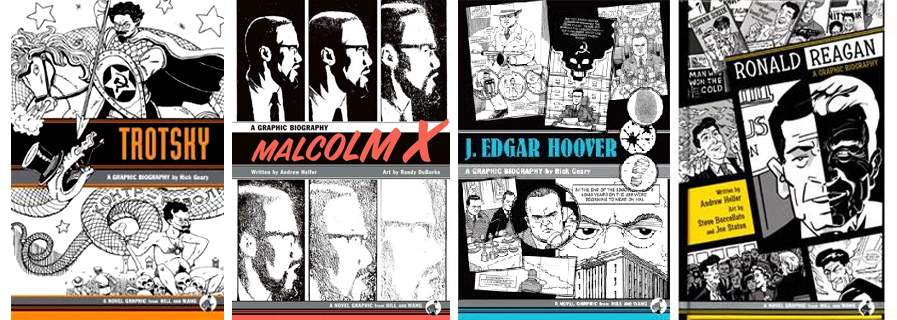
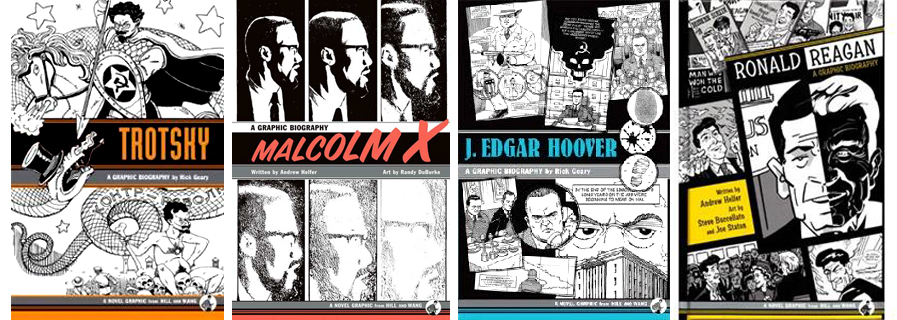
Continuing on with my theme “Battle of the Graphic Biographies” begun earlier this year Che Guevera, this month I’ve had a couple different titles at Hill & Wang take each other on– all a part of their Novel Graphics series. I, somewhat arbitrarily, began reading these books in chronological order: Trotsky, J. Edgar Hoover, Malcolm X, Reagan. My interest is obviously to provide some aesthetic feedback, but more to point out political strengths and weaknesses of the titles.

cover gallery
My first note is that each book appears to be politically tailored for the audience most likely to pick it up—the biographies speak more or less favorably of the people they spotlight.  But my questions going in are, “Do I better understand the person I’m reading about?” “Am I hearing of their life in their own words–while seeing an interpretation of events from a 3rd person?” “Is this historically/politically accurate?”

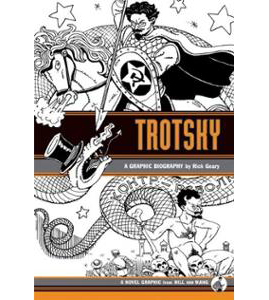
trotsky bio

Title: TROTSKY: A Graphic Biography
Writer & Illustrator: Rick Geary
Published: 2009

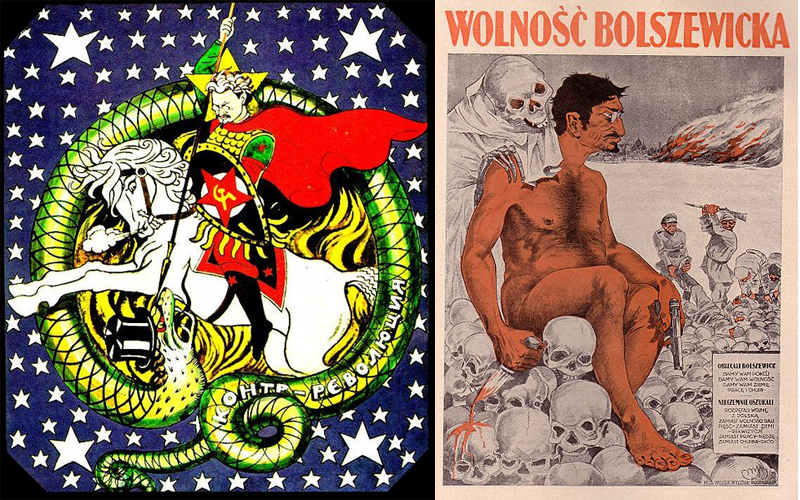
I had serious suspicions about this one, going in. Whereas the other book covers are more or less realistic, Trotsky’s is purely mythological. We see him astride a horse as some kind of atheist St. George–all the while he sits underneath, naked on a pile of human skulls. These images come from two very different interpretations of Trotsky’s role in the Russian Revolution–both over-zealous and emotional, both incorrect. While I appreciate the re-visiting of historical cartoons and illustrations, it seems necessary for me to make note of the the point that both graphics were commissioned by opposing governments during one of the most highly polarized moments of the 20th Century: the rise of the Russian Revolution.

The cover of 'TROTSKY (The Graphic Biography)' took inspiration from these political cartoons of the time. On the left, Viktor Deni, an author working for the Russian Soviet Federative Socialist Republic (RSFSR) in 1918, depicts Trotsky as St. George, slaying the dragon of "counterrevolution". On the right, Polish government anti-communist poster to counter Bolshevik propaganda from Russia during the Polish-Russian war 1920, showing People's Commissar for the Army Lev Davidovich Bronstein (Leon Trotsky). Large caption reads: "Bolshevik freedom."
The cover of ‘TROTSKY (The Graphic Biography)’ took inspiration from these political cartoons of the time. On the left, Viktor Deni, an author working for the Russian Soviet Federative Socialist Republic (RSFSR) in 1918, depicts Trotsky as St. George, slaying the dragon of “counterrevolution”. On the right, Polish government anti-communist poster to counter Bolshevik propaganda from Russia during the Polish-Russian war 1920, showing People’s Commissar for the Army Lev Davidovich Bronstein (Leon Trotsky). Large caption reads: “Bolshevik freedom.”

I think anyone who sees a book of 100 pages claiming to tell the life of Leon Trotsky is pretty much kidding themselves. Once into the story, you might be able to tell why: this man was a mover and shaker of continents, social structures and financial systems in a way that practically boggles the mind. In a time before television, let alone the internet and social media, Trotsky was world-famous for his ideas and his conviction to carry them to fruition.

This book, albeit abridging-ly, details his early years as a landowner’s son in modern-day Ukraine, a student activist and intellectual, his political development, his multiple exiles by the Russian Czar. It’s a whirlwind. In fact, it’s a struggle just to get all of these points down, without even going into what made Trotsky’s ideas so intriguing/dangerous, let alone his various roles in the the Revolution. Despite the obvious limitations, I believe Rick Geary does a stand-up job trying to pull together an epic biography that at least attempts to discuss serious politics.  Geary’s style lends itself well to the time period: a bit cold and minimalistic–but not cartoony. The line-work reminds me of borsch and cold, dry winters. In a good way.

I can’t really blame this book for what it isn’t–it’s not an in-depth biography of the Russian Revolutionary, in any sense. It’s not a clear history of the Russian Revolution either. But it will give you a crash course that may peak your interest, and lead you to other works about one of the most interesting men of modern times.

* * * * * *

malcolm x

Title: Malcolm X: A Graphic Biography
Writer: Andrew Helfer
Illustrator: Randy DuBurke
Published:  2006

Like Trotsky, Malcolm X is one of those four-letter words of the 20th Century. People alternately love and cherish or hate and fear everything that the man stood for. It really is a testament to the power of their ideas and the charisma with which they disseminated them.

Click to enlarge
Click to enlarge

Malcolm’s story has been told in epic fashion many times: there is the Autobiography of Malcolm X, as told to Alex Haley. Spike Lee’s “X” with Denzel Washington was an immediate classic. Once these essential biographies have been consumed, you believe that you know the man’s story. However this graphic biography, in fact, delivers additional information that even someone familiar with Malcolm’s story will find new and enlightening. Scenes I found most interesting included the details of his time as a hustler on the East Coast–as well as his final days in conversation with Nation of Island leader, Elijah Mohammed, whose candid remarks about women are better displayed here than anywhere else that I’ve read.

Malcolm’s entire life is characterized by a seemingly endless sense of change and evolution. In the end, the man who seemed tireless in his conviction, his self-confidence, was also likely his harshest critic. He went from being a pimp and a hustler to a raging animal in prison, a Nation of Islam preacher and black segregationist to working with whites when and where he could. And where we led, people followed. Because of his constant evolution, it is difficult for critics to demonize him. His radicalism has also made it pretty much impossible to water down his message–as has been done with Martin Luther King.

Of all the illustrators of this graphic biography series, I am in love with Randy DuBurke’s style. It is by far my favorite. He illustrates an emotion with what seems be a shadow-heavy photographic realism. Stylized but not cartoony, I even see some graffiti-stylized splatters in the background, that give it an additional grittiness. Given that author and illustrator are two different people in this work, I find their respective trades synching incredibly well.

* * * * * *

hoover bio

Title: J. Edgar Hoover: A Graphic Biography
Writer & Illustrator: Rick Geary
Published:  2008

Rick Geary is back after Trotsky with this graphic biography of FBI chief J. Edgar Hoover. Actually, this book was produced before the Trotsky one, but I’m going in some other kind of chronological order.

Unlike Trotsky and Malcolm X, I had never read a biography of Hoover before, although I was familiar with his role in Communist witch-hunting post-WWII, as well as his hand in the FBI’s notorious COINTELPRO counter-intelligence programs. What hadn’t occurred to me was the length of his office. The man was active in government from Emma Goldman… to Ronald Reagan. Think about that. Through half a dozen presidents. He was arguably the country’s most powerful civil servant. His ability to avoid partisan politics and harness the power of government bureaucracy, ironically, reminds me very much of his arch-nemesis Joseph Stalin. These two men dominated their countries with iron fists, using many of the same tactics, for much the same period of time. The key to both of their success was securing and mastering the administrative machinations of their positions.

While I see Rick Geary showing the light and dark of Hoover in this biography, he is at worst portrayed as a bit of a maniac who dabbled in unconstitutional activities for the protection of his dear country–and the all-sacred “American way of life”. We see the mass deportations of immigrant unionists, communists and radicals more as the shuffling of ants from one place to another outside the country–not the same brutal inhumanity with which Trotsky is depicted, sitting on a pile of bones.

Do I wish the comic would take a little more interest in how J. Edgar Hoover was a detriment to the country? The historical precedents of jailing and deporting descent, spying and wire-tapping, infiltration into progressive groups? Yes, in fact I can’t really think of any other singular man who probably committed more damage to democratic movements of the 20th Century than J. Edgar Hoover. But that’s my opinion on the matter–and Geary makes little to no effort to hide the evidence that would lead someone to those conclusions. He includes his very trouble remarks on communists, unions, student activists, black people–alongside the sea of other people that rubbed him the wrong way.

* * * * * *

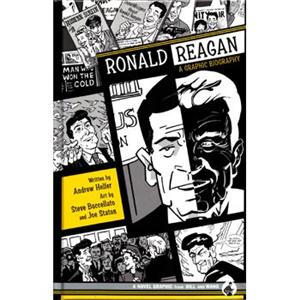
reagan

Title: Ronald Reagan: A Graphic Biography
Writer: Andrew Helfer
Illustrator: Steve Buccelleto and Joe Staton
Published:  2008

Of all of the graphic biographies, Ronald Reagan’s seems the most surreal. This is very much a theme of the book itself. Where was the threshold between Reagan the man and Reagan the actor? Reagan the actor and Reagan the politician? The book very much lends itself to the theory that there were no clear lines, even to Reagan himself. Acting was a part of him from a very young age, as were many of his political and moral influences.

Also more than any other comic in the series, this book relies very much on Reagan’s own interpretation of himself and his life–including instances like his student strike in university, which isn’t documented by the school–or his record 77 rescues as a lifeguard, even though there were many instances in those rescues where, hilariously, people apparently didn’t need to be rescued (THAT comic history vignette, I would love to see). More than many other American leaders, Reagan very much controlled what media and the public thought of him. That was his gift as an actor.

While there is some mention of his early days as an FBI informant, as a ‘friendly’ testifier in the mid-century Inquisition of American leftists and progressives, as well as his later involvement in the dismantling of unions, tax cuts for the rich, military intervention in Grenada… the underpinning theme Geary really seems to be driving home is Reagan’s mastery of the spectacle. It wasn’t really anything he did–and he did many things in his life–it was how he won support, how he charged through his competition and adversaries at the crucial moment. It wasn’t what he did so much as how slickly he was able to get away with it.

I find the artistic style of this work, shared by Buccelleto and Staton, to be my least favorite of the series. Faces and gestures are bubbly, cartoony, very “Leave It to Beaver”-ish, which works for Reagan but not for me. I feel like anyone who watched television during the last century knows this perspective of Ronald Reagan. So despite my distaste I understand perhaps why they went with it. Maybe, for all that time behind the camera, there really was no other way to see the man. He seemed to understand, at an early age, that public image is its own form of immortality.

* * * * * *

Of all the comics that I read, I enjoyed Malcolm X and J Edgar Hoover the most. Both had wonderful artwork and kept me intrigued with information that was new to me. However I appreciate the set as a whole for its fascinating takes on 4 totally different individuals. I have found much more intricacy in all of the books’ designs than I initially thought would be there.

100 Year Rip-Off is Back from Printers!

Fresh out of the box - mmm, the smell of slightly burned toner.
Fresh out of the box – mmm, the smell of slightly burned toner.

Fresh Out of the Box!

On Tuesday this week, I got the call to come and pick up 5 boxes of freshly printed comics – 100 Year Rip-Off has come back to life.  For those of you who follow these posts, you’ll know that this has been Ad Astra’s main project for the past few months.

First order of business is filling pre-orders from the lovely folks who supported me during my Indiegogo campaign–they are deserving of a comic on their doorsteps immediately, along with my most heartfelt thanks. It feels wonderful to have people around you who believe in your project.

Lessons

This Summer has been such a blur of activity, I feel like I haven’t really had time to sit down and process my first publishing experience. From the get-go, I liked the idea of publishing creative work from someone other than myself for the first go at it–I feel like creating and producing are two very different processes that deserve their own special care and attention. Likewise, I wanted to give myself at least some mental time and space to look at the process as much from outside myself as possible–a hard thing to do when you’re staring your own brain child.

And so I impart to you the lessons I’ve learned from this experience from Day 1 – from initial planning, getting in touch with creators, editing, printing, fundraising, and retailing.

Make a Timeline. It’s not that we all follow calendars, but they help your brain foreshadow the journey in which you’re about to take part. Get a cheap calendar from the dollar store, or a get a big piece of paper, and lay out everything you think will be involved in the process of your project.
Enjoy the Process. A lot of the editing work with 100 Year Rip-Off was incredibly tedious–essentially going over each image with a magnifying glass. But I actually enjoy this work, and find the focus involved therapeutic. If you find yourself going into territory that is boring or frustrating–but necessary for your project’s completion, find a way to make it a more enjoyable experience. Creativity, love, and care in work all stem from savored moments. Don’t rush it.

Make Connections.  Anyone who has a project they want to share should always have this in mind. Everywhere you go, you have opportunities to talk about what you’re working on. Don’t get all shy and say “I don’t want to promote myself”. Stop it! You’re not shamelessly promoting yourself–you are promoting your work, which has a life all its own. And let me tell you, it’s way more interesting to talk about with your neighborhood barrista in the morning than the frickin’ weather or new version of the iPhone. Come off it. People love projects. They love hearing about what the people around them are working on. Share the process you’re involved in with others–and you will always find people who say, “When you’re done–save one for me.”

Seriously Calculate Finances. Seriously. I know everyone hates it,  but understanding how much your project is going to cost is pretty important–especially when you’re asking people to help you out with money. This brings me to my next point, which is Indiegogo related.

Details of Delivery. Once your project is done, how’s it getting out to people? If you did a crowd-funding campaign, did you calculate for postage? How about international orders? These all seem like “good problems” to have, that you’re willing to table until you’re far enough along that they will come up–but think about them now. I included a promotional poster in with my Indiegogo campaign–one that I wanted to send unfolded to contributors. Well, after the campaign had ended, I found out that shipping it unfolded was going to cost 2-3 times as much as what people had donated for it! FAIL. Keep shipping in mind.

… I may add to this list later, but these are my immediate reflections on this particular project. I’d like to take some more time in the near future to really lay out the anatomy of the process, and perhaps turn it into its own How-To project.

Thanks for reading.


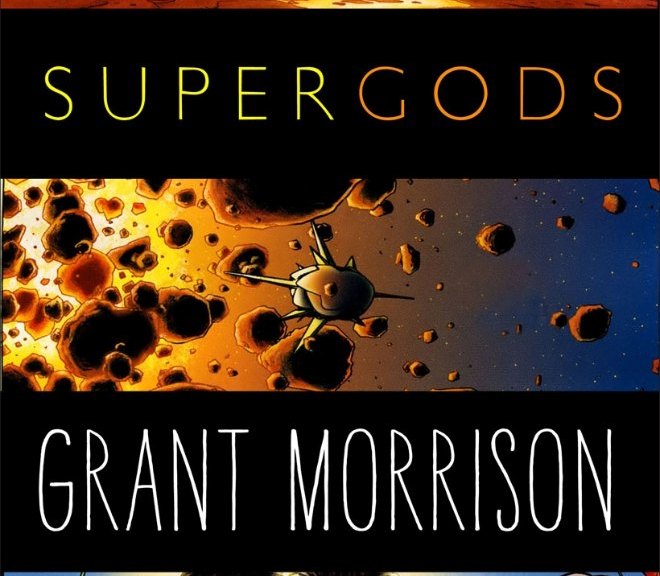
Introduction to Grant Morrison’s SUPERGODS

I’ve just begun reading Grant Morrison’s Supergods and wanted to share the introduction with any non-readers or non-believers. From what seem to be almost arbitrary and even laughable (often laughable) beginnings, the rise of superheroes in comics speaks deeply of the politics and belief systems of our times. Since it’s already available online elsewhere, I thought I’d share with you the book’s introduction–which makes for a great article in and of itself.

supergod_cover

Title: SUPERGODS: What Masked Vigilantes, Miraculous Mutants, and a Sun God from Smallville Can Teach Us About Being Human
Author: Grant Morrison
Published: 2011 by Spiegel and Grau, New York


Introduction
FOUR MILES ACROSS – a placid stretch of water from where I live in Scotland is RNAD Coulport, home of the UK’s Trident-missile-armed nuclear submarine force. Here, I’ve been told, enough firepower is stored in underground bunkers to annihilate the human population of our planet fifty times over.  One day, when Earth is ambushed in Hyperspace by fifty Evil Duplicate Earths, this mega destructive capability may, ironically, save us all—but until then, it seems extravagant, somehow emblematic of the accelerated, digital hyper-simulation we’ve all come to inhabit.

ctte of 100At night, the inverted reflection of the submarine dockyards looks like a red, mailed fist, rippling on a flag made of waves.  A couple of miles of winding road from here is where my dad was arrested during the anti-nuclear protest marches of the sixties. He was a working-class World War II veteran who’d swapped his bayonet for a Campaign for Nuclear Disarmament badge and became a pacifist “Spy for Peace” in the Committee of 100.  Already the world of my childhood was one of proliferating Cold War acronyms and code names.  And the Bomb, always the Bomb, a grim and looming, rain-coated lodger, liable to go off at any minute, killing everybody and everything.

if an a bomb falls

His bastard minstrels were gloomy existentialist folkies whining horn-rimmed dirges about the “Hard Rain” and the “All on That Day” while I trembled in the corner, awaiting bony-fingered judgment and the extinction of all terrestrial life.  Accompanying imagery was provided by the radical antiwar samizdat zines my dad brought home from political book-stores on High Street. Typically, the passionate pacifist manifestos within were illustrated with gruesome hand-drawn images of how the world might look after a spirited thermonuclear missile exchange. The creators of these enthusiastically rendered carrion landscapes never overlooked any opportunity to depict shattered, obliterated skeletons contorted against blazing horizons of nuked and blackened urban devastation. If the artist could find space in his composition for a macabre, eight-hundred-foot-tall Grim Reaper astride a flayed horror horse, sowing missiles like grain across the snaggle-toothed, half-melted skyline, all the better.

Like visions of Heaven and Hell on a medieval triptych, the post-atomic wastelands of my dad’s mags sat side by side with the exotic, triple-sunned vistas that graced the covers of my mum’s beloved science fiction paper-backs. Digest-sized windows onto shiny futurity, they offered android amazons in chrome monokinis chasing marooned spacemen beneath the pearlescent skies of impossible alien worlds. Robots burdened with souls lurched through Day-Glo jungles or strode the moving steel walkways of cities designed by Le Corbusier, Frank Lloyd Wright, and LSD. The titles evoked Surrealist poetry: The Day It Rained Forever, The Man Who Fell to Earth, The Silver Locusts, Flowers for Algernon, “A Rose for Ecclesiastes,” Barefoot in the Head.

On television, images of pioneering astronauts vied with bleak scenes from Hiroshima and Vietnam: It was an all-or-nothing choice between the A-Bomb and the Spaceship. I had already picked sides, but the Cold War tension between Apocalypse and Utopia was becoming almost unbearable.  And then the superheroes rained down across the Atlantic, in a dazzling prism-light of heraldic jumpsuits, bringing new ways to see and hear and think about everything. Te first comic shop in the UK—The Yankee Book Store—opened in Paisley, home of the pattern, just outside Glasgow in the years after the war. With a keen sense of ironic symmetry, the comics arrived as ballast alongside the US service personnel whose missiles threatened my very  existence. As early R&B and rock ’n’ roll records sailed into Liverpool to inspire the Mersey generation of musicians, so American comics hit in the west of Scotland, courtesy of the military-industrial complex, to inflame the imaginations and change the lives of kids like me. The superheroes laughed at the Atom Bomb. Superman could walk on the surface of the sun and barely register a tan. The Hulk’s adventures were only just beginning in those fragile hours after a Gamma Bomb test went wrong in the face of his alter ego, Bruce Banner. In the shadow of cosmic destroyers like Anti-Matter Man or Galactus, the all-powerful Bomb seemed provincial in scale. I’d found my way into a separate universe tucked inside our own, a place where dramas spanning decades and galaxies were played out across the second dimension of newsprint pages. Here men, women, and noble monsters dressed in flags and struck from shadows to make the world a better place. My own world felt better already. I was beginning to understand something that gave me power over my fears. Before it was a Bomb, the Bomb was an Idea. Superman, however, was a Faster, Stronger, Better Idea.

superman strip

It’s not that I needed Superman to be “real,” I just needed him to be more real than the Idea of the Bomb that ravaged my dreams. I needn’t have worried; Superman is so indefatigable a product of the human imagination, such a perfectly designed emblem of our highest, kindest, wisest, toughest selves, that my Idea of the Bomb had no defense against him. In Superman and his fellow superheroes, modern human beings had brought into being ideas that were invulnerable to all harm, immune to deconstruction, built to outsmart diabolical masterminds, made to confront pure Evil and, somehow, against the odds, to always win.

I entered the US comics field as a professional writer in the mid-eighties at a time of radical innovation and technical advance, when the acknowledged landmarks of superhero fiction like The Dark Knight Returns and Watchmen were being published and the possibilities seemed limitless,along with the opportunities for creative freedom. I joined a generation of writers and artists, mostly from a UK working-class background, who saw in the moribund hero universes the potential to create expressive, adult, challenging work that could recharge the dry husk of the superhero concept with a new relevance and vitality.  As a result, stories got smarter,artwork became more sophisticated, and the superhero began a new lease on life in books that were philosophical, post-modern, and wildly ambitious. Te last twenty years have seen startling, innovative work from dozens of distinctive and flamboyant talents in the field. The low production costs (pen and ink can conjure scenes that would cost millions of dollars of computer time to re-create onscreen) and rapid publication frequency mean that in comic books, almost anything goes. No idea is too bizarre, no twist too fanciful, no storytelling technique too experimental. I’ve been aware of comic books’ range, and of the big ideas and emotions they can communicate, for a long time now, so it’s with amazement and a little pride that I’ve watched the ongoing, bloodless surrender of mainstream culture to relentless colonization from the geek hinter-lands. Names that once were arcane outsider shibboleths now front global marketing campaigns.

Batman, Spider-Man, X-Men, Green Lantern, Iron Man. Why have superheroes become so popular? Why now? On one level, it’s simple: Someone, somewhere figured out that, like chimpanzees, superheroes make everything more entertaining. Boring tea party? Add a few chimps and it’s unforgettable comedy mayhem. Conventional murder mystery? Add superheroes and a startling and provocative new genre springs to life. Urban crime thriller? Seen it all before . . . until Batman gets involved. Superheroes can spice up any dish.

But there’s even more going on beneath the surface of our appetite for the antics of outlandishly dressed characters who will never let us down. Look away from the page or the screen and you’d be forgiven for thinking they’ve arrived into mass consciousness, as they tend to arrive everywhere else, in response to a desperate SOS from a world in crisis. We’ve come to accept that most of our politicians will be exposed, in the end, as sex-mad liars or imbeciles, just as we’ve come to expect gorgeous supermodels to be bulimic, neurotic wretches.

We’ve seen through the illusions that once sustained our fantasies and know from bitter experience that beloved comedians will stand unmasked, sooner or later, as alcoholic perverts or suicidal depressives. We tell our children they’re trapped like rats on a doomed, bankrupt, gangster-haunted planet with dwindling resources, with nothing to look forward to but rising sea levels and imminent mass extinctions, then raise a disapproving eyebrow when, in response, they dress in black, cut themselves with razors, starve themselves, gorge themselves, or kill one another.

Traumatized by war footage and disaster clips, spied upon by ubiquitous surveillance cams, threatened by exotic villains who plot from their caverns and subterranean lairs, preyed upon by dark and monumental Gods of Fear, we are being sucked inexorably into Comic Book Reality, with only moments to save the world, as usual. Towering, cadaverous Death-Angels, like the ones on the covers of Dad’s anti-nuke rags, seem to overshadow the gleaming spires of our collective imagination. Could it be that a culture starved of optimistic images of its own future has turned to the primary source in search of utopian role models? Could the superhero in his cape and skin tight suit be the best current representation of something we all might become, if we allow ourselves to feel worthy of a tomorrow where our best qualities are strong enough to overcome the destructive impulses that seek to undo the human project?

We live in the stories we tell ourselves. In a secular, scientific rational culture lacking in any convincing spiritual leadership, superhero stories speak loudly and boldly to our greatest fears, deepest longings, and highest aspirations. They’re not afraid to be hopeful, not embarrassed to be optimistic, and utterly fearless in the dark. They’re about as far from social realism as you can get, but the best superhero stories deal directly with mythic elements of human experience that we can all relate to, in ways that are imaginative, profound, funny, and provocative. They exist to solve problems of all kinds and can always be counted on to and a way to save the day.  At their best, they help us to confront and resolve even the deepest existential crises. We should listen to what they have to tell us.

Indiegogo Fundraiser Over for 100 Year Rip-Off

page1Hi Everyone!

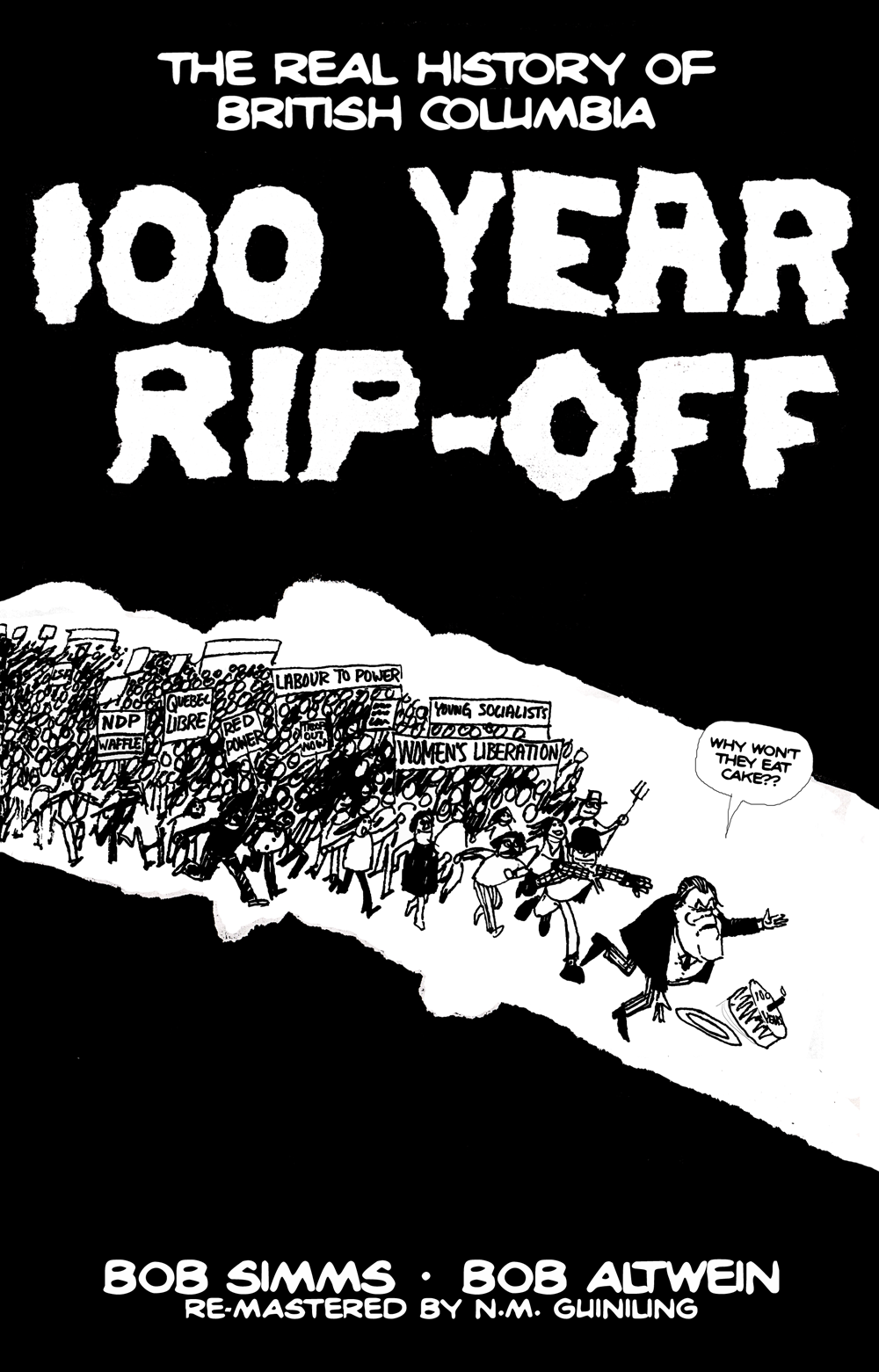
Thank you to everyone who participated in our Indiegogo campaign to re-release “100 Year Rip-Off: The Real History of British Columbia”.

We successfully raised enough money to cover most of the printing costs! Which is fine by me–as we raised $500 more than I was expecting.

This means 100 Year Rip-Off will be getting back from the printers in September, and will be ready to distribute and sell at retail shops across Canada.

From the bottom of my heart, I thank each and every one of you for your generous support. As comic books rise in popularity and cultural relevance, it’s work like 100 Year Rip-Off that show us a long tradition of using comic books for education and social change.

I hope you all enjoy your copy/copies as they arrive at the end of September. For those of you who ordered larger numbers or are receiving a map in addition to the comic, be on the look-out for a larger shipping parcel. For orders outside of the U.S. and Canada, your shipment may be slightly delayed–but should arrive nonetheless by the end of September, as promise.

For those of you interested in keeping in touch, please follow me online!

I apologize for the lack of updating on the website–crowd-funding actually left me feeling a little exhausted. Hopefully content will be flowing at a normal pace really soon.
Facebook Page: https://www.facebook.com/AdAstraComix?ref=hl
Twitter Account: @AdAstraComics

Cheers everyone! Thank you once again, and have a terrific long weekend!

N.M. (Nicole Marie) Guiniling
nicolemarieguiniling@gmail.com

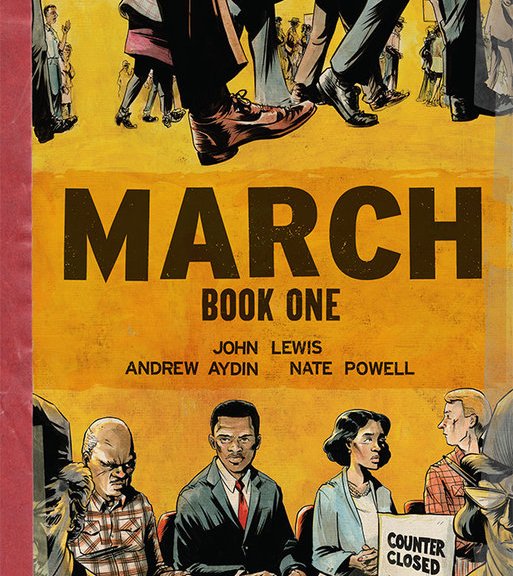
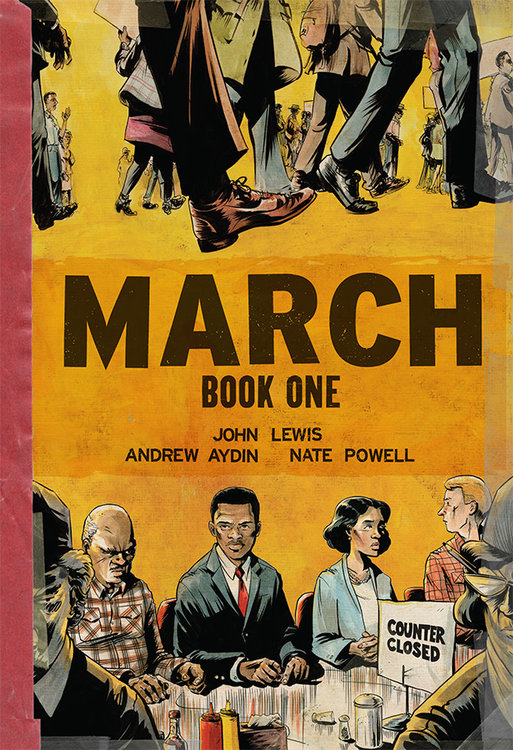
Review of “MARCH: Book One”

March_cover

Title: MARCH: Book One
Creators: John Lewis, Andrew Aykin, and Nate Powell
Published: August 2013 by Top Shelf Press

March: Book One is the first part in a trilogy graphic memoir detailing the life and times of Civil Rights activist and Congressman John Lewis.

Growing up in the United States, you’re led to believe that you learn all there is to know about the Civil Rights Movement in school. You learn about Martin Luther King and Rosa Parks and the Montgomery Bus Boycotts; you learn about the most famous American speech of the 20th Century: “I Have a Dream”.

In a recent article shared through the Zinn Education Project, historian and black activist Bill Fletcher Jr. describes the method by which certain moments and people in the Civil Rights movement have been “mythologized” and “sanitized“. And boy, has our understanding of this history been manipulated! We would be led to believe that forces of the status quo in the 1950s and 1960s–from local police departments up to the President’s office–supported non-violent forms of protest; that racism and racists were isolated to the masses of simple folk in the South.

Of course, the result of this is that students are not understanding the context of these important pieces of history. That is why I’m hopeful of a book like March making its way into classrooms… students deserve a broader view of these issues than what will be allocated to them in 2 or 3 paragraphs of a standard-issue textbook.

As John Lewis, Andrew Aydin, and Nate Powell so eloquently show us in March, this was not the case. The Civil Rights movement was a bloody, uphill battle. The struggle and its gains were not the results of a few actions by those now famous historical figures: the movement moved by way of thousands of committed activists, many of whom were students.

This is a truly beautiful comic book that paints a portrait not just of a man (John Lewis was one of the leaders of the Student Non-Violent Coordinating Committee, and is now a Congressman; he is also the last living person to have given a speech alongside Martin Luther King on Aug 28, 1963). It paints a vivid portrait of a movement that you think you know, but maybe, possibly, probably don’t. Why was non-violent civil disobedience so radical at the time? Why were there rifts between the younger activists and the older black leadership–figures like Thurgood Marshall? How was the Civil Rights movement connected to religious groups? To the labor movement?

Nate Powell has a way of making every picture personable–crisp, yet dreamy, with solid black ink brush strokes complimented by dabbles of watercolor staining. And Andrew Aydin, who works on Congressman John Lewis’ staff, has obviously been instrumental in taking the vast treasure trove of information that is John Lewis’ life experience, and organizing it into an epic memoir. I particularly like the stories that attest to his core character, like growing up on an old sharecropper farm, wanting to be a preacher and practicing his talks on his chickens. These are wonderful stories that bring out the humanity behind the political battles.

These are the stories from the Civil Rights Movement that, I believe, reclaim the history and restore its heart and soul. You can’t learn about a protest movement from a government-sanctioned textbook.. they’ll make you think the whole thing was their idea. And although Congressman Lewis is now a part of that system, well… how he got there will be explained in the next two books of the trilogy.

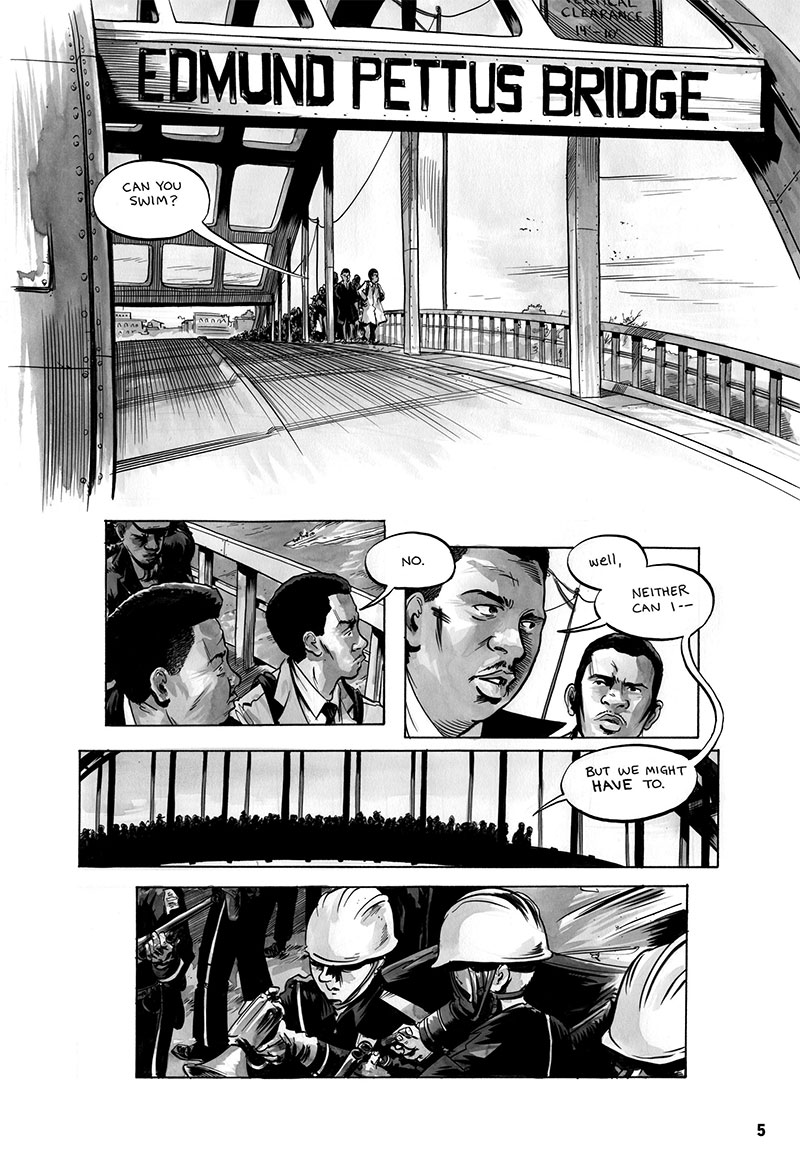
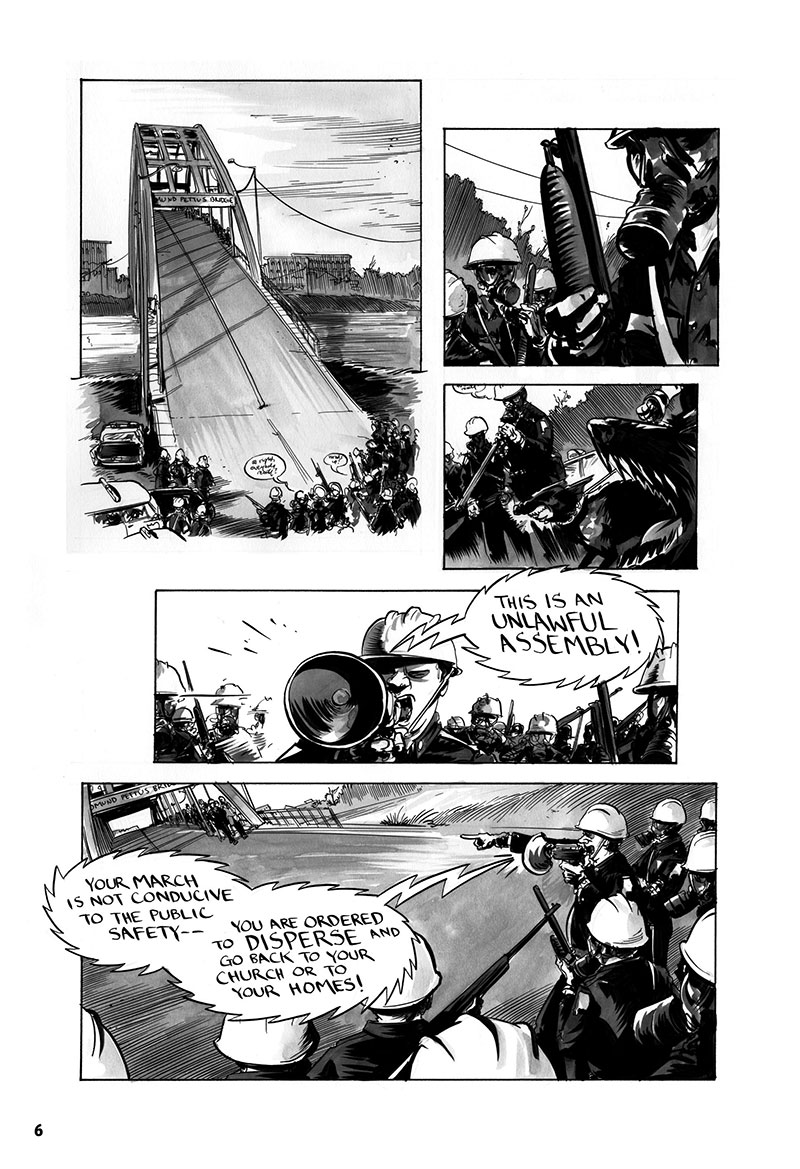
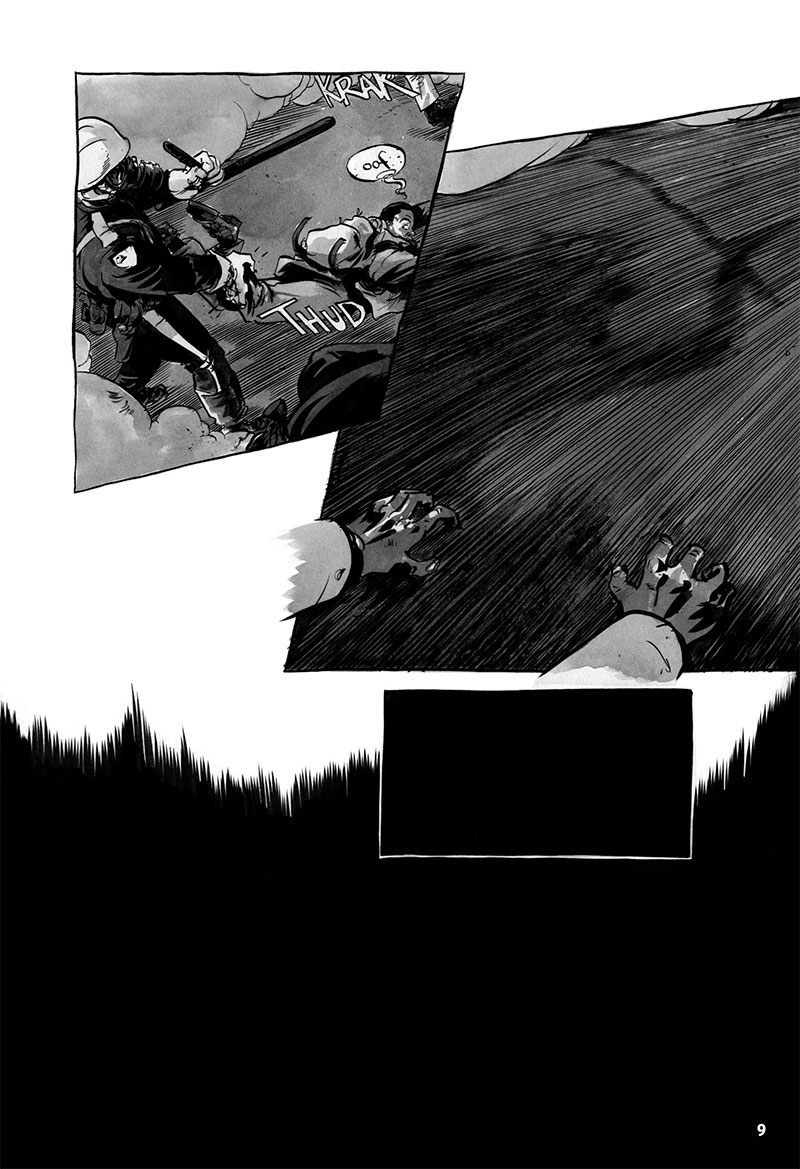
I’m excited about what I’ve seen so far–this is an often raw, ugly–yet true history of the Civil Rights Movement in the United States. To get a glimpse of this, I’ve asked the kind folks at Top Shelf to show you the first five pages of March. I hope you see what I mean–and be sure to pick up a copy when you get the chance!

March_cover

March-interior-hi-res-5 March-interior-hi-res-6 March-interior-hi-res-7 March-interior-hi-res-8 March-interior-hi-res-9

the panel is political.