All posts by adastracomix

We produce, publish and promote comics with social justice themes! Visit www.adastracomix.com for more.

An Up-to-Date Listing of Comics on Israel & Palestine

Ad Astra Comix is pleased to provide an up-to-date listing of comics, graphic novels, and “bandes desinees” about Israel and Palestine. As a part of our growing interest in political comics education, we offer this information as a useful resource, and do not necessarily condone or support all the various viewpoints expressed in the following books. 

by José Gonzalez and NM Burton

palestineTitle: Palestine
Author: Joe Sacco
Published: 1993 (First Edition). Single volume edition published in 2001 by Fantagraphics, currently on its 14th or 15th printing.As a comics journalist, Joe Sacco visually documented his travels through the West Bank and the Gaza Strip in a first-hand account of the people of Palestine. Over the past 20 years it has become, hands-down, the most lauded example of a comic depicting the reality of Israel-Palestine tensions. Sacco’s travels in between late 1991 and early 1992, mixed with comic-rendered flashes of significant historical moments, serves as a great primer to a history and conflict often misunderstood in the West.

* * * * * * * * *

footnotes in gaza

Title: Footnotes in Gaza
Author: Joe Sacco
Published: 2009 by Metropolitan BooksA follow-up to Palestine, this work was released in 2009 documents Joe Sacco’s quest to discover the truth behind the events in Khan Younis and Rafah in November 1956, when Israeli forces were responsible for the deaths of nearly 400 Palestinians. Using largely first-hand Palestinian oral testimony, the comic chronicles the people met and interviewed during his travels, which gives shape to a dark history some 5 decades old. History and its revisions are explored as Sacco’s depictions of the stories told by each interviewee sometimes conflict and circle around the truth of why those Palestinian people were killed.

* * * * * * * *

sarahglidden_howtounderstandisrael

Title: How to Understand Israel in 60 Days or Less
Author: Sarah Glidden
Published: Vertigo (2011)What started off as a Birthright tour to Israel, special tours to help nurture a personal relationship with Judaism, became a challenging journey of personal discovery for Sarah Glidden. She traveled through many popular destinations like Tel Aviv and Jerusalem, though the most striking voyage is her unescorted trip to the West Bank, forcing her to ask serious questions of herself and her identity.Glidden has explained that she found herself discarding many pre-conceived notions that she had about Israel/Palestine before leaving North America.

* * * * * * * *

*

*

jerusalemTitle: Jerusalem: Chronicles from the Holy City
Author: Guy Delisle
Published: Drawn & Quarterly (2012)Another travelogue, this one situated entirely in Jerusalem as comics journalist Guy Delisle documents the life of his family who have travelled there as part of his partner Nadège’s work with Médecins Sans Frontières (Doctors Without Borders). Situated in the eastern part of Jerusalem, Delisle finds himself situated on the precise ground of conflict detailing the lives of people on land with a disputed border and what it means to revere a sacred city.

* * * * * * * *

*

*
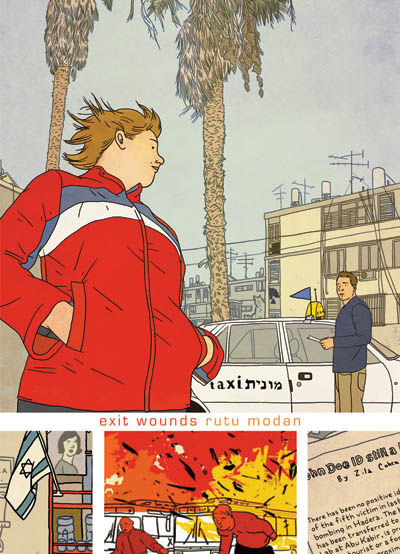
exit wounds

Title: Exit Wounds
Author: Rutu Modan
Published: Drawn & Quarterly

Exit Wounds is Rutu Modan’s first full-length graphic novel, and tells an intricate story of a cab driver living in Tel Aviv who is suddenly faced with the possibility that his father has been killed by a suicide bomber.

Joe Sacco has helped open North American readers up to Modan’s complex and beautiful work by describing Exit Wounds as  “a profound, richly textured, humane, and unsentimental look at societal malaise and human relationships and that uneasy place where they sometimes intersect.”

* * * * * * * *
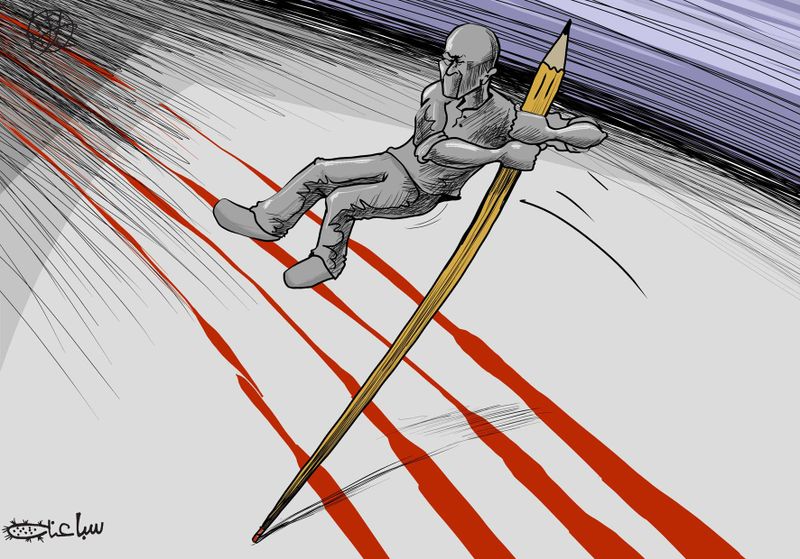
thin red lines

The works of Mohammad Saba’aneh

Though perhaps most known for being imprisoned for five months in Israel from February 2013, Mohammed Saba’aneh’s cartoons have been featured in newspapers throughout the Arab world and he’s had exhibitions in the United Kingdom, the Netherlands, Switzerland, and Jordan. His most recent exhibition, Cell 28, centres on his time in that Israeli prison. Much of his work describes a deep cynicism towards offers of peace coupled with a generally critical view of Israel.

"Arresting Mohammad Saba'aneh" - cartoon by Sherif Arafa. Photo courtesy of Cartoon Movement - click to visit site for a larger image view.
“Arresting Mohammad Saba’aneh” – cartoon by Sherif Arafa. Photo courtesy of Cartoon Movement – click to visit site for a larger image view.

hamas in comicsTitle: Hamas in Comics: Terror and Tyranny in Gaza
Author: Israeli Defense Force (IDF)
Published: 2013

Produced by the Israeli Defence Force (IDF), this comic book introduces young readers to Hamas through the eyes of the Israeli military.  A prominent example of a comic being used as political tool to shape the mindset of children, it also provides a unique glimpse into how the Israeli military envisions its own role in the conflict. Hamas in Comics draws striking parallels with comics you would be more likely to see in WW2-era North America (a time period not often considered to be the most enlightened when it came to representing non-American cultures).

* * * * * * * *

*
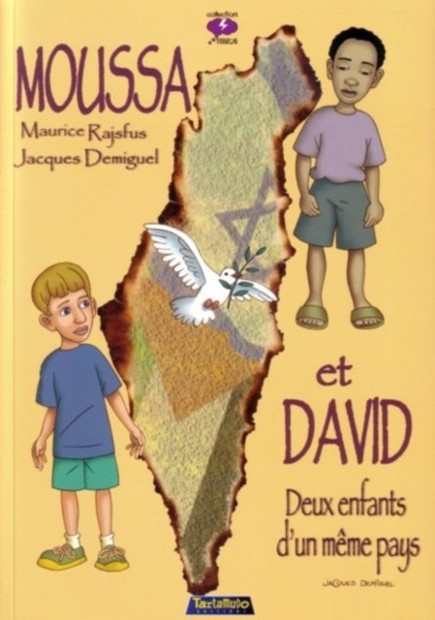
Moussa et David

Title: Moussa et David: Duex enfants d’un meme pays (two children of the same country)
Author: Maurice Rajsfus and Jacques Demiguel
Published: 2007 by Les Edicions Tartamudo (France)

A slightly different approach to a comic book aimed specifically towards children, this work by French Jewish historian Maurice Rajsfus tells the story of two boys who learn they have far more in common than their different religions might suggest. It serves as a lesson that those who are most innocent in this conflict may be able to show the rest how to solve the region’s problems.

* * * * * * * *

*

*
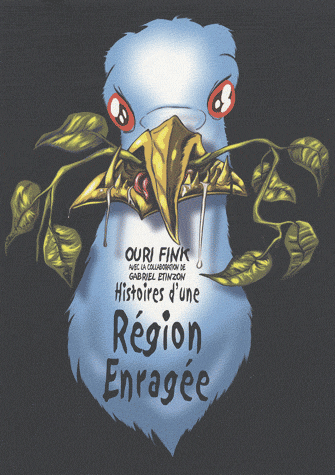
histoires

Title: Histoires d’une Région Enragée (Stories from a Raging Region)
Author: Ouri Fink
Published: 2008 by Gabriel Etinzon

Best known for his long running series Zbeng!, Ouri Fink’s collection of short stories targets political and religious extremists and satirizes them with a number of colourful comparisons. Some of the stories include “Hamas – the world’s mightiest moron versus the Rabbi ben Death” and “Humaus,” which borrows a device from Art Spiegelman comic Maus, but instead casts the Israeli settlers as the cats and the Palestinians as the mice. Fink’s refreshing use of humour sets his work apart from most other somber additions to this category of comics.

* * * * * * * *

*

Farm 54Title: Farm 54
Author: Galit and Gilad Seliktar
Published: 2011 by Ponent Mon S.L

This semi-autobiographical collection of short stories follow a young Israeli girl, and eventually a woman grown, named Noga. The conflict between and Israel and Palestine is muted to Noga during her childhood, but gradually as the stories move forward to Noga’s mandatory military service where she is most directly confronted with the reality of the conflict when she is compelled to take part in a forcible evacuation of Palestinian houses. Created by the brother and sister team of Galit and Gilad Seliktar, it provides a counter-narrative from within Israel that humanizes their closest neighbours.

* * * * * * * *

*

Signals from Gaza and other Webcomics by Samir Harb
Source: http://www.c-left.blogspot.ca/

This webcomic is one of the few examples of a comic from a Palestinian, due to the scarcity of jobs for comic artist in Palestine. Based on a true story, it follows an American Palestinian family trying to build a home in the West Bank. The challenges of maps is brought into focus as the very lines on each map make placing a home so difficult, with the slightest breach in a line being seen as a form of aggression. Considering the story is literally about lines drawn on paper, it makes a comic the perfect medium to explore this, and other disputes on where Israel ends and Palestine begins.

First panel of "Signals from Gaza" - click to be taken to Samir Harb's website.
First panel of “Signals from Gaza” – click to be taken to Samir Harb’s website.

najiThe Political Cartoons of Naji al-Ali

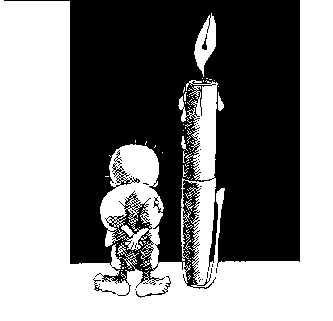
Of all Palestinian political cartoonists, the most influential is arguably Naji al-Ali, not only for the impact of more than 40,000 cartoons that he drew in his lifetime, but for the creation of the Palestinian characature and icon known as “Handhala”. Handhala has had a life and history for decades, depicting a 10-year old Palestinian boy, shoeless and in shabby clothes, with his hands behind his back. Al-Ali has explained that he symbolizes both himself (he was ten when he was forced to leave his homeland), as well as a number of general principles, including an allegiance with the poor and an unwillingness to have problems solved by external forces. Like any who saw it first-hand, Handhala became the iconic witness of the Israeli occupation. And like Handhala, al-Ali insisted he would forever remain a child until he was able to return home to Palestine.

On July 22, 1987 Naji al-Ali was shot in the face outside the London offices of al-Qabas, a Kuwaiti newspaper he worked for. He died of his wounds 5 weeks later.

His is one of the truest examples of the power of political comics to move, inspire, shake up, and frighten those who see them.

Further Reading:

Panels for Peace: Contributions of Israeli and Palestinian Comics to Peace-Building. Chantal Catherine Michel.
http://www.quest-cdecjournal.it/focus.php?id=332

Previous Crowdfunding Projects

As part of our expanded Promotions section, we will be bringing together a monthly digest of political comics from around the world, in search of support. Here is a listing of past crowd-funding projects that we have publicized. 

Content compiled by Amy Miller and N.M. Guiniling


Title: Freaks’ Progress
Author: Gretchen Hasse
Crowdfunding on: Indiegogo

freaks progressFreak’s Progress is twenty-first-century take on the morality play, a traditional theatrical form that demonstrated morally and socially correct behavior. Hasse’s goal is “to explore the deep heterogeneity we live with, and how that heterogeneity can create both deep understanding and radical confusion,” based on her “experiences as an artist, educator, social justice advocate, and resident of urban neighborhoods in transition.”

Hasse has an extensive portfolio of her work available on her website.

This project is accepting funds through the end of the year.

http://www.indiegogo.com/projects/freaks-progress
Title: Digitize History Comics for Reluctant Readers
Author: Bentley Boyd
Crowdfunding: On Kickstarter

Digitize HistoryStarting in 1995, Boyd has been adapting stories of United States history into comics featuring a Chesapeake Bay blue crab named Chester. Originally, the strip syndicated in Virginia with the goal to encourage voluntary non-reading children to engage with history. Now, Boyd seeks funding to digitize his entire collection to make them available to everyone.

During this digitization project, Boyd is also planning to expand on Chester’s adventures through American history by adding more jokes, more details, and by providing links to on-line history resources.

This project is accepting funding through Dec. 27, 2013.


* * * * * * * * * * * * *


graphic noam promo image2

Recognize that chunky sweater?! That’s right, folks–that’s Chomsky, in comic form!
On Indiegogo now is an exciting new political comics project. Click the image above to check out the campaign – or any image on this page, for that matter!

Writer and Illustrator Jeffrey Wilson and Luke Radl are putting together a graphic novel developed from an interview Wilson conducted with Noam Chomsky in 2012. For those familiar with Chomsky, you may understand me when I say that he is a wealth of information that is perhaps difficult to take in all in one sitting. Most recently, I heard him interviewed on CBC Radio Q, on the topic of NSA and spying programs–and just as a side note, Chomsky mentioned a great deal of information with regard to COINTELPRO and the counterintelligence programs that waged war on progressive groups in the 1960s and 1970s. It’s a lot of history and analysis to take in in 10 minutes. And that’s why I think a graphic novel interpretation of Chomsky is so promising. In the words of the creators,

“We take the historical examples used and give them a depth that might otherwise be glossed over. For example, when Chomsky mentioned the Free Speech Movement of the 60’s during the interview, we do the research and take you back to that time period so it is not just a passing reference but a real and dynamic moment.  This work is important because it will offer not only an introduction to the thoughts and insights of Chomsky but the graphic novel form allows us to layer information and move the reader through time and space in unique ways.”

With that said, Wilson and Radl have a lot on their plates…. and that’s AFTER fundraising $15,000.

chicago protest

As for artwork, I can’t think of many other contemporary comic artists who could do better than Luke Radl. He initially got my attention on Cartoon Movement with his comics journalism coverage of the 2012 NATO protests in Chicago, in which members of Iraq Veterans Against the War, led by 3 young Afghan women and peace activists, marched to the gates of the summit. Veterans, in the fashion of the protest on the Washington Monument during the Vietnam War, threw their metals over the fence in one of the most powerful acts of protest I have seen against the war in the last decade. It was an incredible thing to see illustrated. His full portfolio can be viewed here: www.lukeradl.com/illustration

Donate what you can. Share where you can. This looks like a wonderful initiative.

graphic noam promo image


* * * * * * * * * * * * *

Terminal Lance on Kickstarer

the white donkeyJust came across what appears to be an amazing war comic project on Kickstarter. I highly recommend people check it out–if not to add to his already-attained goal–but to pre-order a copy of what is surely to become an incredible comic.
The White Donkey is the creation of Max Uriarte, an artist and US veteran who served on two deployments to Iraq. His regular web comic, Terminal Alliance, features often-funny shorts about army life. While not a military person myself, a lot of my closest friends (including my husband) are veterans–and the stories definitely ring true with what I’ve heard before.

There is richness in those stories that is baited with a bittersweet intrigue: war stories and military life draw just about every observer into it. And because war has a tendency to bring out both the best and worst in a human being, it will forever be a popular subject within all creative media.

Comics are no exception. In fact there is plenty of evidence to prove that comics pioneered a lot of the more realistic portrayals of war–I go into this at length in my post on Harvey Kurtzman, Two-Fisted Tales, and the birth of the anti-war comic.

Max is an incred

Comics with a Cause has just hit the $1,000 mark on Indiegogo. Let’s help them make this happen.

comics with a cause

News of this project totally hit me by surprise. My husband was the one to point it out to me- a new fundraising campaign for a web comic series, inspired by the question of “What men can do to end violence against women” launched by Rodrigo Caballero and his fiancee, Babette Santos in Vancouver last week. What struck me was that, not only did this project sound amazing, but that Babette–who I know completely outside of the world of comic books–was a bridesmaid at my wedding in Vancouver. What a small, wonderful world!
It sounds like this is going to be a pretty slick web comic with a great opportunity for it to be brought into print. The informative nature of the subject matter makes me happy that, once the initial funds are raised, there is no hindrance to anyone benefiting from its contents: a free web comic is a free web comic.

Through networking and contacts, Babette and Rodrigo have already drummed up a lot of initial support in the women’s rights community in the Lower Mainland– at women’s centers, shelters, and through advocacy groups. I think this project has the potential to do something amazing: please, instead of giving money to Gawker (a media company worth over $300 million) to see a 30 second cell phone video of my mayor smoking crack — support something positive. Support Comics with a Cause!

FIRST: Visit the Indiegogo campaign page!

NEXT: Check out their Facebook page for updates!

THEN: Follow them on Twitter at @ComicWithACause

ibly talented artist and storyteller. Check out his work, see for yourself, and consider pre-ordering.

* * * * * * * * * * * * *

Title: Prison Grievances
Project Platform: Kickstarter
Author: Terri Leclercq, (author and educator) 

"Prison Grievances" is a graphic novel of guidance for U.S. prison inmates in their efforts to file complaints and protect their rights. Written by educator, Terri Leclercq.
“Prison Grievances” is a graphic novel of guidance for U.S. prison inmates in their efforts to file complaints and protect their rights. Written by educator, Terri Leclercq.

This project is not to create a book for a regular readership. Prison Grievances is written specifically for inmates of the U.S. prison system, fundamentally focused on education and empowerment. The book, reviewed by people at all levels of the prison system from judges to former inmates, details the step-by-step process for filing complaints with the court system, requesting a special piece of equipment due to a disability–whatever the case may be.

While this book may come across as little more than a practical tool for someone in a different situation than you, it serves a great purpose. The fact of the matter is that 1 in 12 Americans have been in the prison system, and over 2 million people currently sit in jail cells–that’s more prisoners than the People’s Republic of China (which, by the way, still has more people than the U.S.) Anyone who still thinks that the prison industrial complex isn’t a problem should do some more reading on the matter – maybe start with Shane Bauer’s recent heart-wrenching article in Mother Jones: “Solitary in Iran Nearly Broke Me. Then I Went Inside America’s Prisons.”

Leclercq has taken the right approach in tackling this titanic challenge that we face as a society (whether we admit it or not–prisoners becomes ex-prisoners, who are then our co-workers, neighbours, and fellow citizens), and is attempting to hand these men and women a valuable tool. If this project speaks to you, please check out the pitch page and make a donation.

* * * * * * * * * * * * *

SAT, Dec 21st: Open House & Solstice Party

Hey Folks!

If you’re in the Toronto area you are cordially invited to Ad Astra Comix’ Open House and Solstice Party taking place Downtown on Saturday, December 21st. We think it’s probably the best way you could spend the darkest night of the year.

As many readers already know, Ad Astra doesn’t actually have a storefront, but we do have access to a local community space called Soybomb – which has, for the past decade, been a home for independent music and culture in Toronto. Food and drink will be available by donation – and all Ad Astra stock (comics, books, posters, etc.) will be 10%-20% off. So if you’re in the city, you probably shouldn’t miss it!

Here’s our poster. Please feel free to post and share with your social networks. A Facebook RSVP Page has been set up here.

leaflet_no_info

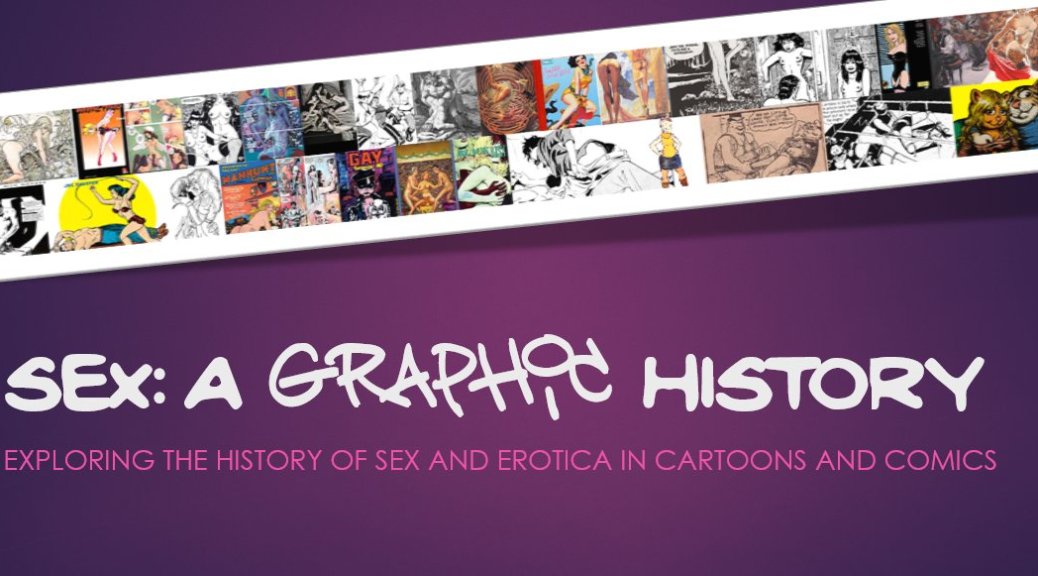
SEX: A Graphic History

Comics, cartoons, and sex in art & literature carry a special kinship. Both have historically been taboo, “low” in status as genres of art; both have been avenues by which to mock and satirize the powerful… and underneath, despite it all, both have an almost universally popular appeal.

Presenter Nicole Marie Guiniling on the history of comic erotica - Toronto, 2013
Presenter Nicole Marie Guiniling on the history of comic erotica – Toronto, 2013


On November 24, we had a series of back-to-back workshops at Ohhh Canada’s new storefront on Queen West on the history of comic book erotica, exploring the long-standing relationship of sex in comics and the related struggle of freedom of expression that has come along with it.

For anyone who joined us for the workshop, we’re providing a list of links and references for further reading, along with a showcase of some of the books we’re carrying as a part of this section of our work. Enjoy!

FURTHER READING

Erotic Comics:
A Graphic History from Tijuana Bibles to Underground
Tim Pilcher (Author), Gene Kannenberg (Author),
AlineKominsky-Crumb (Foreword)

Erotic Comics 2:
A Graphic History from the Liberated 70s to the Internet
Tim Pilcher (Author), Gene Kannenberg (Author), Alan Moore(Foreword)

“What is Erotica and What is Pornography?”
http://h2g2.com/approved_entry/A2163070

Lost Girls, by Alan Moore (author) and Melinda Gebbie (illustrator). Top Shelf Press, 2002.

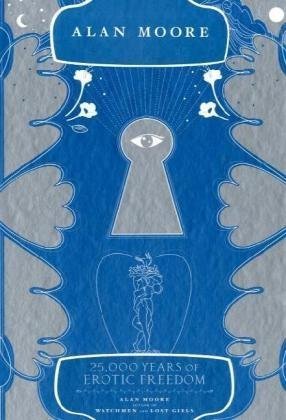
25,000 Years of Erotic Freedom, by Alan Moore (author), 2009. Harry N Abrams Books.

Eight sexy webcomics to read with the door locked
http://io9.com/5886302/eight-sexy-webcomics-to-read-with-the-door-locked

Slipshine: Cute, Fun, Sex-Positive Erotic Comics –
Small fee for subscribing.
www.orgymania.com
Oh Joy Sex Toy! Reviews and Sexual Health by Erika Moen
www.ohjoysextoy.com


Zizki –Webcomic Erotica Galleries (Free)
http://zizki.com/comics/

This INCREDIBLE 2x3 ft poster is "Sexy Times" by Erika Moen and Lucy Knisley will be available, in limited supply during the workshop!

SecretIdentity

Title: SECRET IDENTITY:
The Fetish Art of Superman`s Co-creator Joe Shuster

Author: Craig Yoe, with an introduction by Stan Lee
Artwork: Joe Shuster
Published:  Abrams Comic Arts, New York (2009)

It is a well-known fact in the comic world that the original artist and co-creator of Superman died having earned only pennies on the dollar for his contribution to the world`s most famous superhero—the rights to the character were won by D.C. Comics in the 1940s. So what to make of this work in later years? He never signed his name to it, but the Nights of Horror illustrations that depicted lusty ladies, titillating torture, and all manner of mild S&M scenarios were in fact Shuster. What`s more?! The characters of these filthy booklets all look, at great deal, like one Clark Kent and Lois Lane… Find out more in this curious twist in the history of comics and erotic art.


LostGirls Title: LOST GIRLS (Combined 3 Volume Hardcover)
Author: Alan Moore
Artwork: Melinda Gebbie Published:  Top Shelf Productions (2006)

Writer Alan Moore and his partner Melinda Gebbie, both legends in their respective fields, teamed up for years in the early 1990s to produce a kind of comic and a kind of erotica that the world had never seen: sophisticated, politically and historically conscious, yet honest, human, and sensual.

From back of book: “For more than a century, Alice, Wendy and Dorothy have been our guides through the Wonderland, Neverland, and Land of Oz of our childhoods. Now like us, these three lost girls have grown up and are ready to guide us again, this time through the realms of our sexual awakening and fulfilment. Through their familiar fairytales they share with us their most intimate revelations of desire in its many forms, revelations that shine out radiantly through the dark clouds of war gathering around a luxury Austrian hotel. Drawing on the rich heritage of erotica, Lost Girls is the rediscovery of the power of ecstatic writing and art in a sublime union that only the medium of comics can achieve. Exquisite, thoughtful, and human, Lost Girls is a work of breathtaking scope that challenges the very notion of art fettered by convention. This is erotic fiction at its finest.”


EroticHistory
Title: 25,000 Years of Erotic Freedom

Author: Alan Moore
Artwork: Various
Published:  Abrams, New York (2009)

If there`s anyone who can put 25,000 years of erotic art into perspective, it`s Alan Moore. Infamous author of graphic novel classics like Watchmen and V for Vandetta, Moore is a fan of uplifting both comics and erotica into more highly respectable realms. Much as he has shown us the ability of a comic to be a work of literature, so too in this volume does he show us the long legacy of pornography being a part of our most meaningful and cherished works of human expression.  A moving read!

Book is hardcover with a gorgeous Art Nouveau decal, spotted inside with dozens of colour illustrations and photographs.


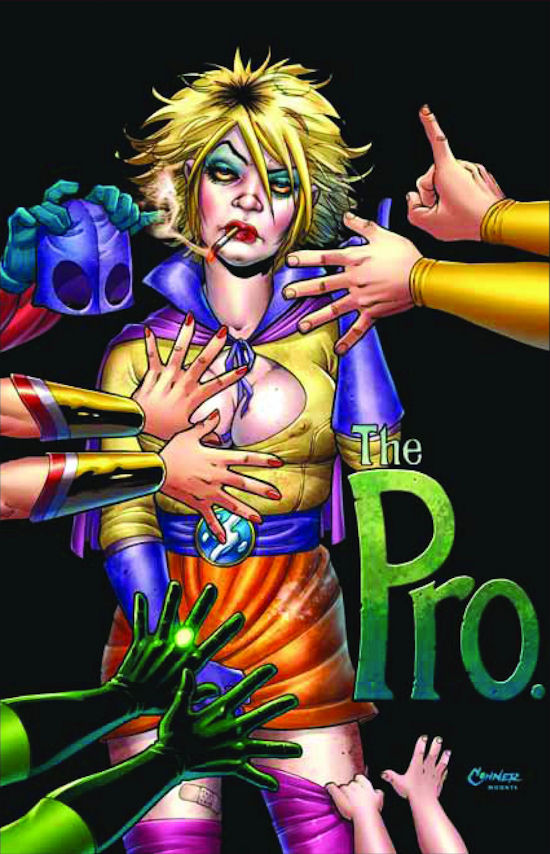
pro-comic-1 Title: The Pro Author: Garth Ennis Artwork: Amanda Conner, Jimmy Palmiotty, Paul Mounts Published:  Image Comics (May 2012) For those of us looking for the lighter side of sex in comics, meet the world`s first prostitute superhero. Superhero prostitute… whatever she is, she`s one hilarious, street-smart, trash-talking tough cookie. This is not only pushing the boundaries of what could legally be sold in an Image Comics title; it also playfully mocks the image of the superhero in the collective imagination—from the spandex,…on down.  As mainstream comics legend Gail Simone says, “This is the comic that Garth, Amanda and Jimmy will be apologizing for in Heaven minutes before being sent directly to Hell. But hey, if their eternal damnation is the only downside, then I demand a sequel.”


SexInc
Title: Sex Inc.
Creators
: Nico and Richard Gallo
Story: Stephanie Halley
Edited: Ezra Mark
Published:  Gary Groth and Kim Thompson, Eros Comix (April, 1998)

From the book: “In the year 2117, the prostitutes of Sex, Inc. attempt to make their living in the urban decay of a collapsed world. Confronted with the limitless fetishes and fantasies of a desperate and enslaved public, the girls attempt to fulfill every while pursuing Sex, Inc.`s personal goals.”

An incredible work of sci-fi erotica, published by two very big names in the comic world, Gary Groth and the late Kim Thompson.


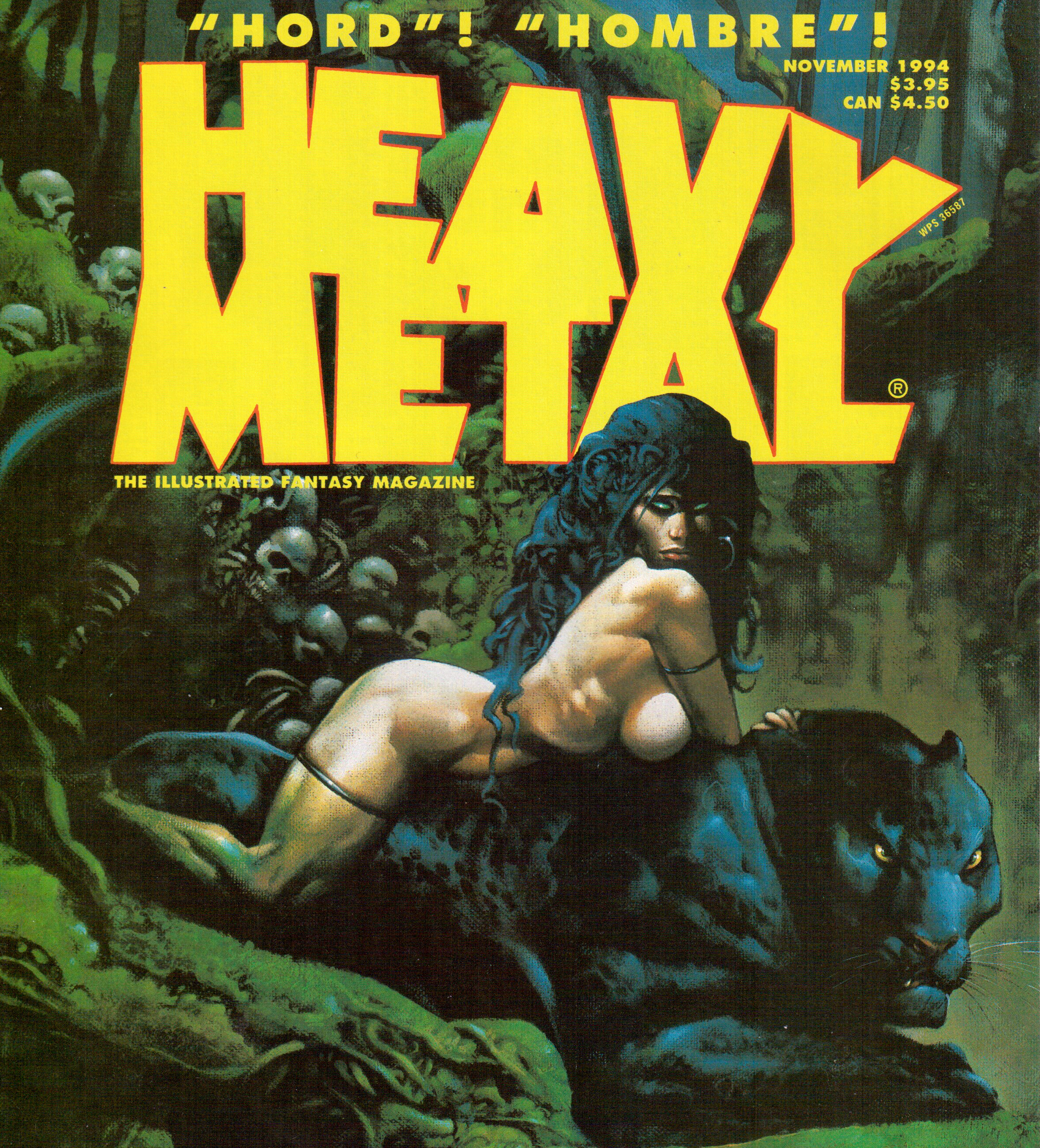
  HeavyMetalTitle: Heavy Metal Magazine
Authors: Various
Artwork: Various
Published:  1977-Present

Celebrated for over 35 years as a publication that welcomed new,  unique sci-fi / fantasy comics, Heavy Metal also welcomed a fair share of erotica, and was cherished as a space where artists could freely express something of a “no holds barred” attitude toward their creativity. Select back issue magazines are available.

The Struggle Continues: Kamala Khan and the Fight for Diversification in Comics

KamalaKhanThis week the comics industry juggernaut Marvel announced a new superhero stepping into their circulation.

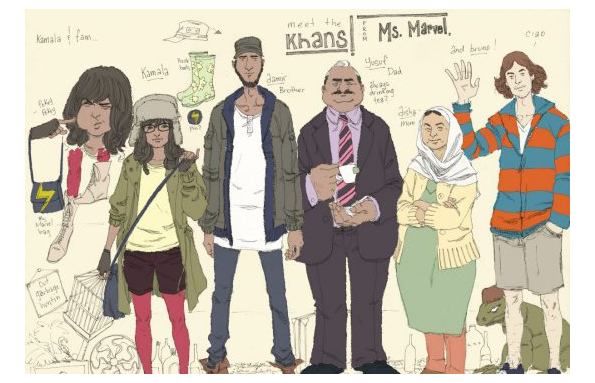
Kamala Khan is a young Muslim woman of Pakistani heritage, growing up in New Jersey. In an article this week in the New York Times about the new character, author G. Willow Wilson explains that she wanted the comic to be about a few things: “…about the universal experience of all American teenagers, feeling kind of isolated and finding what they are.” Wilson explains that this comes through the lens of Kamala being a young Muslim in America who struggles with her faith.

KhanFamily

The prospect of a new comic about this kind of character feels really promising. Even the art displays something new and comforting about it. I feel like Kamala could actually be a real person that I know. But aside from pointing out how Kamala will be different than previous Marvel superheroes, very little is discussed of her.

About a quarter of the article is taken up with examples of Marvel’s shoddy history of attempting to introduce minority characters. Thus if we are not already familiar, readers begin to introduce themselves to the battle against sexism and racism in the comic book world. Navigating the gauntlet of narrow editorial mindsets and penny-pinching fans… is seeing the underlying reality that most positions in the comic business are still inhabited by white men, and that this environment has often embarrassing and ugly consequences.

There are so many incredible examples of how working mostly with white men to create a comic universe comprised mostly of white men and male-idealized women can take its tole on your ability to even imagine diversification.

Mark_DanSome fun examples of this are instances such as DC Comics’ Dan DiDio in his outburst, now famous in the comic book world, at the San Diego Comic Con in 2011. When a member of the audience suggested that DC hire more women, DiDio emphatically responds, “WHO? Who should we hire? Tell me right now!” Let’s keep in mind that the suggestion came as a result of DiDio literally asking the audience what DC Comics should be doing to boost readership and reader confidence. As has been noted by many, if you actually listen to the exchange (an MP3 is conveniently available), you’ll note that DiDio’s response sounds less like a question and more like a challenge. DiDio continues to embarrass himself as an editor at America’s #2 comic publisher with actions like forbidding Batwoman authors from allowing the character, who is currently portrayed as a lesbian, to marry her partner. Superheroes are about self-sacrifice; they “shouldn’t have happy personal lives,” he explained to fans at the Baltimore Comic Con.

In August, 2013, comics creator Mark Millar was in the spotlight, particularly for his comments about the subject of rape in comics. “The ultimate [act] that would be the taboo, to show how bad some villain is, was to have somebody being raped, you know?” he said. “I don’t really think it matters. It’s the same as, like, a decapitation. It’s just a horrible act to show that somebody’s a bad guy.” Millar went on to boast that he “always likes to push it and see something [he’s] never seen before.” Monika Bartyzel’s response in The Week:

But Millar is wrong. We have seen rape in comics before, and we’ve seen it a lot. In fact, rape shows up repeatedly in Millar’s work (Wanted, The Authority, Kick-Ass 2), which echoes a longer tradition of rape suffered by superheroines like Black Cat, Ms. Marvel, and Rogue. Rape is no more an unspeakable taboo in comics culture, where the industry is overrun with continual sexual harassment and rape threats, than it is in real life.

Are we seeing a pattern yet?

Honestly, so much has been said about sexism in comics in recent years, comic creators have gone from ignoring it to denying it, to then claim it’s not their responsibility to change it.

Despite it being less of a publicly heated debate (perhaps because it’s more embarrassing?) we see this trend not only around gender, but around race. Brandon M. Easton, an African American animation writer, layed out the numbers in a Bleeding Cool article last year:

Clearly, breaking into Marvel or DC is insanely difficult and few people of any background manage to get close; but the fact that there are less than 3.0% of Blacks credited on all Marvel and DC titles as of June 2012 illustrates a serious problem that requires greater exploration.

Without necessarily trying to, Easton sums up a large part of the attitude problem facing society and the microcosm of the comic book industry. It is about racism specifically, but we can extract important lessons about all forms of systemic oppression:

In the U.S., it becomes a situation where some White people feel personally indicted as a racist and the burden rests on Black people to 1) prove racism still exists and impacts all of us, 2) explain the difference between a White person living their daily lives vs. the institutionalized system of racism, and 3) defend yourself against claims of “reverse” racism as the very mention of the issue means that you hate White people. Almost every online discussion of race boils down to these three arguments before it’s all said and done. And ultimately, nothing changes because some folks refuse to separate the system from their personal identity.

…So what does this all have to do with the fresh young Kamala Khan? Well, it could tell us that the mainstream comic book industry, despite some very old habits and mindsets, is trying to move forward.

Miles_MsMarvel…And yet.

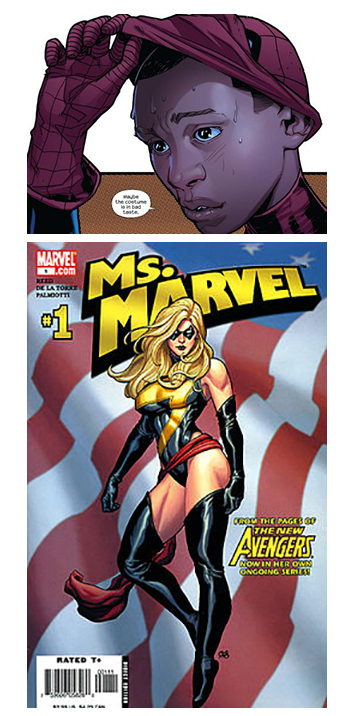
Khan appears to be her own superhero, when she is, in fact, going to become the new Ms. Marvel…Oh dear. Marvel and D.C. both have an embarrassing record of stuffing minorities–African Americans, women, and LGBT folk–into superhero characters that are already molded and defined as the characters of white men. Why is this a problem? To me, it boils race and gender down to pigment and body parts, and ignores the basic understandings of systemic oppression: that of a categorically different life experience. The idea that a Black Spiderman or a Ms. Marvel would carry on with the same missions and objectives as their white male counterparts, in essence, tells us what the comic creation establishment means when they huff and haw at accusations of racism and sexism: beyond pigment and body parts, we’re all the same. So why go out of our way to hire/include/portray minorities in comics?

Relatively speaking, I don’t think we are all the same. Perhaps a Pakistani Muslim superheroine like Kamala Khan would be concerned with American military drone strikes killing hundreds of civilians back home… Perhaps superheroes of colour would be more in tune with criminal behavior that has negatively impacted their communities or countries of origin, as opposed to some generic gangsters or bad men in suits?  And I can’t speak for all women, especially women superheroes, but perhaps a feminist perspective would *completely* change a superhero’s take on the world–its problems and its solutions.

What’s also enlightening, in the end, is the attitude of introducing diversity. “Fans respond with their dollars,” said Axel Alonso, the editor in chief of Marvel Entertainment, In the sense of margins and numbers, there is the logical fear that minority issues won’t connect with the majority and their wallets. As some of the most POWERFUL comics creators in the world said, “The comics follow society. They don’t lead.”

comicsPanel
Some leaders who apparently “don’t lead.”

I find that to be an interestingly defeated attitude for an industry’s top dogs. Any industry–but especially one with creativity at its core. And especially one so capable that it can put out a press release about the Muslim superheroine Kamala Khan on Monday, and have it picked up by two dozen major newspapers by Wednesday.

It seems to me that the biggest news the comic world can make these days is news of change.

Ultimately, the comic industry giants have yet to be able to overcome the major hurdles of sexism and racism, because they genuinely do not know how. Don’t worry guys, you’re not alone on that one. But until there is a comprehensive examination of racism and sexism, not as topics of sensitivity training, but as pervading systems of oppression in our society (with histories. with context) then we have little hope for the new characters being born, no matter how diverse they appear to be.

“Oil and Water” by Steve Duin and Shannon Wheeler


Title: Oil and Water
Written by: Steve Duin
Illustrated by: Shannon Wheeler
Introduction by: Bill McKibben
Published by: Fantagraphics (2011)

cover

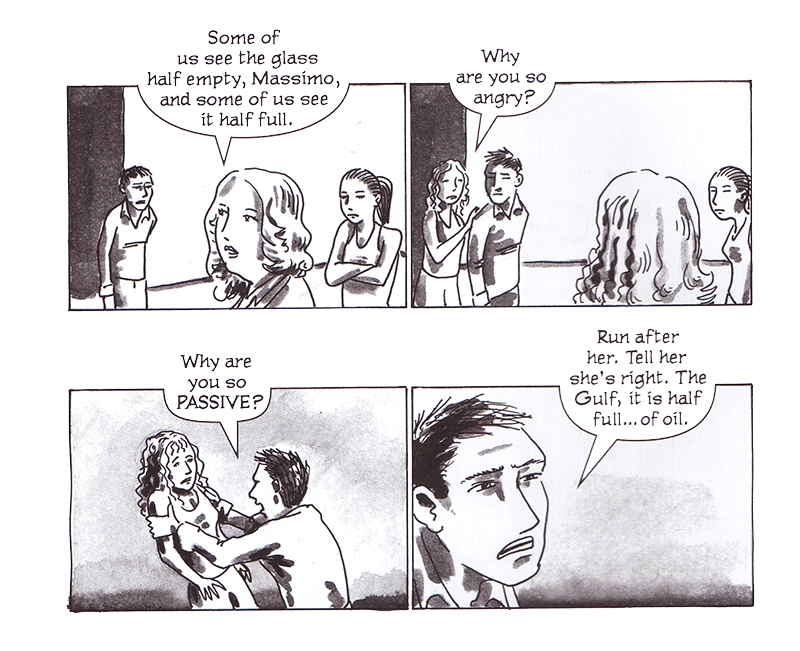
Oil and Water is a work of comics journalism exploring the impact of the 2011 BP oil spill on the coastal communities and ecosystems of Louisiana, through the eyes of a delegation of activists from Oregon.

Most of us probably know some about the disaster that led to the largest oil spill in human history. The deaths of 11 BP workers aboard the Deepwater Horizon and the following 87 days of petroleum gushing unabated into the Gulf was, to a group of progressives from Oregan, the calling they needed to visit Louisiana and bear witness–to the spill, yes, but perhaps moreso the larger and deeply troubling questions it posed: What are the real effects of ecological disasters? Are these disasters avoidable? Ultimately, in a world that is quickly running out of fossil fuels, is the disaster even the root problem?

deepwater horizonEven those of us who have looked at the greater implications may find it hard to fully understand the impact of the BP oil spill without a visit to the Gulf coast. This was, at least in part, the viewpoint of the Oregon delegation, which included writer Steve Duin and artist Shannon Wheeler.

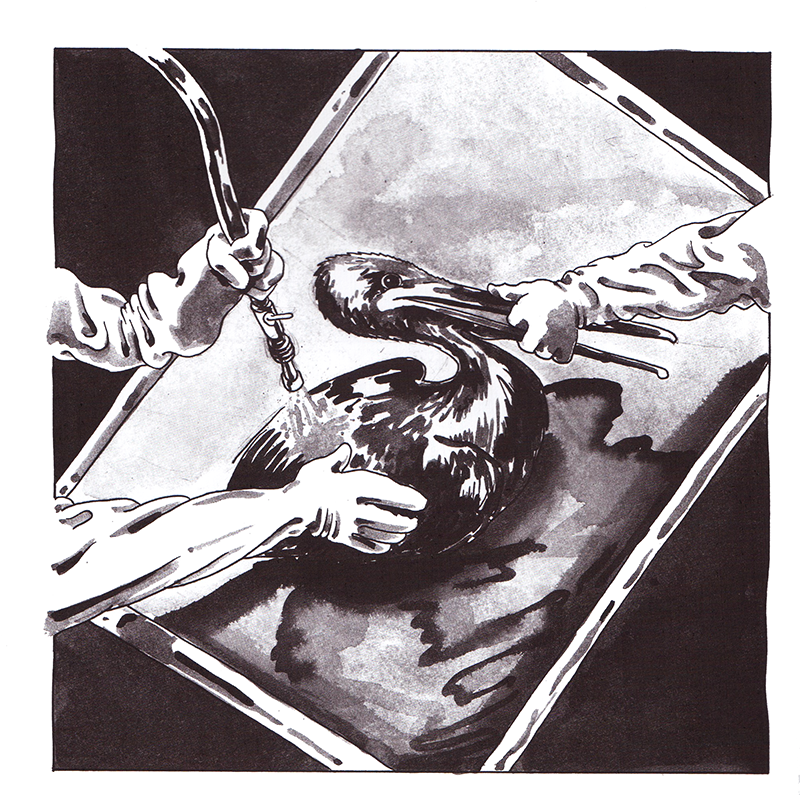
Profiles are drawn of the different personalities, from their flight into Louisiana until their last day, which certainly gives Oil and Water a ‘documentary’ feel. Scenes are intermissioned by small, 4-paragraph pages detailing some of the many troubling aspects of the spill, including BP’s record of cutting corners to save costs, or the devastation of the Gulf’s sea turtle populations.

The artwork is black and white, with sketches filled in with a patchy, dark watercolour stain, certainly intended to mimic the appearance of oil. For Shannon Wheeler, an artist who is arguably known more around the world for his series Too Much Coffee Man, it struck me a bit by surprise. The art overall has a sense of haste, giving me the impression that they were rendered not from photographs but from on-the-scene sketching–something that may or may not be true.

I am impressed with the changing of perspectives throughout the book. Duin seems to have really captured the thoughts and expressions of a number of trip participants and Louisiana locals, who voice their fair share of cynicism towards activists and outsiders parachuting into their neighborhood–seemingly a deja vu of the Katrina aftermath. In these sequences, we see members of the delegation change their way of seeing the world–and change their minds as to how they will act.Half_full


“Oil and Water” is a masterful collage of stories that, none to its detriment, only begins to scratch the surface of this tragedy. It would be a useful map of topics for someone looking for a starting point to the Deepwater Horizon disaster.

brown pelican

(Don’t) Join the Army, by Darren Cullen

North America: Why Aren’t you familiar with Darren Cullen? I think he’s right up your alley.

While his previous art, available for viewing on his site, http://www.spellingmistakescostlives.com covers other subject matter, his first published book, out October 17, is (Don’t) Join the Military – an absolute assault on the eyes that blends incredible artwork, political satire, and a dark sense of humour that had me thinking all through it that he must be a veteran.

jointhearmy_cover
Title: (Don’t) Join the Military
Author & Illustrator: Darren Cullen
Self-Published: October 2013
More Info: Darren Cullen’s Website: Spelling Mistakes Cost Lives

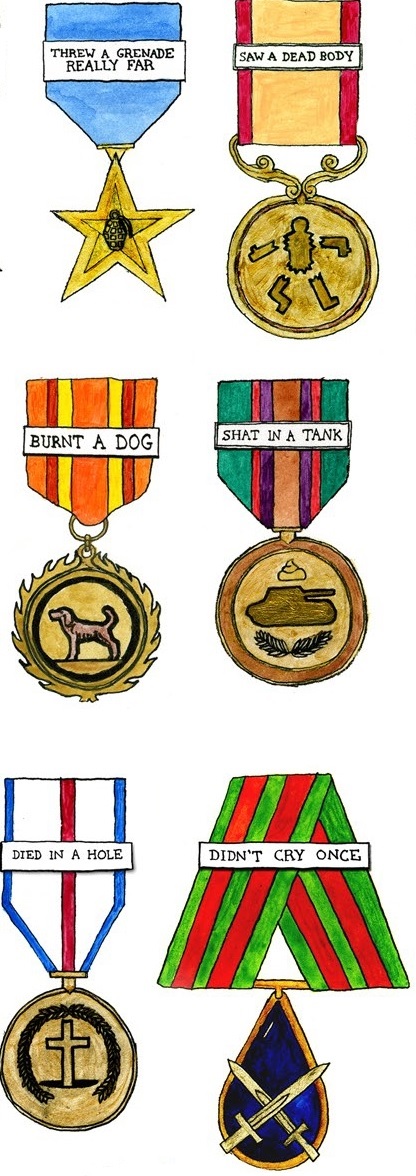
As the U.S. struggles with its ongoing war machine, here is a document that nips the syphoning of soldiers in the bud: at recruitment. Largely composed of content that mimics and mocks the recruitment-style propaganda, familiar to those of us on both sides of the Atlantic, Cullen juxtaposes biting humour (that will make you laugh out loud, as dumb as that sounds in a review) against images of war that can barely be reconciled: dismembered bodies, civilians being murdered, and soldiers having breakdowns.

The over-arching theme remains the lunacy of war, the ignorance needed to carry one out, and the level of lying and manipulation that must take place to market them.

burn down the sea

“I’m really interested in advertising and the gulf between the advert and the reality,” says Cullen.  “…and there doesn’t seem to be a starker example of that than when it comes to army recruitment. The adverts makes it look like a kayaking and abseiling holiday but if you join up you’re thrown into an actual hell on earth, forced to kill and be killed. It’s horrific.”

military_forces

If this were not all enough, there are lots of goodies stuffed into the booklet itself. Most notably, in my opinion, is the fold-out at the end–a jaw-dropping 3-4 ft insert that reminds me of a Mayan Codex… a fold-out expanse of war in its various dimensions, from recruitment to death.

scroll_selection
Just a small selection of Darren Cullen’s fold-out in (Don’t) Join the Army.

It need not be said that this kind of work doesn’t speak to everyone. Cullen has weathered quite a bit of difficulty just in finding a printer who would help him publish, due to the content–which I think is saying something in this day and age. But the offence is not so much to the violence, in my opinion. We see depictions of violence and war frequently. But this cuts into the insanity of advertising violence and war being sold to us as something other than what it is, and mocks it ruthlessly for being so blatant a contradiction.  It seems quite natural, in this context, that Cullen would point out, “I think the expectation and the reality [of the military] are so different, it’s a perfect subject for satire.”

medals_of_honour

Understanding Comics: The Invisible Art

 Understanding-Comics_00

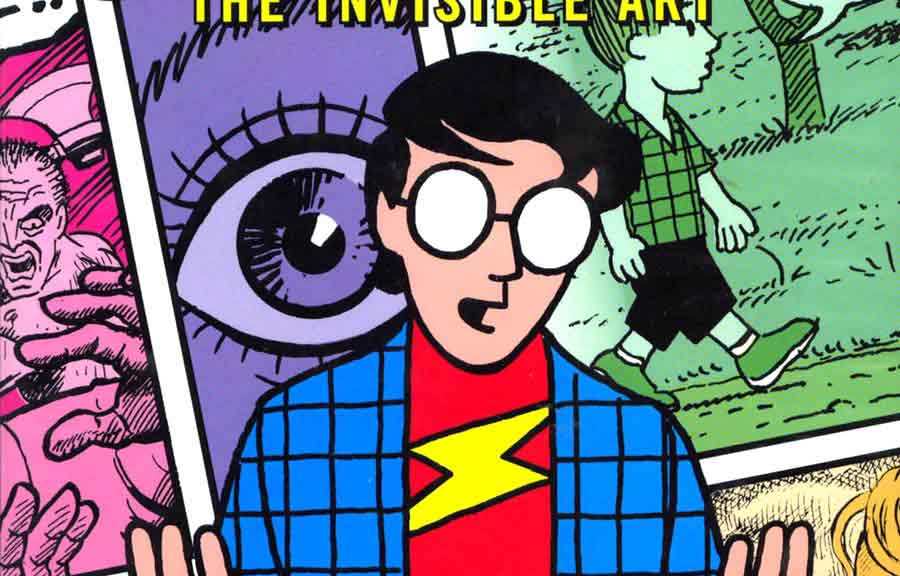
Understanding Comics – The Invisible Art is quintessential reading for those who appreciate comic books as a legitimate art form. It explores, with great authority, the method underlying the form of combining words and pictures in sequential art storytelling.

So what does all that mean to folks who don’t fall under the Art Nerd category?

Well, the ideas covered in this book can tackle some of the following subjects:

– Why comics, cartoons, and “sequential” art has been used for thousands of years
– Why the medium is accessible as a popular art form, as well as being capable of great sophistication
– Why film isn’t just “like comics, but better” – a favorite point raised by many comics afficionados including Alan Moore

Scott McCloud, who is creator of the both the book’s works and graphics, actually illustrates his theory and methodology as you’re reading about it–which is great for visual learners, and definitely drives home the points he is trying to make. What is more, the research is intensely thorough. Check out the chart on page 52-53 where he maps out the geography of the comic art universe, in which comics are located based on their varying gravity towards Reality, Meaning, and the Picture Plane.

mccloud-uc-triangle

symbolsDrawn images, McCloud points out, are all symbols, including the visual depictions of our languages. Yet written language is received, and is the process of training and education… whereas a drawing of a woman or a boat is perceived–that is, instantaneously understood as a representation of that thing. Comic arts, among other things, is a practice of reconciliation between these two distance cousins–an attempt to harmonize them in a way that only uses one sense–sight–to take it in, and yet professes all of our senses, and all perceived dimensions–including time.

So what does the typical comic reader get from reading Understanding Comics?

Aside from getting your mind blown about the abilities of the medium, Understanding Comics will truly help you to further appreciate decent comic art. It will help you to recognizing quality; it will help you to differentiate style, including cultural influences that you may not have previously noticed (Japanese comics, for example, are notably different in method than American or European comics, and this can be linked quite conclusively to a difference in values, philosophies, and methods of thinking.)

You may wish to pick it up as a map of what kinds of styles are out there, in terms of culture, style, time period. Or you may find it empowering to more deeply understand the comics you already know and love. Whatever the case may be, the book is a must-read for comics aficionados… and, arguably, those looking to understand why comics are once again on the rise.

For those who read and like Understanding Comics – you will probably want to check out McCloud’s next installment – Reinventing Comics, which takes the theory and method to the next level, and explores some of the new realms comics are tackling.

Scott McCloud also has a wonderful Ted Talk that combines the fundamentals of both of these books. Click on the image below to check it out in a new window.

scott mccloud

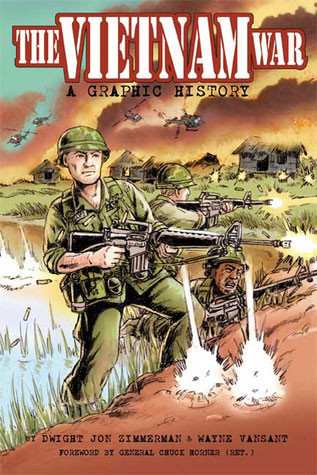
Re-Writing History: Review of A Graphic History of the Vietnam War

Some discussion has come up around Ad Astra Comix and a recent addition to our stock list– a graphic history of the Vietnam War. Not only does the book gloss over major historical events, like the Gulf of Tonkin incident (and the fact that it never happened, yet was a major cause for the war to escalate). The historical narrative, which has had 40 years of time for reflection, comes to some very troubling conclusions. As a new generation looks back on Vietnam as the war of their Grandmothers and Grandfathers, and as a generation that has been raised far too comfortably around operations in Iraq and Afghanistan being “business as usual, there is a serious need to dispel this re-write of history in the comic record. -NMG.

by Allen Ruff, guest contributor

A Little Background

As the U.S. aggression in Vietnam escalated in the mid-1960s, the liberal Cold Warrior Walter Rostow, an advisor to John Kennedy and Lyndon Johnson, spoke of the need of “winning hearts and minds” of the Vietnamese, at least those under the control of the US client regime in Saigon, if US force was going to prevail. As the barbarity of the venture — the toll in lives destroyed and the devastation exacted — spread, the invaders not only failed on that front in Vietnam, but also lost the campaign for political support, the battle for hearts and minds back in the States.
By the time this photograph was taken, public support for the Vietnam War had plummeted.

The war makers, of course, suffered a humiliating defeat despite their firepower. Failing to defeat militarily what was primarily a peasant-based anti-colonial and nationalist movement already decades old, it also lost the war on the political, ideological and cultural levels. Never having them in the first place, it never won the bulk of the Vietnamese people. The war machine murdered, maimed and debased too many and destroyed too much for that ever to happen. Those that survived, after all, were not about to buy the nonsense about “freedom” and “liberty” churned out by US propaganda specialists and parroted by a succession of corrupt, murderous regimes in Saigon. All the claims of the American “Free World” mission to save the country from “Communist Peril” rang hollow as that tiny land was scorched by what amounted to in a massive fly-by shooting.

Trang Bang, June 8th, 1972. A U.S.-Allied South Vietnamese air force plane dropped a napalm bomb on the village 26 miles outside of Saigon.
 Defeat in some sense became inevitable, a done deal, when the Washington war makers simultaneously lost large swaths of political support at home. They lost the battle of ideas, the claims and justifications, and explanations of what the war was about as the body counts and war costs mounted.
That loss of domestic political support for the war has never been forgotten, especially by those intent on winning future wars abroad who have come to view that home front defeat as a significant “lesson” of the conflict, not to be repeated.
In their ongoing efforts those still imagining that Vietnam could have been won and those already invested in current and future interventions have utilized every available means at their disposal to revise and reframe the  story. At that level, the portrayals and accounts in the popular culture – television and film, in music, art and print media, even the comic book press – have long been been utilized in the campaign to mold “hearts and minds”, especially among the young and the impressionable, the potential recruits and fodder for future imperial campaigns.
Few recent examples illustrate that fact better than Zimmerman and Vansant’s graphic rewrite of the Vietnam war’s history. Well-illustrated by the clearly talented Vansant and shrewdly scripted by Zimmerman to include the actual words of participants, the book in some ways has more to do with the present than it does with some approximately accurate portrayal of what the US did to Southeast Asia.

the-vietnam-war-a-graphic-history_1024x1024
Title: The Vietnam War – A Graphic History
Written by: Dwight Zimmerman
Illustrated by: Wayne Vansant
Published: New York: Hill & Wang, 2009. 143pp

Now, of course, it can be rightly argued that the writing and depictions of history are always selective and that all historians make choices and have an agenda, an axe to grind. and that a graphic history could not possibly be comprehensive in any sense of the term. That all remains true since the agenda of this rightward revision of the war on ‘Nam comes clear right in the opener, in the foreword written by the retired Air Force General, Chuck Horner.
A combat pilot during Vietnam, Horner later commanded the U.S. and allied air assets during Desert Shield and Desert Storm. According to the publisher’s boilerplate accompanying his account of the Gulf War co-authored with fiction writer Tom Clancy, he, Horner “was responsible for the design and execution of one of the most devastating air campaigns in history.”

Horner, in one page, casts Vietnam in terms clearly pitched to the novice, the young high-schooler or working class kid, perhaps.

“Like other wars,” he tells us, America’s war in Vietnam, “began with a premise of good versus bad and which was which depended on whom you side with.” Well, okay for the obvious, war as some shape shifting morality play.
He then proceeds to explain that, “As the conflict dragged on, those views changed into the reality of a dedicated, committed North Vietnamese enemy and the committed-but-not dedicated US led-coalition.” The implication is simple (and simplistic): The US and its junior “coalition” partners (Who they were, he doesn’t say) lost because they weren’t dedicated enough, didn’t have the endurance or the will to win. Or, by implication, one running throughout the book, that their determination was undermined not so much by the tenacity of the Vietnamese adversary but by the falling away of support at home.
He goes on: “President Kennedy had committed our nation, but then President Johnson instituted polices that lacked dedication.” Here, immediately, one of the main themes of the conservative accounts creeps in: the war came to be lost because the civilian leadership, especially the politicians back home lacked the guts and the determination to see it through.
Following Johnson, “President Nixon became dedicated to getting us out of our commitment (to whom or what, Horner doesn’t say), but at “great cost to our honor.” Apparently even Nixon, known during the height of the war as the “Mad Bomber,” is viewed by this former Air Force lifer as aiding and abetting the commission of that sin of sins among the military, dishonor. (In some sense Nixon ended up getting a dishonorable discharge, but not for the major war crimes for which he should have been tried.)
What might be drawn from all that? Horner lays it out: “Years later, in Desert Storm, our politicians and our military, remembering the lessons of Vietnam, set goals and conducted operations that deserved our unqualified commitment and dedication.” That matter of dedication and steadfastness, once again.
Horner then raises a second read on the history commonly forwarded by the right: “In the case of the Vietnam War, the divergence of political will and goals resulted in constraints on our military operations.”  Disregarding or not knowing that war is the extension of politics, he seems to suggest that the whole thing could have been “winnable.” If only the military didn’t have to fight with “one hand tied behind its back” and they weren’t “stabbed in the back” by the peace movement and their allies in the “liberal” media.
The old canards die hard.
Horner tells us, as well, that “our South Vietnamese ally’s leadership could not rally the dedication of its own people.” As venal, repressive and as illegitimate as the US-bolstered Saigon sham of a government was, could it have been any different?  Horner may think so, but few others versed in the history appear to hold that peculiar line.
The Good General asserts, in closing, that Zimmerman and Vansant have come together to present the history, “in a clear and comprehensible way.” He concludes his foreword by describing the work’s present day purpose: “It serves to enlighten those for whom Vietnam is only academic history, so that we may be armed against making the same mistakes in the future.”
Interspersed with occasional accounts of heroic efforts by troops on the ground, the bulk of the narrative is loaded with half truths and craftily retooled tellings.  Parts of it read as if it was selectively scripted by someone with the suppressed memory of a sleepwalking amnesiac.
This tale — an illustrated comic after all — might seem “comprehensible” to the novice, those unfamiliar. After all, if Vietnam was nothing but a series of mistakes made mainly by a civilian leadership at home, unwilling to fight to win, then a further mistake, perhaps, might be made by one looking to this work for some understanding, today, of what that criminal enterprise perpetrated against the people of Southeast Asia actually was about.

allen ruffAllen Ruff is a U.S. Historian, Social & Political Activist; Host, Thursday’s “A Public Affair” – WORT, 89.9fm, Madison, Wisconsin; & Writer of Non-Fiction and an Occasional Novel. You can find more of his writings on his blog, Ruff Talk.
Battle of the Graphic Biographies: Hill and Wang

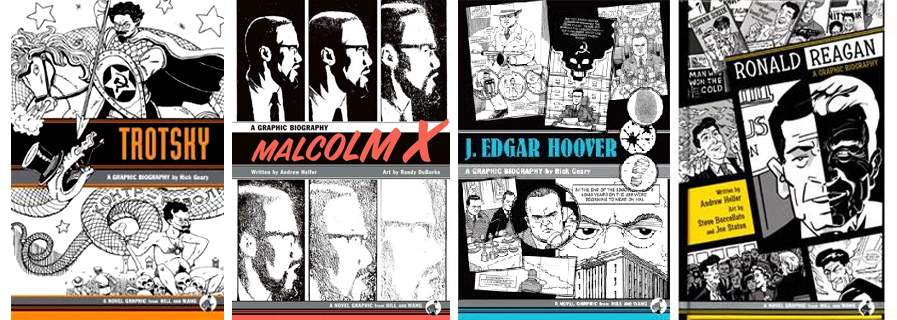
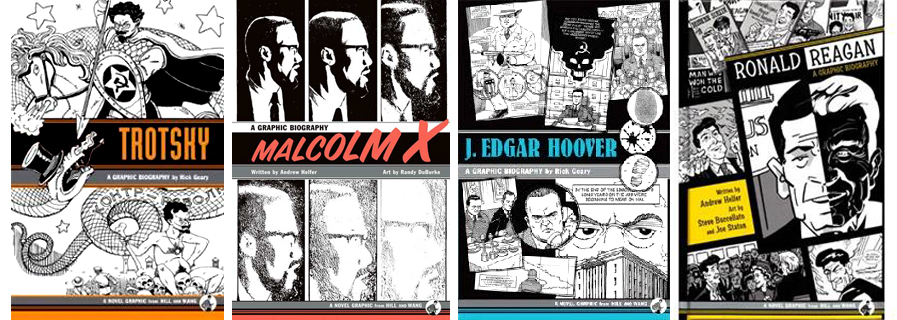
Continuing on with my theme “Battle of the Graphic Biographies” begun earlier this year Che Guevera, this month I’ve had a couple different titles at Hill & Wang take each other on– all a part of their Novel Graphics series. I, somewhat arbitrarily, began reading these books in chronological order: Trotsky, J. Edgar Hoover, Malcolm X, Reagan. My interest is obviously to provide some aesthetic feedback, but more to point out political strengths and weaknesses of the titles.

cover gallery
My first note is that each book appears to be politically tailored for the audience most likely to pick it up—the biographies speak more or less favorably of the people they spotlight.  But my questions going in are, “Do I better understand the person I’m reading about?” “Am I hearing of their life in their own words–while seeing an interpretation of events from a 3rd person?” “Is this historically/politically accurate?”

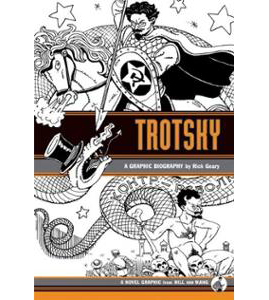
trotsky bio

Title: TROTSKY: A Graphic Biography
Writer & Illustrator: Rick Geary
Published: 2009

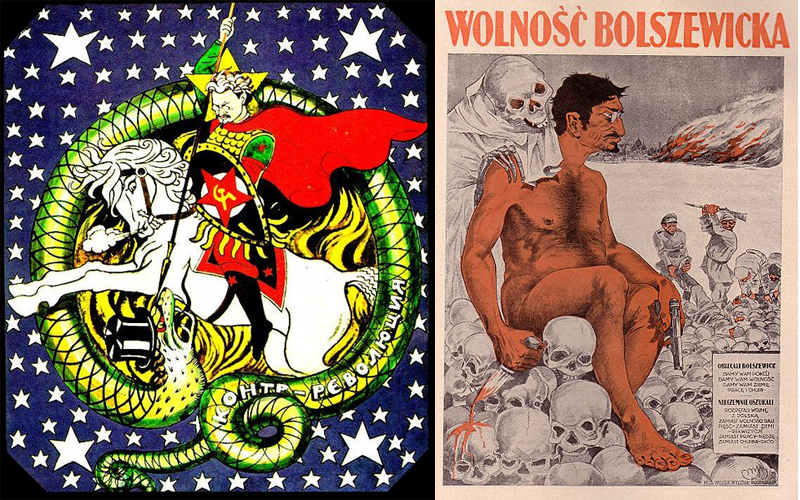
I had serious suspicions about this one, going in. Whereas the other book covers are more or less realistic, Trotsky’s is purely mythological. We see him astride a horse as some kind of atheist St. George–all the while he sits underneath, naked on a pile of human skulls. These images come from two very different interpretations of Trotsky’s role in the Russian Revolution–both over-zealous and emotional, both incorrect. While I appreciate the re-visiting of historical cartoons and illustrations, it seems necessary for me to make note of the the point that both graphics were commissioned by opposing governments during one of the most highly polarized moments of the 20th Century: the rise of the Russian Revolution.

The cover of 'TROTSKY (The Graphic Biography)' took inspiration from these political cartoons of the time. On the left, Viktor Deni, an author working for the Russian Soviet Federative Socialist Republic (RSFSR) in 1918, depicts Trotsky as St. George, slaying the dragon of "counterrevolution". On the right, Polish government anti-communist poster to counter Bolshevik propaganda from Russia during the Polish-Russian war 1920, showing People's Commissar for the Army Lev Davidovich Bronstein (Leon Trotsky). Large caption reads: "Bolshevik freedom."
The cover of ‘TROTSKY (The Graphic Biography)’ took inspiration from these political cartoons of the time. On the left, Viktor Deni, an author working for the Russian Soviet Federative Socialist Republic (RSFSR) in 1918, depicts Trotsky as St. George, slaying the dragon of “counterrevolution”. On the right, Polish government anti-communist poster to counter Bolshevik propaganda from Russia during the Polish-Russian war 1920, showing People’s Commissar for the Army Lev Davidovich Bronstein (Leon Trotsky). Large caption reads: “Bolshevik freedom.”

I think anyone who sees a book of 100 pages claiming to tell the life of Leon Trotsky is pretty much kidding themselves. Once into the story, you might be able to tell why: this man was a mover and shaker of continents, social structures and financial systems in a way that practically boggles the mind. In a time before television, let alone the internet and social media, Trotsky was world-famous for his ideas and his conviction to carry them to fruition.

This book, albeit abridging-ly, details his early years as a landowner’s son in modern-day Ukraine, a student activist and intellectual, his political development, his multiple exiles by the Russian Czar. It’s a whirlwind. In fact, it’s a struggle just to get all of these points down, without even going into what made Trotsky’s ideas so intriguing/dangerous, let alone his various roles in the the Revolution. Despite the obvious limitations, I believe Rick Geary does a stand-up job trying to pull together an epic biography that at least attempts to discuss serious politics.  Geary’s style lends itself well to the time period: a bit cold and minimalistic–but not cartoony. The line-work reminds me of borsch and cold, dry winters. In a good way.

I can’t really blame this book for what it isn’t–it’s not an in-depth biography of the Russian Revolutionary, in any sense. It’s not a clear history of the Russian Revolution either. But it will give you a crash course that may peak your interest, and lead you to other works about one of the most interesting men of modern times.

* * * * * *

malcolm x

Title: Malcolm X: A Graphic Biography
Writer: Andrew Helfer
Illustrator: Randy DuBurke
Published:  2006

Like Trotsky, Malcolm X is one of those four-letter words of the 20th Century. People alternately love and cherish or hate and fear everything that the man stood for. It really is a testament to the power of their ideas and the charisma with which they disseminated them.

Click to enlarge
Click to enlarge

Malcolm’s story has been told in epic fashion many times: there is the Autobiography of Malcolm X, as told to Alex Haley. Spike Lee’s “X” with Denzel Washington was an immediate classic. Once these essential biographies have been consumed, you believe that you know the man’s story. However this graphic biography, in fact, delivers additional information that even someone familiar with Malcolm’s story will find new and enlightening. Scenes I found most interesting included the details of his time as a hustler on the East Coast–as well as his final days in conversation with Nation of Island leader, Elijah Mohammed, whose candid remarks about women are better displayed here than anywhere else that I’ve read.

Malcolm’s entire life is characterized by a seemingly endless sense of change and evolution. In the end, the man who seemed tireless in his conviction, his self-confidence, was also likely his harshest critic. He went from being a pimp and a hustler to a raging animal in prison, a Nation of Islam preacher and black segregationist to working with whites when and where he could. And where we led, people followed. Because of his constant evolution, it is difficult for critics to demonize him. His radicalism has also made it pretty much impossible to water down his message–as has been done with Martin Luther King.

Of all the illustrators of this graphic biography series, I am in love with Randy DuBurke’s style. It is by far my favorite. He illustrates an emotion with what seems be a shadow-heavy photographic realism. Stylized but not cartoony, I even see some graffiti-stylized splatters in the background, that give it an additional grittiness. Given that author and illustrator are two different people in this work, I find their respective trades synching incredibly well.

* * * * * *

hoover bio

Title: J. Edgar Hoover: A Graphic Biography
Writer & Illustrator: Rick Geary
Published:  2008

Rick Geary is back after Trotsky with this graphic biography of FBI chief J. Edgar Hoover. Actually, this book was produced before the Trotsky one, but I’m going in some other kind of chronological order.

Unlike Trotsky and Malcolm X, I had never read a biography of Hoover before, although I was familiar with his role in Communist witch-hunting post-WWII, as well as his hand in the FBI’s notorious COINTELPRO counter-intelligence programs. What hadn’t occurred to me was the length of his office. The man was active in government from Emma Goldman… to Ronald Reagan. Think about that. Through half a dozen presidents. He was arguably the country’s most powerful civil servant. His ability to avoid partisan politics and harness the power of government bureaucracy, ironically, reminds me very much of his arch-nemesis Joseph Stalin. These two men dominated their countries with iron fists, using many of the same tactics, for much the same period of time. The key to both of their success was securing and mastering the administrative machinations of their positions.

While I see Rick Geary showing the light and dark of Hoover in this biography, he is at worst portrayed as a bit of a maniac who dabbled in unconstitutional activities for the protection of his dear country–and the all-sacred “American way of life”. We see the mass deportations of immigrant unionists, communists and radicals more as the shuffling of ants from one place to another outside the country–not the same brutal inhumanity with which Trotsky is depicted, sitting on a pile of bones.

Do I wish the comic would take a little more interest in how J. Edgar Hoover was a detriment to the country? The historical precedents of jailing and deporting descent, spying and wire-tapping, infiltration into progressive groups? Yes, in fact I can’t really think of any other singular man who probably committed more damage to democratic movements of the 20th Century than J. Edgar Hoover. But that’s my opinion on the matter–and Geary makes little to no effort to hide the evidence that would lead someone to those conclusions. He includes his very trouble remarks on communists, unions, student activists, black people–alongside the sea of other people that rubbed him the wrong way.

* * * * * *

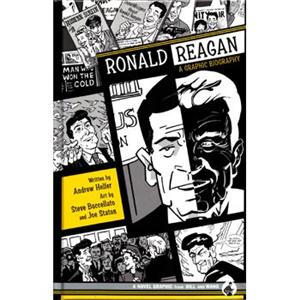
reagan

Title: Ronald Reagan: A Graphic Biography
Writer: Andrew Helfer
Illustrator: Steve Buccelleto and Joe Staton
Published:  2008

Of all of the graphic biographies, Ronald Reagan’s seems the most surreal. This is very much a theme of the book itself. Where was the threshold between Reagan the man and Reagan the actor? Reagan the actor and Reagan the politician? The book very much lends itself to the theory that there were no clear lines, even to Reagan himself. Acting was a part of him from a very young age, as were many of his political and moral influences.

Also more than any other comic in the series, this book relies very much on Reagan’s own interpretation of himself and his life–including instances like his student strike in university, which isn’t documented by the school–or his record 77 rescues as a lifeguard, even though there were many instances in those rescues where, hilariously, people apparently didn’t need to be rescued (THAT comic history vignette, I would love to see). More than many other American leaders, Reagan very much controlled what media and the public thought of him. That was his gift as an actor.

While there is some mention of his early days as an FBI informant, as a ‘friendly’ testifier in the mid-century Inquisition of American leftists and progressives, as well as his later involvement in the dismantling of unions, tax cuts for the rich, military intervention in Grenada… the underpinning theme Geary really seems to be driving home is Reagan’s mastery of the spectacle. It wasn’t really anything he did–and he did many things in his life–it was how he won support, how he charged through his competition and adversaries at the crucial moment. It wasn’t what he did so much as how slickly he was able to get away with it.

I find the artistic style of this work, shared by Buccelleto and Staton, to be my least favorite of the series. Faces and gestures are bubbly, cartoony, very “Leave It to Beaver”-ish, which works for Reagan but not for me. I feel like anyone who watched television during the last century knows this perspective of Ronald Reagan. So despite my distaste I understand perhaps why they went with it. Maybe, for all that time behind the camera, there really was no other way to see the man. He seemed to understand, at an early age, that public image is its own form of immortality.

* * * * * *

Of all the comics that I read, I enjoyed Malcolm X and J Edgar Hoover the most. Both had wonderful artwork and kept me intrigued with information that was new to me. However I appreciate the set as a whole for its fascinating takes on 4 totally different individuals. I have found much more intricacy in all of the books’ designs than I initially thought would be there.