
Dear Prospective Contributors: Welcome!

The Delicate Art of Getting It: Comics as a Tool for Unpacking Privilege
“Black and Third World people are expected to educate white people as to our humanity. Women are expected to educate men. Lesbians and gay men are expected to educate the heterosexual world. The oppressors maintain their position and evade their responsibility for their own actions. There is a constant drain of energy which might be better used in redefining ourselves and devising realistic scenarios for altering the present and constructing the future.”
How many times has some variation on this theme been thrown in the face of some well-intentioned person? They’re “just trying to understand”, and how can they do so if you won’t explain? As an upper middle class white dude, I remember asking such innocent-seeming questions myself, failing to appreciate what the Audre Lorde quote above explains: educating your oppressor is draining! I was lucky enough to have a kind and very patient friend to deliver a staggering series of savage defeats in debates I had imagined I’d won. It took years for the implications of her arguments to penetrate the murky sludge of privilege and teach me an essential lesson: it can be hard to understand what we do not experience. The experience of oppressed people and our difficulty in understanding it makes them an other, separate from us and outside our understanding.
 For those unfamiliar with this academic term, the “other” describes the relationship of those excluded or oppressed by a group or society by virtue of their identity. You know what they say where clarity’s concerned: “a .jpg is worth a blog post but a meme will do in a pinch.” So there’s a kind of emotional truth to the expressions of the otters linked above that we wouldn’t get from a graduate course on the subject. The appeal of a snarling otter over the excruciating tedium of a dozen French philosophers is obvious. This otter is asks us to go beyond feeling bad about our privilege and understand it is disgusted with our failure to do anything about it – or maybe just disliked that chewed up watermelon.
But otters keep a busy schedule and can’t be everywhere! Luckily, there are comics. The internet has helped broadcast the voices of the oppressed to a wider audience than was previously possible. People who would struggle to get a speaking role on a third-string sitcom can have audiences in the hundreds of thousands, and comics are one of the most accessible media to do so. For regular people struggling to understand how their privilege can be harmful to otters, comics beat the heat of the librarian’s stare when your intellectual sweat starts to stain the aging furniture your local bibliotheque.

Comics can be an excellent way to visually represent concepts that take ages to present in text. That’s 500 years of exploitation in six panels, and if it lacks the nuance of a textbook on the triangular trade, hey, it’s a starting point. An interested person with good intentions can proceed from here to Google, Wikipedia or the nearest library. It is the beginning of a frame of reference. Most importantly, it conveys an emotional truth.
So much of oppression hinges on emotional truth. One can produce endless statistics on mortality rates during Atlantic crossings, the value generated by slaves for the American economy, the value of unpaid housework to the capitalist economy or whatever else suits you. But notwithstanding statistical significance, you know what they say: tell a human story, people can relate. If you want to bore them, use statistics.

While there might be a startling brutality to statistics on trans suicides, many may find it easier to relate the above comic to their own experience of breaking difficult news to their parents. It is always the case when unpacking your privilege that a dash of empathy goes a long way, and if the personal is political it’s electrical too. So comics are a place to plug in, and that’s always good. They can be especially effective when someone who shares your privilege uses comics as a way to speak directly to your experience, and acknowledges the frustration of being called out while you are trying to educate yourself. If this comes with two scoops of tough love, at least you can see yourself in the face of the person behind the pencil.

Nothing, of course, is universal. But the beauty of comics are their incredible diversity. Not every comic will illuminate every question. Seeking understanding is catching fish with your bare hands, slippery at the best of times, without mediating that search through art. For those of us hoping to improve our allyship, it is alright to admit that we just don’t get it. Sometimes, we may have no reaction to a given comic at all.

And that’s ok. In our journey to understand the differences that separate us, and the way our behaviour has the capacity to harm people, we do not need to instantly grasp every concept that’s presented. Some questions have answers you can’t put in comics, or books for that matter. Ultimately these are questions rooted in human experience and therefore best addressed through human interaction. Still, if you want to avoid putting your foot in your mouth and potentially hurting someone’s feelings, comics can be a great place to start. You never know whose life you might make a little easier.

Ad Astra Comix is building an index of comics to help prospective allies educate themselves! In the meantime, check out some of web comics linked here with permission from the artists–or e-mail us if you think there’s a particularly crucial comic to have on the list! If the comic in question comes in print, we may be interested in ordering it, so feel free to contact us about that, too. 🙂

Friday, March 21: It’s the Comix Equinox!
*Sharing is Caring – Please Forward on Social Media!*
Ad Astra Comix Presents:
* THE COMIX EQUINOX *
Inaugural Spring Party

The Times They Have A-Changed | Review of “SDS: A Graphic History”
By Hugh Goldring, Staff Editor
Written largely by alternative comics legend Harvey Pekar, “Students For a Democratic Society – A Graphic History” is a vexing text. Published in 2008, it breezes through a decade of radical organizing with moments of resistance narrated by witnesses to the history of the SDS. Along the way we learn the names, faces and stories of many of the most famous activists associated with the legendary student group, as well as some of their mentors. It is both a formal history and a collection of brief individual accounts, some spanning decades or a single afternoon, of former members of the SDS.
Continue reading The Times They Have A-Changed | Review of “SDS: A Graphic History”
New DC Superhero Based on Indigenous Youth Activist Shannen Koostachin
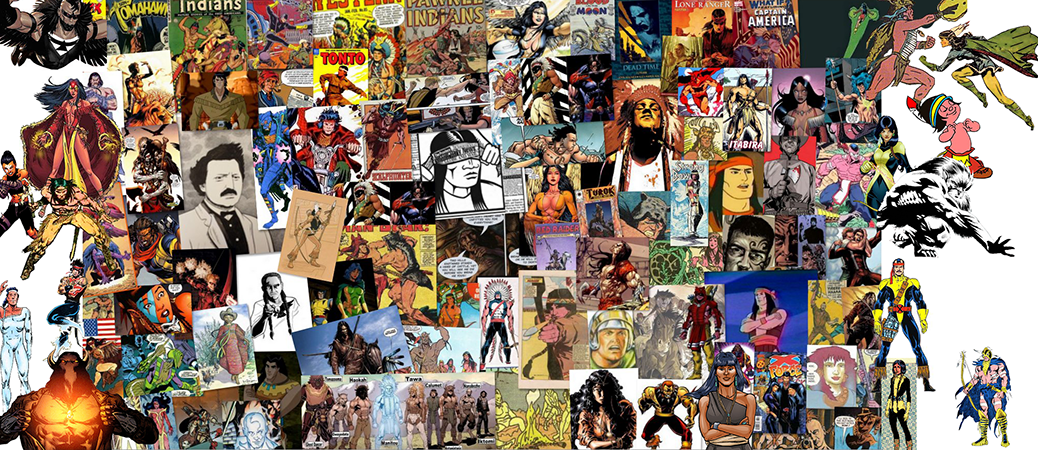
In a recent posting on DC Women Kicking Ass, sources have confirmed that comic artist Jeff Lemire has followed through on his projection from last year that he would be creating a new superhero based on deceased Indigenous teen activist Shannen Koostachin. They will be appearing in Justice League United #1, which comes out this May.

Who is Shannen Koostachin?
Shannen Koostachin was born in Attawapiskat First Nation on James Bay coast, Ontario, Canada. Most recently Attawapiskat has made headlines for its dire living conditions, from boiling orders to inadequate housing insulation, which has drawn increased attention nationally and internationally to the reality that the conditions of many Indigenous communities in Canada are more comparable to the Third World than an industrialized democracy like Canada.
She attended J.R. Nakogee elementary school, which had been housed in makeshift portables shipping containers since 2000, when it was condemned and closed due to a decades-old fuel leak. Then a teenager, Shannen learned that Canadian government was not giving proper funding to First Nation Aboriginal Schooling systems around Canada.
In 2007, the federal government had backed away from a third commitment to building a new school for Attawapiskat. Using the power of social media like Youtube and Facebook, Shannen and other Indigenous youth launched the Students Helping Students campaign for a school for Attawapiskat.Koostachin spoke out about the experiences of her community in newspapers, at conferences, and on the steps of Parliament Hill in 2008. In 2009, at the age of 14, in 2009 she was nominated for the International Children’s Peace Prize.
Tragically, Shannen died on May 30, 2010 in a car accident. Her legacy to improve the conditions of First Nations communities–particularly youth and students–lives on in a campaign called Shannen’s Dream.

35 Years of World War 3 – An Exclusive Interview
It’s been thirty-five years of World War 3.
As momentous as it sounds, no one could have known in 1979 that this self-published periodical based in New York City would become the longest-running anthology of political comics in the world–at least, that we’ve been able to find.
Continue reading 35 Years of World War 3 – An Exclusive Interview

MARCH: Book One honoured in 2014’s Corretta Scott King Book Awards
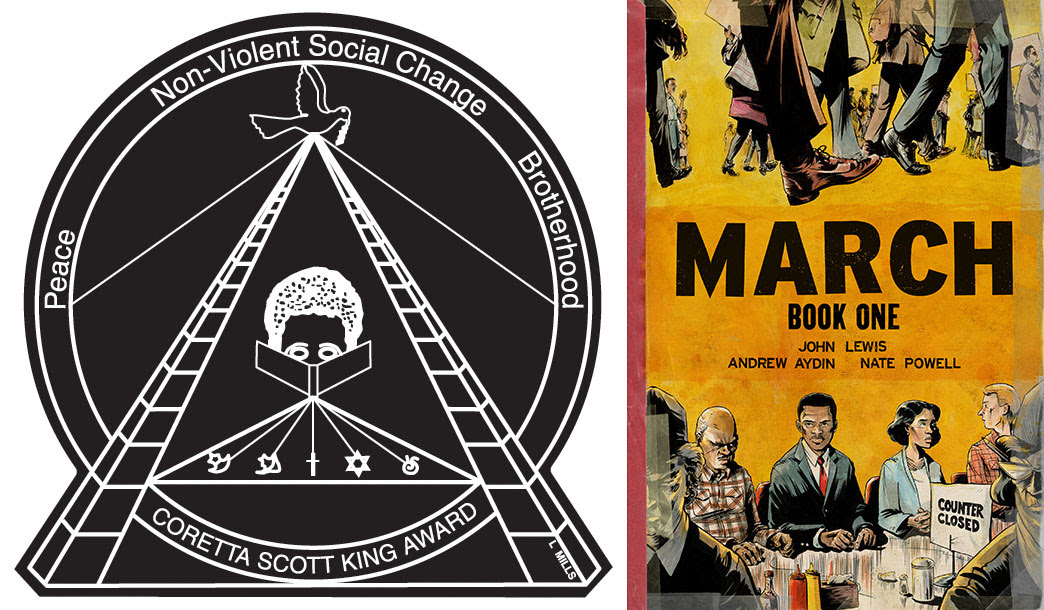
The Coretta Scott King Book Awards are given annually to outstanding African American authors and illustrators of books for children and young adults that demonstrate an appreciation of African American culture and universal human values. The award commemorates the life and work of Dr. Martin Luther King, Jr., and honours his wife, Mrs. Coretta Scott King, for her courage and determination to continue the work for peace and world brotherhood. The Awards were founded in 1969 at the American Library Association (ALA) Annual Conference in Atlantic City, New Jersey.
“MARCH: Book One”, an autobiographical graphic novel by former Civil Rights leader and Congressman John Lewis, tells the complex, often troubling, often inspiring, story of freedom fighters launching a movement in the U.S. South that would change the entire country. The book is co-authored by Andrew Aydin, a member of Congressman Lewis’ staff, and by veteran comic illustrator and storyteller, Nate Powell.
A full list of award winners is below.
2014 Author Award Winner
Rita Williams-Garcia, author of “P.S. Be Eleven” published by Amistad, an imprint of HarperCollins Publishers. In this spirited stand-alone sequel to “One Crazy Summer,” the Gaither sisters return to Brooklyn after a summer spent with their mother in Oakland, California. Delphine, Vonetta and Fern thrive in the tumultuous era of the late 1960s, but Delphine is tasked by her mother to, “P.S. Be Eleven.”
Rita Williams-Garcia, the author of the Newbery Honor–winning novel “One Crazy Summer,” also a winner of the Coretta Scott King Award, a National Book Award finalist, and the Scott O’Dell Award for Historical Fiction. Residing in Jamaica, N.Y., she is on the faculty at the Vermont College of Fine Arts.
2014 Illustrator Award Winner
Bryan Collier, illustrator of “Knock knock: my dad’s dream for me” illustrated by Bryan Collier and published by Little, Brown and Company, Hachette Book Group. In “Knock knock: my dad’s dream for me,” Bryan Collier brings to life Daniel Beaty’s powerful narrative of a son’s longing for his absent father. With his distinctive watercolor and collage technique, Collier captures the nuances of the urban setting and the son’s journey to manhood.
2014 John Steptoe Award for New Talent
Theodore Taylor III, illustrator of for “When the beat was born: DJ Kool Herc and the creation of hip hop” written by Laban Carrick Hill and published by Roaring Brook Press, a division of Holtzbrinck Publishing Holdings Limited Partnership . Taylor’s stylish artwork shows young Clive Campbell’s transformation into the DJ who helped launch hip-hop in the early 70’s. Using retro cartoon-style illustrations rendered in a palette that emphasizes browns, greens, reds and greys he transforms words on a page into a rhythmic beat that brings the words alive.
2014 Author Honor
John Lewis and Andrew Aydin, authors of “March: Book One,” illustrated by Nate Powell, and published by Top Shelf Productions
Walter Dean Myers, authors of “Darius & Twig,” published by Amistad, an imprint of HarperCollins Publisher
Nikki Grimes, author of “Words with Wings,” published by WordSong, an imprint of Highlights
2014 Illustrator Honor
Kadir Nelson, illustrator and author of “Nelson Mandela,” published by Katherine Tegen Books, an imprint of HarperCollins Publishers.
The Coretta Scott King Book Awards seal images and award names are solely and exclusively owned by the American Library Association.

Cartoonists to Director of the Angoulême Comics Festival: Drop SodaStream
 For more information: http://lettertoangouleme.tumblr.com/
CARTOONISTS TO DIRECTOR OF ANGOULEME FESTIVAL: DROP SODASTREAM
Sacco, Siné, Katchor, Kerbaj, Coe, Drooker, Kuper, Madden, Tobocman, among dozens of others protest sponsorship by Israeli settlement manufacturer
FRIDAY, JANUARY 31, 2014– Over forty cartoonists and illustrators from a dozen countries around the world released an open letter today to Franck Bondoux, director of the International Festival of Comics at Angoulême, asking the festival to drop its relationship with the Israeli drink manufacturer SodaStream. Among those signing the letter were French cartoonists Siné, Baudoin, Carali, and Chimulus, Americans Joe Sacco, Eric Drooker, Ben Katchor, Peter Kuper, Matt Madden, Seth Tobocman and Sue Coe, as well as Palestinian cartoonist Mohammad Saba’aneh, Lebanese Mazen Kerbaj, Sudanese Khalid Albaih, Tunisian Willis From Tunis, Israeli Amitai Sandy, Brazilian Carlos Latuff, Spanish Elchicotriste, Italian Gianluca Costantini, and many more.
The letter comes as SodaStream increasingly is targeted by an international boycott due to the presence of its primary factory in the Israeli settlement of Ma’ale Adumim. The day before, headlines were made when actress Scarlett Johansson ended her seven-year relationship with the charity OxFam over disagreements stemming from her role as a paid spokesperson for SodaStream.

The Angoulême International Comics Festival is the largest in Europe, and the second-largest in the world. The announcement that it would be sponsored this year by SodaStream drew immediate condemnation from French activists.
The full text of the letter and list of signatories follows:
Lettre ouverte à / Open letter to:
Monsieur Franck Bondoux
Direction du Festival international de la bande dessinée
71 rue Hergé
16000 Angoulême
We, cartoonists and illustrators from all countries, are surprised, disappointed and angry to find out that SodaStream is an official sponsor of the Angoulême International Comics Festival.
As you must know, SodaStream is the target of an international boycott call for its contribution to the colonization of Palestinian land, due to its factory in the illegal settlement of Ma’ale Adumim, its exploitation of Palestinian workers, and its theft of Palestinian resources, in violation of international law and contravening international principles of human rights.
Angoulême has had an important role in the appreciation of comics as an art form for over 40 years. It would be sad if SodaStream were able to use this event to whitewash their crimes.
We ask you to cut all ties between the Festival and this shameful company.
Sincerely,
+++++++++++++++++
Khalid Albaih (Sudan)
Leila Abdelrazaq (USA)
Avoine (France)
Edd Baldry (UK/France)
Edmond Baudoin (France)
Steve Brodner (USA)
Berth (France)
Susie Cagle (USA)
Jennifer Camper (USA)
Carali (France)
Chimulus (France)
Jean-Luc Coudray (France)
Philippe Coudray (France)
Marguerite Dabaie (USA)
Eric Drooker (USA)
Elchicotriste (Spain)
Jenny Gonzalez-Blitz (USA)
Ethan Heitner (USA)
Paula Hewitt Amram (USA)
Hatem Imam (Lebanon)
Jiho (France)
Ben Katchor (USA)
Mazen Kerbaj (Lebanon)
Lolo Krokaga (France)
Nat Krokaga (France)
Peter Kuper (USA)
Carlos Latuff (Brazil)
Lasserpe (France)
Lerouge (France)
Matt Madden (USA/France)
Mric (France)
Barrack Rima (Lebanon/Belgium)
James Romberger (USA)
Puig Rosado (France)
Mohammad Saba’aneh (Palestine)
Joe Sacco (USA)
Malik Sajad (Kashmir)
Amitai Sandy (Israel)
Siné (France)
Seth Tobocman (USA)
Eli Valley (USA)
Willis From Tunis (Tunisie/France)
Jordan Worley (USA)
Si vous êtes dessinateur et que vous voulez vous associer à cette lettre ouverte, merci d’écrire à: lettertoangouleme@gmail.com
If you are a cartoonist and you want to endorse this open letter, please write to: lettertoangouleme@gmail.com
Tintin: Breaking Free of Class-Only Politics
By Hugh Goldring | @ooHugh
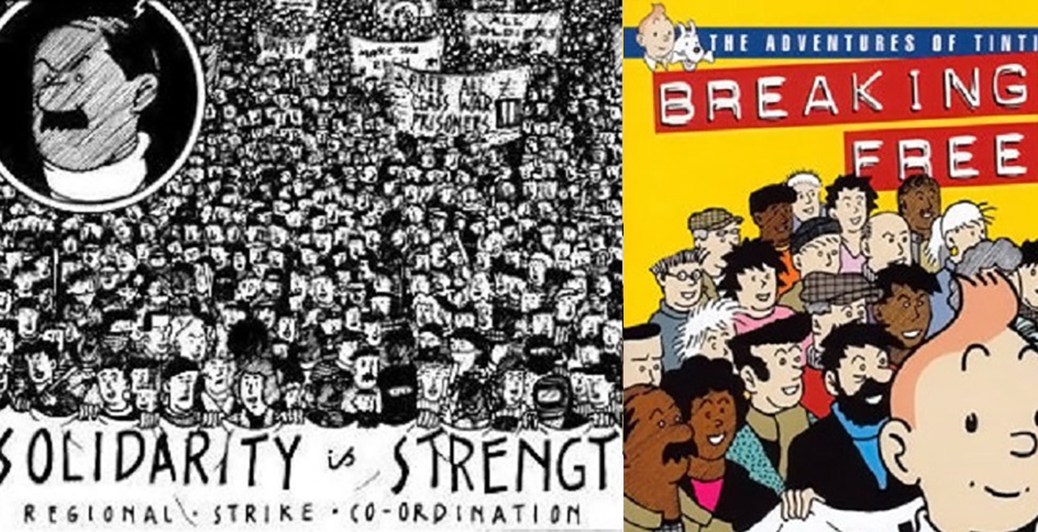
“The Adventures of Tintin: Breaking Free” is a comic about class war. If that doesn’t sound quite like Tintin’s typical adventures through Orientalist portrayals of the 1930s, there’s a reason why.
Published under the pseudonym J. Daniels, ‘Breaking Free’ expropriates Hergé’s classic images of the reporter turned adventurer and remakes him as the central protagonist of a general strike. Featuring a cast of familiar faces in entirely unfamiliar roles, ‘Breaking Free’ is as much a blueprint towards revolution as it is an exercise in wishful thinking.

Title: Breaking Free / The Adventures of Tintin
Author: ‘J. Daniels’
Illustrator: ‘J. Daniels’
Original Release: February, 1992
Published: Attack Intl (UK)
Other Spec’s: Softcover, 176 pages, black and white interior.
Of central interest is that, for a comic about class war, ‘Breaking Free’ has a lot to say about other struggles: the fighting proletariat are not all gruff blue-collar blokes in flat caps, though there’s no shortage of them here. But the story teems with the diversity of the systemically oppressed: housewives tired of devalued housework, lesbians running away from intolerant homes and elderly being driven out of their communities by gentrification. The idea that all our struggles are connected is intimately threaded through the narrative of the general strike, driving the strike on by recognizing that all are allies in the fight.
Before the strike begins, Tintin and his uncle (a transformed Captain Haddock) head out to take in a football match. In the crowd outside, a fascist is selling a newspaper. As this excerpt shows, this is no crude caricature of a fascist. Employing language about safety and economic security, the fascist organizer plays on the worst fears of the working class. But the Captain is no stranger to solidarity, and makes the left-wing argument very ably: black or white, it’s us against the bosses.

The Captain aptly deconstructs the notion of a ‘white’ race in simple terms, demanding to know which sort of immigrant the fascist descends from. In the sincerity of its depiction of fascism and nuance of the Captain’s arguments, the comic treats the issue of race seriously. Certainly more can be said on the tendency of white men to dominate within even progressive social movements, but at least it addresses the issue seriously.
The question of women’s roles in the struggle also crops up, as in this excerpt, and gets a broader showing than race. Tintin treats Mary as little more than a domestic servant, prompting a well deserved dressing down.

Mary emphasizes that she’s neither swayed by lesbians nor middle class feminists, debunking those chauvinistic myths about feminism by speaking from her own experience. Rather than be easily persuaded, Tintin flies off the handle, and needs time to cool off before coming around to understanding her point of view.
In just a few short pages, the comic covers domestic work, working class feminism and sexual assault. These are not abstract problems for academics to write endlessly on – they are issues affecting left-wing organizing in the 21st century. Tintin later puts in his time as a babysitter so that some of the women can get out to the strike meetings.

Although Tintin wises up about feminism quick enough, he still has some internalized homophobia to deal with. Rather than coddling him, his squatter neighbour Nicky puts it to him very frankly. Tintin is just as guilty of breaking society’s rules, and all Nicky asks is that he live and let live. If his acceptance seems to come a little too easily when she forces him to admit that homophobia is one more way the rich divide us, Tintin is not completely reformed.
But Tintin learns, albeit slowly. When Nicky and the rest of a queer contingent at the strike are hassled by a protester who quickly resorts to homophobic slurs, Tintin turns up out of the crowd to tell him off.

The point the comic is making is twofold – first, that gay and lesbian people have as much of a stake in the class struggle as anyone else. Fairly elementary stuff, all told. But the more radical insistence is on visibility – not only are they welcome, but their banner demonstrates public support of the strike, reflecting both diversity and solidarity.
Granted that the origins of many liberation movements are in fact decades older, Breaking Free came out in 1992, at a time when intersectionality was still working to get a foothold in leftist organizing, particularly within the realm of labour. It is a great read for anyone involved or interested in progressive organizing.

Remembering Debra Jane Shelly
 It is with much sadness that the Toronto comic book community learned last weekend of the sudden and tragic passing of one of its brightest supporters.
Debra Jane Shelly was a comics fan, supporter, and self-described (and celebrated) nerd. She was known for her years of behind-the-scenes support at Comic Cons and other events celebrating comics and pop culture. With her partner Kevin, Debra opened the doors of The Comic Book Lounge and Gallery on College St at Clinton in early 2012. The Lounge was unique in serving both as a comic shop and a gathering space, hosting Life Drawing classes, book launches, award ceremonies and socials.
In 2013, she co-founded the Lounge’s Ladies Night, which met bi-monthly and became a gathering point for women comic book fans in a community still largely dominated by and catering to a male audience. It was a first for the Toronto comics community, and came at a time when the critical question of diversity in comics (readers as much as creators and characters) was gaining serious momentum internationally.
Yet Debra was known for her positivity, and did less to criticize the comic community’s shortcomings than to nurture the people, spaces, and ideas that were inspiring.
“To so many people she was the first person we told of our successes and failures & she always knew the best way to respond -how to congratulate and console us. That kind of contribution doesn’t fit on a resume but it was felt throughout the community.”
–Alice Quinn, Ladies’ Night co-founder

This remembrance has been assembled in conversation with others who knew Debra. The Comic Book Lounge and Gallery has notified its followers that they will be posting memorial service information as it becomes available.
 adastracomix.com