100 Year Rip-Off, A People’s History of B.C. to be Re-released After 40 Years Canada’s Oldest ‘Graphic History’ on Record Highlights Stories of Working Class and People of Colour
July 20, 2013
Canada’s oldest recorded comic book history is coming back from the dead after more than 40 years—if it gets a little help. On the anniversary of B.C. joining Confederation, specialty comic book publisher Ad Astra Comics is launching a 40-day fundraiser for the comic book “100 Year Rip-Off: The Real History of British Columbia”. The campaign, which aims to raise a modest $800, will help to cover the costs of re-mastering and printing the comic for the first time in over four decades.
“100 Year Rip-Off: The Real History of British Columbia” is a blue-collar comic book history of the first 100 years of B.C.’s confederated history. Written by the late Robert Simms and illustrated by artist and current B.C. resident Bob Altwein, 100 Year Rip-Off was originally produced as a one-time 8-page broadsheet, accompanied by a counter-culture newspaper.
Ad Astra Comics, in consultation with Altwein, has digitized and re-mastered the work and provided complimentary additions to the content, including a map and glossary addressing the finer details of the original work. The text remains un-altered.
“100 Year Rip-Off is a graphic history that almost slipped into oblivion–right at a time when comic books and ‘graphic history’ comics in particular are reaching a peak in popularity,” says Nicole Marie Burton, campaign coordinator and founder of Ad Astra Comics, a micro-publisher that specializes in political and historical titles. The project is headquartered with the publisher in Toronto.
A quality printing of the re-mastered work means that 100 Year Rip-Off can get a new lease on life–and that means a new generation of readers will be able to benefit from these little-known stories of the province’s history.”
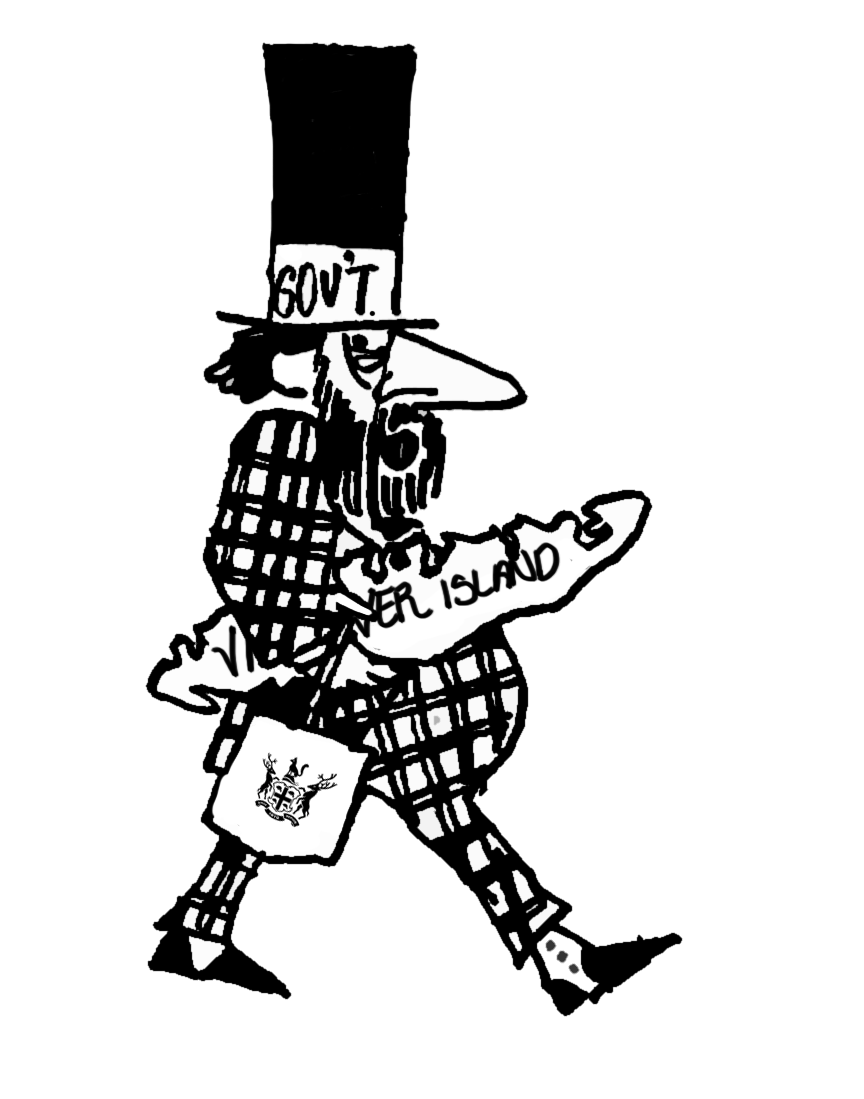
That history, according to 100 Year Rip-Off, includes a number of episodes in which B.C.’s residents were given the short end of the stick–as the name indicates. It documents, through meticulous research, the seizure of lands from B.C.’s First Nations alongside the banning of Indigenous cultural practices like the pot-latch. It progresses by chronicling the often-volatile history of labour struggles within the region, from the formation of B.C.’s first unions to the province’s recurring threat of a Winnipeg-style general strike. History enthusiasts will take interest in the detail of the text, while comic book lovers will enjoy the ‘School House Rock’ style of illustrations, so indicative of the contemporary comic and cartooning scene of the 1970s.
Burton points out that young activists may take interest in the rendition of the 1938 ‘Sit-downers Strike’ that took place at the Vancouver Art Gallery and in the Georgia Hotel–an action very reminiscent of the recent Occupy Movement.
100 Year Rip-Off is a standard-sized comic book of 30 black-and-white pages. Participants in the project’s IndieGoGo campaign can contribute for as little as $7 and get their own copy of the book mailed to them. Larger contribution packages include buying a bundle of comics at a reduced price–perfect for schools, unions, book stores, and special interest groups–along with a poster-sized version of the comic book’s reference map, which has been added to this specially re-mastered edition.
“The project is about revitalizing and popularizing the working class history of this province,” explains Burton. “But it is also celebrating the creative work of the comic itself, which in turn has become a part of our history.”
For more information, please visit the “100 Year Rip-Off” IndieGogo Campaign Page:
At its offset, it would seem that Fallout may be a part of a bandwagon to which most of the world is unbeknownst. The history of the self-described “graphic history” is a relatively short one. A natural off-shoot of the also-overly-used term, “graphic novel,” it has become something of a gold rush in a struggling book industry. Their accessibility and palettability makes them ideal for classroom and other educational settings… they appeal to young and old alike, etc. In a saying that seems as tacky as it is unlikely to the everyday cynic, graphic histories make learning fun.
But they also, often, make learning simple. Simplistic. Too simplistic. In fact many ‘graphic histories’ that have come out recently appear to be about topics by which the authors themselves don’t even appear to be highly engaged or inspired.
But, that is not this comic book.
Title: Fallout: J. Robert Oppenheimer, Leo Szilard, and the Politics of the Atomic Bomb Writtenby: Jim Ottaviani Artworkby: Various (including Janine Johnston, Chris Kemple, Steve Lieber, Vince Locke, Bernie Mireault, Eddy Newell, and Jeff Parker) CoverIllustration by: Jeffrey Jones Published: 2000 by General Tektonics (GT) Labs, as a part of a series of books about science and scientists
Originally printed in 2000, making it a bit ahead of the graphic history game, Fallout documents the Top Secret rise, gritty enactment of, and perhaps also the fall–if not materially, then politically, and above all morally–of the Atomic Age. It is a part of a larger series released by the publisher, GT Labs, of books that popularize (and perhaps humanize) science and the history of science to those not in the ‘know’.
Blending first-hand accounts and quotes with hypothetical dialogue–deemed at the preface of the book to be true “science fiction”–Fallout takes you from the inception of the atomic bomb, as it was first simply a theory in the minds of a handful of scientists–many of whom were struggling to escape the grip of fascism in Europe. An prime example is the physicist Leo Szilard, one of the Manhattan project’s founders, who barely escapes Germany as a refugee in one of the last trains out of the country (he explains that he avoided scrutiny by traveling first class).
It is in this climate that scientists begin to do what would otherwise be unthinkable: keeping their work Top Secret, not publishing their findings, enlisting not only the funding but considerable control of scientic research through the U.S. military. It was all for a greater good: to defeat the rise of Nazi Germany and to one day, possibly, hopefully, end the War–to end all wars. For in the scientific mind, if it were in fact a given that the world is ruled by reasonable men–what man would there be who would begin a war against a country with a nuclear bomb? The book is rivetting not only in its ability to explain the scientific basis of how a nuclear reaciton works (something that has never made sense to me) but also in seeing how these men, who were all more or less geniuses and culturally enlightened intellectuals, could be led to believe that this project was not only a good idea, but an absolute necessity.
The read is intriguing, even gripping (the first test of a nuclear chain reaction being recorded on the panel with the “click” “click” “click” “click” of the counter–the sound we all now associate with radioactivity in fallout zones–kind of gives you this ‘lightbulb over your head’ moment… “Aha! So that’s what each ‘click’ represents!”). You can tell from the narrative that the book is not only painstakingly researched, but done so by someone who believes in the need to know and understand the story. Perhaps this is an obvious requirement for all books of quality, but one that I would never take for granted in the category of a “graphic history”.
I would give this book the highest of recommendations. It is everything I hope a graphic history to be when I open it for the first time. And although I began this piece talking about the medium, an exceptional graphich history will in my opinion, pull you into talking about the content as much, if not more, than the form.
In 2013, we are all so familiar with bite-sized pieces of atomic energy–from nuclear power plants to the trademark mushroom cloud, the bombing of Hiroshima and Nagasaki, Chernobyl and the meltdowns in Fukushima. But the introduction of such power into the realm of what was humanly possible was just as explosive, in the 1930s-50s, for everything from international Geo-politics to the limits philosophical and moral dilemmas that one human being can handle. In the words of Edward Teller:
“I made the great mistake of feeling relieved of my responsibility… the chance to show the world that science can stop a terrible war without killing a single person was lost.”
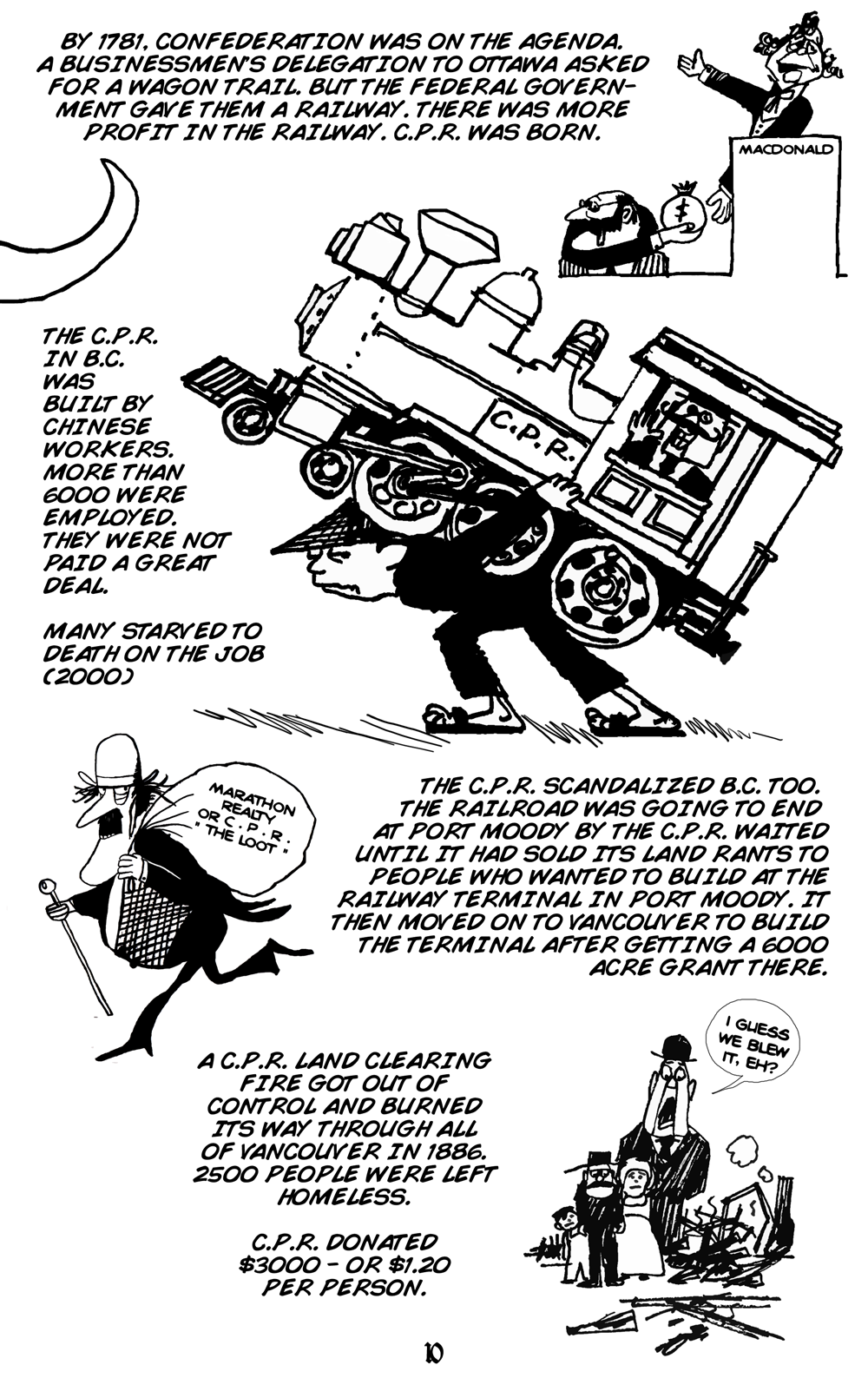
Available here for the first time is a collection of pages from Ad Astra Comix’s upcoming re-release of the 100 Year Rip-Off. Originally printed in 1971 for the B.C. Centennial, Ad Astra, in cooperation with the artist Bob Altwein, are making the work available for a new generation. Enjoy!
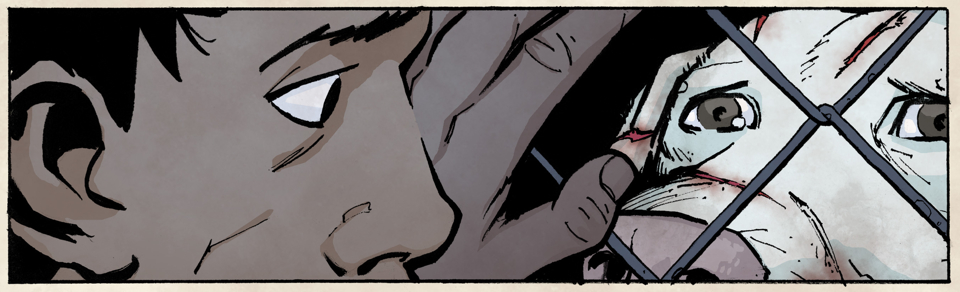
The series opens with one of the main characters taking down a dog fighting ring. It’s a feel-good moment where a few horrible people are given their just desserts, and some dogs get the justice they deserve.
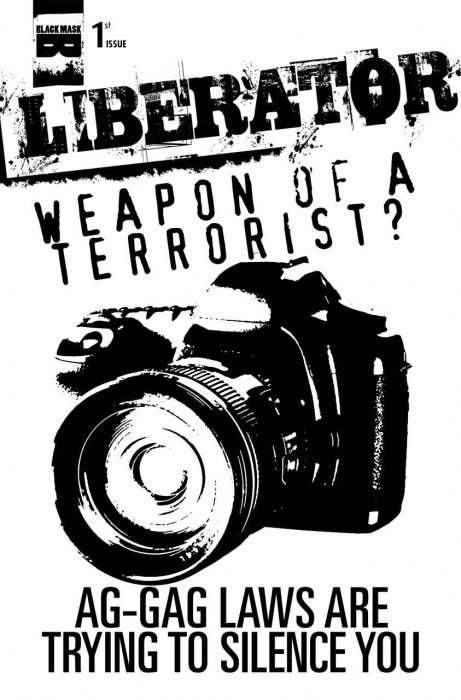
Title: Liberator Issue: #1 Writing: Matt Miner Art: Javier Sanchez Aranda Published: in 2013 through Black Mask Studios and a successful Kickstarter campaign More info: http://mattminer.net/
Liberator is a series that tells the story of two animal liberation activists who save dogs and other animals from abuse. While one has a long history of making a public presence in activism, the other chooses to work in the shadows, taking direct vigilante-style action against abusers, most of whom are themselves breaking the law with their activities. Each issue comes in at about a dozen pages of full-colour graphics, and is coupled with literature (located in the back) on animal rights work.
I do tend to approach my comic reviews in two ways. One is aesthetic: is the story good? Does the art kick ass? The other side of my reviews tends to focus on political/social relevance and its method of delivery. Like the Bechdel test, a comic that is most politically relevant doesn’t make it a good story—nor are the two mutually exclusive. They embody separate goals, hopefully ones that work together.
Aesthetically I think Liberator is pretty impressive. It is more or less self-published under the new label of Black Mask Studios, after a Kickstarter campaign that brought comic and animal lovers together quite successfully. Key points in the comic show some really nice artwork with great colour schemes. I don’t quite feel a connection to the narrative yet, but it is only Issue #1.. (I point this out because Matt Miner made me cry within about 6 pages of his story “Light” in the Occupy Comics Issue #2 that just came out– so my standards are high with him. Great comic, by the way. Read it. Read it now.)
In only a dozen pages, the comic nonetheless makes lots of commentary, and not just on animal rights. One is that a lot of people who literally devote their lives to helping others (humans or animals) work the crappiest of minimum wage jobs to get by. (Check). Another is that men who encounter other men’s disrespect of women should call that shit out. (Check). I think there is also more subtle commentary here, like when a black man refers to a dog he is abusing as “his property” (irony?) –or the never-ending activist debate with regards to making effective change by political protest vs. other more creative, even illegal forms of resistance.
(All of this is hypothetical in a comic book, of course. Which is what makes it so great.)
Liberator clearly has an agenda. Guess what? Everything does, including comic books. My opinion is if you’re pouring your life/money/job into creating something and you’re not using it to say something meaningful, you’re making a bad investment There is a self-awareness in political comics that the project’s completion will be able to further assist with a topic that generally lacks creative avenues of discussion–like animal abuse, or violence against women, or mistreatment of prisoners. For a long time the comics community and activists of varying causes have waved the other away–“No one will buy that.” “Sounds campy.” “What’s the difference between a comic with a political agenda and propaganda?”…..and vice versa, “A comic dumb’s down the topics we’re trying to discuss,” “Comics take time and money,” and again, “No one will buy it.”
To fit a lot of potential discussion into such a small space is indicative of the medium’s ability. So even if I’m not totally compelled by the narrative just yet, my hat goes off to the Liberator team, and I look forward to picking up the next copy.
Additional Notes:
I have funny, petty criticisms of Liberator (like, No one wearing a Conflict shirt would wear blue cargo pants) that boil down to me thinking/writing out loud. But I also felt it was honing in (maybe too much?) on a small minority of psychotic animal killers and abusers. I mean, how many of those can there be out there?
The day after I read Liberator, my husband wouldn’t stop talking about Mike Vick’s dogfighting bust, and I just couldn’t get it out of my mind that this was a man who obviously didn’t live in the shadows, and he has a thing for training dogs to kill other dogs, and motivating them through methods like pressing a hot iron against their faces. He was a superstar football player with thousands of people following him on social media, laughing at his jokes, and ready to buy whatever he endorsed. And he killed animals for fun.
Is the animal-abusing psychopath …common? Or perhaps regardless of its frequency of occurrence, does that make it any less real or disturbing where and when it happens? Maybe there are issues that effect a larger swath of our population, like the number of homeless pets out there, but comic books focusing on extreme crimes and abuses is nothing new.
…as a side note, the special edition cover of Issue #1 absolutely wins my heart over. I will be following this comic closely, and I encourage others to do the same.
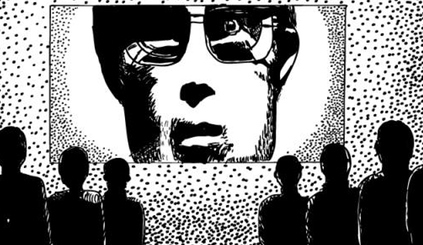
Stuart McMillen’s webcomic adapts (and updates) Postman’s famous book-length essay, Amusing Ourselves to Death, which argues that Aldous Huxley’s vision of the future in Brave New World was ultimately more accurate than the one proposed by George Orwell in 1984. (Via).
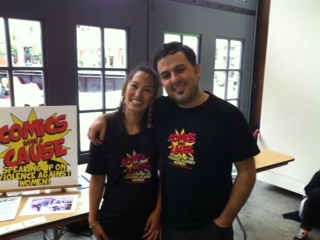
Comics With a Cause co-founders Rodrigo Caballero and Babette Santos
Ad Astra: You’re in the final stretch of your Indiegogo campaign! How would you describe the experience so far?
Rodrigo: Running my first Indiegogo campaign has definitely been a huge learning curve, especially for someone like myself whose knowledge (not to mention enthusiasm!) for the ins and outs of social networking platforms is not always up to par. Definitely my eyes have been opened to the idea of crowd funding- there is so much potential for doing advocacy and charitable work on the Internet, but so much time and effort to be invested as well. The sheer diversity of initiatives and ideas being funded right now through crowd funding, however, is mind-blowing and it’s exciting times for people with new and innovative ideas. I very much see our indiegogo campaign as the humble first steps taken in a longer path of development.
AA: The concept of a web comic about a subject matter like domestic abuse must have been new for some people.
R: Yes, definitely new, although it seems that’s been a positive thing for most people learning about the project, especially for those already working in the field of violence against women in a supportive capacity. There seems to be a thirst for new approaches to raising awareness of the topic. Violence against women is a very difficult subject to broach because it makes most people uncomfortable and it’s not the sort of thing one hears brought up in day-to-day conversations. For the most part, there’s been an unwritten code of silence that underlies the topic of violence against women in society. I think comics and graphic novels have a lot of potential, because if you can’t confront people directly about it at first, you can at least have them read about it in a format other than news reporting or statistics and if the story is compelling enough, they can and hopefully will talk about it with others. Expressing the subject in the form of a story allows for discussion in a manner that’ s a little less direct but hopefully still engaging. That’s the theory anyway!
AA: And what kind of spectrum of feedback have you gotten?
R: The feedback I’ve received on through our CWAC campaign has been overwhelmingly positive and for the most part people (including individuals working for organizations) have demonstrated a lot of enthusiasm for the idea. There seems to be a notion that a comic series addressing violence against women has a lot of educative potential as well (i.e. lots of comments about using this in the classroom and with younger audiences). I’m flattered by this sentiment and indeed part of me hopes “BRANDED” does one day make it to classrooms but admittedly there is also a small part of me that is wary of it. And that’s because there may be an assumption underlying this that comics/graphic novels is something for kids. Of course, audiences already familiar with the medium know that this limiting stereotype was broken a long time ago and that many of the most successful graphic novels have handled very serious or political subjects in very unconventional yet compelling ways and in a manner that is unique to the medium. The other thing is that when we slap the word ‘education’ on something, it can carry a lot of baggage with it, just as the term ‘entertainment’ can. This comes from outmoded ways of thinking that equate learning with textbooks and grading and entertainment with passive consumption. I think there’s a lot of room for unpacking these terms and exploring comics as more of a liminal space.
AA: Let’s go back a bit. Where did the idea of “BRANDED” originate from? Were you inspired by other comic books already out there? What about the subject matter?
R: Like many others, the clincher for me in terms of what comics are capable of accomplishing was reading Art Spiegelman’s Maus and works by Alan Moore and Marjane Satrapi. Regrettably, in terms of raising awareness of violence against women, my familiarity with the phenomenon (also like many others) comes from knowing someone who has experienced sexual assault and having an intimate understanding of the traumatic and dispiriting effects that accompany it.
My idea for writing “BRANDED” in particular came from attending a panel on National Day of Remembrance and Action on Violence Against Women last December. Part of the event featured an installation where about a hundred black cut-out silhouettes of women were positioned everywhere and each one featured a short real-life account of a woman’s experience with male violence. These were collected by crisis line workers over the period of a single month. There was something about the immediacy of these stories that I found staggering and that spoke to just how obscured the phenomenon of violence against women is– here were all of these horrendous real-life accounts of violence against women, and the majority of them never reach public consciousness. During the subsequent panel discussion, the question was also raised, “What is the role of men in ending violence against women?” That was very much my own personal call to action and for whatever reason, the idea entered my mind– I’m going to make a comic series addressing violence against women–and I just knew from that point onwards this was something that I was going to have to do. From there, the premise and most of the characters basically spilled out of me in one brainstorming session shortly afterwards.
AA: “BRANDED” includes a figure known as “The Brander”. Comics have expanded so much since the first days of caped crusaders. What inspires you to continue on with the inclusion of a ‘caped’ hero–someone with a secret identity and extraordinary abilities?
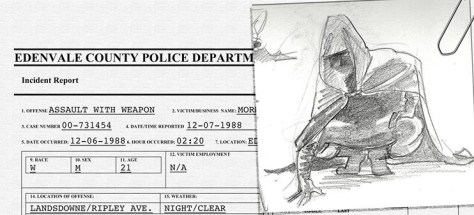
R: Well, the first thing is that I don’t really consider “BRANDED” to be a superhero story per se, nor will The Brander have any extraordinary abilities (although the secret identity trope is very much a part of the character). That’s because she or he is very peripheral to the story and only gets minimal page time. Instead, most of the story centers on a group of characters whose lives are impacted in different ways by The Brander’s actions, which are at best controversial and morally not so easy to justify. Readers familiar with the “women in refrigerators” phenomenon (sparked by Gail Simone a number of years ago) will be familiar with the argument that too often in comics, we see female characters maimed, raped, incapacitated or killed off ruthlessly and abruptly, usually in order to provide a motivation for the protagonist/superhero. “BRANDED” eschews such shock-value devices and instead depicts women as survivors (not just victims) of male violence and its consequences. The presence of The Brander–a vigilante who has decided to seek redress for women survivors of male violence because the law has been deemed incapable of providing this-is meant to provoke readers into thinking about what sort of factors would actually drive somebody to adopt such a role. In real life, it’s estimated that only a fraction of sexual assault incidents are reported to the police by survivors and of these statistically only a fraction result in a conviction or imprisonment, so I think this theme of absence of redress or lack of justice is a very real one for many survivors of violence. My idea was to have a vigilante who went around branding the faces of perpetrators of sexual violence in order to expose them and place the burden of shame and stigma on them rather than the survivor, which is what we tend to see too often in real life. The Brander, despite only having a minor role in the story, is meant to embody the response (albeit a dramatic one) to this absence of redress and there’s a certain inevitability to the character’s appearance that I hope comes across when we bear the statistics in mind. When we recall the example of the vigilante group “Anonymous” and their intervention in the recent Rataeh Parsons case, The Brander isn’t too far a stretching of reality.
AA: What advice would you have for others fundraising for projects with a similar interest?
R: It’s important to build a community around your cause or project. For me, even though I decided to go ahead and launch an Indiegogo campaign for “BRANDED,” I’m still very much in the formative stages of building a community or audience for the comic. This can only happen over time but I think when it does, the comic will really start to take on a life of its own. Also, for any men becoming involved with speaking up on violence against women, such as myself, it’s important to inform yourself to the best of your ability and remain ever sensitive to your position relative to the phenomenon of violence against women while not adopting the role of someone speaking on behalf of survivors. Too often in so many spheres the voice of women is marginalized and the last thing we need is for this to happen in raising awareness of violence against women. I can’t pretend to have fully learned how to negotiate this dynamic, but I can certainly
remain cognizant of it.
AA: After your Indiegogo drive is over, what can supporters expect to see from Comics with a Cause in the months ahead?
R: The if-everything-goes-according-to-plan picture is: We will finish finding the funding to produce about 85 pages of script to be illustrated by Reetta Linjama, our current illustrator, and hopefully hire somebody who can colour all the pages too. Our aim is to start releasing the comic series episodically (perhaps weekly) beginning early September and I would like to take it right up to December 6 which is the National Day of Remembrance and Action on Violence Against Women. This will depend though on how much funds we can raise for the project. Right now the best way to help out is through our Indiegogo campaign which ends June 22, but we may try and figure out a way to allow people to keep donating after that, ideally on a new website dedicated to the comic series. In the meanwhile, any news and updates can be found on our Facebook Page.
Of course, the other question people always bring up is, when do we see the printed or graphic novel edition? Like most comic artists/writers, I’m all for that! But let’s get the thing made first…
AA: Thanks, Rodrigo! Best of luck as these final days!
Some of you will remember when I blogged about Liberator during its Kickstarter campaign. Looks like that money went to some good use – holy smokes, that artwork in this is amazing. Congratulations to writer Matt Miner and the Liberator team.
Writer: Matt Miner
Pencils/Inks: Javier Sanchez Aranda
Colors: Joaquin Pereyra
Edits/Letters: Vito Delsante
Publisher: Black Mask Studios
Standard Cover: Tim Seeley, with Rod Reis colors
A hard-edged vigilante series about two young heroes who avenge the torture of animals, created by writer and real-life dog rescuer Matt Miner (Occupy Comics).
All of Miner’s personal share of profit goes to dog rescue work.
After confirming the project with the work’s artist, Bob Altwein, I am now set to begin reprinting 100 Year Rip-Off within the next two weeks!
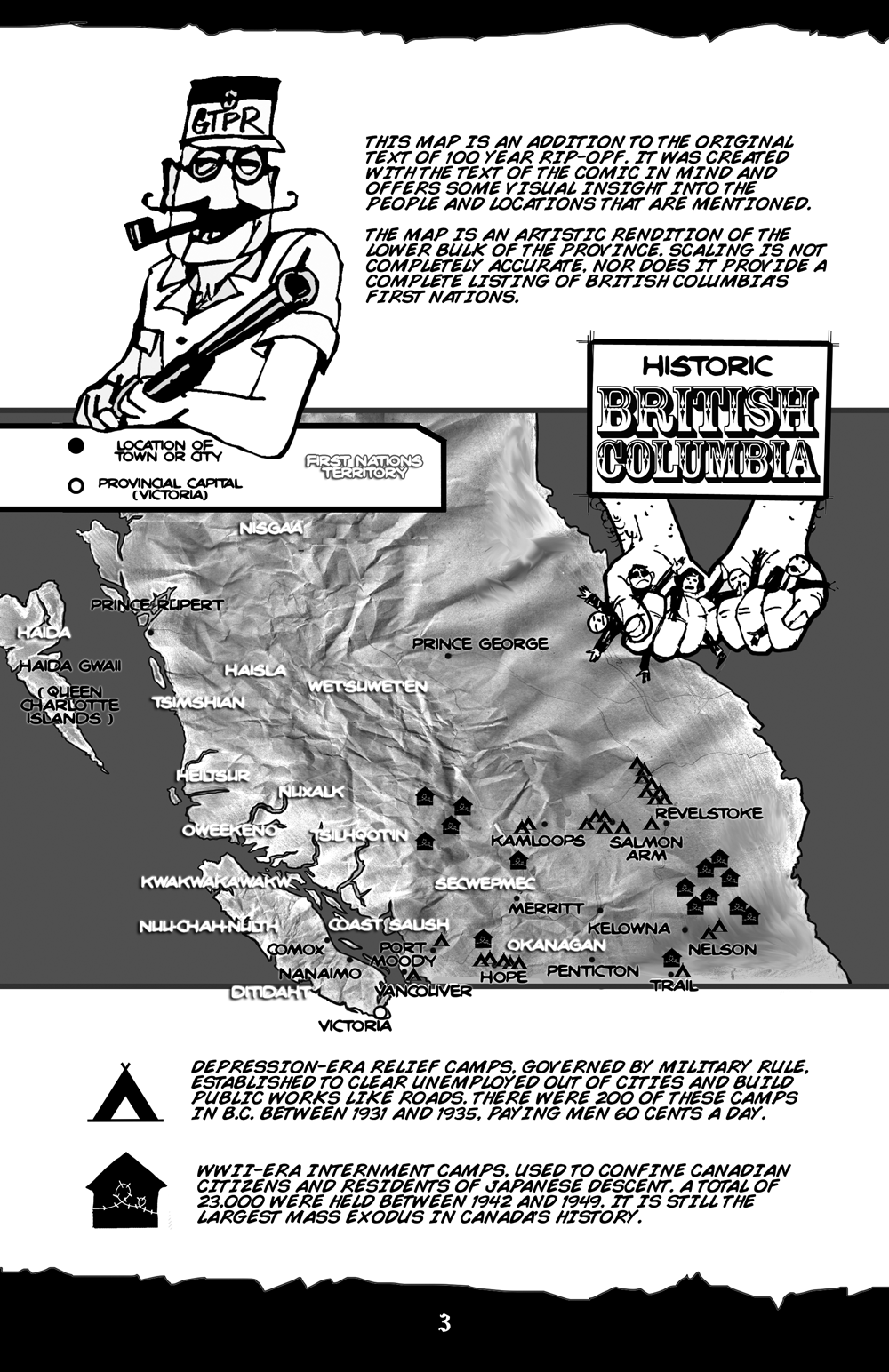
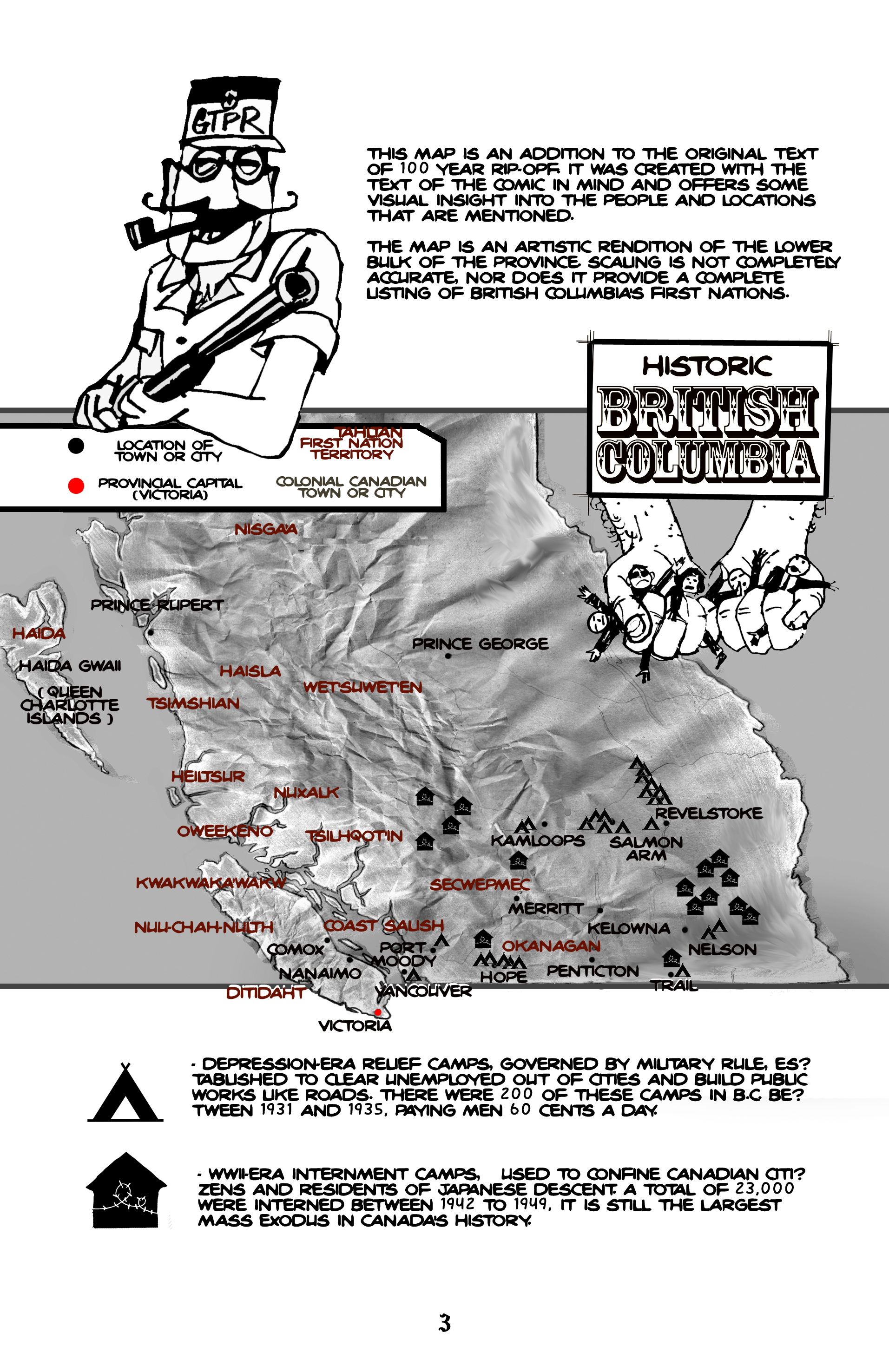
An exciting add-on to this momentous occasion (my first experience with “printing”/”publishing”) is some supplementary information that I’m providing within this graphic history of British Columbia.
Click to enlarge
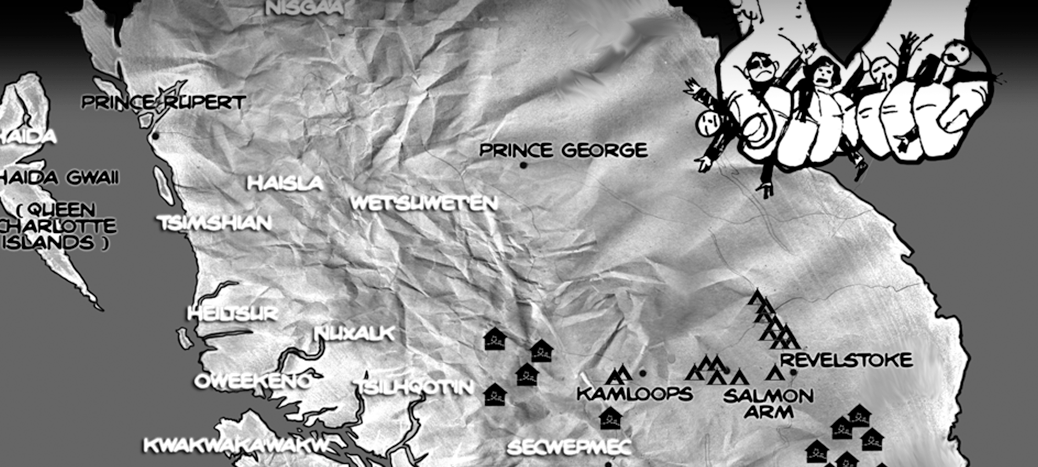
Posted here is an “Historic” Map of B.C. that I’ve drawn. It includes the territories of First Nations in the province; relief camps during the 1930’s, which were hotbeds of squalor and social unrest; and finally, the locations of B.C.’s 15 WWII-era internment camps, where thousands of Canadian citizens and residents of Japanese descent were held against their will. It was the largest mass exodus in Canada’s history.
Needless to say, I was a bit surprised that even this basic information (the numbers and locations of these camps around B.C.) necessitated several hours at the Toronto Reference Library. You think everything is on the internet… until you want to investigate history in detail.
While the map is located on page 3 of this 30-page comic book, I have also added a glossary of names and terms to the back, for those outside of B.C. who may not immediately understand that B.C. Hydro is our public electricity company, or that the I.W.W. stands for Industrial Workers of the World.
I look forward to your feedback! If this is up your alley, then stay tuned – #100Year Rip-Off will be available for purchase as a 30-page comic book in July 2013!
At the Toronto Comic Arts Festival this year, I posed a question to a number of comics creators: Why has Comics Journalism taken hold so well in comics, but so poorly as a quote-unquote “legitimate” form of journalism?
The response of many was that, to the contrary, no one has said that comics journalism isn’t legit. My response in turn, was that we still can’t open up 99% of our printed media in North America to find an example of this incredible genre. 99% is probably generous. 99.9%.
Symbolia Magazine had a rebuttal for me.
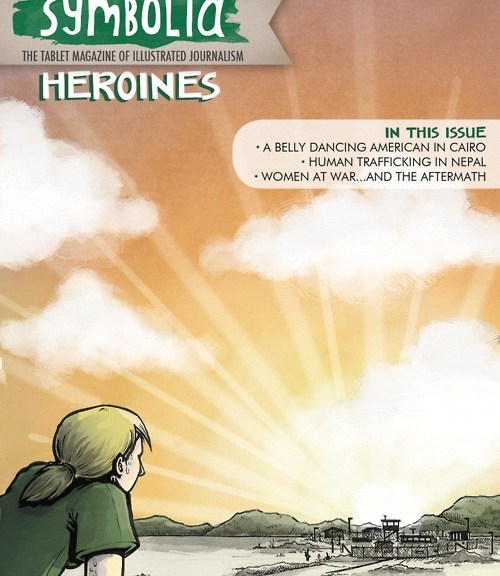
Here is a magazine that is entirely devoted to Comics Journalism, or Cartoon Journalism. The publication is a pay-per-issue or by annual subscription, available for online viewing through interactive PDF’s. Another term for interactive is best thing ever.
There is such a huge variety of work available here, from artistic style to focus of journalistic investigation. Whereas most of the work (that I’ve read thus-far) does not include the journalist in the story, there is a strong sense of personalization nonetheless through the images that depict the subject of the accompanying words. Subjects range from war to the story of an artist who wanted to build the world’s first museum devoted to insect genitalia.
The focus isn’t politics or making stories personal. The focus is simply comics journalism, which lends itself to exploring a wide variety of topics from the beginning to the end of each issue.
Definitely check out Symbolia, if you haven’t already. I plan on continuing my subscription and reviewing individual pieces as they come up.

 FOR IMMEDIATE RELEASE















 R: Well, the first thing is that I don’t really consider “BRANDED” to be a superhero story per se, nor will The Brander have any extraordinary abilities (although the secret identity trope is very much a part of the character). That’s because she or he is very peripheral to the story and only gets minimal page time. Instead, most of the story centers on a group of characters whose lives are impacted in different ways by The Brander’s actions, which are at best controversial and morally not so easy to justify. Readers familiar with the “women in refrigerators” phenomenon (sparked by Gail Simone a number of years ago) will be familiar with the argument that too often in comics, we see female characters maimed, raped, incapacitated or killed off ruthlessly and abruptly, usually in order to provide a motivation for the protagonist/superhero. “BRANDED” eschews such shock-value devices and instead depicts women as survivors (not just victims) of male violence and its consequences. The presence of The Brander–a vigilante who has decided to seek redress for women survivors of male violence because the law has been deemed incapable of providing this-is meant to provoke readers into thinking about what sort of factors would actually drive somebody to adopt such a role. In real life, it’s estimated that only a fraction of sexual assault incidents are reported to the police by survivors and of these statistically only a fraction result in a conviction or imprisonment, so I think this theme of absence of redress or lack of justice is a very real one for many survivors of violence. My idea was to have a vigilante who went around branding the faces of perpetrators of sexual violence in order to expose them and place the burden of shame and stigma on them rather than the survivor, which is what we tend to see too often in real life. The Brander, despite only having a minor role in the story, is meant to embody the response (albeit a dramatic one) to this absence of redress and there’s a certain inevitability to the character’s appearance that I hope comes across when we bear the statistics in mind. When we recall the example of the vigilante group “Anonymous” and their intervention in the recent Rataeh Parsons case, The Brander isn’t too far a stretching of reality.




 adastracomix.com