World War 3 – #44 – The Other Issue

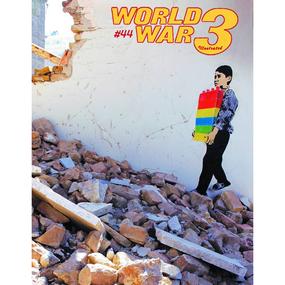
coverWorld War 3 is America’s longest-running radical comics anthology. While I’ve never reviewed an issue for Ad Astra, a lot of radical comic artists (including those I’ve featured here) have graced their pages. This issue took on the idea of “the other” – when ideas and people are perceived as alien, even opposite or in conflict with the given norm.

Issue #44 includes:

“Alien Europe” by Ganzeer – An exploration of cultural differences across time and space. This appears to be based on a lecture, or perhaps just a thought process of the author, but he shows how all culture is, in short, a homogenization of converging cultures.

“Single Lens Reflex” by Sandy Jimenez – Autobiographical piece about gentrification, photography, and class dynamics in artistic interpretation. That description makes it sound stuffy and academic, but it is extremely personal and heartfelt. I think this is an amazing story that is told very well. Sandy Jimenez has a great understanding of memoir narrative–looking back on a feeling that he had over a period of years and identifying how it developed, how he came to understand and overcome it, and what remains. A gem – one of my favourite contributions to the issue.

SLR_page9

“Kemba Smith” by Sabrina Jones and Marc Mauer – part of a larger book called Race to Incarcerate: A Graphic Retelling about the U.S. prison system (available as of April 2013 from The New Press). “Kemba Smith” tells the story of a 24 year old college student with no previous record, who was sentenced to 24 years in prison for her connection to her drug-dealing boyfriend.

“Charest, Dehors! Inside Quebec, Out in the Streets” – by Jesse Staniforth and Dan Buller. Great personal account of the massive student protests in Quebec – a story that we’ve yet to fully unravel and appreciate in the rest of Canada/North America in general. Great illustrations from Dan Buller, mostly from photographs from the protests, accompanied with reproductions of some of the protest/street art that appeared over the course of the action.

“Baddawi” – A comic memoir by Palestinian American comic artist Leila Abdul Razzaq, who has illustrated her family history from Israel’s 1948 ethnic cleansing campaign, to her father living as a child in a refugee camp, to her own modern-day self. Making her debut in this issue of WW3, Razzaq focuses on her family, showing  how her grandmother survived Al Naqba at the age of 17, and how her father became the most successful marble tycoon of their family’s refugee camp.

Further notes: Razzaq’s style is very simple. My first impression was that it reminded me of Satrapi’s Persepolis for its simple line work and good use of contrast. But on further inspection I see some interesting and original details–garments with designs that are distinctly Palestinian, imagery of invading soldiers coming out of the ocean. I think Razzaq probably faced/faces the challenge of having content in her stories that is so powerful, it can overshadow or overpower her artwork. It’s a good challenge, and I can’t wait to see how her work develops and evolves with her storytelling.

“A Real Hero” by Tom Keough –  A personal memory of the artist and two friends sticking up for a man who was getting beaten to death by a group of men in the street.

“One Rainy Night” – Peter Kuper’s enactment of a conversation with a once-rich and beautiful woman. This one-page piece is part of a larger body of work entitled, Drawn to New York: An Illustrated Chronicle of Three Decades in New York City.

“One City, One People, One Planet” – The legendary Seth Tobocman makes some inspiring observations about the human response to Hurricane Sandy.

“Nap Before Noon” by Barrack Rima – translated from Arabic and read right-to-left, tells the story of the authors first trek into Europe as an immigrant.

Devil Dog: The Amazing True Story of the Man Who Saved America

coverTitle: Devil Dog: The Amazing True Story of the Man Who Saved America
Author: David Talbot
Illustrator: Spain Rodriguez
Published: 2010 by Simon & Schuster (Pulp History Series)

It’s almost impossible to fathom the life of Smedley Darlington Butler. He began his military career at 16 (in 1898, in response to the supposed Spanish attack on the U.S.S. Maine off the coast of Cuba), and spent the next 34 years rucking and getting shot at in China, the Philippines, Central America and the Caribbean. He would also serve in WWI, being deployed in France.


If that were not enough, consider that in Butler’s final years he was among the country’s most decorated veterans and fiercest critics. Just 5 years before he died, he wrote a book called “War is a Racket” about the nature of the U.S. military industrial complex—a slogan that still gets used today in the anti-war movement.

Unfortunately Smedley Butler’s incredible story fades with each generation. The idea that “War is a racket” became at risk of becoming just another dusty and out-dated slogan of protest.

What “Devil Dog” brings to the table is a remix on a story that’s too good to forget in the past and too important to leave on the fringes.
smedley spread
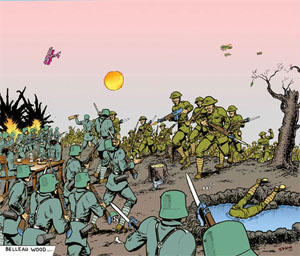
Staying true to the look and feel of its “Pulp History” series, Devil Dog is actually a book of prose dotted with vibrant comic art by the wonderful Spain Rodriguez, in addition to press clippings and other contemporary visuals- art, photographs, etc.–all of which lends to the “Pulp” nostalgia that the series is shooting for. It is, much to my pleasant surprise, a very artfully written piece—you can tell Talbot is engaged by the story and wants you to feel it, too—with each chapter feeling like its own self-standing story of adventure, suspense, romance. Spain’s illustrations, especially with the Technicolor palette choice, really give the book the feel of an old pulp adventure comic.

devil-dog-belleau-wood_300w
More importantly, Smedley’s anti-imperialist politics aren’t editorialized by the book’s creators. In fact David Talbot goes out of his way to illuminate much of Butler’s military adventures (even prior to his anti-war awakening) as campaigns of corporate adventurism. He has probably taken a cue from Butler’s own memoir-styled book, where he is looking back on everything that he did with mature hindsight.

I would recommend this work to anyone interested in American war / anti-war history: it truly is a gem. The narrative is one that works well for being told aloud—if it weren’t for a few passages of sex and violence, it would be an amazing story to read to kids.

If you want to know more about the work, S&S actually made a trailer for their Pulp History series- and you can check that out here:

ScreenHunter_12 May. 04 11.20

Matt Bors Event Press Release

AA leaflet image

FOR IMMEDIATE RELEASE
Political Cartoonist Matt Bors in Toronto to Talk Up New Book,  Afghanistan Trip,
Comics Journalism & Activism

Event Spokesperson: Nicole M. Guiniling (Ad Astra Comix)
Phone(647) 863-4994
E-mailnicolemarieguiniling@gmail.com
URLwww.AdAstraComix.com

Between May 9 – 11, political cartoonist Matt Bors will be in Toronto showcasing his new book, Life Begins At Incorporation: Cartoons and Essays. In addition to exhibiting his work at the Toronto Comic Arts Festival (TCAF) May 10 – 11 at the Toronto Reference Library, Bors will be presenting his work on Friday evening, May 10 at 7:30PM at the Toronto Comic Book Lounge.

Matt Bors is a nationally-syndicated political cartoonist, editor, and writer based in Portland, Oregon. In 2007 at the age of 23, he was the youngest nationally-syndicated cartoonist in the United States. Since then his work has graced the pages of WIRED Magazine, The Los Angeles TimesVillage Voice, and The Nation.

Life Begins at Incorporation is Matt Bors’ second book. It received 170% funding on the website Kickstarter in 2012, and was released to funding backers and pre-orders in April 2013. It features cartoons and essays on a variety of topics, from gun control, women’s rights, and the environment to the Global War on Terror (a segment of Bors’ talk is devoted to his trip as a comics journalist to Afghanistan in 2010).

In 2012, Bors was both a Pulitzer Prize Finalist for Editorial Cartooning and the first alternative-weekly cartoonist to win the Herblock Prize for Excellence in Cartooning. At a time when political cartooning is widely considered to be a ‘dying art’ by the journalism industry, Bors’ cartoons have received significant mainstream political traction. In 2012, one of his works was presented by U.S. Congressman John Larson during a house floor debate on the Affordable Care Act, while another piece about Osama Bin Laden’s driver, Salim Hamden, was smuggled to him while he served as a detainee of the Guantanamo Bay Detention Camp.

Bors is available to interview in-person during his stay in Toronto May 9-11, or by phone at the interviewer’s convenience.

Interested parties can find examples of his work and more information on his website, www.MattBors.com. A .PDF copy of Life Begins At Incorporation is available for review upon request.

“The Political Comics of Matt Bors,” is organized by the website Ad Astra Comix, which reviews, researches, promotes and distributes political and historical comic art.

What People Have Said of Bors’ Work
(Quotes From the Back Cover of Life Begins):

Life Begins at Incorporation is equal parts maddening and hilarious. Matt Bors reminds us that in an unjust world, laughter is an absolute necessity. The only disappointment in this book is that despite my wishes to the contrary, ‘The Avenging Uterus’ is not in fact real.” – Jessica Valenti, founder of Feministing.com & author of The Purity Myth

Bors embodies the highest virtues of political cartoonists: fearless, provocative satire and cutting, acerbic insights. He’s also unfailingly funny.” – Glenn Greenwald, columnist for The Guardian

Able to eviscerate a target with a single panel. You never want to end up on the wrong side of his pen 
and ink!” – Markos Moulitsas, Publisher, Daily Kos

Bors has the right stuff and then some.” – Christopher Hitchens, author of God Is Not Great

A bunch of cunty liberal garbage.” – Person on the Internet

Uncovering and Re-mastering “100 Year Rip Off: The Real History of British Columbia”

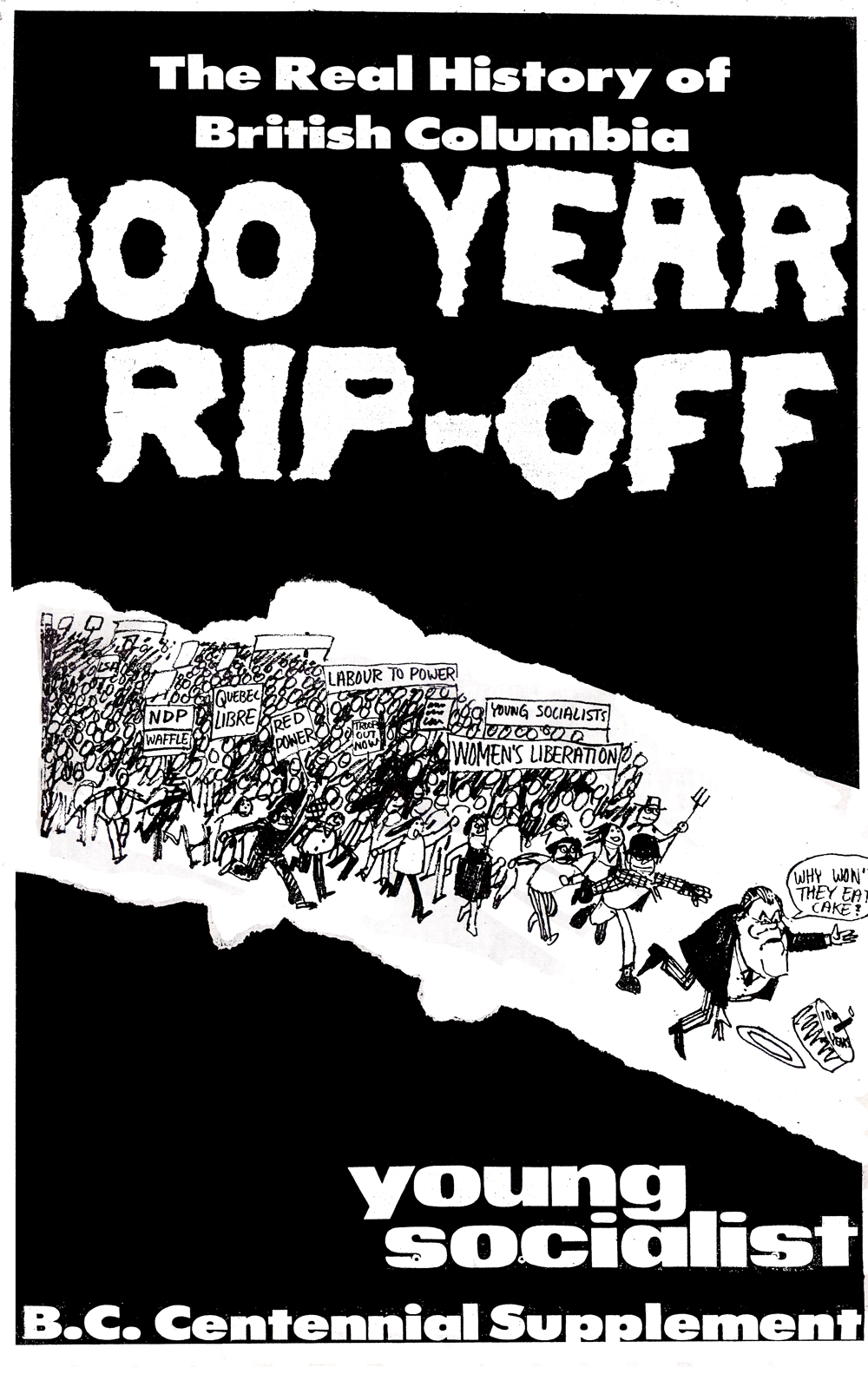
edited_cover_smallerSome time ago now, I was more deeply submerged in socialist literature than comic books. Luckily, when I received an old, shoddy copy of this tabloid-sized piece, I kept it.

Originally released in 1971 for the Centennial commemoration of B.C. joining Canada, a group called Young Socialist released this tabloid-sized comic history as a reading supplement. Despite a few out-of-date depictions (a short section on Chinese migration building the B.C. railways is crudely stereotyped), the work is stylistic and well-researched, in addition to lending insight into labour tensions (particularly the BC Fed vs. rank and file workers) in the province at that time.

I am now at the point where, as much as I want to review every new political comic release that is coming out, I too want to dig for those historic gems that were far more ahead of the times than they ever could have imagined. Who would have thought that in the last decade alone, the category of “educational comics” ranging from history and economics to science and the arts would be in a scramble for an exploding market? “Graphic histories” have popped up like weeds on every subject and personality; they are now the bread and butter of a middle school classroom.

My copy of 100 Year Rip Off is in good condition, but is the copy of a copy that wasn’t. I haven’t been able to find another copy online, and can only assume that other remaining copies in the country are most likely in personal collections. I have scanned it onto my computer and plan to spend the next few weeks re-mastering the images, to have it available as a downloadable .PDF file. It’s a wonderful piece of Canadian radical history, and I look forward to seeing it the way it was when it first came out.

“Wage Theft” Educates Workers About Their Rights

View the comic as a PDF file in both English and Spanish.

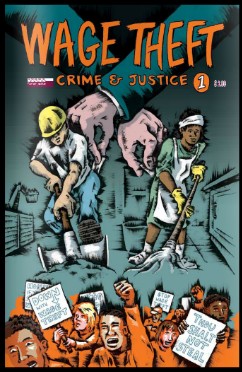
This is an interesting new comic that’s just been brought to my attention. It’s called Wage Theft: Crime & Justice (1# – will there be a series?), and is more or less an educational pamphlet that details interviews with low-income earners (including migrant and undocumented workers) who are experiencing illegal cuts to their pay checks from their employers. The project appears to have been launched by a group called Interfaith Worker Justice out of Texas, with grant support from a couple of different church groups.

Wage Theft is written by Jeffry Odell Korgen and illustrated by Kevin C. Pyle (whose work includes Take What You Can Carry, Blindspot, and Prison Town. He is also a former co-editor of World War 3, America’s longest-running radical comics anthology.)

If you have trouble viewing the booklet above, try this link here.

Days of Destruction Days of Revolt – By Chris Hedges and Joe Sacco

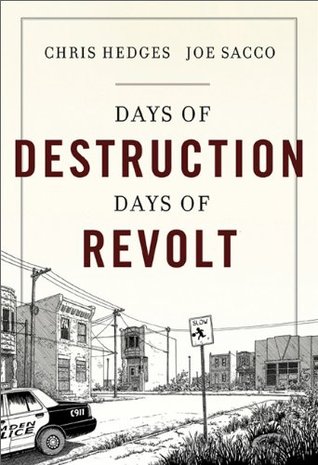
cover DDDRTitle: Days of Destruction, Days of Revolt
Written by: Chris Hedges, Joe Sacco
Illustrations by: Joe Sacco
Published: 2012 through Knopf Canada (a division of Random House Canada)
List price: $29.95 CAD

Chris Hedges was trained to be a minister, and Joe Sacco is known to draw comics. Both, however, have made their strongest marks within the realm of journalism: Hedges as a foreign correspondent reporting from Central America, the Balkans, the Middle East, and Africa. Joe Sacco made comics journalism a concrete category with works like Palestine, Safe Area Gorazde, The Fixer, and others.

It seems only natural that the two would work together. They have overlapped each other’s geographical locations of coverage on a few occasions, particularly with Israel/Palestine and areas in the Balkans. Both understand the complexity of what they investigate and the need for empirical as well as historical inquiry.

immokaleeBut what I find intriguing about Days of Destruction, Days of Revolt is the way I see their previous work illuminate these pages to reveal a truly devastating picture of the state of America. Hedges draws on a treasure trove of historical events he has personally witnessed or painstakingly researched to show how the elite of the U.S.A. may not be as invincible as they think; Sacco’s trademark illustrations immediately recollect visions of a street in Gaza—and yet, I’m not looking at a street in Gaza here; I’m looking at a street in Camden New Jersey or Immokalee, Florida.

To be clear, the book is about a little more than destruction and revolt. Those two points are the focus of two separate chapters. Others include:

Days of Theft:  Pine Ridge, South Dakota

Days of Seige: Camden, New Jersey

Days of Devastation: Welch, West Virginia

Days of Slavery: Immokalee, Florida

Days of Revolt: Liberty Square, New York

What is recounted in these pages isn’t sensationalism. Sensationalism would imply that truths were stretched, or quotes taken out of context. What it amounts to is a gallery of some of the worst places to live in the United States today—regions termed by Hedges to be “the sacrifice zones” of unfettered capitalist exploitation. And therein lies the fundamental trouble with DDDR which digs at you through your read of it: that is, from cover to cover, it’s all true.

west virginiaEach chapter is an article written by Hedges, documenting their travels to a particular site. Locals are interviewed and are the subjects of most of Sacco’s illustrations in the book (his work is typically either a landscape for an area, or a person talking of their experiences.) Within this format, Hedges makes invaluable use of his time as a foreign correspondent, drawing on that experience to show how these regions are being treated much the same as third-world countries under foreign occupations, domestic dictatorships, or the suffocating yoke of international debt. This is contrasted with his written descriptions (and Sacco’s visuals) of the people who inhabit these areas: most are simple people whose definitions are blurred, sometimes completely overtaken by the hardship around them. Hedges and Sacco point out strength and sacrifice in those they interview, as much as they profile individuals who, understandably, in the words of Hedges, are “living lives in which tenderness and security are grabbed in desperate snatches.”

This work is truly a testament to those most voiceless in America today—from West Virginians dying of the coal industry’s carcinogenic air, to the millions of Latin Americans living a modern-day slavery Hell in the American South. Their stories are illuminated with Sacco’s artwork, and their finds profound historical, philosophical, even moral depth with Hedges’ words.

It will disgust and anger you, but it is a must-read.

First Order of Books In!

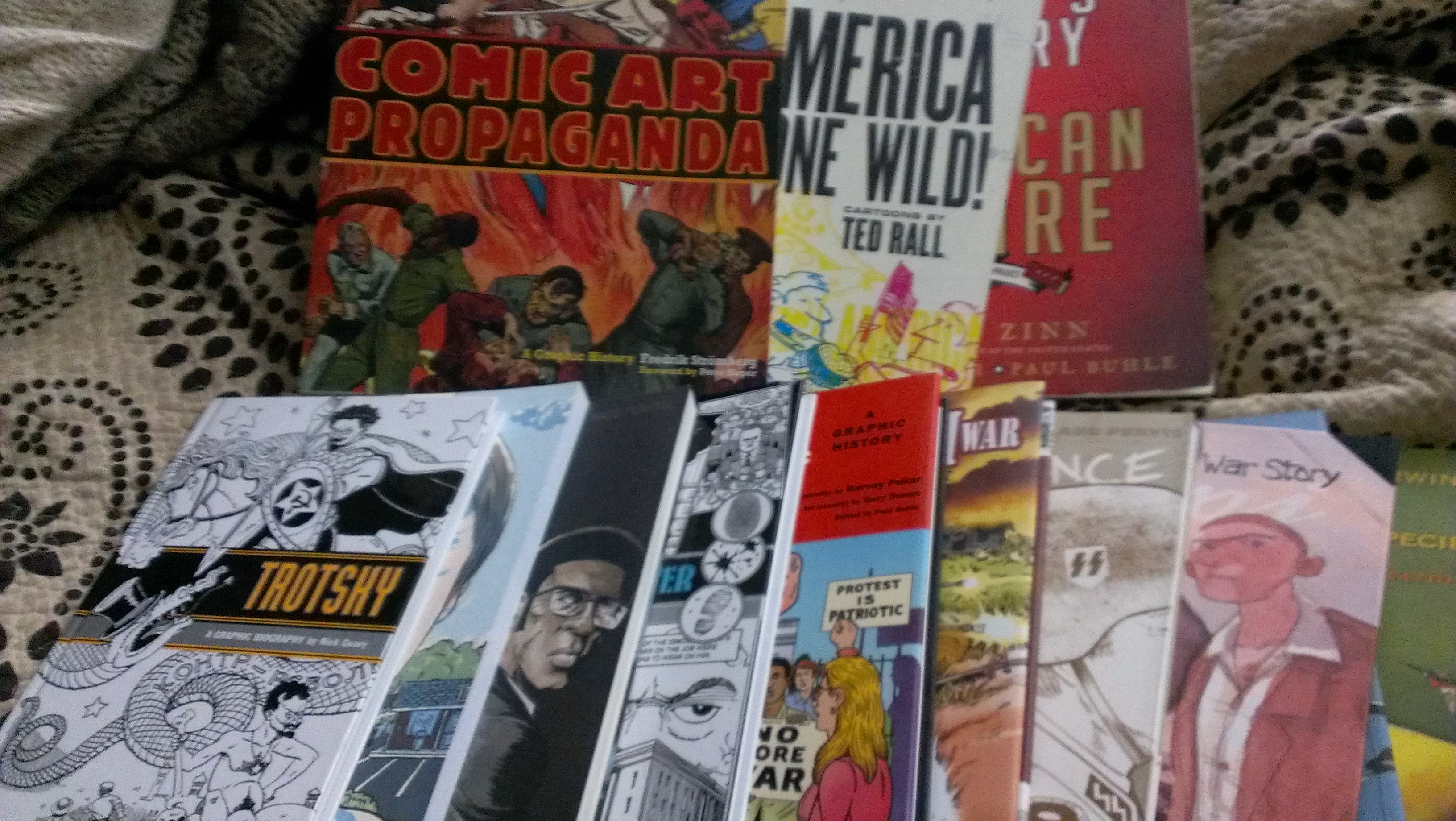
April 24 – Well, I didn’t foil a terrorist plot to derail a train in Ontario today — nor did I sternly warn North Korea to cease its reckless behavior. The big news in my world is that my very first shipment of political comic books came in the mail today.

new arrivals

Beginning in May, I will be tabling at a variety of cultural and political events to talk and sell political comics in Toronto. Why have I decided to launch as a distro? There are a couple of reasons… I love recommending books to folks, and I like being able to provide a way for me to pass on what I’ve read to others (the distro will include both new and used stuff), I think political comics are like most specialty comics: you can find a few at any given comic shop, but almost never a full and decent selection–I want to do this. And now for my favorite reason: activists, history buffs, and political junkies don’t go to comic shops. Comic book people go to comic shops. I want to bring political comics to folks who don’t think there’s anything for them in the medium.

If you’re in the Toronto area and have an event that you believe could benefit from such fine graphic literature, please drop me a line–thanks!

The Political Comics of Matt Bors + Launch of Ad Astra Distro

Fellow Torontonians, I hope you’ll join us on Friday May 10 for an incredible presentation on political cartooning, political comics, comics journalism, and more at Ad Astra Comix’s first event: The Political Comics of Matt Bors. Matt will be in town for the Toronto Comic Arts Festival (TCAF) happening that weekend at the Toronto Reference Library, and to promote his new book, Life Begins at Incorporation.

Here is a copy of the poster we’ll be putting up beginning this week:

May-10-Poster-1

In conjunction with the event, Matt has agreed to have his book distro’d by Ad Astra Comix here in Canada, which is pretty exciting. So the event is also a launch for Ad Astra to begin actively distributing political comics!

I’m also extremely grateful to the kind folks at the Comic Book Lounge for inviting us into their space. It’s so nice to have comic shops that are not only supplying me with my next fix of comics, but also see themselves as an integral piece in an active and vibrant community- and Comic Book Lounge is an enthusiastic believer in this.

In addition to a presentation, where will be a book sale and signing, a bar lovingly stocked with local beer and wine, and free snacks. I can’t emphasize enough that there will be free snacks.

Folks can RSVP for the event on Facebook here. We look forward to seeing you there!

Dark Rain: A New Orleans Story

Dark Rain_DJ_D.inddTitle: Dark Rain: A New Orleans Story
Author: Mat Johnson
Illustration: Simon Gane
Published:  2010 by Vertigo Comics

Dark Rain is a fictional heist story set against the backdrop of an historical moment in both time and space—a flooded New Orleans immediately after Hurricane Katrina in 2005. When Katrina hit, I personally thought it was an event of such a magnitude that it would find its way into more comics. After all, it’s a medium that has a long reputation for wrapping current events and recent history into its story lines. What I find interesting about Dark Rain, though, is that it is more true than most readers realize while they’re reading it.

There are two fundamental elements taking place here. The first is that there is a fictional narrative of Dabny and Emmit, two ex-cons who, despite a recent history of bad luck, now see a golden opportunity to rob a flooded bank. This comes into conflict in two ways. They are physically confronted with the reality that Dark Rain, a private security contractor (read: mercenaries) have been deployed to protect the bank, and their twisted Colonel has a similar heist plot in mind.  They are also socially and morally confronted with the reality that the people around them, their neighbors and fellow community members, desperately need their help.

DRGNK.HC #1.final.qxpThe second over-arching element is a political and social commentary of how Hurricane Katrina was handled: how the event intervened in millions of lives, and subsequently, how opportunists intervened in the disaster for financial gain—a reality that has been under-reported, largely because it was in the aftermath of the disaster, after camera crews and reporters packed up and went back to their regularly-scheduled programs.

Seriously, I have yet to find a review of Dark Rain that points out what, to me, was so obvious it made me buy the book—the fact that the name Dark Rain is an allusion to Black Water, the largest private military contractor in the U.S. at the time. They have since changed their company name to Academi, in the face of horrifying investigations into their practices both in the U.S. and particularly Iraq (as of right now, in 2012, there are more private military contractors in Iraq than there were U.S. soldiers, ever. A reminder that the Iraq War is still going on—it has just been privatized.) For more information about this, I highly recommend picking up Jeremy Scahill’s book Blackwater: the Rise of the World’s Most Powerful Mercenary Army

Now I don’t know if Mat Johnson had this in mind, but I find it incredibly difficult to believe otherwise. Blackwater was deployed to New Orleans immediately following Hurricane Katrina, to protect “valuable assets” in the city. There is a great video of Scahill talking about witnessing this first-hand while he was covering Katrina as a reporter for Democracy Now!. After hearing that testimony from an award-winning investigative journalist, I also find the storyline of a heist to be ironic—if not, also, subtly alluding to Blackwater’s activities. Scahill points out in the talk that the company was hired by the Department of Homeland Security to deploy to New Orleans, at a cost to U.S. taxpayers of $950 per man, per day. If that’s not a heist, I don’t know what is.

Blackwater (Academi) military contractors deployed in New Orleans, 2005

I’d like to think that was all part of Mat Johnson and Simon Gane’s plan… but I’m still having a hard time tacking that hypothesis down as proven–seriously, no one has written about this?! Still, it gives me pause to think about some of the critical reviews I’ve read of this work. The common criticism of Dark Rain is that the personal story doesn’t mesh with the social/political commentary. Maybe those reviewers, in reality, are complaining of all that space those written words. As the cold hearted Colonel would say….


read between the lines

The Silence of Our Friends (2012)

coverTitle: The Silence of Our Friends
Authors: Mark Long and Jim Demonakos
Illustrator: Nate Powell
Published: 2012 by First Second Books

L.P. Hartley said, as noted in the book, “The past is a foreign country. They do things different there.”

Taking place in Houston, Texas, in 1968, The Silence of Our Friends is a brief memoir of Mark Long’s childhood against the backdrop of his town’s peaked racial tension. The title comes from that famous quote by Martin Luther King Jr., who said, “In the end, we will remember not the words of our enemies, but the silence of our friends.”

Long was raised in a white, Liberal, Christian middle-class family—as American as apple pie, it seems. They find themselves in Houston when Mark’s father, Jack, moves the family to take a job as a TV camera man and the TV station’s “race reporter”. Through his job, Jack befriends a local Civil Rights leader, Larry, a teacher who has rallied students at a segregated university in the 3rd Ward—Houston’s impoverished African American community. The school’s administration banned the right of SNCC to organize (The Student Non-violent Coordinating Committee—a nationwide student group elemental in the rise of the Civil Rights Movement on post-secondary campuses). For more information about this history, I recommend reading a [White-written] news article from the time period, complete with all its presuppositions and bias. This 1967 piece from Harvard Crimson paints a pretty good picture, in addition to providing background on this chapter in Houston’s history.

Despite significant tensions, Jack and Larry’s families attempt to forge a bond in a time and place when it was considered against the rules for African Americans to be in a “white” neighbourhood  even at the invitation of community members, and the Ku Klux Klan openly passed out flyers for their monthly meetings.

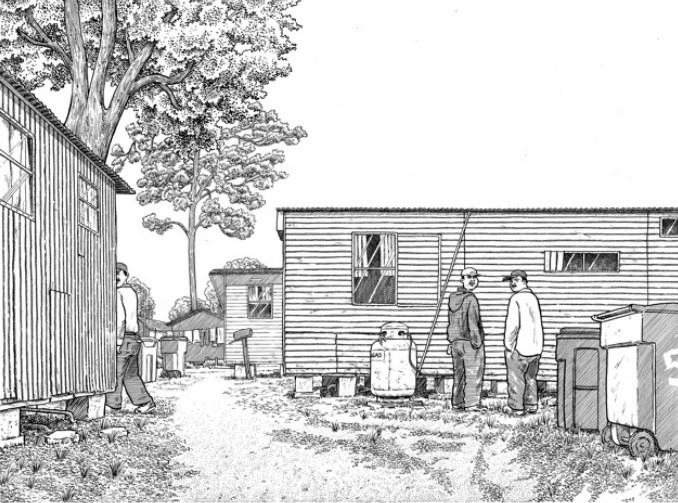
soof_artworkThe story is told masterfully against many different backdrops that reflect the memory’s time and place: images of the Vietnam War constantly on TV, rodeos and ‘crabbing’ as weekend past-times. The writing displays an intimate recollection of the events of this time and place—subtleties that pop for modern readers, because so much seems to have changed. A little boy pretending that he’s a soldier in Vietnam; a mother politely arguing with a next-door neighbor about how the war is wrong; a Black man quietly observing that he hasn’t spoken to a white person for any length of time since he was in the Army. One of my favorite scenes is when the children of Jack and Larry’s families are getting to know each other. They spend a good minute just looking at each other. Then they take the time to feel each other’s skin and hair—to investigate difference innocently, without the obstruction of judgement or power dynamics. This is captured most beautifully by Mark’s younger sister, who is blind.

Nate Powell’s artwork equals the story in quality and care. I’ve been a fan on Nate’s work for so long that it’s sometimes impossible for me to appreciate the specific things he does to make a particular work stand out for what it is. The flow of panels here is so well mastered—using song lyrics of contemporary hits (like Sam Cooke’s  “A Change Gonna Come”) to guide us from one scene to another. His artwork is never static—each page is presented with an amazing overall aesthetic. Backgrounds jump from open and white to closed in and dark; the realism of a car driving down a street will be spotted with emotive/expressionistic shapes from the headlights. When I look at his work, I feel like I could be in a dream, where reality unhinging is a slight and beautiful thing. (I also can’t but notice that the subtitle of the work is “The Civil Rights Struggle was Never Black and White”–and Nate, who often works only in B&W, has used a lot of grey tones here.)

There is no other comic book that really compares to this work—it is unique and educational as much as it is personal and moving. However it seems to be opening the doors for more work of a common history—Powell has done artwork for another comic documenting Civil Rights history, March (Book One) written by Congressman John Lewis, Andrew Aydin. I look forward to adding this work, alongside The Silence of Our Friends, to my bookshelf.

soof_artwork2

the panel is political.