#SuperMOOC Week 2: Superman and Reflections of Masculine Idealism

superman_idealist

We’re nearing the end of Week Two over at Ball State University’s Gender Through Comics, (Twitter hashtag: #SuperMOOC), and we’ve been reading Superman Birthright by veteran comics writer, Mark Waid. I enjoyed listening to Instructor Christy Blanch’s interview with Mark last Thursday, which actually led me to pick up Birthright again–I’d put it down after 1 1/2 issues on Wednesday night, cause I just couldn’t get into it. But it definitely started to come together for me, and I’m glad that I’m now much more acquainted with one of the world’s oldest superheroes.

I’ve developed my own thesis by which to tackle Superman: he reflects our evolving notion of masculine idealism. A lot has changed in terms of how we perceive the “perfect” man or woman in the last 100 years. Superman keeps getting re-invented to reflect this. But what connects them? How is the Superman of the 1930s’ Action Comics still Superman just as much as Clark Kent in Superman Birthright? Maybe, to do this, we should look at what is noticeably different?

superman_vegetarian
“Living things have a kind of glow around them. They’re surrounded by a halo of colours. …I’m not sure if that halo is a soul or an aura or what. I do know that at the end of the life cycle, it fades pretty quickly and what’s left is… hard to look at. Empty in a way that leaves me empty, too….But when it’s there, my God, how it shines.”

Kent’s Vegetarianism

This is an interesting update–one that Mark Waid touched on in the interview, explaining that this wasn’t intended to just be New Age mumbo-jumbo, and I agree. I think he is effectively exploring a higher understanding by way of Kent’s alien super-abilities. I believe this to be one of the many positive effects of sci-fi culture on modern pop culture, equivalent to Christianity’s influences of divine idealism on the Renaissance, if that makes any sense. That is, we as humans develop notions that don’t actually exist, but come into existence by us imagining them as notions of God or another higher being, like an alien. Thus we develop interpretations of inalienable rights, Utopias, …. and, well, places where we don’t have to kill other living things just to survive. That is an idealism entrenched in lots of Sci-Fi, and Waid has selected it as a “Superman” trait. I think this was an excellent decision, and emphasizes that an ideal masculine trait, now, is to be able to empathize and connect with life around you.

Kent begins his identity as Superman by travelling the world and searching out knowledge and adventure. This is compared to Pa Kent’s time in the Army in Issue #3 of Birthright, but it reminds me a lot of Che Guevera in the chapter of his life when he wrote his Motorcycle Diaries. It reflects a deliberate and positive step in the maturation process.

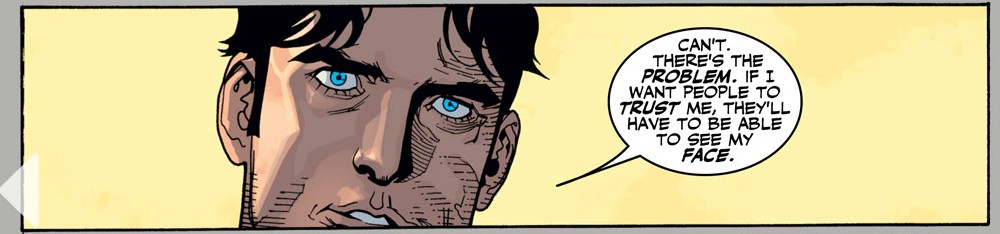
superman_isolatedThis ‘search for himself’ is coupled with the reality that Kent struggles with his identity and the gap that exists between himself and his [not-so-fellow] man. He describes that it never takes long for his relationships with other people being to break down, once his abilities become known. “Invariably, they freak,” he says. “They become retroactively paranoid, wondering what else Clark Kent is hiding from them.”

In my mind, this narrative runs parallel to the concept of privilege. In addition to being an alien with superhuman abilities, Clark Kent also happens to be an able-bodied white male, who was raised in the most powerful and militarily aggressive country on Earth: the United States. It shows him attempting to make friends with non-Americans in his travels, to no avail once they discover just how much more powerful [privileged?] he is than they are.
He struggles with balancing his desire to help people without isolating himself from them. He longs to be accepted as a human.
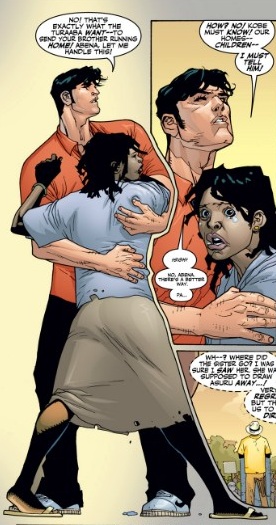
superman_whitemansburdenWhen Kent tries to advise a local African leader not to march because he foresees violence against him, the villagers are right to point out that he is a white outsider trying to dictate to them. It doesn’t mean Kent has bad intentions, and some readers may think that this objection makes the characters simple and petty, but there is real history and politics there that he is not, or has chosen not to be, aware of. If anything Waid downplays this in the story; in real life, I think a man like Kent would be facing serious trust issues well before he started lifting buildings.

On this note, I can’t help but point out that a summary of this plot line smells a bit of “white man’s burden”. Kent wants to help people who need help the most, so he goes to help a minority tribe in Africa. Some of the images depicting this are particularly noteworthy, like this one to the right, which could also be critiqued from a perspective of gender as well as race. What can I say? It’s hard to write realistic stories without touching real-life issues like politics, gender dynamics, race relations, histories of colonialism and imperialism, etc. Comics have traditionally been comfortable in their own universe[s], but that is slowly, slowly changing, and I think panels like this are an indication of both an attempt to be more real, while also clinging to old stereotypes. (I mean, really, how long has Abena known Kent? Two weeks? If I were her and this guy came out of no-where with mega perception and rock-hard abs, I’d think he was CIA–hands down.)

Waid uses a great term in the #SuperMOOC interview: comics are a “visual short-hand” form of storytelling. I acknowledge that it’s hard not to simplify human conditions and relationships. Duly noted, but I wouldn’t be doin’ my job if I didn’t point this stuff out.

A side-note: The epitomy of “cheeziness” is the absence of believability. Superhero stories are in a constant struggle to maintain believability. To do that, Superman is all about depicting things on the edge of what we can sense and understand: that means everything from the constant introduction of new concepts (logically), to the depiction of senses that we find difficult or impossible to detect, such as superhuman sight, hearing, and movement. The illustrations in Birthright are vital to this, and really carry the story.
superman_crying
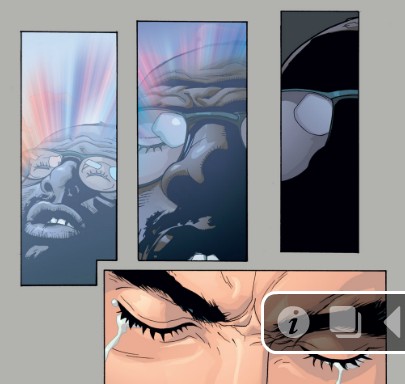
Linked to the first image explaining why Kent is vegetarian, here he sees his friend’s “aura” fade away, and he knows that he is gone forever. This effect emphasizes the pain and loss Kent feels, and is in turn emotional for the reader.

Superman crying: this is part of the evolution of masculine idealism, as well as the creative struggle for believability. The idea that men are supposed to hide their emotions is thankfully falling out of date as a prejudice that is both detrimental to men and world around them. Furthermore, emotion is an essential element within the anatomy of epic narrative: battles where life and death hang in a balance must make emotional connections. Crying , at least for any writer worth their salt, is not a sign of weakness in a character, but an indicator that they understand and are intimately connected with that world. As well, we ideally expect to see story characters crying around the points in the story when we, the readers, feel like crying. This connects the protagonist not only to the world around them, but to their audience as well, and creates a better story experience.
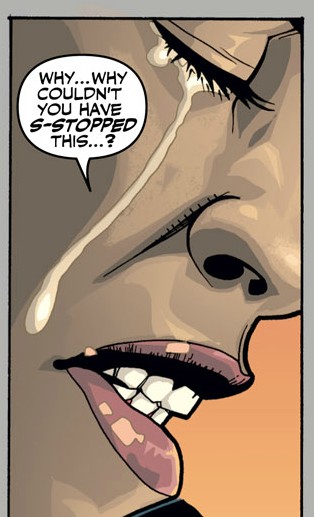
superman_perfectmaninimperfectworldPart of Superman’s modern-day struggle, invariably, becomes one of masculine idealism vs. realism: can a near-perfect man exist in an imperfect world? Since man can influence the world through his abilities and actions, and this man does, despite the world remaining imperfect—is he still a perfect man / an ideal? Is he still “Superman”?

Superman has traditionally had a strong father-son bond. This is a part of masculine idealism: ideal men come from ideal father-son relationships. This explains the place of prominence for Kah-el (Clark Kent’s birth father) in previous Superman narratives—as well as Pa Kent.

Pa Kent and Clark struggle to understand their connection, now that Clark wants to explore his extraterrestrial roots.
Superman is always an optimist. This distinguishes him from new superheroes, who are often expected to take on a “more realistic” perspective on the world, as well as old superheroes who have been reinvented within the modern “anti-hero” framework.

What to make of Lois Lane?
superman_loislane
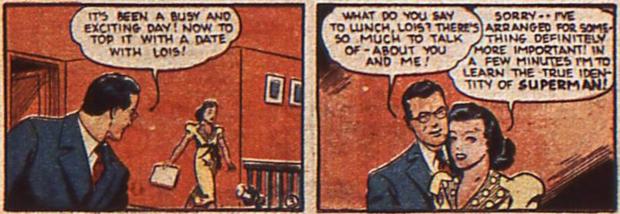
superman_loislane1944Superman is as much a reflection of the evolution of gender perceptions as just about any pop culture icon that outlasts a generation. But what do we make of Lois Lane? In the very first Superman comics, Lane was a very attractive, feisty and smart news reporter who is dedicated to her career and her independence, despite the occasional dramatic lapse of utter dependence on Superman and his supernatural abilities. In the most recent remakes of Superman, we see Lane as…. A very attractive, feisty and smart news reporter who is dedicated to her career and her independence, despite ALSO having the occasional dramatic lapse of utter dependence on Superman and his supernatural abilities. Despite some subtle changes, (and one really confusing case of Lois Lane turning Black for a day), the woman has remained much more glued to her original form.

If Superman has changed so much over 75 years, why not Lane? Was Lois Lane classic, at in her inception, already a progressive enough reflection of the female gender? Are comic creators’ notions of women and their ‘social evolution’ simply stagnant—it just doesn’t get any better? I’m unsure about this one, and want to give it some future thought. I actually think that it presents an interesting argument: gender perceptions of men have changed more than women in the history of comics. This is despite massive social, political, and economic changes in the status of women in that time.

I’m looking forward to reading others’ thoughts on this, as we continue with the #SuperMOOC class. Thanks for reading. More to come with Week 3.
A Piece of Thatcher Comic History!


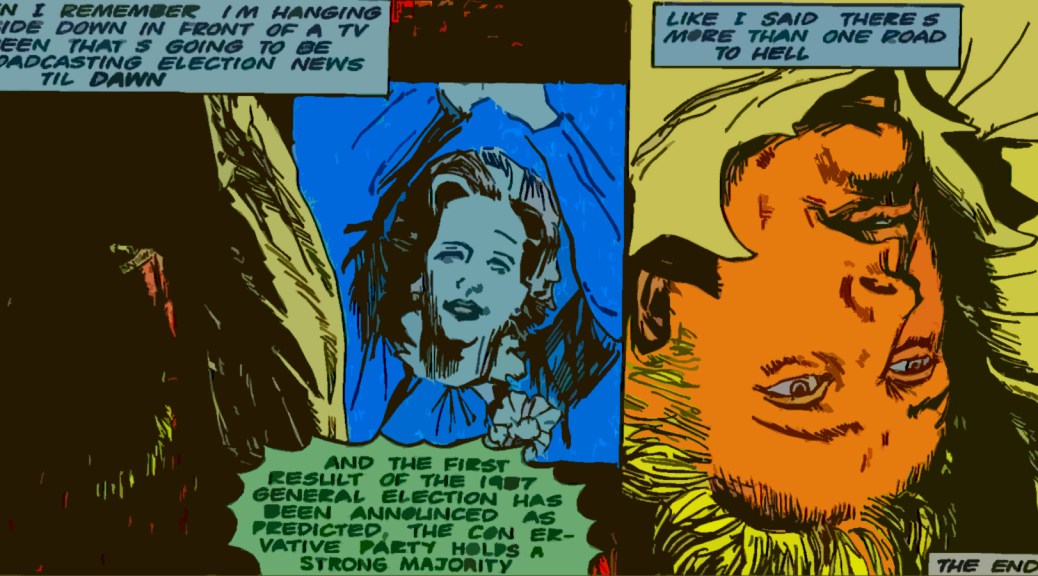
Well, I’ve barely begun my search and look at this comic rendition of Margaret Thatcher. The artist is sophisticated, from my point of view: he/she artfully portrays Thatcher in a position of victory with her arms raised, as this narrator, whose ideas are at odds with conservatism, has his own arms lowered in his captive defeat.

Anyone know where this is from?

tribute to margeret thatcher

#SuperMOOC Week 1: “Gender Through Comics” Intros with Strangers in Paradise

Of all the topics that could be discussed endlessly with regard to socio-political relevance in comics, Gender is probably the first that comes to mind. Discussions are literally endless.

It is also the topic I’ve personally grappled with most as well, as, to me, there really aren’t a lot of clear, pointed answers. Writing a concise blog post about the subject is downright impossible. So when the opportunity came along to take the online “Gender Trough Comics” MOOC, presented by educator and comics afficionado Christy Blanch, I thought it was worth a try.

What’s a MOOC, you ask? It’s new to me too. It stands for Massive Open Online Course – generally offered for free, and completed without the reward of academic credit. It’s a great realm that’s just beginning to blossom for people who are interested in education for the sake of education.

Our first week is generally about getting acquainted: with the material, the social networking platforms, and with 7000 other “classmates” with whom we share discussion boards and hashtags. (By the way, if you’re interested in enrolling, there’s still time: just check out the Canvas.net page. Comixology offers a lot of discounted material for the course as well, so it’s not too hard on the bank account either.)

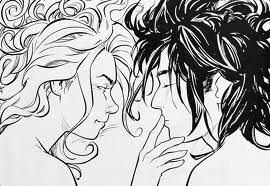
Strangers_in_Paradise_by_HappilyDayzedOur first set of reading material for the week is a collection of work by comics creator Terry Moore: Strangers in Paradise, Vols I and II; and Rachel Rising.
Needless to say, this is the beginning of the series, so characters are going to develop in complexity and change, but it is interesting to see where everyone’s starting point it. My thoughts on Strangers in Paradise, having just finished Volume 1, are as follows:

Moore is making a story that is composed of several gender stereotypes. You have Katchoo, the Man-Hating Lesbian: fearless, trouble-maker, liberated, smoker, cat-owner (all stereotypically associated with lesbians). You’ve got Francine, the Hetero Female: timid,lacking confidence/certainty, reactive (instead of pro-active), and seemingly unsure of what she wants in life. These are all stereotypes of a heterosexual/”man’s” woman, and it all boils down to the theory that women lack agency- this is something I’d love to explore more of later on.)
And we have Freddie. Familiar Freddie! The Hetero Male stereotype. My first thought was that he must be some hormone-raging college kid, maybe 19 or 20. Then he is revealed as a wealthy business man, probably late 20s, early 30s (owns a fancy car, etc.) He appears to be wealthy and successful, and yet he also seems bent on guilt-tripping Francine–implying some forthcoming insecurity/control issues.

I see two over-arching themes here that are the most impressive to me.

#1: Moore is transforming stereotypes into archetypes. That is, she is taking qualities that we normally perceive to be highly superficial about a person based on their gender or sexual orientation, and using them to compel the story forward. I’m finding this theory interesting, and am anxious to see if I still feel that this is true after reading the longer Volume 2….

#2: It’s clear that this comic is trying to convey that no one has a “normal” sex life. The next door neighbour in the story is a creepy Peeping Tom, Freddie accidentally brings home a prostitute to get over Francine, who is then removed from the scene by a 6ft, 250lb bull dyke*, who crashes through the apartment wall to reveal Freddie’s apartment neighbour celebrating his anniversary to his blow-up doll with a lil’ Champagne.

In future posts over the next month and a half, I’ll be adding my notes on various pieces of material from the syllabus. Feel free to send me your feedback, or ask me about the course.

-N

* – my apologies for using a potentially offensive term: however, “bull dyke” is the stereotype presented, and is differentiated from the stereotypes of  “lesbian” or even “man-hating lesbian”.

Citation for Comic Books

citation neededHey All.

While the place of this blog is very openly casual in its review and analysis, I see that slowly changing. As time goes by, I’m finding that the people who take interest in my writing and research are not looking at it for its entertainment value, but for its [potential] scholarship. The fact that there is not yet an established, comprehensive guide to citing the graphic arts (in all their variance of work) is testament to the fact that comic studies is still something of a Wild West, academically speaking.

Since taking on a research project earlier this year, I’ve struggled with the notion of comics citation. How would  it work? There are so many different types of comics out there. Likewise, comics is so rarely a single-person effort. How to you properly cite for Writer, Editor, Illustrator (not to mention penciller, inker, colourist, etc.)

I came across a piece on Academia.edu that I wanted to share. Maybe not a read for everyone, but if you’re within the realm of comics research, it might interest you.  (Heads up: Academia.edu is a social media platform for academics – just sign up like you would on Facebook, and you get access to millions of articles on every subject imaginable… yes, even Citation of comic books.)

Referencing Comics: A Comprehensive Citation Guide

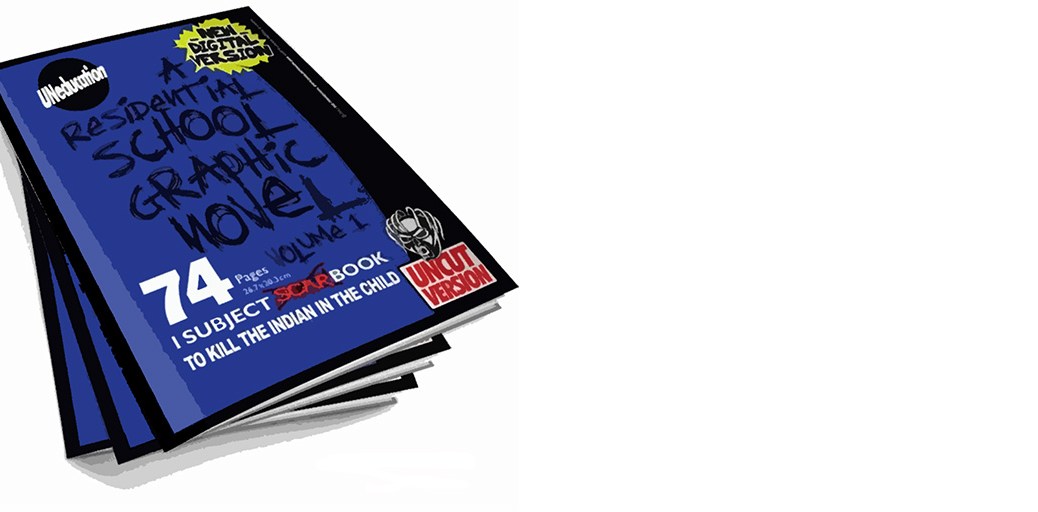
“A Residential School Graphic Novel” by Jason Eaglespeaker

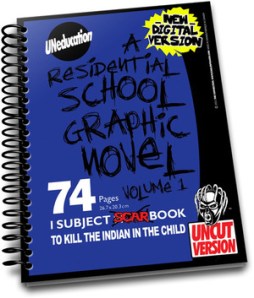
Quite some time ago, I made a preview post about a comic book that I hadn’t yet gotten my hands on: A Residential School Graphic Novel, by Jason Eaglespeaker out of Calgary, AB. A few weeks ago, the book arrived and I feel that the review is now long overdue.

residential graphic novelTitle: UNeducation Volume 1: A Residential School Graphic Novel
Author/Illustrator: Jason Eaglespeaker (with dozens of community names listed under “contributors”)
Published: 2011 by Jason EagleSpeaker via “The Connection” in Calgary, AB – with support from Alberta Foundation for the Arts and Canada Council of the Arts

You can tell that Eaglespeaker isn’t messing around: he has a vision and he means business. This project has the righteous and unwavering purpose of educating native and non-native alike on the raw and real history of the residential school system and its effect on the first peoples of this land.

In addition to loving comic books, I am also a lover of zines, political literature, scrapbooks—in general, I am fascinated by ideas and how people choose to convey them.

Eaglespeaker’s Residential School Graphic Novel is a mix of all four of the mediums that I mention. There are original comic narratives here, mostly told in the Black Foot language. There are scores of newspaper clippings, compiling news coverage from around Canada of residential school abuses, even murders, that have never been solved. Overarching this are quotes and core ideas about the residential school system that the author has selected to point out some fundamental truths: quotes like Dr. Duncan Campbell Scott, Deputy Superintendent General of Indian Affairs in 1920, who said:

“I want to get rid of the Indian problem. Our object is to continue until there is not a single Indian in Canada that has not been absorbed.”

…and so, generations of children were torn away from their families. Their heads were shaved, their clothes were burned, their bodies were bruised until they stopped speaking their language. Generations of children never learned what it meant to be a parent, because they had none. Family units and knowledge of the importance of those roles within a community began to disintegrate.

1996The format reminds me a lot of a zine: different sections use different methods of conveying these ideas. The beginning has quotes and newspaper clippings; the next section is oriented to look like a newspaper, called ‘Residential School News’ (it looks like the cover of Weekly World News). In it, the author uses his natural talent with slogans and sound bites to talk about some of the many issues that can be addressed with regard to residential schools: the psychology of being born with this severe emotional and cultural baggage, the storm of emotion at knowing that this baggage is not his people’s fault—that it was imposed, through the school system, by law; likening the treatment of native children to the treatment of POW’s in war-time; searching for what remains of native culture; and finally, settlement. Resolution. Eaglespeaker points out that the last residential school closed in 1996. (That’s right 1-9-9-6, as in less than 20 years ago).

Towards the end of the book are several short comics. The first depicts a native mother having her child torn away from her. The text is in Blackfoot, which, as a non-speaker of the language, emphasizes the realness of the story. It also makes me feel like I don’t have control—I’m an outsider, a bit, I guess—as I’m reading it, and I can only imagine flipping that around and being in her position as she approaches the residential school, asking for her child, and everyone is talking in English. Or the next scene, where the children are in school, and a nun slams a little boy’s head on his desk for speaking in Blackfoot.

Monochrome colours in the residential school depict a drab existence, devoid of culture or anything from the children’s previous life (their clothes are thrown away, and their hair is chopped off.)

The following comic is about two children who attempt to escape from the residential school. They finally make it home to their family, but the strip ends with their parent explaining that they have to go back to the school (it was written into law at the time).

The final comic is of a reality that I don’t believe I’ve ever seen in a comic, ever. I will note that I ordered the “uncut” version of the book, and that there is a PG version available for schools and younger audiences.

unredeemedIt is (essentially) titled “Will the circle ever end?”  and depicts a young native boy who is the victim of repeated sexual assault at the hands of a white man of his residential school. It is unclear exactly who this paedophile is, but he is depicted as some kind of priest or pastor. The panels themselves are crumpled, torn, burned in some sections, taped back together. It’s so terrible and intense. Finally it depicts the boy growing into a man, and he himself has now become a predator-within his family and community. He then is charged and sent to jail, where he again becomes a victim of the other inmates. The story ends with the man, now old and out of life, holding up a black and while photograph of himself as a child. Below the panel are the words, “…my life is unredeemed.”

The volume, as a whole, is a tour-de-force on the realities of this history. Residential Schools are a behemoth of an issue: so many ideas, concepts and debates stem from it—one of the reasons it’s such a crime to dismiss it, or downsize is as “a native thing”, ignoring the fact that it would not have even been a “native” issue if whites had not imposed it upon them for a century.

Eaglespeaker rightly sees it as a past, a history, from which stem many, many, many stories. In this book, you’re looking at the system from the past, the present, and the future looking back; you’re feeling the abuse as the native and reading the first-person quotes of government officials, seeing how they justified the atrocities. It is well-rounded and no-holds barred. I’m extremely grateful for its existence, and hope it reaches every school, every student, every corner in this country, and beyond. It’s about time this book has come into being.

For more on Eaglespeaker’s work, his full catalogue of published work can be found on The Connection.

history is brutal

“The Death of Elijah Lovejoy” Depicts Final Moments of Abolitionist’s Life

1_cover_flatTitle: The Death of Elijah Lovejoy
Author: Noah Van Sciver
Published: 2011, 2D Cloud Micropublisher
Got My Copy: At TCAF 2012, but you can order a copy through their website: www.2dcloud.com or by contacting the author at http://nvanscriver.wordpress.com

(Noah Van Scriver puts out some regular strips through his blog. I picked up this piece from the Toronto Comic Arts Festival last year.)

As I wind down from my trip visiting my Mom and Grandma in Lawrence KS, I felt it poignant to review a comic that takes us back to that notable time of Midwestern history when neighbours, friends and family alike were literally at each other’s throats over the question of slavery.

The Death of Elijah Lovejoy is about the untimely demise of one of the country’s many little-known abolitionists. Elijah Lovejoy was a church leader, writer, editor, publisher, and staunch abolitionist. The man had a life that was defined by two fundamental struggles in American history: the struggle against slavery and racism, and the freedom of the press. A monument of Elijah is dedicated to these fights in Alton Illinois, where the man took his final breaths. Earlier in his years, Elijah had caused great controversy when he protested the killing of escaped slave Francis L. McIntosh, who was chained to a tree and burned alive in Elijah’s town at the time of St. Louis, MS.  His stance on the McIntosh murder, and his persistence in printing anti-slavery literature, would follow him to his grave.

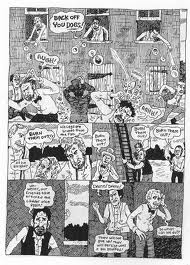
I’m not too worried about sounding the spoiler alert with this review: the title gives away the cold reality that Elijah dies. The comic is a play-out of that final evening, when a mob of angry villagers has Elijah and his colleagues surrounded at the location of his printing press. (This was his 4th printing press—the previous three had been seized and destroyed by mobs.)

panelsVan Sciver uses his simple, black-and-white illustrations to depict Lovejoy and his colleagues as they defense Elijah’s fourth (and final) printing press in Alton. The text, particularly the conversations, are hypothetical, but probably not far from what was said that night. The panels plainly show the unwavering sense of righteousness that was felt on both sides of the slavery issue, in which men would level buildings, hunt each other down, and burn people alive to make a point.

For more information on the comic, check out the links above. For more info on Elijah Lovejoy, the internet reveals that his story is not altogether forgotten. Here are a few links.

Wikipedia Entry on Lovejoy:
http://en.wikipedia.org/wiki/Elijah_Lovejoy

Lovejoy’s Biography on Spartacus Educational:
http://www.spartacus.schoolnet.co.uk/USASlovejoy.htm

slavery mob burning
Early depiction of Elijah and his colleagues being surrounded by a pro-slavery mob and burned out of the building that housed his printing press.

Supreme Court Ruling Raises Relevance for Reading Chester Brown’s LOUIS RIEL

panelsSome of you may have heard of the historic Canadian Supreme Court ruling this week – which spelled victory for a struggle as old as Canada itself.

In a ruling closely followed by Canada’s Metis community, the Supreme Court determined this last week that Ottawa has not lived up to their end of the bargain made through the Manitoba Act of 1870. This was the agreement that quelled the uprising of the Red River Metis community, made Manitoba a part of Canada, and in turn said that the federal government would set aside land for the children of Red River.

Section 31 of the Act, the court ruled, was to “give the Métis a head start in the race for land and a place in the new province. This required that the grants be made while a head start was still possible.”

Many Canadian readers know where I’m going with this, let alone fans of graphic novels, because it is still one of the most acclaimed graphic histories and graphic biographies to date. I’m referring, of course, to the man who led the negotiations: a Metis man by the name of Louis Riel.

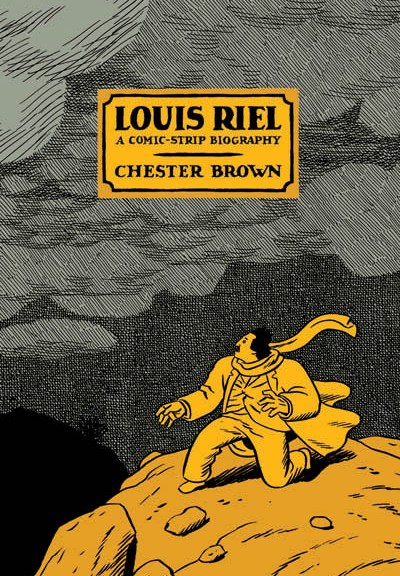
coverLouis Riel: A Comic Strip Biography
Author & Illustrator: Chester Brown
Published: 2006 by Fantagraphics

simple styleChester Brown released Louis Riel to almost immediate critical acclaim. Here was both a piece of Canadian history brought to life, and a genuine masterpiece of stylized art. When I first picked up the book, I disliked the art style despite respecting its quality and consistency throughout the book. I’ve just never been into minimalist drawings… not until recent re-thinking, anyway. But a friend of mine brought up a good point the other day: Chester Brown literally had all of 3, maybe 4 pictures of the man with which to draw an entire book about him. Sound difficult? I think it was… and I’m not sure if the minimalism was the result of solving that problem, but it does in a way that doesn’t seem like defensive measure.

The work of biography is just as artful as the illustration. Here is a sequential portrait not of a one-dimensional populist leader, but a man with conflicts–material and mental–who became larger than life. The book displays his natural inclinations as a leader with as little judgement as his delusions that he was a messenger of God. The best biographies are arguably those where you are certain of the author’s admiration for their subject–but you’re not quite sure what it is they find the most fascinating.

Despite minimalism, there are also wonderful details, like puffs of air in pictures where there is snow on the ground, and brackets around text when depicting that the language spoken is other than English.

I think I’m a little late in convincing many Canadian readers that this is a book worth owning- what I would recommend
is for readers outside of Canada to pick up this title- Chester Brown is a wonderful artist and writer, and in the process they can learn a little about Canadian history and one of its distinct cultural groups.

web riel

The Dudes Behind the Mask: An Interview with Matt Pizzolo, a Founder of the new Black Mask Studios

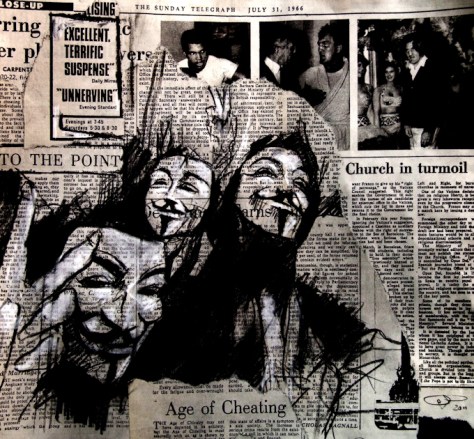
Artwork courtesy of Guy Denning
logoNicole: Who is the group behind Black Mask Studios? Did you all know each other before Occupy? Through comics? Through activism? Through the art / music scene? 
Matt: Black Mask is founded by Steve Niles, Brett Gurewitz, and me. I’ve known Brett for a pretty long time, but I’d only met Steve shortly before Occupy. We were on a horror comics panel together at San Diego Comic Con, and I accidentally insulted him during the panel… which is always the start of the best friendships. We got along pretty quick though because we both come from the punk scene and bring that sensibility to our work, both in terms of integrating social issues into the content and in terms of producing through the DiY ethic. It was a few months later that Occupy Wall Street began and I had the idea for Occupy Comics–Steve was one of the first people I reached out to about it and he helped me get the whole thing rolling. Brett was quick to help support the Kickstarter and when that was done he asked how he could help with the project as it moved forward beyond the Kickstarter. So we all met up and Black Mask was born.
N: How did Occupy seem like a movement special enough to have a comic book dedicated to it?
M: Occupy is really special because it’s a social justice movement that transcends party politics, which is particularly critical these days when bitter partisanship prevents pretty much anything at all from getting done. What excited me about Occupy is that it quickly spread to all different types of people coming from diverse backgrounds and banding together around an idea rather than an ideology. The very earliest iteration of the Tea Party was similar in that it sprang up from non-partisan populist rage, but it was quickly co-opted. I felt anything we could do in our own small way to help try and prevent Occupy from being co-opted was important because it’s a really unique movement and needs to be protected from entrenched political groups.
occupy cover 1N: Conversely, why did comics seem like the art medium to go with for a political art project?
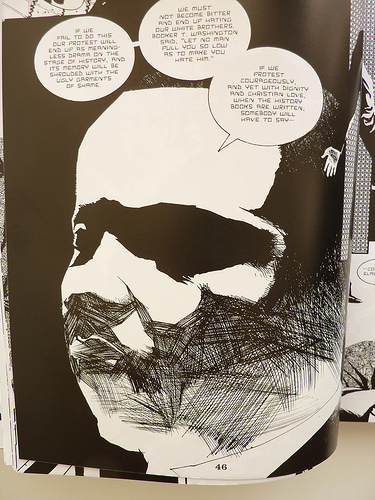
M: … Comics are a very personal, hand-crafted art form (usually created by just one or two people) and the anthology format expands that into a chorus of individual voices… which is precisely what Occupy is: a chorus of individual voices. That’s why the news media didn’t know how to cover it, the news format requires a leader or representative with a list of talking points or demands. A movement like Occupy doesn’t function that way, so comics seemed like the ideal medium to reflect it.
N: Beyond Occupy Comics… what decision brought about the larger vision of creating Black Mask as a publishing body for multiple bodies of work?
M: Well initially I didn’t want to be responsible for distributing Occupy Comics; it was enough of a colossal task to organize and produce it as a volunteer effort. I’d hoped I could then just bring the book to a publisher who would connect the dots getting it to an audience, after all the project was very hot coming off its Kickstarter. And certainly publishers were really aggressive about wanting to take it on, if for no other reason than the amazing roster and tremendous press coverage.
But, nonetheless, the offers from the publishers were all pretty awful… and I realized that if the offers were that bad for a project with people like Alan Moore, David Lloyd, Art Spiegelman, Ben Templesmith, Charlie Adlard and all the other dozens of amazing creators on the roster, then it must be nearly impossible to try and get a decent deal for anything that’s not superheroes or zombies. I’ve always been a fan of the more transgressive, confrontational, socially-conscious comics, and there’s a great history of those themes in comics, but not so much these days. So I decided I’d put the additional work in on building a pipeline for Occupy if we could sustain the pipeline and use it to support other outsider-type comics. Luckily Brett and Steve and all the awesome creators who’ve joined the team agreed with me. It’s unintentional but not by accident that every book on the initial slate [includes at least one person] who contributed to Occupy Comics. Darick Robertson on Ballistic, Matthew Rosenberg and Patrick Kindlon on 12 Reasons To Die, and Matt Miner on Liberator. The people who joined Occupy Comics all share a certain unique sensibility and that’s what holds Black Mask together.

<br.

N: And I’m sorry to be that shitty journalist, but… where are Alan Moore and Art Spiegalman fitting into all of this? I see their names getting mentioned in the press but I don’t see anything on the website…
M: Alan Moore and Art Spiegelman are both contributors to Occupy Comics. They’re both giants, of course, so they get a lot more attention than the rest of the team when headlines are being written.
N: Favourite comic book (preferably political comic book, but I can’t really force that on you) and why?
M: The obvious thing would be to say V For Vendetta or Maus (both of which are favorites), but for a deep cut that blew my mind as a kid I’d say The Realist by Joseph Michael Linsner (an Occupy [Comics] contributor as well) in Cry For Dawn #7 (1992) collected in the Image Comics trade Angry Christ Comix. It’s kind of an inversion of American Psycho, about a guy who kills corporate suits and hangs their ties on his wall. Cry For Dawn was a self-published black & white comic with gorgeous, evocative art and powerful, angry storytelling–so unique to comics. That’s the type of thing that burned a correlation between punk and comics into my young mind. For something more contemporary, I’d say I’m really looking forward to Molly Crabapple’s Shell Game, which I backed on Kickstarter–her work is just incredible.
Thanks so much Matt – looking forward to Occupy Comics and all the rest from Black Mask!
Black Mask and Occupy Comics can be found on Twitter and Facebook:
You can check out their website here:
occupycomics-cover_artby-guy-denning

Black History: A Comic Book Reading List

For the last 10 days of February, I put out a list of Top 10 Comics relating to Black History. I didn’t consider this a quintessential list; moreso, I wanted it to be a startting point for anyone interested in exploring the genre/medium combo.

From the get-go, I knew I could at least name 10 different titles, although I hadn’t read them all. And as research tends to do, I’ve added another few to this list, along with some notes. 

Black History Comics – A Reading List

bayou page shotBAYOU – 2010, by Jeremy Love.
It’s the Deep South–in the deep dip of the Depression. Young Lee was already afraid of the Bayou–that was where they dumped the body of Billy Glass–and who knows how many other blacks who “hadn’t known their place”. But when Lee’s white friend goes missing and her father is suspected to be involved, Lee sets out into the Bayou, a dark place of murder and magic, to rescue the girl from whatever has taken her, and in turn rescue her father from the fate of the gallows.
Here in the “new world” we often have a hard time picturing our history as folklore and our folk lore as mythology, but that is what is at work here. Jeremy Love does a great job with this book bringing that mythology to life in the stylization of Uncle Remus and his Br’er Rabbit, Br’er Fox, et al. He even takes it a little further, with pieces of social memory that still seem a little too real, too close, to feel entirely comfortable with: flocks of “Jim Crows” that will eat you alive; monsters with the faces of minstrel characters. There is an anthropomorphic element here–lots of talking animals, stories and song that make the characters really pop. Think “Alice in Dixieland”.
Two Volumes have been released of the story so-far: I do hope that more is on the way…
Published: 2010 by Zuda Comics (online arm of D.C. – now closed.)
Awards: Glyph Comics Awards – Best Writer, Best Artist, Best Female Character, Best Comic Strip, and Story of the Year (2009);
Best Digital Comic for the Eisner Awards – Nominee (2010);
American Library Association – 1 of Top 10 Graphic Novels for Teens (2010);
Further Reading: Nice Analysis over at Web Comic Overlook (although self-admittedly long.)

nat turner page shotNAT TURNER – 2006 by Kyle Baker. Four issues bound into two volumes here tell the story of Nathaniel “Nat” Turner, leader of one of the largest slave revolts in American history. The genius of this comic is that it tells a compelling story while allowing the historical value to shine through. It uses all excepts of Nat Turner’s own words, taken from a “confession” he gave to a newspaper while in prison awaiting his execution (the word “confession” of course, is an editorialization from the newspaper of the time–however, one can hardly expect him to be remorseful for killing the men who killed and enslaved his kinfolk). We not only have a primary source, but a first-hand account of what we’re seeing depicted in pictures: the life of a 19th Century slave, the horror of life from capture, transport, sale, work, and punishment. The role of religion and prayer for slaves who survived. As a political and historical comics enthusiast, this is one of the gems. Kyle Baker looks to have taken 19th Century newspaper illustrations and breathed them full of life and human emotion. This and a nail-biting narration have practically gift-wrapped this bloody episode of American history.
Published: 2006 by Kyle Baker Publishing
Awards: Glyph Comics Awards – Best Artist, Best Cover, Story of the Year (2006);
Glyph Comics Awards – Best Artist (2008);
Further Reading: Nice review on Eye on Africa Blog


jackie robinson coverJACKIE ROBINSON, Issues 0 – 6 – Written by sports-writer Charles Dexter. Now I know nothing about this comic – save that it was published in 1950 and that it’s real. That makes it one of the earliest comic book depictions of a black historical figure (maybe the first?) and impossible to leave off this list, where I try to encourage that there is black representation, but also a note-worthy link to Black History (sorry Black Panther, Storm, Huey Freeman…)
That being said, I know nothing of the quality of this comic – the writing, the artwork. But regardless I like having this comic on my reading this for two reasons. It’s not only that it’s the sole comic that is more than 10 years old… consider the fact that a black baseball player would have difficulty finding lodging or a bar to sit in when this comic was released. Second, it’s written by a sportswriter, and I love sportswriter/political commentator cross-overs (the “Olberman” effect?).
Published: 1950 – 1951 by Fawcett
Further Reading: Good luck getting yourselves a copy of this – some issues retail as high as $75 for their 16 pages. But a decent telling of Jackie’s story (and the story of African Americans in the major leagues) can be found here at Awesome Stories.com 


SOOF - page shot

THE SILENCE OF OUR FRIENDS – 2008, Written by Mark Long, Jim Demonakos, and illustrated by Nate Powell. This is a deceptively simple memoir of a man who moved to a small Texas town with his liberal white family in the 1960s. The town was intensely segregated, and the author remembers the stir it caused when his Dad invited a black friend and his family over for dinner. Besides political overtones and largely untold events of recent Texas history, which included protests and a serious accusation of black demonstrators firing on police–which was later determined to be false–Silence of Our Friends is a story of childhood memory that is touching, personal and honest. With a heavy emphasis on Powell’s art, the narrative re-creates the [often quiet] tension of racism, privilege, and friendship.
Published: 2008, by First Second Comics / Macmillan
Awards:
Further Reading: I’m a huge fan of Nate Powell’s artwork, so I will take this time to direct you to his blog over here at See My Brother Dance

MALCOLM X A GRAPHIC BIOGRAPHY – 2006, by Andrew Helfer, Randy DuBurke.
Published: 2006 by Hill and Wang
I have yet to full read this piece, but have it on my list. There is also another Malcolm X biography – by Jessica Sara Gunderson and Seifu Hayden. Neither Helfer nor Gunderson are names that I’m very familiar with in comics, so I’ve been slow to pick these titles up. However they are available for those interested.

King coverKING: A COMICS BIOGRAPHY OF MARTIN LUTHER KING JR. – 2005, by Ho Che Anderson. Generally considered to be more comics journalism, this volume collects over 10 years of Ho Che Anderson’s work into a biography of the renowned civil rights leader.  From a review on Amazing: “KING probes the life story of one of America’s greatest public figures with an unflinchingly critical eye, casting King as an ambitious, dichotomous figure deserving of his place in history but not above moral sacrifice to get there. Anderson’s expressionistic visual style is wrought with dramatic energy; panels evoke a painterly attention to detail but juxtapose with one another in such a way as to propel King’s story with cinematic momentum.”
Published: 2005, by Fantagraphics (the Complete Edition)

birth of a nation coverBIRTH OF A NATION – 2004, by Aaron McGruder and Reginald Hudlin and Kyle Baker.
McGruder, Hudlin and Baker definitely have satire in their sights for this piece – that being said, it touches on black culture and history more uniquely than other books mentioned here. Aaron has admittedly used some real stories in this work, gathered by himself and friends over the years to make this comedic work ask a darkly humorous question: If East St. Louis seceded from the Union, would anyone really care? East St. Louis (“the inner city without an outer city” it says), is an impoverished town, so poor that Fred Fredericks, its idealistic mayor, starts off Election Day by collecting the city’s trash in his own minivan. (A real story is inserted here, says McGruder – some people kept their trash on their rooftops to discourage the packs of wild dogs from rummaging through it. No joke…well, yeah, I guess he kind of makes it into a joke.) But the mayor believes in the power of democracy and rallies his fellow citizens to the polls for the presidential election, only to find hundreds of them disenfranchised (this was the 2000 election, so that part is also totally believable).
“Birth of a Nation” to me, is what comics have always been about–pointed political commentary that makes you split your stomach laughing at the same time. And in doing so, it raises questions of culture and national identity. A great read.
Published: 2005, by Three Rivers Press

ROSA PARKS & THE MONTGOMERY BUS BOYCOTT – 2007, by Connie Colwell Miller (Author) and Dan Kalal (Illustrator).
Part of the Graphic Library series, this book is an introduction to Rosa Parks and her involvement in the Civil Rights movement. Because the author provides a sequential and clear outline of the historical events of the time, the story of Rosa Parks and the Montgomery bus boycott is told in a meaningful and interesting way. The graphic novel is broken into four chapters, each one telling a specific part of Rosa Parks’ story. Through the content presented, readers are introduced to important figures involved in the civil rights movement, racial segregation laws, significant dates and court decisions, important events in the civil rights movement, and the political and social climate of the time. Furthermore, the author shows the impact the Montgomery Bus Boycott had on the civil rights movement and tells about Rosa s life after the boycott.
Published: 2007 by Capstone Press

still-i-rise-graphic“STILL I RISE”: A GRAPHIC HISTORY OF AFRICAN AMERICANS – 2009, by Roland Laird (Author), Taneshia Nash Laird (Author), Elihu “Adofo” Bey (Illustrator), Charles Johnson (Foreword)
Still I Rise is a lot packed into a little book: the entire history of Black America– recently updated in a new edition that includes the election of Barack Obama as the U.S.A.’s first African American president (the first edition, published in 1997, took us up to the Million Man March). I believe this work has excelled in highlighting history left out of a lot of American textbooks, for whatever reasons: including early attempts of slaves and former slaves uniting with white indentured servants, along with the rise of early black entrepreneurs and politicians in the South who were constantly attacked, broken down and weeded out. it it a solid portrayal of a lengthy question, and shows that the notion of American history as “white” history is manufactured, and deliberately dismissive of black culture.
Published: 2009 by Sterling

BLACK IMAGES IN THE COMICS – 2012, Edited by Fredrik Stromberg (Introduction by Charles Johnson).
Endlessly browsable illustrated journey through comics’ history of radical portrayals both good and bad.
This book spotlights over 100 comic strips, comic books, and graphic novels to feature black characters from all over the world over the last century, and the result is a fascinating journey to, if not enlightenment, then at least away from the horrendous caricatures of yore. Fredrik Stromberg, who is from Swede, explains in the introduction that he more of less made the volume because it had not yet been made; he set out to make a comprehensive art history of (mostly) white people’s depictions of blacks: as primitive and savage–even cannibalistic, then as dim-witted clowns. Halfway through the 20th Century, this begins to change, and with the inclusion of more positive representations of blacks (mostly African Americans), we see the emergence of black writers and artists, breaking new ground once again.
What begins as a somewhat depressing window on the small-ness of humanity has something of a happy ending with this evolution. However I’m reminded of the words of Charles Johnson, who in the introduction writes, “I wait for the day when…stories in which a character who just happens to be Black is the emblematic, archetypal figure in which we — all of us — invest our dreams, imaginings, and sense of adventure about the vast possibilities for what humans can be and do– just as we have done, or been culturally indoctrinated to do, with white characters…”
Published: 2012 by Fantagraphics


Some Additions:

My entire reading list is seriously lacking in the realm of arts and culture. I looked far and wide for a Hip Hop Graphic History, but am perhaps a bit early on that one – Ed Piskor’s exciting Hip Hop Family Tree comes out this October. Until then, you can preview some work on Boing Boing – or pre-order it from Fantagraphics!

Black Comix: African American Independent Comics, Art and Culture
Damian Duffy (Author), John Jennings (Author), Keith Knight (Introduction) – 2010, by Mark Batty Publisher

Super Black – 2011, by Adilifu Nama.
Super Black, although not a comic, it the most thorough work yet to break ground on the subject of black people in comics – their representation and significance. This also extends to blaxploitation film and art, where we see a real packaging of the ‘Black Hero’ for the first time in mainstream American culture.  Available through Amazon, some university literature courses, and perhaps your more-than-average book store.

ABINA AND THE IMPORTANT MEN – 2011, By Trevor R. Getz. Read more about it on the publisher’s website at Oxford University Press.

BAYOU ARCANA – An anthology of work in a similar vein to Bayou, looking at historical roles of race and gender in the Deep South.

The MARCH TRILOGY – Coming out in August, 2013. A graphic novel memoir of former Civil Rights leader and U.S. Representative John Lewis.

THE CAMPFIRE SERIES – by Steerforth Press includes “Mohammed Ali: King of the Ring” and a “Nelson Mandela” graphic biography.

There is also a “Nelson Mandela: Authorized Comic Book” that was produced by the Nelson Mandela Foundation.

African American Classics

the panel is political.