Ad Astra Comix is excited to announce an upcoming anthology by Peter Collins, a Canadian artist, AIDS activist and prisoner.
Peter has been imprisoned for more than three decades at various prisons. In that time he has worked as a prison abolitionist, challenging the racism, incompetence and corruption of the prison industrial complex. He has also honed his skills as an artist and produced hundreds if not thousands of comics about Canadian politics, life in prison and social justice.
” ‘Rehabilitated’ like a bug under a kid’s magnifying glass. ” At the bottom: ” (Psychologically tortured until burnt out) “
Recently, a friend reached out to us to see if we would be interested in publishing Peter’s work. After getting a chance to look at his biting commentary that alternates between very dark humor and very human vulnerability, we were happy to say yes. We are glad to be working with Peter as well as some of his friends and supporters to help crowd-fund and publish an anthology of his work to form part of a record of the life of this man.
On a somber note, Peter is currently suffering from an aggressive cancer that has spread from his bladder to his stomach walls, lungs and bones. He is entering the 32rd year of a Life 25 sentence. He has spent the better part of the last 3 decades trying to make amends for the suffering that he caused when he killed Constable David Utman. He has worked to personally transform himself, and to make the world a better place. His risk has been addressed long ago, and CSC refuses to release him because of his political advocacy and critique of the prison system.
We hope that undertaking this project will help raise awareness of Peter’s situation and help push for him to be granted compassionate release. This anthology will be our small part in amplifying the voice of a thoughtful, compassionate man who has overcome incredible obstacles to live a giving, creative life. To keep up to date on the details of Peter’s situation, you can like the Peter Collins Support Committee on Facebook.
To stay up to date on this project, follow Ad Astra Comix on Facebook and Twitter if you haven’t already done so. We will be posting examples of Peter’s work in the lead-up to the crowdfunder. Thanks for taking the time to read – Stay tuned for more details!
A historian, the old joke goes, is someone who chases after you calling out “that’s not how it happened!” Good history sees the devil in the details. It looks past the obvious events to understand the human relationships that lie underneath. But beyond good history, there is great history. Great history links these human experiences to the systems of power and domination that shaped the past and continue to shape the present. In exploring the experience of black men serving in the American army during WWI, ‘The Harlem Hellfighters’ achieves both.
Title: The Harlem Hellfighters Author: Max Brooks Illustrator: Caanan White Published: Broadway Books (2014) Pages: 272 pages OtherSpecs: Colour cover with B&W interior Purchase: In the Ad Astra Online Store
The Harlem Hellfighters is not about WWII, a fashionable war regardless of your politics. It is about the Great War for Civilization, now often described as World War One, though the first global war was the Seven Years War. There was nothing particularly civilized about it, and ‘The Harlem Hellfighters’ does a great job of tracking this from the United States to the artillery-chewed meadows of an exhausted Europe. It follows the eponymous Hellfighters, an all-black combat regiment, at a time when there was a great deal of anxiety that if people of colour were allowed to shoot white people, they might get a taste for it. This racism ran so deep that the army was sending their rifles out to private gun clubs and issuing broomsticks to the Hellfighters. Nonetheless, they made it to the front, and the comic takes us along for a flame-throwing, bomb-dropping, trench digging slaughter of a tour through humanity’s most wretched moments. We see through mud and clouds of poison gas- the death of the romance of war.
The obvious way to write this story was to showcase the heroic determination of black Americans who enlisted in the US army. Military service and citizenship are tied in a very tight knot in American culture. For black Americans, who were persecuted and marginalized throughout the United States, participating in this ultimate expression of citizenship is easy to hold up as a virtue. There are certainly times when the narrative takes this route. In one instance, a black recruit is walking through a southern American town during training and is attacked by a gang of white racists. Following orders to keep his cool, he endures their violence silently. On another occasion, a black soldier is rescued from a gang of his white ‘comrades’ by a military policeman. When the MP encourages him to drop it rather than press charges for assault, he ends up beaten and imprisoned, but he doesn’t leave the army. All of this is an accurate depiction of the determination that it was necessary for black soldiers to show in the openly white supremacist American army. It highlights the courage, patience and endurance necessary for these men to stay their course.
This kind of easy liberal narrative is a popular one for general histories. Liberal history has no trouble acknowledging that things were bad in the past. But it stops there, often tying up the narrative strings in a neat little package of self-congratulatory nationalism. ‘The Harlem Hellfighters’ could have stopped here. But it didn’t, thank fuck. Instead, it calls out the ugly facts of history. It opens by explaining how bloody, how pointless and how ultimately futile the First World War was. It has a character cheekily explain that the cause of the war is that having made a hell for peoples of every colour all around the world, there was nothing left for the white man to do but turn on himself. And it shows, at every opportunity, the shabby treatment of black soldiers in the Army. This goes beyond blacks being second class citizens and actively shows that the Army made policies specifically to keep black people from getting the idea they were equal to whites.
The problem with liberal history is that it stops with the personal. It situates discrimination in the past and leaves it implicit that of course our great, open-spirited democracies have long since overcome the kind of chauvinism that marred the dignity of our otherwise distinguished forebears. It is comfortable with showing the ills of the past, precisely because it needs those ills to tell a story that things are continuously getting better. While ‘The Harlem Hellfighters’ does not come out and name colonialism, white supremacy or capitalism as the root cause of the suffering endured by black Americans, that level of explicit political consciousness would seem out of place in the mouths of many of its characters. But they understand these things intuitively from experience, and they offer their own understanding to each other and to the reader. This is a more valuable thing.
There is some worrying sentimentalism towards the end of the comic, with the usual lines about America being founded as the first nation of ideals. But the founding myth of American exceptionalism was often used by black Americans resisting white supremacy, and if it is not politically appetizing, neither is it out of place. The comic tells a story, not only of individual suffering and solidarity, but of the systems of violence that run underneath. It makes it perfectly clear that it is not bad people here or there responsible for incidents of discrimination; it is a system supported by the American government and maintained by the American military for the benefit of white people.
We talk about visual styles being striking, but in Caanan White’s case it doesn’t strike so much as barrage the reader. The detailed, expressive style can be a bit busy at times and one gets the sense that this is a comic that deserves to be printed in colour. But the faces and postures of the men convey their emotions expertly, and the trenches come to death in gory detail from peeling flesh to rotting corpses. If the style were a little cleaner, it might explode more exactly on target, but I suppose war is a busy, confused business too. This is not to say that it is unworthy of the narrative; far from it. But the devil’s in the detail and I can’t help feeling there’s a bit too much of it.
There is something a little bit disturbing about the blood-lust of the soldiers in ‘The Harlem Hellfighters’. The comic does not quite express their motivations for being there, unless we are meant to believe that they share the sentiments of the man who says he couldn’t down an opportunity to be paid by white people to shoot white people. But the eagerness to fight instead of rot in the trenches waiting for a shrapnel squall to shred your flesh was a real enough part of the First World War. Trench warfare traumatized a generation of men who coped in whatever way they could. Displaying the grim brutality of that conflict underscores the moral ambiguity of the story as a whole. For all that ‘The Harlem Hellfighters’ is about racism, it is the story of a group of men determined to cross the ocean and kill strangers who have never harmed them. If it is uncomfortable at points, it should be. ★
By: Jared Ross, Hon. BA. MA in Cultural and Imperial History
Thank G-D! A Jewish comic that isn’t about the Holocaust. I know this sounds flip, but as a “Jewish intellectual”, in Toronto, I’m always enthused when Jewish history isn’t framed though such a narrow lens. There are so many persecutions to pick from, and while I acknowledge that the Holocaust is important to study, Jewish history shouldn’t be just one sad slow train to Auschwitz.
Enter ‘Mendoza the Jew’, a graphic history of a poor Sephardi Jewish boxer in 18th century London. It represents a different story, and a poorly told one. The style of the comic is quite brisk, with bold colours and lots of action sequences. It is heavily narrated with lots of explanation and the modern author showing up to brief the reader on any vague historical points. Each chapter begins with a Hebrew letter that spells out Daniel. The comic is only one part of the piece, with a section of primary sources as well and an explanation of the writer’s process as well.
Title: Mendoza the Jew: Boxing, Manliness, and Nationalism: A Graphic History Author: Ronald Schechter Illustrator: Liz Clarke Published: Oxford University Press (2013) Pages: 240 pages Dimensions: 25.1 x 3 x 20.1 cm Other Specs: Softcover, colour cover and interior Purchase: In the Ad Astra Online Shop
Expelled from England in the 14th century, Jews were allowed back into England by Oliver Cromwell and it became a home for Sephardic Jews who came from Spain via the Netherlands. The Sephardic community was already well established when they were joined by Ashkenazi Jews from the Pale of Settlement in Eastern Europe (Modern day Russia, Ukraine, Poland and Romania) in the late 19th and early 20th century.
It is in part due to figures like Mendoza that the Sephardic community was so successful. Taking advantage of England’s “tolerant” attitudes towards religious minorities and the effects of the Enlightenment, the Jewish community was allowed a degree of integration that was not possible in most of Western Europe. While still suffering persecution, it was as an old prof of mine used to say, “run-of-the-mill 19th century anti-semitism”, in contrast to the race-based dehumanizing persecutions that mark the 20th century.
“What do you mean, ‘your people’?”
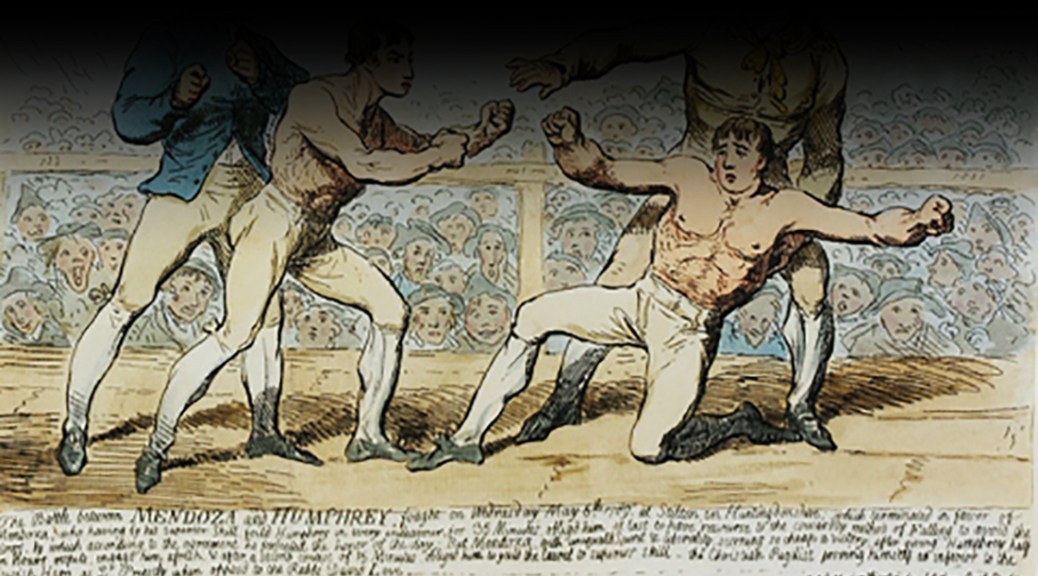
Daniel Mendoza’s story illustrates the tension between tolerance and assimilation quite nicely. The son of a Schochet, (a kosher butcher), Daniel Mendoza soon discovers that a quick way to acceptance is boxing, a sport that was embraced by both the working class and the gentry as quintessentially English (like tea and sado-masochism). Mendoza wins several high profile bouts, and parlays his success into running a series of boxing academies for both nobles and the working class.
After losing a rather shady match to his old partner, John Humphries, Mendoza agreed to a rematch, with each writing letters to the newspapers of the time challenging each other’s health, manliness and honesty.
Mendoza won the rematch and with it a princely sum of 2000 pounds. He then went on to beat Humphries in a third rematch (one that took 72 rounds).
The author speculates this was due to either gambling, alcoholism, bad investments or a combination of all three. Defaulting on his debts and jailed in 1797, Daniel took on a variety of jobs including as a publican and pedlar. He continued to box and stage exhibition matches, but died penniless in 1836.
In the words of the author, the story of Mendoza fits into the school of “history from below” and helps to illustrate why Britain avoided a revolution, unlike France. He points to Britain’s religious tolerance, free press and ability to harness a nascent British identity as a reason for its relative political stability. In this the author is right, but he also neglects to mention that Britain was able to co-opt many of its subject people, ethnic minorities like the Irish and Scottish Highlanders into replicating the same structures of rule and control in an Imperial context, and as such use migration as a pressure valve, something that was not done in France.
So let us evaluate the author’s claim. ‘History from below’ in this context is also very much a history of whiteness. The 18th century marked the rise of scientific racism. The work of Blumenbach, dividing humanity into five races, was published in 1779. The idea that each race had a separate origin (polygenesis) was a tool of imperialist expansion and the justification for slavery as an ideology. Jews as a category were always hard to classify. Were they white? Were they intelligent? How could they be separated from the Aryan/ Nordic White Anglo-Saxon?
Interestingly enough, Mendoza also acted as a second for Tom Molineaux, a freed Virginian slave. The author does not mention this.
The push of this ideology of race was stubbornly resisted. Manliness and ideas of masculinity were a weapon that Jews deployed to prove that they were just as manly as the White man. This subverted the ethnocentric language of white supremacy and allowed some Jewish men to express their identity in ways that were culturally permitted. This strategy had a long shelf-life. In the aftermath of increasing anti-semitism following World War One, Jewish veterans used the language of patriotism and masculinity to protect themselves from discrimination. One particular case was the Jewish flying aces, considered among the most masculine of war heros during World War One. In an excellent article by Todd Samuel Presner, “Muscle Jews and Airplanes: Modernist Mythologies, the Great War, and the Politics of Regeneration” there is a discussion about the efforts of Jewish flyers to publicize their deeds and claim that because of their military service, they should be recognized as German nationalists. Unfortunately this was all for naught, as the Nazi’s expunged their service records, and while allowing for special treatment for some, sent others to camps.
In the 18th century Daniel Mendoza and other Jewish men used the language of nationality and masculinity to combat persecution by putting themselves forward as paragons of strength, athleticism and sportsmanship; values dear to the English nationalist project. After World War one, German Jewish veterans tried the same tactic. In England, it was to some extent successful; in Germany, it was not It remains to be seen whether a minority should ever try to embrace the cultural and gender norms of a society to end their own persecution.
* * * * *
Jared N Ross is a museum and history enthusiast who has worked in museums and education for 10 years. Starting as a lowly summer-student playing a 19th century British soldier, he has continued to work at many Museums and historic sites, including Fort York, Mackenzie House and Black Creek Pioneer Village. He has presented to thousands of students on all aspects of 19th century life, from the power of the original mass media (the printing press), to the first waves of immigration in 19th century Toronto. He completed his Undergraduate Honours in History at Mount Allison University in New Brunswick, and a Master’s in British and Imperial History at York University. He hopes one day to lead a Klezmer-Celtic Fusion band.
110 Comics Workers Sign Petition / Bondoux Refuses / Op-Ed by Organizers In French Newsweekly
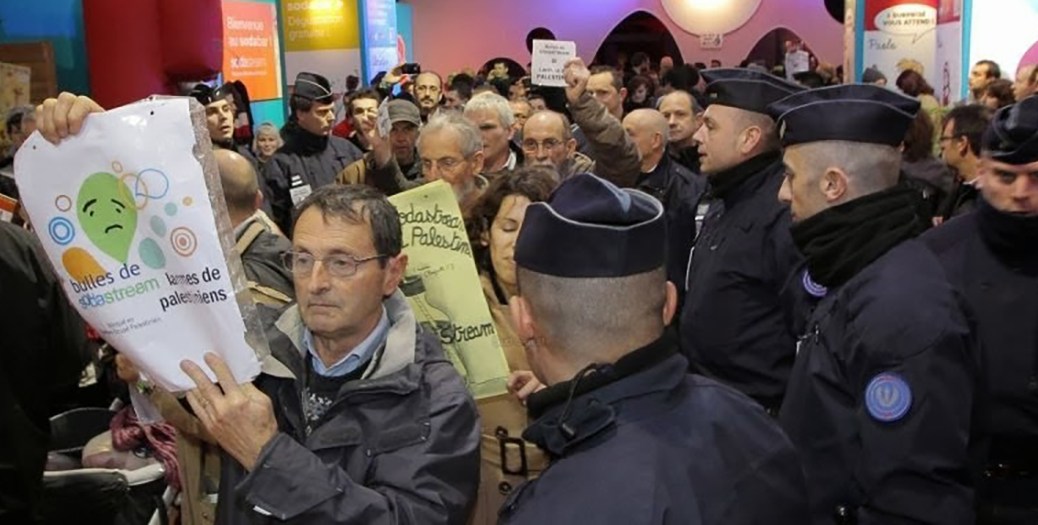
An open letter addressed to the head of the of the Angouleme International Comics Festival and the broader comics industry demanding an end to “business as usual” with Israel has reached 110 signers as the Festival opened on January 29th, including Alison Bechdel, Jaime Hernandez, Ben Katchor, 2013 Grand Prix winner and Charlie Hebdo contributor Willem, 2012 Grand Prix winner François Schuiten, 2010 Grand Prix winner Baru, 1984 Grand Prix winner Mézières, Canadian cartoonist Guy Delisle (author of Jerusalem and special guest at the 2014 Palestine Comics festival), and Lucille Gomez, the cartoonist hired to draw comics by Sodastream at the 2014 Festival.
The full letter and updated list of signatories can be found here.
The letter specifically calls out the Angouleme Festival’s relationship with the Israeli company Sodastream, which operates manufacturing plants in the Palestinian Occupied Territories and in the Naqab desert region of Israel. Franck Bondoux, the director of the Festival, who in 2014 denied that Sodastream operated in the Occupied Palestinian Territories, this week shifted his defense and claimed it was inappropriate to talk about Palestinian rights due to recent events in France. He was quoted in the French newspaper Sud Ouest on January 23:
“We are no longer in the same situation as last year,” remarked Bondoux, whom we reached last night. “SodaStream announced in 2014 that the factory under discussion will be moved. This means that the problem is in process of being resolved and has been understood.” The executive director of the festival further believes that the letter “moves into a broader proposal with terminology that goes much farther in its call for a boycott.” “We have moved from a discussion where one speaks of a specific problem to a total generality.” “This is an incitement to a stronger, more militant form of resistance.” Bondoux refuses to “judge” or “comment” if only to say “that in the current situation [reference to Charlie Hebdo and Kosher supermarket attacks], I’m not certain whether this is a time to welcome such proposals.”
Organizers of the open letter, Ethan Heitner (NYC) and Dror Warschawski (Paris) published a response to Bondoux in the French newsweekly Le Nouvel Observateur.
This is not the review I want to be writing about Joyce Brabner’s ‘Second Avenue Caper’. I’d like to discuss it on its own terms. Reading it, the Dallas Buyers’ Club was the first thing that came to mind and I thought how incredibly obvious that was. How it didn’t really need to be mentioned, particularly when people have done such a good job of critiquing the obvious flaws of that film.
Unfortunately, there is a striking parallel between ‘Second Avenue Caper’ and Dallas Buyers Club that needs to be discussed, because it’s typical of a trend in moving Hollywood dramas about moments of historical importance. It’s not just a question of who gets to be the hero and who gets to be the sidekick. It’s a problem with what gets put into these stories – moving, human drama – and what gets left out.
Title: Second Avenue Caper: When Goodfellas, Divas, and Dealers Plotted Against the Plague Author: Joyce Brabner Illustrator: Mark Zingarelli Published: November 2014 by Hill and Wang (a Macmillan subsidiary) Pages: 160 pages Dimensions: 19.9 x 1.8 x 21 cm Other Specs: Hardcover. Colour cover with B&W interior Purchase: 24.99 In the Ad Astra Comix Shop
“Second Avenue Caper” is the work of Joyce Brabner, distinguished comics author, dedicated activist and frequent subject of the comic ‘American Splendor‘ by her late husband, Harvey Pekar. The comic is told as an interview with her friend, Ray. It is illustrated by Mark Zingarelli, an experienced artist who contributed to R. Crumb’s ‘Weirdo’ and to American Splendor. The comic uses the interview as a framing device to narrate the story of Ray’s experience of the early days of the AIDS crisis as well as the larger historical context. It is centred around his work as a member of a group that was responsible for smuggling experimental drugs into the US for AIDS patients. That is the obvious similarity with the ‘Dallas Buyers Club’ (For those of you who are unfamiliar with the Dallas Buyer’s Club, here is a trailer:)
There is some obviously wack shit about this film that people haven’t been shy about calling out. Namely, it’s all about a straight white dude in a story about a crisis that overwhelmingly affected queer people and people of colour. It makes that white dude the hero of the story and hands him a plate of cookies for overcoming *some* of his bigotry. The film cast a cis man, Jared Leto, to play a trans woman. Leto’s performance was criticized as wooden and unbelievable and the character was criticized as being a stereotype. All of this is pretty well putrid, but it’s also well trod ground.
In the film, and in ‘Second Avenue Caper,’ a political narrative emerges alongside the human story. These narratives are sharply divergent and it’s in this divergence that I think the real value of a story like ‘Second Avenue Caper’ lies.
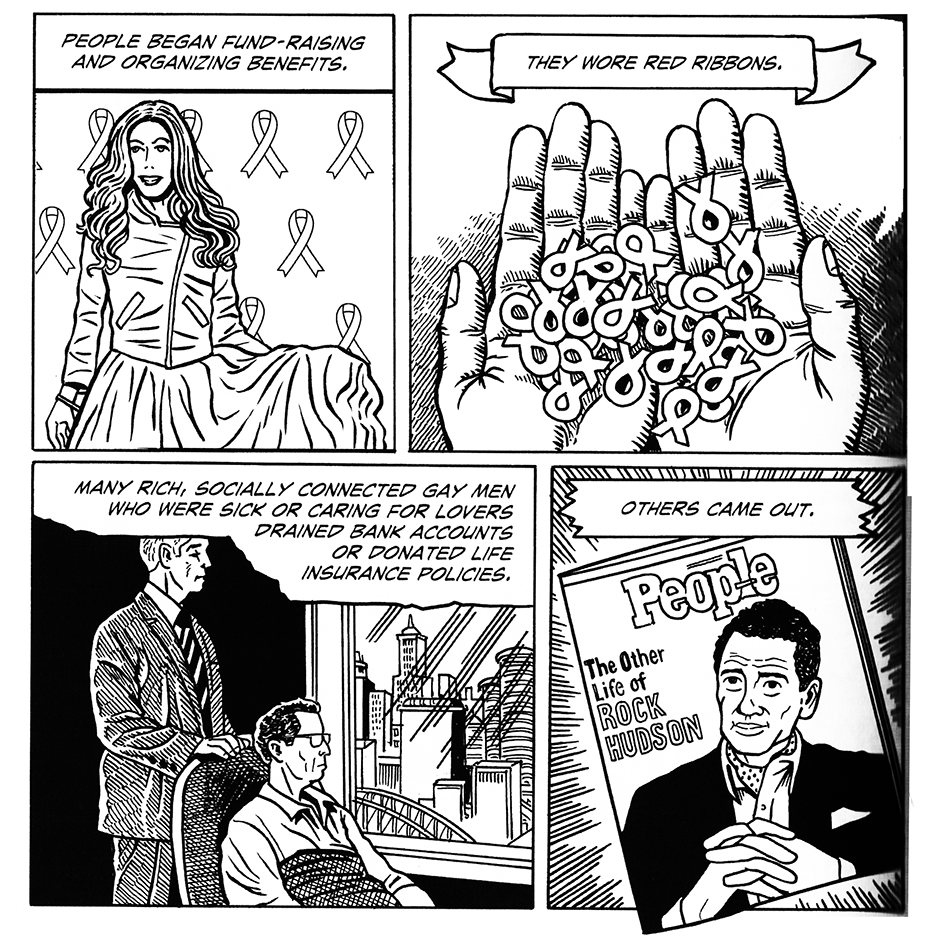
Both are “based on a true story,” but Dallas Buyers’ Club is an outlier. The story of most people in the early days of the AIDS crisis is a story of queer people and people who used needle drugs. ‘Second Avenue Caper’ gives us an ensemble cast: it’s narrated by a gay male nurse, but his circle of friends stretches to include other gay men, lesbians, trans people, and people of colour. One character lacks status in the United States and is in danger of being deported even as he dies of AIDS. Instead, he ends up being driven across America in an RV being used to smuggle pharmaceutical drugs over the border. The narrator’s mother makes an appearance, doing her best to understand her son’s “lifestyle” and in the end criticizing her church for their un-Christian behaviour.These characters enjoy more or less development – the narrator gets the most panel time, by necessity. But they speak, eloquently, about their experiences of a system that ignores them, at best. Some talk politics while others simply live them. There are artists and activists, rich gay men and a closeted pizzeria worker from a Mafia family. It’s an incredible story. And that’s great. So is Dallas Buyers Club when you get down to it. But while both have tender moments, heartbreak and human drama, only one acknowledges the political realities of the crisis.
‘Second Avenue Caper’ calls Reagan out for refusing to even speak the fucking name of the disease. It features the revolutionary work of the direct action group ACT UP and the success of its confrontational tactics. (In general, ACT UP doesn’t get enough love. Check out this Oral History Project to learn more.) The comic goes out of its way to present an ensemble cast and include the contribution of lesbians in fighting in a struggle unlikely to affect their own bodies– a contribution that too often goes unacknowledged. And the comic is frank about how families abandoned their queer kids and hospitals turned patients away, isolating victims of AIDS when they were at their most vulnerable. It comes up more than once that the government and the public can’t quite be persuaded to give a fuck about what was seen as a gay disease and how that helped to spread the epidemic. Although it is a moving, human work with beautiful moments, it is also deeply personal.
By contrast, Dallas Buyers Club is a free market fairy-tale. It is about a literal cowboy, a hard drinking, chain-smoking serial womanizer who wears his ignorance as a badge of honor. He is shown as defying arrogant government agencies who seem determined to block the entry of untested AIDS drugs into the US, mostly out of bureaucratic spite. The protagonist’s gradual, begrudging willingness to treat his oppressed clients like human beings is profoundly fucked. It’s not an improvement for bigots to slowly learn how to respect individual members of oppressed groups. That’s how the overwhelming majority of them already are. They are quite capable of making exceptions and recognizing the humanity of individual members of oppressed groups. There is nothing heroic about his tolerance.
So here’s the larger point: Yes, representation matters. But even if a gay man or a trans woman had been the protagonist of Dallas Buyers Club it still would have been a libertarian’s fantasy. It still would have failed to acknowledge the deep, structural discrimination which worsened the AIDS crisis, put public health at risk and isolated tens of thousands of vulnerable people. It would also have failed to show the ways that people not only fought to survive, but fought back against the racist, homophobic reality of Reagan’s America. ‘Second Avenue Caper’ manages to do all those things while being every bit as funny, engaging and relatable as any Hollywood Blockbuster.
When we are told, “Everything changed on September 11th,” it is easy for the cynic to note that the only true change has been the object of our cultural hysteria. By 2001 our old enemy, communism, was 10 years into the dustbin of history. There had been some effort to make the global justice movement into a new foe, but beating unarmed protestors made “us” look like the bad guys. …Then al-Qaeda more or less literally fell from the sky to rescue us from the anomie of life without an enemy. The pedestal, left by all those toppled statues of Lenin, now hosted dictators of so-called rogue states, each to be torn down in their turn. All the while, the idea that we had done something to create these enemies, much as we had failed to consider where previous enemies came from, went unexamined. But enemies do not simply rise from the shadows…
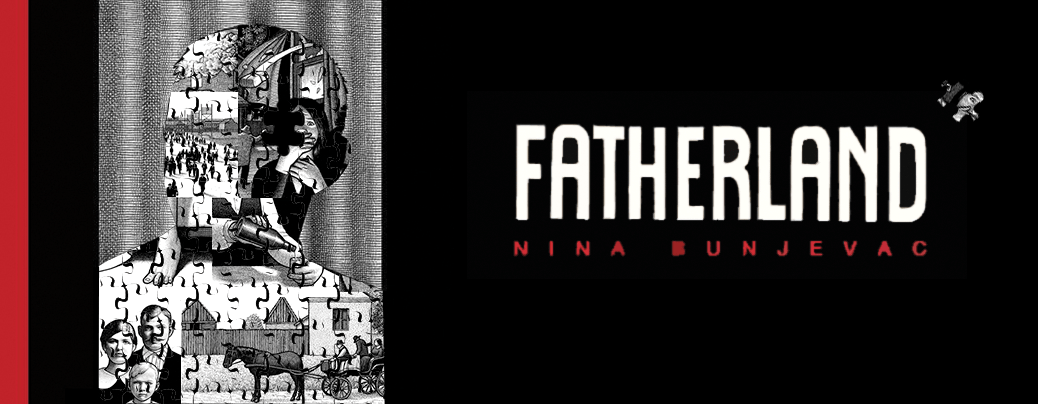
Title: Fatherland Author: Nina Bunjevac Illustrator: Nina Bunjevac Published: Jonathan Cape (Sept, 2014) Dimensions: 8.7″ x 11.1″ Purchase: Hardcover in our online store
This is a review of Fatherland and how it negotiates the tension between terrorism, a cultural obsession and mental health, a cultural aversion. It is also an exploration of the resemblance we can find between the story in Fatherland and more current events. Here, the terrorists do not look like the ones we know today, but in a way, they have a similar story. They did not climb out of a smoldering cleft in the earth, clutching a detonator in one hand and a home-made bomb in the other. They are the products of their circumstances, circumstances we have more control over than we usually care to admit.
Peter Bunjevac Sr. was a terrorist. The comic is only half-finished when it is revealed that he has died. Nina Bunjevac goes to pains to describe her father’s upbringing and to illustrate the sociopathic tendencies he manifested at a young age. She describes the brutal beatings her grandfather gave her grandmother in front of her father. She explores the kindness his aunt showed him, the sole kind figure in a troubled life, who was herself an outcast when she got pregnant out of wedlock. She shows how her father was jailed for supporting a popular communist critical of party excess, and how he fled the country and came to Canada as a refugee. In short, she spares no detail in demonstrating all the little cruelties of life that might have helped to make him what he was: a terrorist.
Peter Bunjevac on left.
There is something very old fashioned about the art style that leads us through nearly a century of Bunjevac family history. Combined with the black and white palette, the traditional use of panels and the drawings of family photos, one gets the feeling of leafing through a family album. But normally such keepsakes hide the truths we do not want to see; the drunk father, the scolding grandmother, and other dark secrets of the family. In Fatherland, we are presented with all of this. The scene changes very neatly from Nina and her sister bickering in the present day to her grandfather striking her grandmother as though it were all one story.
Which, of course, it is. In contemporary media we usually confront either the banal or the horrific, but rarely both at once. It is a mixture of the everyday and the extraordinary that works very well for historical dramas and was used to great effect in Art Spiegelman’s Maus. It gives the reader a sense that the narrator is very reliable, and that they are enjoying a special relationship with the author. Indeed, Bunjevac occasionally interjects with her own feelings and deepens this sense of intimacy. ‘Here is my family’s story,’ she says. ‘Parts of it are boring. Parts of it are awful. Parts of it are cute, funny, even tender. Above all it is human.’
Which returns us to the present day. Humanity is the thing that society denies to terrorists when it makes them out to be senseless fanatics. We take them out of context, defining them entirely by the actions we wish to condemn, stripping them not only of humanity but their history. They do not need a reason to be evil in this narrative; they simply are evil. The truth is not so simple.
Terrorists are always hurt people and they are often sick as well. The two recent “terror” attacks in Canada speak to this point. Both Michael Zehaf-Bibeau and Martin Rouleau were identified by people close to them as mentally ill. Their lives had fallen apart – Rouleau’s business had failed and he had lost his partner and child. Zehaf-Bibeau was staying in a homeless shelter. He had a history of run-ins with the law. Rouleau was being monitored by government agencies. They did not drop out of the sky. This is also the reminder we get from Peter Bunjevac, Nina’s father. Although he was a terrorist he was not an inexplicable monster who no one could have anticipated. He was very plainly a man to whom the world had been unkind.
Of Zehaf-Bibeau, “’His behaviour was not normal,’ said David Ali, vice-president of Masjid Al-Salaam mosque in Burnaby. He said: “We try to be open to everyone. But people on drugs don’t behave normally.” This is not an unusual attitude with regard to people who are unwell. We ourselves are busy or anxious or shy. We do not want to concern ourselves with people who struggle to stay sane. We are especially wary of those who look like they are losing that struggle. But it is the harm and neglect our society causes that creates alienated, desperate, miserable people. We cannot pretend to be surprised when these people resort to desperate acts or when they become desensitized to suffering. They have suffered too long themselves.
Nina Bunjevac reminds us of this. She tells a very intimate story that many would not want to share. She shows the humanity of people who do cruel things and she shows the weaknesses of people struggling to do right. Her mother grapples with leaving her father in spite of his involvement with a terrorist group. People long to speak up about problems in Yugoslavia but fear state reprisal.
Only the panels are black and white in Fatherland; the narrative is all shades of gray. We would do well to remember that life is very much like that.
You understand science. Or more accurately, you could understand science. Although there’s no denying it can be difficult, I’ve too many times heard people exclaim that while they love science, they simply can’t wrap their heads around it. Instead, a love of science expresses itself as a fetish, with obscure facts, like how often a fly poops, being touted around as worthwhile knowledge.
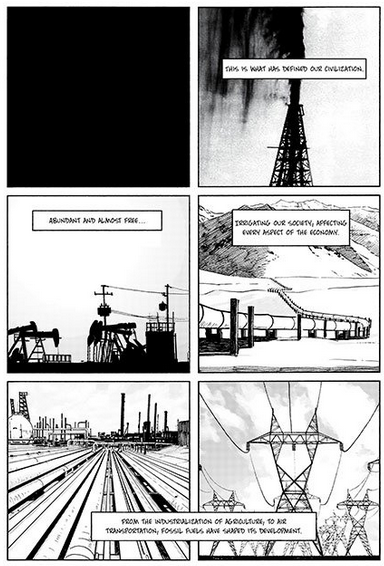
When it comes to the biggest environmental issue of all time for the human species, climate change, you see alarming headlines that mix alarming (and sometimes misleading) facts without actually informing you on how it’s happening, and how your behaviour influences it. This is the gap Climate Changed by Philippe Squarzoniv attempts to fill.
Title: Climate Changed:A Personal Journey through the Science Author: Philippe Squarzoni Illustrator: Philippe Squarzoni Published: 2014 (Abrams Comic Arts) Pages: 480 Dimensions: 16.5 x 3.2 x 23.5 cm Get Your Copy: In the Online Shop
Squarzoni’s book is as thick as a textbook, though far less dense and plodding. Its pages mix images of the author’s personal life with interviews and charts that make up much of the evidence for climate change. Though not as slick as a high budget movie, it walks the problem forward from the beginning, and then thoroughly examines the issue in a level-headed way.
Squarzoni found himself in a position many others share, a believer in climate change who only knew it was something to worry about. His journey through the research walks each reader through not only the changes we might be seeing, but how they’re happening. The way his life is juxtaposed with the research brings the science home, making it a journey that doesn’t just make you reflect on scary factoids, but genuinely try to understand them in the context of your own life.
It may be that being presented in a comic makes the subject far less intimidating, yet still gives you the chance to dwell on each page. Instead of a movie or TV documentary, you can linger on each page, rereading points that flow so easily off the tongue of an expert, better acquainting yourself with a trickier point. You can also take time to understand a graph or see the small changes in an image of landscape. You likely won’t finish it in one sitting, but it doesn’t take too much effort to keep it out of your shameful pile of unfinished books.
As excellent as it is, the book does have a few flaws. Some of the research, particularly the section on nuclear power, was a bit thin. For instance, a statement on nuclear waste taking decades to decompose with no solution to that in sight, when it’s been reduced to years, is misleading. Although small errors like that one inadvertently demonstrate one of the other great joys in science: being sceptical. If there’s one more thing a reader might take away from this book, it’s how to look at science not as something to be passively received, but something to actively engage with and attempt to understand personally.
By looking at the issue from so many angles, a reader can begin to grasp just what climate change means both scientifically, and in their own life. It makes science something that isn’t a fun curiosity, but rather a pursuit that belongs to all of us. One of the great limitations of science is how too easily people assume it’s a pursuit for the intellectual elites. Though scientists sometimes fail in communicating their ideas, it’s time people started making greater efforts in understanding it. It’s a knowledge base that belongs to everyone, and books like Climate Changed help bring it to us, if you make the effort in picking it up first.
Unlike most histories from above or below, Fluid Prejudice stands out as one that doesn’t provide a coherent narrative. Instead, it’s a dream-like journey through Australian history, haunted by the violence of colonization. Single-image cartoons jostle with longer stories, and well-known figures sit side-by-side with personal stories. Some characters recur in different forms across stories, shifting from the foreground to the background. This jumble creates a more radical approach to history which leaves questions and contradictions unanswered, rather than offering the reader an easy vantage-point.
Title: Fluid Prejudice Creators: Sam Wallman, Aaron Manhattan, Safdar Ahmed, Katie Parrish, and others (50 contributors in total) Editor: Sam Wallman Published: Self-published in 2014 Page Count: 175 pages Other Specs: Softcover, black and white interior with colour cover Purchase: In the Ad Astra Comix online store
While it may be tempting for many white activists to dissociate themselves from Australian racism, the collection doesn’t allow the reader to imagine that they can be outside processes of colonization. In one comic, two environmentalists engaging in direct action query whether this is part of the continuing white colonization of the forest. In another, white Occupy protesters pause to consider the irony of following the chant “Always was, always will be, Aboriginal land” with “Whose streets? Our streets!”
“Memory from Occupy”. Contribution by Sam Wallman.
Similarly, we never get to wholly lose identification with the middle-class Australians who are so often the target of activist derision. For example, a comic about the destruction of old growth forests is followed by another in which a man looks at a newly-opened suburb, daydreaming about a home there. While the image hints at typical narratives of suburbia as a site of ecological destruction and bland whiteness, there’s also an element of sympathetic identification.
Australia’s history as a penal colony, too, is treated through a overlapping stories which never quite settle into a single perspective. Fluid Prejudice focuses on stories of escape, with convict William Buckley reappearing several times throughout the collection. Mary Bryant, a transported thief, escapes and is later pardoned. However, the optimism of these stories is balanced by the stark list of different convict occupations in 1847 Tasmania, and the subtle reminders that convicts also played a role in the violence of colonization.
Both cities and the landscape become haunted sites. The Tasmania tiger, hunted to extinction as a part of the effort to impose a European approach to agriculture, reappears throughout the book stalking the supposedly-tamed undergrowth. Within the city, state and social control is undermined by a lesbian beat, working-class resistance to restrictions on free speech, and an underground city of train station platforms and graveyards which remain below the streets. No place is more authentically a site of struggle than others.
Contribution by Karina Castan
Fluid Prejudice rejects the erasure of the violence Australia was built on, but it also highlights moments of solidarity and hope. One comic reminds us that the only known protest against Germany’s persecution of Jewish people following Kristallnacht came from the Australian Aborigines’ league in 1938. In another, people run over rooftops and onto the top of trams as part of attempts to escape police crackdowns on public speech. We’re reminded of a period when unions were more radical, and prepared to down tools to save public space and support other struggles.
As well as these more overtly political stories, many of the notes of optimism and humour in this collection touch on the politics of gender and sexuality: Percy Haynes is followed by a policeman and charged for wearing women’s clothes, only to have the magistrate decide that since women can wear pants, there’s no reason men can’t wear dresses if they choose. Zeki Müren, a Turkish singer, performed in drag in Sydney in 1974 to an enthusiastic crowd of homesick Turkish immigrants.
Part of the beauty of this collection is the inclusion of mundane scenes and lives that would not usually reach the history books. There are fragmentary scenes of an Aboriginal embassy, passengers on a tram, a trip to Healesville sanctuary, even a dumpster. We learn about Rosaleen Norten, the witch of King’s Cross, and then about cartoonist Ruby Knight’s mother. Arlene Textaqueen replaces the front cover of conservative newspaper The Australian with responses to the question, ‘Where are you really from?’
Through the combination of explicitly political and more personal stories, resistance is written through many different forms and spaces. This is a helpful alternative to the ‘one true way’ approach to activism, in which a single set of tactics and strategies is the only way to be radical enough (or, conversely, polite enough).
Fluid Prejudice, as we might expect from an alternative history, undermines the myths Australia is built on, from heroic stories of settlers eking out a living in the bush to the ongoing erasure of the violence against Aboriginal people and other marginalized groups. However, it also encourages more critical reflection on our positions as activists and the ways in which we do—or don’t—identify with others within Australian society.
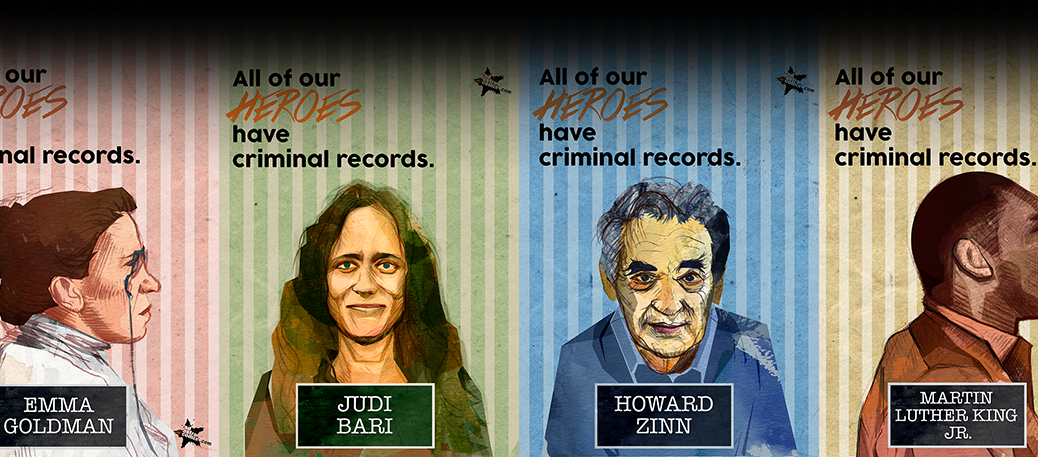
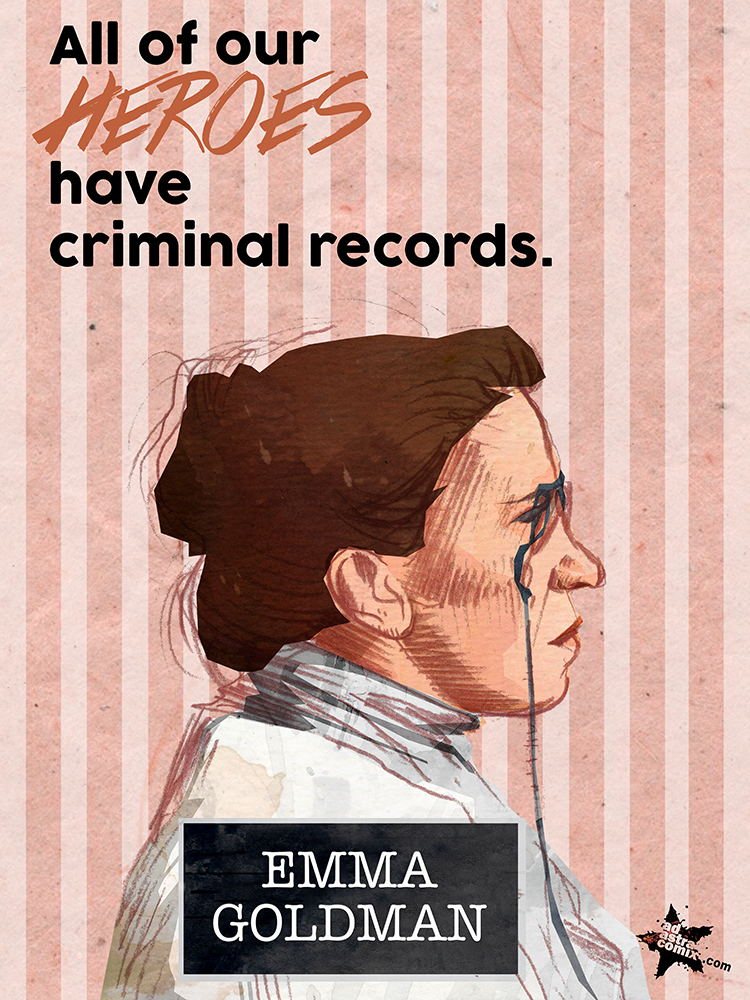
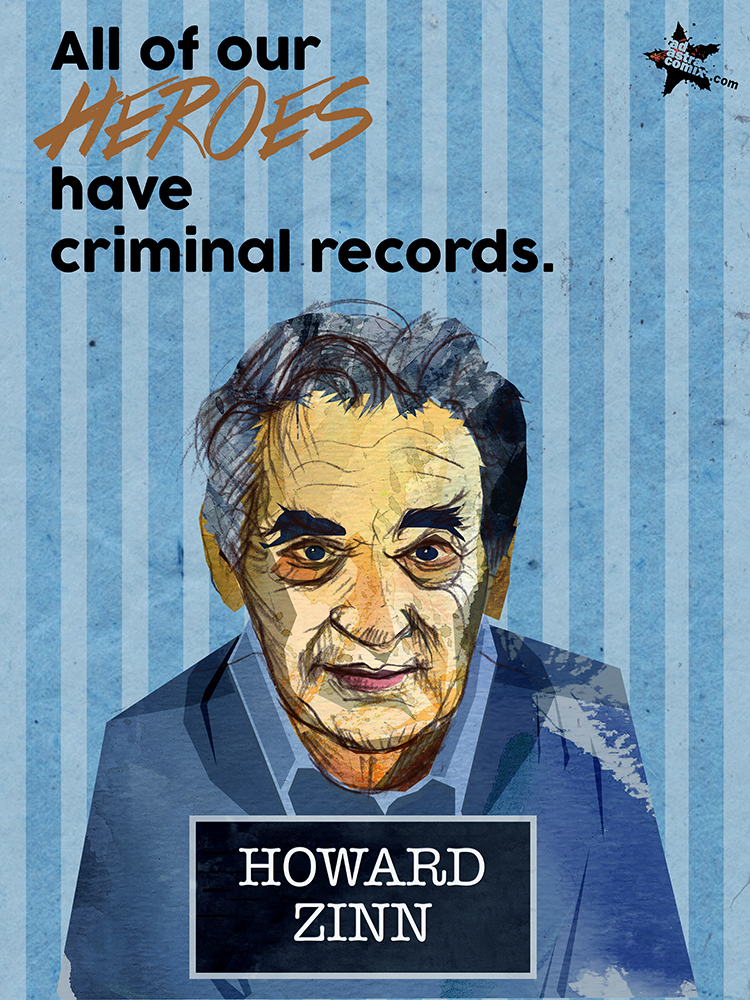
We are very pleased to be re-releasing our poster series, encouraging readers young and old to consider a different kind of hero than we normally think of when reading comics. These four posters boldly claim, “All Our HEROES Have Criminal Records“.
This visual campaign is inspired by the lives of four people who have been arrested for their grassroots organizing and/or activities of civil disobedience: Martin Luther King, Jr., Howard Zinn, Emma Goldman, and Judi Bari. They reflect a healthy variety of political backgrounds (civil rights, environmentalism, anti-war, people’s history, feminism, and anarchism) – and each has appeared, at least once, in comic form. All artwork by Sean Richman.
We’re excited to be making these posters available for sale! Visit the Ad Astra Online Shop to get your favorite, or collect all four. Numbers are limited for this printing, so if you don’t get one – stay tuned!
EMMA GOLDMAN (Booking #23178) Goldman was an anarchist and feminist known for her political activism, writing, and speeches. She played a pivotal role in the development of anarchist political philosophy in North America and Europe in the first half of the 20th century. Arrested in 1917 with Alexander Berkman for conspiring to “induce persons not to register” for the newly instated WWI military draft.
Emma Goldman appears in A Dangerous Woman : The Graphic Biography of Emma Goldman, Sharon Rudahl; edited by Paul Buhle. Published by New Press in 2007 (ISBN 3: 9781595580641)
HOWARD ZINN was an historian, author, activist, WWII veteran, and commentator on American politics and history. By the end of the 1960s, as a result of Zinn’s campaigning against the Vietnam War and his influence on Martin Luther King, Jr., the FBI designated Zinn a high security risk to the country, a category that allowed them to summarily arrest him if a state of emergency were to be declared. The FBI memos also show that they were concerned with Zinn’s repeated criticism of the FBI for failing to protect blacks against white mob violence. Zinn’s daughter said she was not surprised by the files; “He always knew they had a file on him”. — with Howard Zinn.
Howard Zinn appears in A People’s History of American Empire: The Graphic Adaptation, by Howard Zinn, Mike Konopacki and Paul Buhle. It was published by Metropolitan Books in 2008 (ISBN#: 978-0805087444).
JUDI BARI was an American environmentalist and labor leader, a feminist, and the principal organizer of Earth First! campaigns against logging in the ancient redwood forests of Northern California in the 1980s and ’90s. She also organized efforts through Earth First! – Industrial Workers of the World Local 1 to bring timber workers and environmentalists together in common cause. On 24 May 1990, in Oakland, California, the vehicle used by Bari and Darryl Cherney was blown up by a pipe bomb planted in it. Bari was severely injured by the blast, as the bomb had been placed under her seat; Cherney suffered minor injuries. Bari was falsely arrested for transporting explosives while she was still in critical condition with a smashed pelvis and other major injuries. The FBI took jurisdiction of the case away from the Bureau of Alcohol, Tobacco, Firearms and Explosives, saying it was a terrorism case.
Judi Bari’s story appears in WOBBLIES! : A Graphic History of the Industrial Workers of the World by Mike Alewitz, Sue Coe, Sabrina Jones, Paul Buhle and Nicole Schulman. It was published by Verso Books in 2005.
Martin Luther King, Jr. (Booking #:7089) MLK was an American pastor, activist, humanitarian, and leader in the African-American Civil Rights Movement. He is best known for his role in the advancement of civil rights using nonviolent civil disobedience based on his Christian beliefs. Arrested in 1962, 1963, and 1965 while demonstrating for civil rights in the American South.
The story of Martin Luther King Jr. can be found in many titles at this time. The first appeared in 1958, called Martin Luther King and the Montgomery Story (written by Alfred Hassler and Benton Resnik, produced by the Fellowship of Reconciliation) , and has been re-released by Top Shelf Productions.
Another is KING, a three-part biography by Ho Che Anderson, published by Fantagraphics between 2003-2005.
















![IMG_20140920_185756[1]](https://i0.wp.com/adastracomix.com/wp-content/uploads/2014/09/img_20140920_1857561.jpg?w=248&h=331&ssl=1 "IMG_20140920_185756[1]")
![IMG_20140920_184241[1]](https://i0.wp.com/adastracomix.com/wp-content/uploads/2014/09/img_20140920_1842411.jpg?w=218&h=164&ssl=1 "IMG_20140920_184241[1]")
![IMG_20140920_185811[1]](https://i0.wp.com/adastracomix.com/wp-content/uploads/2014/09/img_20140920_1858111.jpg?w=218&h=163&ssl=1 "IMG_20140920_185811[1]")


 adastracomix.com