Tag Archives: political comics

Battle of the Graphic Biographies: Hill and Wang

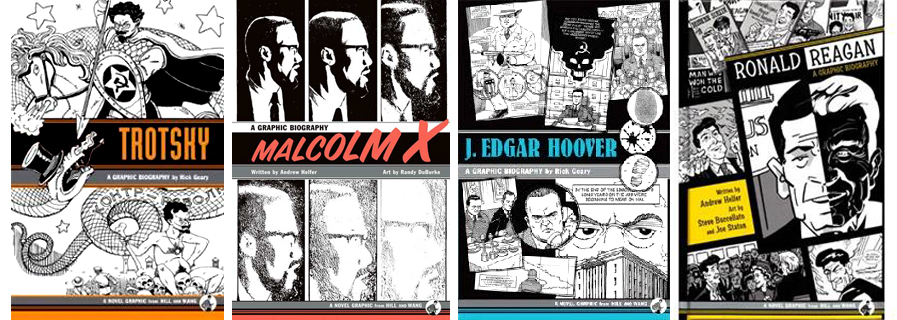
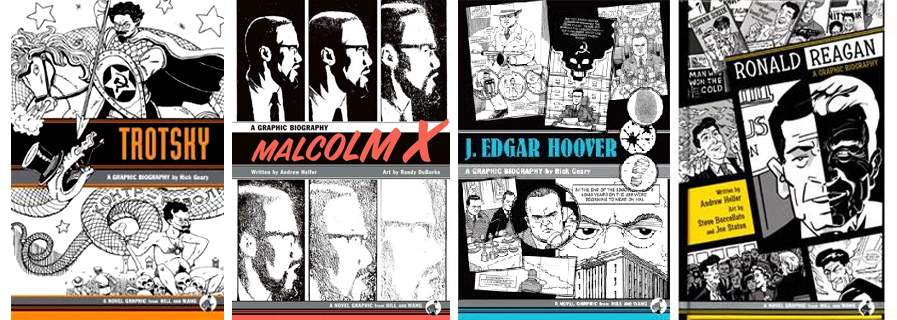
Continuing on with my theme “Battle of the Graphic Biographies” begun earlier this year Che Guevera, this month I’ve had a couple different titles at Hill & Wang take each other on– all a part of their Novel Graphics series. I, somewhat arbitrarily, began reading these books in chronological order: Trotsky, J. Edgar Hoover, Malcolm X, Reagan. My interest is obviously to provide some aesthetic feedback, but more to point out political strengths and weaknesses of the titles.
cover gallery
My first note is that each book appears to be politically tailored for the audience most likely to pick it up—the biographies speak more or less favorably of the people they spotlight.  But my questions going in are, “Do I better understand the person I’m reading about?” “Am I hearing of their life in their own words–while seeing an interpretation of events from a 3rd person?” “Is this historically/politically accurate?”
trotsky bio

Title: TROTSKY: A Graphic Biography
Writer & Illustrator: Rick Geary
Published: 2009

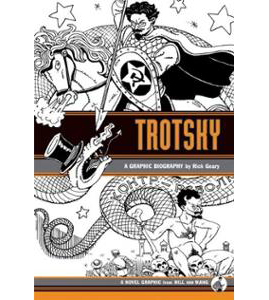
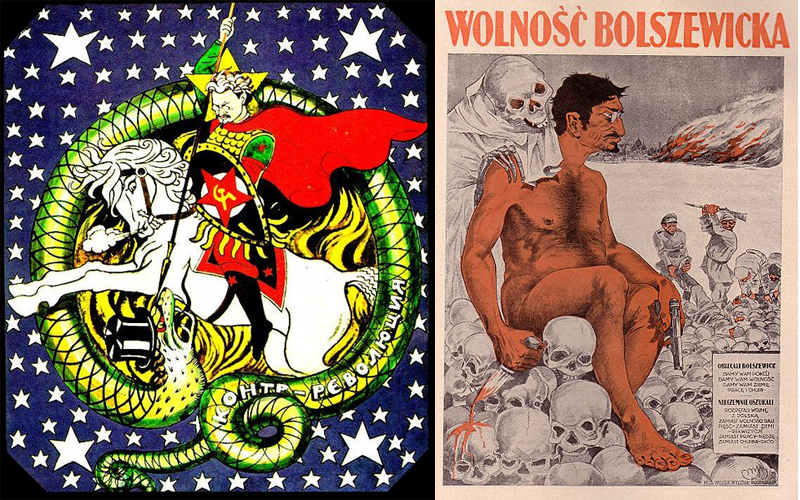
I had serious suspicions about this one, going in. Whereas the other book covers are more or less realistic, Trotsky’s is purely mythological. We see him astride a horse as some kind of atheist St. George–all the while he sits underneath, naked on a pile of human skulls. These images come from two very different interpretations of Trotsky’s role in the Russian Revolution–both over-zealous and emotional, both incorrect. While I appreciate the re-visiting of historical cartoons and illustrations, it seems necessary for me to make note of the the point that both graphics were commissioned by opposing governments during one of the most highly polarized moments of the 20th Century: the rise of the Russian Revolution.
The cover of 'TROTSKY (The Graphic Biography)' took inspiration from these political cartoons of the time. On the left, Viktor Deni, an author working for the Russian Soviet Federative Socialist Republic (RSFSR) in 1918, depicts Trotsky as St. George, slaying the dragon of "counterrevolution". On the right, Polish government anti-communist poster to counter Bolshevik propaganda from Russia during the Polish-Russian war 1920, showing People's Commissar for the Army Lev Davidovich Bronstein (Leon Trotsky). Large caption reads: "Bolshevik freedom."
The cover of ‘TROTSKY (The Graphic Biography)’ took inspiration from these political cartoons of the time. On the left, Viktor Deni, an author working for the Russian Soviet Federative Socialist Republic (RSFSR) in 1918, depicts Trotsky as St. George, slaying the dragon of “counterrevolution”. On the right, Polish government anti-communist poster to counter Bolshevik propaganda from Russia during the Polish-Russian war 1920, showing People’s Commissar for the Army Lev Davidovich Bronstein (Leon Trotsky). Large caption reads: “Bolshevik freedom.”

I think anyone who sees a book of 100 pages claiming to tell the life of Leon Trotsky is pretty much kidding themselves. Once into the story, you might be able to tell why: this man was a mover and shaker of continents, social structures and financial systems in a way that practically boggles the mind. In a time before television, let alone the internet and social media, Trotsky was world-famous for his ideas and his conviction to carry them to fruition.

This book, albeit abridging-ly, details his early years as a landowner’s son in modern-day Ukraine, a student activist and intellectual, his political development, his multiple exiles by the Russian Czar. It’s a whirlwind. In fact, it’s a struggle just to get all of these points down, without even going into what made Trotsky’s ideas so intriguing/dangerous, let alone his various roles in the the Revolution. Despite the obvious limitations, I believe Rick Geary does a stand-up job trying to pull together an epic biography that at least attempts to discuss serious politics.  Geary’s style lends itself well to the time period: a bit cold and minimalistic–but not cartoony. The line-work reminds me of borsch and cold, dry winters. In a good way.

I can’t really blame this book for what it isn’t–it’s not an in-depth biography of the Russian Revolutionary, in any sense. It’s not a clear history of the Russian Revolution either. But it will give you a crash course that may peak your interest, and lead you to other works about one of the most interesting men of modern times.

* * * * * *

malcolm x

Title: Malcolm X: A Graphic Biography
Writer: Andrew Helfer
Illustrator: Randy DuBurke
Published:  2006

Like Trotsky, Malcolm X is one of those four-letter words of the 20th Century. People alternately love and cherish or hate and fear everything that the man stood for. It really is a testament to the power of their ideas and the charisma with which they disseminated them.

Click to enlarge
Click to enlarge

Malcolm’s story has been told in epic fashion many times: there is the Autobiography of Malcolm X, as told to Alex Haley. Spike Lee’s “X” with Denzel Washington was an immediate classic. Once these essential biographies have been consumed, you believe that you know the man’s story. However this graphic biography, in fact, delivers additional information that even someone familiar with Malcolm’s story will find new and enlightening. Scenes I found most interesting included the details of his time as a hustler on the East Coast–as well as his final days in conversation with Nation of Island leader, Elijah Mohammed, whose candid remarks about women are better displayed here than anywhere else that I’ve read.

Malcolm’s entire life is characterized by a seemingly endless sense of change and evolution. In the end, the man who seemed tireless in his conviction, his self-confidence, was also likely his harshest critic. He went from being a pimp and a hustler to a raging animal in prison, a Nation of Islam preacher and black segregationist to working with whites when and where he could. And where we led, people followed. Because of his constant evolution, it is difficult for critics to demonize him. His radicalism has also made it pretty much impossible to water down his message–as has been done with Martin Luther King.

Of all the illustrators of this graphic biography series, I am in love with Randy DuBurke’s style. It is by far my favorite. He illustrates an emotion with what seems be a shadow-heavy photographic realism. Stylized but not cartoony, I even see some graffiti-stylized splatters in the background, that give it an additional grittiness. Given that author and illustrator are two different people in this work, I find their respective trades synching incredibly well.

* * * * * *

hoover bio

Title: J. Edgar Hoover: A Graphic Biography
Writer & Illustrator: Rick Geary
Published:  2008

Rick Geary is back after Trotsky with this graphic biography of FBI chief J. Edgar Hoover. Actually, this book was produced before the Trotsky one, but I’m going in some other kind of chronological order.

Unlike Trotsky and Malcolm X, I had never read a biography of Hoover before, although I was familiar with his role in Communist witch-hunting post-WWII, as well as his hand in the FBI’s notorious COINTELPRO counter-intelligence programs. What hadn’t occurred to me was the length of his office. The man was active in government from Emma Goldman… to Ronald Reagan. Think about that. Through half a dozen presidents. He was arguably the country’s most powerful civil servant. His ability to avoid partisan politics and harness the power of government bureaucracy, ironically, reminds me very much of his arch-nemesis Joseph Stalin. These two men dominated their countries with iron fists, using many of the same tactics, for much the same period of time. The key to both of their success was securing and mastering the administrative machinations of their positions.

While I see Rick Geary showing the light and dark of Hoover in this biography, he is at worst portrayed as a bit of a maniac who dabbled in unconstitutional activities for the protection of his dear country–and the all-sacred “American way of life”. We see the mass deportations of immigrant unionists, communists and radicals more as the shuffling of ants from one place to another outside the country–not the same brutal inhumanity with which Trotsky is depicted, sitting on a pile of bones.

Do I wish the comic would take a little more interest in how J. Edgar Hoover was a detriment to the country? The historical precedents of jailing and deporting descent, spying and wire-tapping, infiltration into progressive groups? Yes, in fact I can’t really think of any other singular man who probably committed more damage to democratic movements of the 20th Century than J. Edgar Hoover. But that’s my opinion on the matter–and Geary makes little to no effort to hide the evidence that would lead someone to those conclusions. He includes his very trouble remarks on communists, unions, student activists, black people–alongside the sea of other people that rubbed him the wrong way.

* * * * * *
reagan

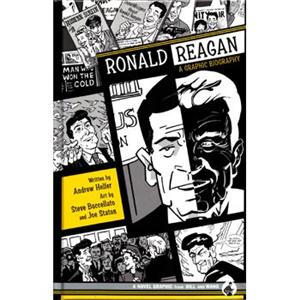
Title: Ronald Reagan: A Graphic Biography
Writer: Andrew Helfer
Illustrator: Steve Buccelleto and Joe Staton
Published:  2008

Of all of the graphic biographies, Ronald Reagan’s seems the most surreal. This is very much a theme of the book itself. Where was the threshold between Reagan the man and Reagan the actor? Reagan the actor and Reagan the politician? The book very much lends itself to the theory that there were no clear lines, even to Reagan himself. Acting was a part of him from a very young age, as were many of his political and moral influences.

Also more than any other comic in the series, this book relies very much on Reagan’s own interpretation of himself and his life–including instances like his student strike in university, which isn’t documented by the school–or his record 77 rescues as a lifeguard, even though there were many instances in those rescues where, hilariously, people apparently didn’t need to be rescued (THAT comic history vignette, I would love to see). More than many other American leaders, Reagan very much controlled what media and the public thought of him. That was his gift as an actor.

While there is some mention of his early days as an FBI informant, as a ‘friendly’ testifier in the mid-century Inquisition of American leftists and progressives, as well as his later involvement in the dismantling of unions, tax cuts for the rich, military intervention in Grenada… the underpinning theme Geary really seems to be driving home is Reagan’s mastery of the spectacle. It wasn’t really anything he did–and he did many things in his life–it was how he won support, how he charged through his competition and adversaries at the crucial moment. It wasn’t what he did so much as how slickly he was able to get away with it.

I find the artistic style of this work, shared by Buccelleto and Staton, to be my least favorite of the series. Faces and gestures are bubbly, cartoony, very “Leave It to Beaver”-ish, which works for Reagan but not for me. I feel like anyone who watched television during the last century knows this perspective of Ronald Reagan. So despite my distaste I understand perhaps why they went with it. Maybe, for all that time behind the camera, there really was no other way to see the man. He seemed to understand, at an early age, that public image is its own form of immortality.

* * * * * *

Of all the comics that I read, I enjoyed Malcolm X and J Edgar Hoover the most. Both had wonderful artwork and kept me intrigued with information that was new to me. However I appreciate the set as a whole for its fascinating takes on 4 totally different individuals. I have found much more intricacy in all of the books’ designs than I initially thought would be there.

Indiegogo Fundraiser Over for 100 Year Rip-Off

page1Hi Everyone!

Thank you to everyone who participated in our Indiegogo campaign to re-release “100 Year Rip-Off: The Real History of British Columbia”.

We successfully raised enough money to cover most of the printing costs! Which is fine by me–as we raised $500 more than I was expecting.

This means 100 Year Rip-Off will be getting back from the printers in September, and will be ready to distribute and sell at retail shops across Canada.

From the bottom of my heart, I thank each and every one of you for your generous support. As comic books rise in popularity and cultural relevance, it’s work like 100 Year Rip-Off that show us a long tradition of using comic books for education and social change.

I hope you all enjoy your copy/copies as they arrive at the end of September. For those of you who ordered larger numbers or are receiving a map in addition to the comic, be on the look-out for a larger shipping parcel. For orders outside of the U.S. and Canada, your shipment may be slightly delayed–but should arrive nonetheless by the end of September, as promise.

For those of you interested in keeping in touch, please follow me online!

I apologize for the lack of updating on the website–crowd-funding actually left me feeling a little exhausted. Hopefully content will be flowing at a normal pace really soon.
Facebook Page: https://www.facebook.com/AdAstraComix?ref=hl
Twitter Account: @AdAstraComics

Cheers everyone! Thank you once again, and have a terrific long weekend!

N.M. (Nicole Marie) Guiniling
nicolemarieguiniling@gmail.com

Press Release: Fundraising Begins for Canada’s Oldest Graphic History!

example2FOR IMMEDIATE RELEASE

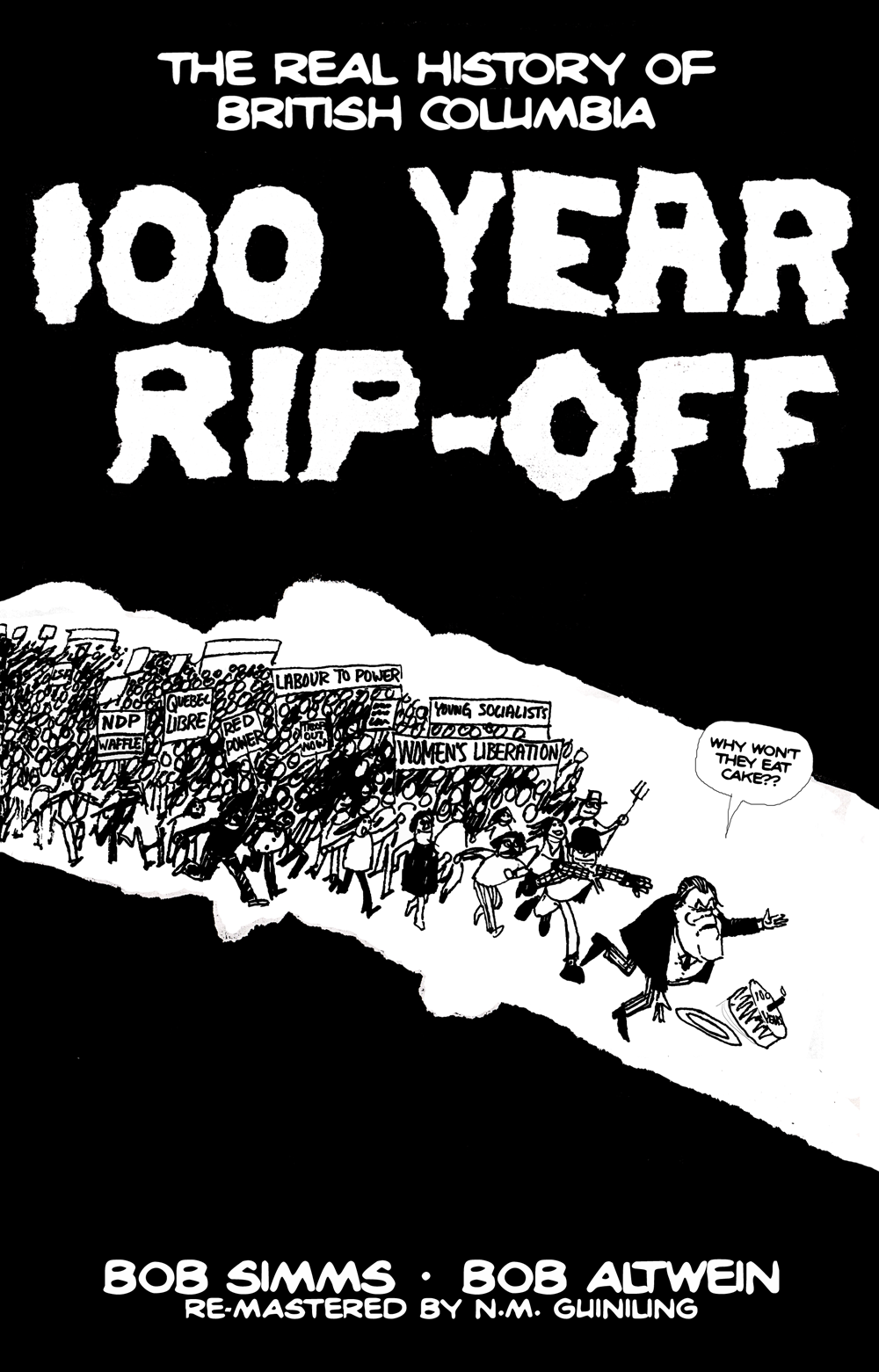
100 Year Rip-Off, A People’s History of B.C. to be Re-released After 40 Years
Canada’s Oldest ‘Graphic History’ on Record Highlights Stories of Working Class and People of Colour

July 20, 2013

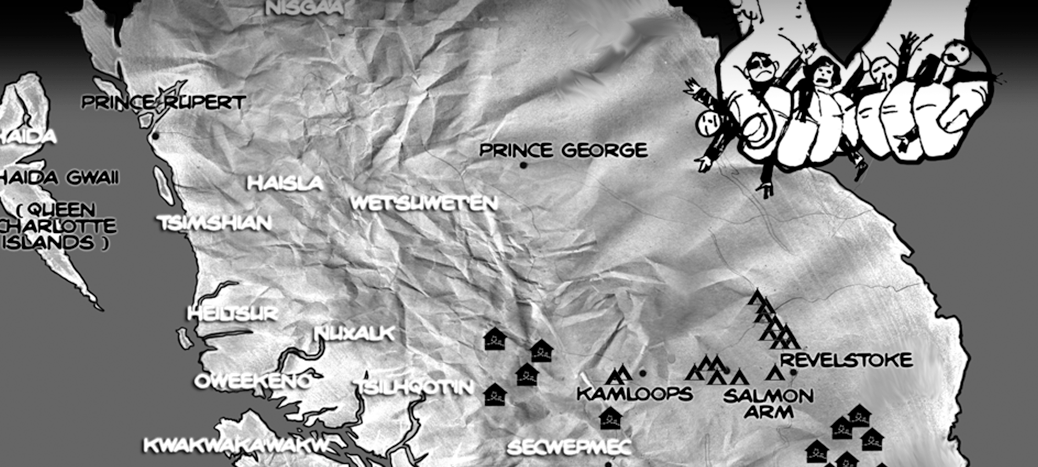
Canada’s oldest recorded comic book history is coming back from the dead after more than 40 years—if it gets a little help. On the anniversary of B.C. joining Confederation, specialty comic book publisher Ad Astra Comics is launching a 40-day fundraiser for the comic book “100 Year Rip-Off: The Real History of British Columbia”. The campaign, which aims to raise a modest $800, will help to cover the costs of re-mastering and printing the comic for the first time in over four decades.

“100 Year Rip-Off: The Real History of British Columbia” is a blue-collar comic book history of the first 100 years of B.C.’s confederated history. Written by the late Robert Simms and illustrated by artist and current B.C. resident Bob Altwein, 100 Year Rip-Off was originally produced as a one-time 8-page broadsheet, accompanied by a counter-culture newspaper.

Ad Astra Comics, in consultation with Altwein, has digitized and re-mastered the work and provided complimentary additions to the content, including a map and glossary addressing the finer details of the original work. The text remains un-altered.

“100 Year Rip-Off is a graphic history that almost slipped into oblivion–right at a time when comic books and ‘graphic history’ comics in particular are reaching a peak in popularity,” says Nicole Marie Burton, campaign coordinator and founder of Ad Astra Comics, a micro-publisher that specializes in political and historical titles. The project is headquartered with the publisher in Toronto.

A quality printing of the re-mastered work means that 100 Year Rip-Off can get a new lease on life–and that means a new generation of readers will be able to benefit from these little-known stories of the province’s history.”
That history, according to 100 Year Rip-Off, includes a number of episodes in which B.C.’s residents were given the short end of the stick–as the name indicates. It documents, through meticulous research, the seizure of lands from B.C.’s First Nations alongside the banning of Indigenous cultural practices like the pot-latch. It progresses by chronicling the often-volatile history of labour struggles within the region, from the formation of B.C.’s first unions to the province’s recurring threat of a Winnipeg-style general strike. History enthusiasts will take interest in the detail of the text, while comic book lovers will enjoy the ‘School House Rock’ style of illustrations, so indicative of the contemporary comic and cartooning scene of the 1970s.

Burton points out that young activists may take interest in the rendition of the 1938 ‘Sit-downers Strike’ that took place at the Vancouver Art Gallery and in the Georgia Hotel–an action very reminiscent of the recent Occupy Movement.

100 Year Rip-Off is a standard-sized comic book of 30 black-and-white pages. Participants in the project’s IndieGoGo campaign can contribute for as little as $7 and get their own copy of the book mailed to them. Larger contribution packages include buying a bundle of comics at a reduced price–perfect for schools, unions, book stores, and special interest groups–along with a poster-sized version of the comic book’s reference map, which has been added to this specially re-mastered edition.

“The project is about revitalizing and popularizing the working class history of this province,” explains Burton. “But it is also celebrating the creative work of the comic itself, which in turn has become a part of our history.”
For more information, please visit the “100 Year Rip-Off” IndieGogo Campaign Page:

http://igg.me/at/100YearComic/x/1048985

Press Contact:
Nicole Marie Burton
c/o Ad Astra Comics
nicolemarieburton@gmail.com
647-863-4994
http://www.adastracomix.com

Huxley vs. Orwell: The Webcomic

Biblioklept's avatarBiblioklept

Stuart McMillen’s webcomic adapts (and updates) Postman’s famous book-length essay, Amusing Ourselves to Death, which argues that Aldous Huxley’s vision of the future in Brave New World was ultimately more accurate than the one proposed by George Orwell in 1984. (Via).

View original post

The Art of a Comic with a Cause: Interview with “BRANDED” Author Rodrigo Caballero

Rod_Babs_VanCAF_2013
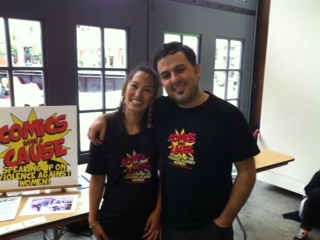
Comics With a Cause co-founders Rodrigo Caballero and Babette Santos

Ad Astra: You’re in the final stretch of your Indiegogo campaign! How would you describe the experience so far?

Rodrigo: Running my first Indiegogo campaign has definitely been a huge learning curve, especially for someone like myself whose knowledge (not to mention enthusiasm!) for the ins and outs of social networking platforms is not always up to par. Definitely my eyes have been opened to the idea of crowd funding- there is so much potential for doing advocacy and charitable work on the Internet, but so much time and effort to be invested as well. The sheer diversity of initiatives and ideas being funded right now through crowd funding, however, is mind-blowing and it’s exciting times for people with new and innovative ideas. I very much see our indiegogo campaign as the humble first steps taken in a longer path of development.

AA: The concept of a web comic about a subject matter like domestic abuse must have been new for some people.

R: Yes, definitely new, although it seems that’s been a positive thing for most people learning about the project, especially for those already working in the field of violence against women in a supportive capacity. There seems to be a thirst for new approaches to raising awareness of the topic. Violence against women is a very difficult subject to broach because it makes most people uncomfortable and it’s not the sort of thing one hears brought up in day-to-day conversations. For the most part, there’s been an unwritten code of silence that underlies the topic of violence against women in society. I think comics and graphic novels have a lot of potential, because if you can’t confront people directly about it at first, you can at least have them read about it in a format other than news reporting or statistics and if the story is compelling enough, they can and hopefully will talk about it with others. Expressing the subject in the form of a story allows for discussion in a manner that’ s a little less direct but hopefully still engaging. That’s the theory anyway!

AA: And what kind of spectrum of feedback have you gotten?

R: The feedback I’ve received on through our CWAC campaign has been overwhelmingly positive and for the most part people (including individuals working for organizations) have demonstrated a lot of enthusiasm for the idea. There seems to be a notion that a comic series addressing violence against women has a lot of educative potential as well (i.e. lots of comments about using this in the classroom and with younger audiences). I’m flattered by this sentiment and indeed part of me hopes “BRANDED” does one day make it to classrooms but admittedly there is also a small part of me that is wary of it. And that’s because there may be an assumption underlying this that comics/graphic novels is something for kids. Of course, audiences already familiar with the medium know that this limiting stereotype was broken a long time ago and that many of the most successful graphic novels have handled very serious or political subjects in  very unconventional yet compelling ways and in a manner that is unique to the medium. The other thing is that when we slap the word ‘education’ on something, it can carry a lot of baggage with it, just as the term ‘entertainment’ can. This comes from outmoded ways of thinking that equate learning with textbooks and grading and entertainment with passive consumption. I think there’s a lot of room for unpacking these terms and exploring comics as more of a liminal space.

AA: Let’s go back a bit. Where did the idea of “BRANDED” originate from? Were you inspired by other comic books already out there? What about the subject matter?

R: Like many others, the clincher for me in terms of what comics are capable of accomplishing was reading Art Spiegelman’s Maus and works by Alan Moore and Marjane Satrapi. Regrettably, in terms of raising awareness of violence against women, my familiarity with the phenomenon (also like many others) comes from knowing someone who has experienced sexual assault and having an intimate understanding of the traumatic and dispiriting effects that accompany it.

My idea for writing “BRANDED” in particular came from attending a panel on National Day of Remembrance and Action on Violence Against Women last December. Part of the event featured an installation where about a hundred black cut-out silhouettes of women were positioned everywhere and each one featured a short real-life account of a woman’s experience with male violence. These were collected by crisis line workers over the period of a single month. There was something about the immediacy of these stories that I found staggering and that spoke to just how obscured the phenomenon of violence against women is– here were all of these horrendous real-life accounts of violence against women, and the majority of them never reach public consciousness. During the subsequent panel discussion, the question was also raised, “What is the role of men in ending violence against women?” That was very much my own personal call to action and for whatever reason, the idea entered my mind– I’m going to make a comic series addressing violence against women–and I just knew from that point onwards this was something that I was going to have to do. From there, the premise and most of the characters basically spilled out of me in one brainstorming session shortly afterwards.

CWAC2

CWAC3

AA: “BRANDED” includes a figure known as “The Brander”. Comics have expanded so much since the first
days of caped crusaders. What inspires you to continue on with the inclusion of a ‘caped’ hero–someone with a secret identity and extraordinary abilities?

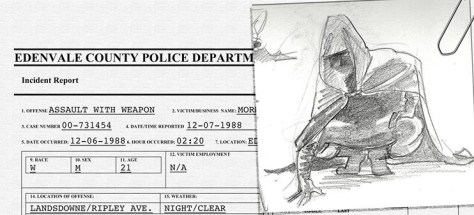
womeninrefrigeratorsR: Well, the first thing is that I don’t really consider “BRANDED” to be a superhero story per se, nor will The Brander have any extraordinary abilities (although the secret identity trope is very much a part of the character). That’s because she or he is very peripheral to the story and only gets minimal page time. Instead, most of the story centers on a group of characters whose lives are impacted in different ways by The Brander’s actions, which are at best controversial and morally not so easy to justify. Readers familiar with the “women in refrigerators” phenomenon (sparked by Gail Simone a number of years ago) will be familiar with the argument that too often in comics, we see female characters maimed, raped, incapacitated or killed off ruthlessly and abruptly, usually in order to provide a motivation for the protagonist/superhero. “BRANDED” eschews such shock-value devices and instead depicts women as survivors (not just victims) of male violence and its consequences. The presence of The Brander–a vigilante who has decided to seek redress for women survivors of male violence because the law has been deemed incapable of providing this-is meant to provoke readers into thinking about what sort of factors would actually drive somebody to adopt such a role. In real life, it’s estimated that only a fraction of sexual assault incidents are reported to the police by survivors and of these statistically only a fraction result in a conviction or imprisonment, so I think this theme of absence of redress or lack of justice is a very real one for many survivors of violence. My idea was to have a vigilante who went around branding the faces of perpetrators of sexual violence in order to expose them and place the burden of shame and stigma on them rather than the survivor, which is what we tend to see too often in real life. The Brander, despite only having a minor role in the story, is meant to embody the response (albeit a dramatic one) to this absence of redress and there’s a certain inevitability to the character’s appearance that I hope comes across when we bear the statistics in mind. When we recall the example of the vigilante group “Anonymous” and their intervention in the recent Rataeh Parsons case, The Brander isn’t too far a stretching of reality.

AA: What advice would you have for others fundraising for projects with a similar interest?

R: It’s important to build a community around your cause or project. For me, even though I decided to go ahead and launch an Indiegogo campaign for “BRANDED,” I’m still very much in the formative stages of building a community or audience for the comic. This can only happen over time but I think when it does, the comic will really start to take on a life of its own. Also, for any men becoming involved with speaking up on violence against women, such as myself, it’s important to inform yourself to the best of your ability and remain ever sensitive to your position relative to the phenomenon of violence against women while not adopting the role of someone speaking on behalf of survivors. Too often in so many spheres the voice of women is marginalized and the last thing we need is for this to happen in raising awareness of violence against women. I can’t pretend to have fully learned how to negotiate this dynamic, but I can certainly
remain cognizant of it.

AA: After your Indiegogo drive is over, what can supporters expect to see from Comics with a Cause in the months ahead? 

R: The if-everything-goes-according-to-plan picture is: We will finish finding the funding to produce about 85 pages of script to be illustrated by Reetta Linjama, our current illustrator, and hopefully hire somebody who can colour all the pages too. Our aim is to start releasing the comic series episodically (perhaps weekly) beginning early September and I would like to take it right up to December 6 which is the National Day of Remembrance and Action on Violence Against Women. This will depend though on how much funds we can raise for the project. Right now the best way to help out is through our Indiegogo campaign which ends June 22, but we may try and figure out a way to allow people to keep donating after that, ideally on a new website dedicated to the comic series. In the meanwhile, any news and updates can be found on our Facebook Page.

Of course, the other question people always bring up is, when do we see the printed or graphic novel edition? Like most comic artists/writers, I’m all for that! But let’s get the thing made first…

AA: Thanks, Rodrigo! Best of luck as these final days!

CWAC1

Whistle-Blowers and War Resisters: Phase 1

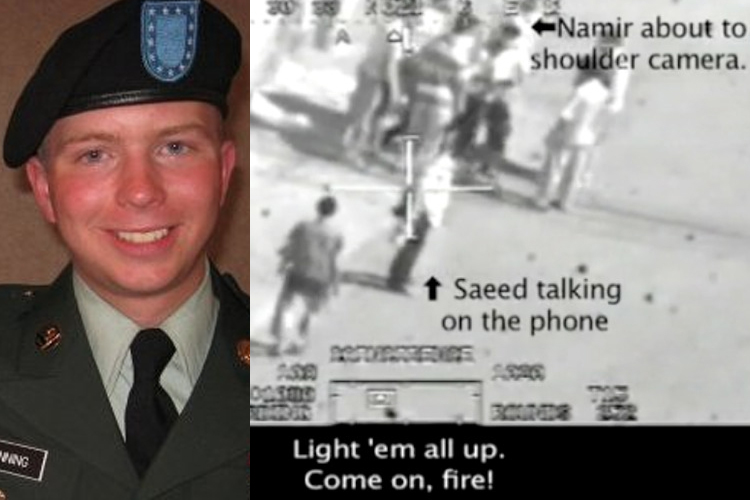
Destination this weekend: Ft. Meade, Maryland, where hundreds/thousands are gathering to protest the continued imprisonment of whistle-blower Bradley Manning. June 1st marks the beginning of his 4th year in prison- over a year of which has been in solitary confinement–and his trial has only just begun.

Private FirstClass Bradley Manning pictured left, alongside a video clip of the now-notorious military footage that he released to the world -"Collateral Murder" - which shows U.S. soldiers firing on civilians, including journalists, in Iraq.
Private FirstClass Bradley Manning pictured left, alongside a video clip of the now-notorious military footage that he released to the world -“Collateral Murder” – which shows U.S. soldiers firing on civilians, including journalists, in Iraq.

My plan: to cover the rally and the case of whistle-blowers and war resisters from a comics journalism perspective. Who are whistle blowers and war resisters within the current framework of the Global War On Terror? What are the historical precedents? What compels them to face jail time, potentially life sentences for standing up / speaking out / leaking classified information?

Obviously, I will be biased in my investigation. My husband is a former U.S. 82nd Airborne Paratrooper who served a 15 month tour of duty in Afghanistan–and would be arrested the minute he stepped back into the United States on grounds of desertion, as his contract was being extended to include a second tour. As his partner and someone who has heard intimately on his time in the military, I feel confident in saying that the injustices he witnessed were first-hand; stuff not of a “necessary evil” or “duality of man” that resigns one to complacence. I believe he and Bradley Manning share a story–a story shared, in one way or another, by all whistle-blowers, war resisters, and veterans who have decided to make a stand, and I’d like to share that story with all of you.

I bring with me the 5 P’s:

Pencils
Pens
Paper
Paints
Phone (Voice recording / camera / Internet)

Wish me luck.

For more information on the Ft. Meade rally and the case of Bradley Manning, check out http://www.bradleymanning.org

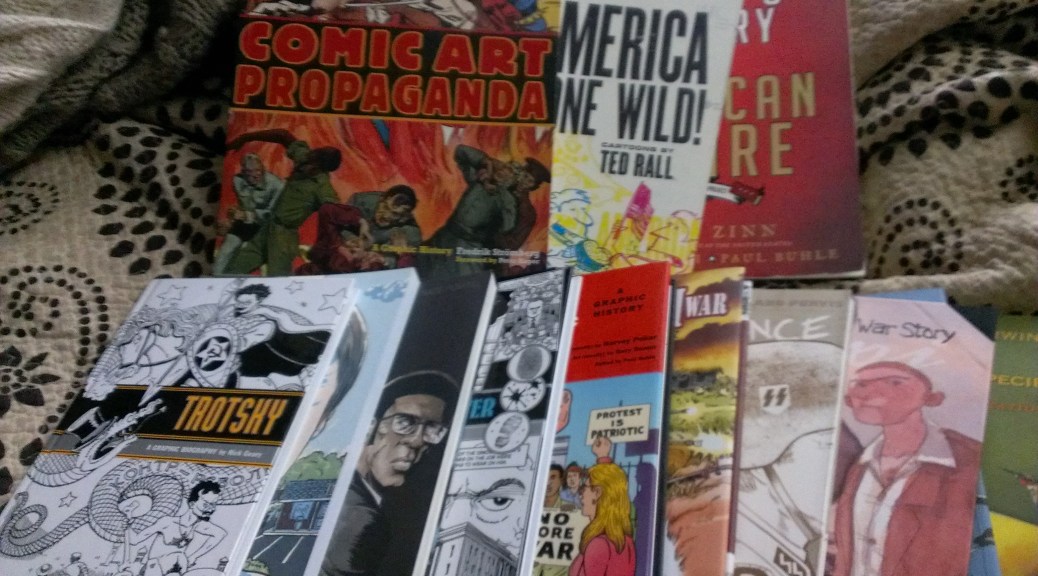
Complete Up-To-Date Stock List

Last Updated: August 19, 2013.

America Gone Wild!
Creator: Ted Rall
Published: 2006 by Andrews McMeel Publishing
Details: Softcover


Bayou (I, II)
Creator: Jeremy Love
Published: 2010 by DC Comics
Details: Softcover. Parts 1 and 2 of a 3-part series (last book is yet to be released). Review available.


The Bush Junta: 25 Cartoonists on the Mayberry Machiavelli and the Abuse of Power
Creator: (Various – Anthology)
Edited by: Mach White and Gary Groth
Published: 2004 Fantagraphics Books
Details: Softcover. Includes work by Seth Tobocman, Ted Rall, Peter Kuper, Spain Rodriguez, Steve Brodman, Lloyd Dangle, Carol Swain, Ted Jouflas, and Ethan Persoff


Che: A Graphic Biography
Creator: Spain Rodriguez
Edited: Paul Buhle
Published: 2008 by Verso Books
Details: Softcover. Review available.


Che: A Graphic Biography
Writing: Sid Jacobson
Art: Ernie Colon
Published: 2009 by Hill and Wang
Details: Hardcover. Review Available.


Che: A Manga Biography
Writer: Kiyoshi Konno
Artist: Chie Shimano
Published: 2010 by Penguin U.S.A. (Originally published in Japan
Details: Softcover English translation.Review available.


Comic Art Propaganda
Writing: Fredrik Stromberg
Art: Various
Published: 2010 by Ilex Press Limited.
Details: Softcover. Forward by Peter Kuper.


Dark Rain: A New Orleans Story
Writing: Mat Johnson
Art: Simon Gane
Published: 2010 by Vertigo Comics
Details: Hardcover. Review available.


SOLD OUT –Devil Dog: The Amazing True Story of the Man Who Saved America
Writing: David Talbot
Art: Spain Rodriguez
Published: 2010 by Simon & Schuster
Details: Hardcover. Review Available.


Edible Secrets: A Food Tour of Classified U.S. History
Writing: Michael Hoerger and Mia Partlow
Art: Nate Powell
Published: 2010 by Microcosm Publishing
Details: Softcover. Review available.


Extraction! Comix Reportage
Creator: Various
Published: Cumulous Press
Details: Softcover. No longer in print. Review available.


FLOOD! by Eric Drooker
Creator: Eric Drooker
Published:
Details: Softcover. No longer in print. Review available.


SOLD OUT —Footnotes in Gaza
Creator: Joe Sacco
Published: 2009 by Joe Sacco
Details: Softcover. Review available.


The Hammer& The Anvil: Frederick Douglas, Abraham Lincoln, and the End of Slavery in America
Writing: Dwight Jon Zimmerman
Art: Wayne Vansant
Published: 2012 Hill and Wang
Details: Hardcover. Forward by James M. McPherson


Hyena in Petticoats: The Story of Suffragette Nellie McClung
Creator: Willow Dawson
Published: 2011 by Puffin Canada
Details: Softcover.Review Available.


J. Edgar Hoover: A Graphic Biography
Creator: Rick Geary
Published: 2008 by Hill and Wang
Details: Hardcover


Liberator: Issues 1 – 4
Creator: Matt Miner and Joel Gomez
Published: 2013 (Black Mask Studies)
Details: Single issues available with protective board/bag. Review available.


Life Begins at Incorporation
Creator: Matt Bors
Published: 2013 (self-published)
Details: Softcover. Review available. Author website here: http://www.mattbors.com


Louis Riel
Creator: Chester Brown
Published:
Details: Review available.


Mayday: A Graphic History
Creator: The Graphic History Collective
Published:
Details: Interview with comic makers available.


Not the Israel My Parents Promised Me
Words: Harvey Pekar
Art: JT Waldman
Published: 2012 by Hill and Wang
Details: Hardcover. Review available.


Notes for a War Story
Creator: Gipi
Published: 2007 by First Second
Details: Hardcover. Collector’s Edition.


SOLD OUT—-A People’s History of American Empire: The Graphic Adaptation
Creator: Howard Zinn, Paul Buhle
Published: 2010
Details: Softcover. Review Available.


Trotsky: A Graphic Biography
Creator: Rick Geary
Published: 2009 by Hill and Wang
Details: Hardcover. Part of Geary’s Hill and Wang Graphic Biography series.


The Silence of Our Friends
Creator: Mark Long, Jim Demonakos, Nate Powell
Published:2012 by First Second
Details: Softcover. Review available.


Students for a Democratic Society: A Graphic History
Writer: Harvey Pekar
Art: Gary Dumm
Editing: Paul Buhle
Published: 2008 by Hill and Wang
Details: Additional text by SDS Members; additional art by Josh Brown, James Cennamo, and others. Hardcover.


Take What You Can Carry
Creator: Kevin C. Pyle
Published: 2012 by Henry Holt
Details: Softcover.


SOLD OUT—UNeducation Volume 1: A Residential School Graphic Novel
Creator: Jason Eaglespeaker
Published: 2012 (self-published)
Details: Author website here: http://www.eaglespeaker.com. Review available.


V for Vendetta
Writer: Alan Moore
Art: David Lloyd, Steve Whitaker, Shiobhan Dodds
Published: 1988 by Vertigo Publishing
Details: Softcover. Definitely not a first edition. Review available.


The Vietnam War: A Graphic History
Writing: Dwight Jon Zimmerman
Art: Wayne Vansant
Published: 2009 by Hill and Wang
Details: Hardcover.


Who is Ana Mandieta?
Creator: Christine Redfern and Caro Caron
Published: 2011 by The Feminist Press
Details: Hardcover. Review available.


World War 3 Illustrated
Creator: Various (Anthology)
Details:  America’s longest-running anthology of radical comics. Published quarterly in New York City. Currently on #44 – “The Other Issue”. Review available.

Political Comics at #TCAF 2013

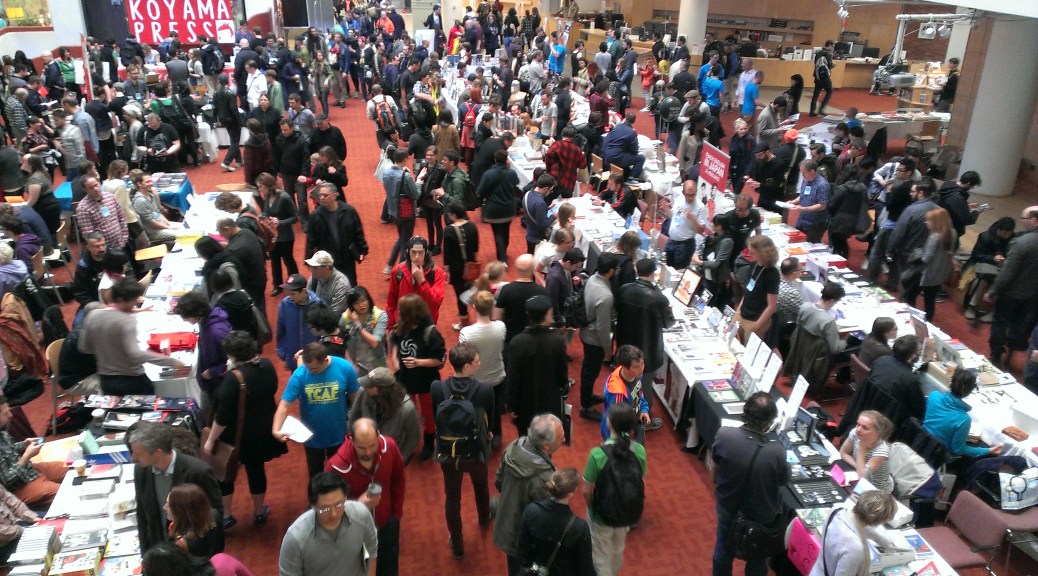
It’s safe to say that this past week was one of the busiest for me in recent memory. On top of working a 40 hour week at my day job (in 4 days), the Toronto Comic Arts Festival was in full swing and I was pulling together what I’d hope would be two kick-ass events for the weekend.phone photos 058
TCAF breaks records every year–has since I’ve been attending at least. If this year didn’t reach fire-code-breaking capacity at the Toronto Reference Library (in addition to several off-site satellite locations), and to be sure, they’re still still waiting on the official numbers, then it was awfully close. More notably there was an insane amount of talent at the show: Art Spiegelman and Francoise Mouly of RAW Magazine / MAUS / New Yorker fame. Jaime + Gilbert Hernandez, Tagame, Matsumoto, Chester Brown, Seth, David B… the list goes on.
Unlike my previous years at the festival, I saw a notable rise in interest (as well as work available) pertaining to political comic books. This is despite the skiddishness that remains around the term “political”. But whatever people want to call it, I found much more to chew on over the weekend than in years past.
Before I go into some books, a note on Comics Journalism.
If there’s one way to get people to talk comfortably about political comics and their viability, it’s Comics Journalism. I think it’s seen as a happy medium for a lot of  different interest groups, whether it’s non-comic folk looking for some different non-fiction, or comic fans looking for a different type of page to turn. In turn, the sub genre doesn’t effect the topic. Joe Sacco really birthed the term, from his thumb-to-index-finger loins, with work like Palestine and Safe Area Goražde, using comics to take on some pretty acceptable topics of intrigue in the journalism community… but since, really, you could do a comics journalism piece on just about anything and it would have the potential to be amazing. I look forward to seeing more and more come to maturity in this genre over the coming years.
…And secondly, a brief note about Art Spiegelman’s MAUS. I did not include MAUS in this list, because 1) I think it’s deserving of a little more commentary than one paragraph, for all it has done to influence the world of political comics… and comics in general. 2) It was put out 20 years ago. I feel like it’s a bit silly to put it among a list of up-and-comers with newly released works. (In other words, there will be more on MAUS as a specific work to come soon on Ad Astra!)
OK. To the books.

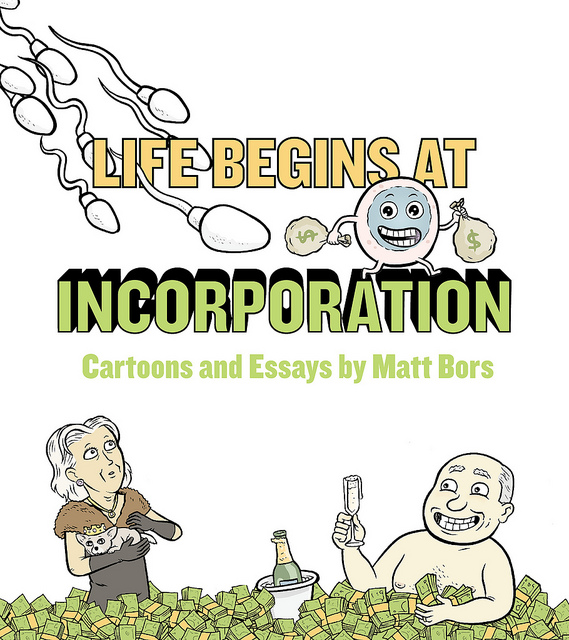
mattbors_lifebeginsatincorporation
LIFE BEGINS AT INCORPORATION by Matt Bors – I’ve never considered myself a fan of editorial cartoons, so when I decided to back Matt’s Kickstarter campaign, that really just meant that I liked his work more than I cared to admit. After a bit of discussion and a lot of planning on both ends, Matt was able to make it up to Toronto to promote his book at TCAF, in the midst of some type of Eastern-Time-Zone-only book tour.
The book is a collection of political cartoons and essays spanning years of wonderful American political drama- from the gay marriage debate that is still somehow being discussed, to the continuing occupation of Afghanistan and the reality that war-time simply seems to be the perpetual reality for Americans, post-9/11. I have plenty to say about this book and have already uttered plenty of niceties here. My recommendation over reading my book-length review is just to buy the book. It’s better.
From left to right: Rutu Modan (Jerusalem), Matt Bors (Portland), Sarah Glidden (vagabond drifter), Josh Neufeld (New York City)

I will add, however, that Matt gave a great presentation to an engaged crowd at the Comic Book Lounge on May 10, the night before TCAF–despite monsoon thunderstorms and a competing 10th Anniversary TCAF party down the road (we had this shit scheduled MONTHS ago. We’re not the splinter group. THEY’RE the splinter group!). Attendees included at least one other fellow Kickstarter backer, which was great to see.
On Saturday evening, Matt and I shared a table with comic creators Josh Neufeld, Sarah Glidden, and Rutu Modan to discuss “Comics & Politics” at TCAF to a great crowd who asked lots of questions–from comics journalism to comics activism, free speech and “to draw or not to draw” (discussing the Mohammed cartoon), stereotypes, backlash for work done… it was great. And what’s more, it shows a genuine interest in political comics from a variety of entry points.
sarahglidden_howtounderstandisrael

HOW TO UNDERSTAND ISRAEL IN 60 DAYS OR LESS by Sarah Glidden – Right in there on the topic of Comics Journalism. Sarah Glidden went to Israel on a Birthright trip and came out of it with How to Understand Israel in 60 Days or Less. Not only is it a journalistic piece about the country, it is journalism of herself experiencing it. The artwork is very much a European comic book style, with simple, expressive line work and really nice coloring (these are pretty much the first two things I think about when someone says European Comics). It’s packed with a thousand little stories that maybe tell us more about an American’s viewpoint on Israel than Israel itself, in all its historical and political turmoil. But I like the frankness that Glidden gave when describing the outcome of the book while at the TCAF panel (at the risk of seeming “wishy-washy”), when she said that this place became real when she traveled there, and the people in it became human beings. While I may not agree with Sarah on her political conclusions (and I’ve yet to see, as I’ve yet to finish the book!), it hardly seems relevant when we’re talking about a work of art that is depicting a personal experience.joshneufeld_ADNewOrleans

A.D. NEW ORLEANS by Josh Neufeld – This book has been on my list to pick up for some time, and it was a pleasure to share a stage with Josh and talk to him about this project. I’ve yet to fully pinpoint my thoughts on this, but there is something to be said about  a writer’s perception of an experience, and a visualist’s perception of the same thing. Neufeld seems to pick up on details of the Hurricane Katrina disaster that go missing in other accounts–and it’s not just a matter of mainstream vs. independent media. The wreckage, the crowds, the sweat, the loss of cherished items… all pulls at you differently when you are immediately able to absorb the information through a drawn depiction, without the filter or process of language. I particularly like the variety of people interviewed and their respective color palettes in the book’s pages. This will be a great one to finally read cover to cover.

I also got two other books that were illustrated by Josh Neufeld – The Influencing Machine: Brooke Gladstone on the Media, and Stowaway, written by Tori Marlan. Both works of comic journalism, although entirely different.


davidB_bestofenemiesBEST OF ENEMIES by Jean-Pierre Filiu et David – When I first eyed this book at TCAF last year, I’d already spent all my money. Good thing I have a better job this year. Best of Enemies explores the long and complex history of U.S.-Middle East relations. It is part 1 of 3: 1783-1953, and so incredibly fascinating. David B.’s illustrations are absolutely addictive; despite history typically being considered a dry subject matter, he ads enough art and style to the panels to keep even the subject’s most un-enthused reading on. In my limited French comprehension, David had to tell me in English that he and Jean-Pierre, an historian and former diplomat, are busy working on the next book, despite their own crazy schedules traveling around the world. I look forward to reading this one, as well as the coming two.


vendittihuddleston_homelanddirectiveTHE HOMELAND DIRECTIVE by Robert Venditti and Mike Huddleston – One of the few works of fiction that I picked up over the weekend, this self-described ‘political thriller’ is available through Top Shelf Productions, one of my favorite publishers. I always worry about books that look like this one… I don’t want to read a comic book version of the Bourne Identity, although the plot to this one sounds a bit more like the BBC TV show, Utopia. What pushed me over the fence with this one was the attention to detail that I can see–the stylistic and color scheme differences in the artwork as the pages change scenes, the elaborate plot that all ties together at the end (according to the dude from Top Shelf…. who I believe, cause they’re usually believable). Great cover art, too. I will get to this one, albeit a little later than some of the others. Suspicion ensues….


harveypekar_clevelandHARVEY PEKAR’S CLEVELAND with art by Joseph Remnant – In hindsight I’m trying to remember the reason I purchased this comic. It may have been the incredibly detailed pen and ink cross-hatch artwork, or the wonderfully vivid content of working class history in the Midwest, or the introduction by Alan Moore. All are good takers; combined, they won me over. It looks like a great read that most people would greatly under estimate.


7SbooksSEVEN STORIES PRESS at TCAF
Was so psyched to see Seven Stories Press –traditionally not a comics publisher–at TCAF this year. What a great addition to the exhibitors list. Tons of historical and political comics to choose from. I would place them as pretty much the only contenders to have stocked radical comics at the festival. Kudos to them coming and to TCAF for welcoming change and getting them on-board!

THE BEGINNING OF THE AMERICAN FALL by Stephanie McMillan – Yet another work of comics journalism, documenting the nature and relevance of the Occupy Movement in the U.S. This book was the 2012 winner of the RFK Center for Justice & Human Rights Journalism Award – not an award that I’m familiar with, but impressive nonetheless for a type of journalism not yet fully grasped. I am particularly interested in this because it is a political comic that isn’t afraid to take a side- it clearly sees its prerogative as educating a broader audience about the Occupy Movement and inciting a greater level of political participation in the world around us. Can’t wait to read.

AS THE WORLD BURNS by Derrick Jensen and Stephanie McMillan – Also at the Seven Stories Press table was this title, also one that I’d never heard of. This book teams McMillan up with notorious deep ecology activist Derrick Jensen to make satirical play on the impending environmental and ecological crises of out time. While it is fictional (perhaps allegorical?) it is undeniably meant to shock people at just how close we’re getting to a great collapse. Looking forward to the read.

PARECOMIC by Sean Michael Wilson and Carl Thompson – Also by Seven Stories Press, about Michael Albert and his development of Participatory Economics. I will probably pair this one up with another comic I plan to review about capitalist economics and see how many of you are still awake at the end. Introduction by Noam Chomsky. See, now you have to buy it.

canadian books

CANADIAN POLITICAL COMICS at TCAF

If political comics can be construed as typical, then it is assumed that the great bulk of them at the festival would be from the U.S. Despite TCAF being a Canadian event, there’s just more of everything coming from the U.S. in comics. But to my delight I was able to find some great work available through Conundrum Press, a publisher based out of Nova Scotia.

THE HERO BOOK by Scott Waters – Not so much a graphic novel or comic as an illustrated memoir (it says that right on the cover), The Hero Book is an artistic yet journalistic look at the culture and psychology of Canadian soldiers. At least, that’s as far as I can tell. Sorry, I was too busy looking at the ABSOLUTELY JAW-DROPPING artwork to read any more than a couple of sentences. Holy shit, this book is beautiful. And from what I can tell, the content is right up my alley. Looking forward to the read.

CHIMO by David Collier – While dealing with the topic of Canadian soldiers like the work above, Chimo appears to be much more comic book-y. As a part of the Canadian Forces Artists Program (seriously, I was surprised as well to hear that such a thing existed), Collier actually went through basic training to be able to write this book. As far as I know, he was in his early 40’s at the time. Impressive, David! It makes drawing out 100 pages sound pretty damn easy!

PAUL JOINS THE SCOUTS by Michel Rabagliati – This book fascinates me. The folks at Conundrum described it to me as something from their ‘Young Adult’ section, but pointed out that it covers a lot of the FLQ crisis in Quebec during the 1970s. What an interesting combination! I love the idea of mixing political and non-political plot lines (isn’t that more like real life?). Paul is the author’s semi-autobiographical character, so it would appear that the work draws from a lot of first-hand experience. Looks like a great piece – can’t wait to pick it up.

Edible Secrets: A Food Tour of Classified U.S. History

ediblesecrets_coverTitle: Edible Secrets: A Food Tour of Classified U.S. History
Authors: Michael Hoerger and Mia Partlow
Illustrations: Nate Powell
Published: 2010 by Microcosm Publishing

As pointed out in its introduction, food is as good a filter as any for relating to government secrecy: both are ever-present realities of life that we swallow without much further thought. This book is a creative one, in that it ties a lot of things together. It’s a history book, a comic, a zine, …and a reproduction of declassified government documents.   All relating to food, either as a code word or as a coincidental element in major geo-political events (Black Panthers leader Fred Hampton was framed for robbing an ice cream truck at age 19; U.S. officials tried to assassinate Fidel Castro by spiking his milkshake with poison).

It’s a quirky take on a lot of different things that I enjoy reading about: history, secrecy, art, and food. I think it may take a special interest in the subject matter for the reader to really get down with this book, in my opinion—but I freakin’ love it. Nate Powell’s illustrations are the icing on the cake here: the first chapter’s title page shows Fred Hampton, dressed as Robin Hood, passing out ice cream to the neighborhood children. He hands a small boy a popsicle in the shape of a Black Power fist. Seriously, it doesn’t get any better than this. Original, political, historical, shocking, artistic: awesome.

fred hampton


Devil Dog: The Amazing True Story of the Man Who Saved America

coverTitle: Devil Dog: The Amazing True Story of the Man Who Saved America
Author: David Talbot
Illustrator: Spain Rodriguez
Published: 2010 by Simon & Schuster (Pulp History Series)

It’s almost impossible to fathom the life of Smedley Darlington Butler. He began his military career at 16 (in 1898, in response to the supposed Spanish attack on the U.S.S. Maine off the coast of Cuba), and spent the next 34 years rucking and getting shot at in China, the Philippines, Central America and the Caribbean. He would also serve in WWI, being deployed in France.


If that were not enough, consider that in Butler’s final years he was among the country’s most decorated veterans and fiercest critics. Just 5 years before he died, he wrote a book called “War is a Racket” about the nature of the U.S. military industrial complex—a slogan that still gets used today in the anti-war movement.

Unfortunately Smedley Butler’s incredible story fades with each generation. The idea that “War is a racket” became at risk of becoming just another dusty and out-dated slogan of protest.

What “Devil Dog” brings to the table is a remix on a story that’s too good to forget in the past and too important to leave on the fringes.
smedley spread
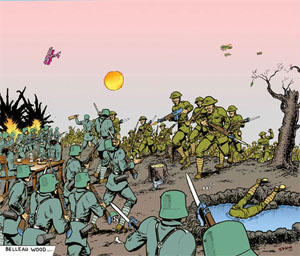
Staying true to the look and feel of its “Pulp History” series, Devil Dog is actually a book of prose dotted with vibrant comic art by the wonderful Spain Rodriguez, in addition to press clippings and other contemporary visuals- art, photographs, etc.–all of which lends to the “Pulp” nostalgia that the series is shooting for. It is, much to my pleasant surprise, a very artfully written piece—you can tell Talbot is engaged by the story and wants you to feel it, too—with each chapter feeling like its own self-standing story of adventure, suspense, romance. Spain’s illustrations, especially with the Technicolor palette choice, really give the book the feel of an old pulp adventure comic.

devil-dog-belleau-wood_300w
More importantly, Smedley’s anti-imperialist politics aren’t editorialized by the book’s creators. In fact David Talbot goes out of his way to illuminate much of Butler’s military adventures (even prior to his anti-war awakening) as campaigns of corporate adventurism. He has probably taken a cue from Butler’s own memoir-styled book, where he is looking back on everything that he did with mature hindsight.

I would recommend this work to anyone interested in American war / anti-war history: it truly is a gem. The narrative is one that works well for being told aloud—if it weren’t for a few passages of sex and violence, it would be an amazing story to read to kids.

If you want to know more about the work, S&S actually made a trailer for their Pulp History series- and you can check that out here:

ScreenHunter_12 May. 04 11.20