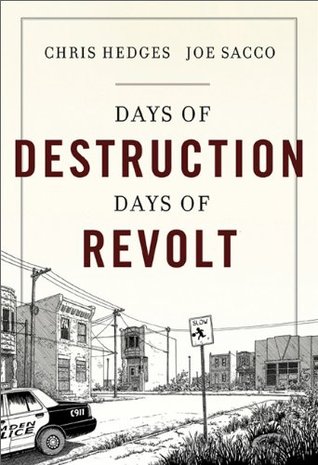
Title: Days of Destruction, Days of Revolt Written by: Chris Hedges, Joe Sacco Illustrations by: Joe Sacco Published: 2012 through Knopf Canada (a division of Random House Canada) List price: $29.95 CAD
Chris Hedges was trained to be a minister, and Joe Sacco is known to draw comics. Both, however, have made their strongest marks within the realm of journalism: Hedges as a foreign correspondent reporting from Central America, the Balkans, the Middle East, and Africa. Joe Sacco made comics journalism a concrete category with works like Palestine, Safe Area Gorazde, The Fixer, and others.
It seems only natural that the two would work together. They have overlapped each other’s geographical locations of coverage on a few occasions, particularly with Israel/Palestine and areas in the Balkans. Both understand the complexity of what they investigate and the need for empirical as well as historical inquiry.
But what I find intriguing about Days of Destruction, Days of Revolt is the way I see their previous work illuminate these pages to reveal a truly devastating picture of the state of America. Hedges draws on a treasure trove of historical events he has personally witnessed or painstakingly researched to show how the elite of the U.S.A. may not be as invincible as they think; Sacco’s trademark illustrations immediately recollect visions of a street in Gaza—and yet, I’m not looking at a street in Gaza here; I’m looking at a street in Camden New Jersey or Immokalee, Florida.
To be clear, the book is about a little more than destruction and revolt. Those two points are the focus of two separate chapters. Others include:
Days of Theft: Pine Ridge, South Dakota
Days of Seige: Camden, New Jersey
Days of Devastation: Welch, West Virginia
Days of Slavery: Immokalee, Florida
Days of Revolt: Liberty Square, New York
What is recounted in these pages isn’t sensationalism. Sensationalism would imply that truths were stretched, or quotes taken out of context. What it amounts to is a gallery of some of the worst places to live in the United States today—regions termed by Hedges to be “the sacrifice zones” of unfettered capitalist exploitation. And therein lies the fundamental trouble with DDDR which digs at you through your read of it: that is, from cover to cover, it’s all true.
Each chapter is an article written by Hedges, documenting their travels to a particular site. Locals are interviewed and are the subjects of most of Sacco’s illustrations in the book (his work is typically either a landscape for an area, or a person talking of their experiences.) Within this format, Hedges makes invaluable use of his time as a foreign correspondent, drawing on that experience to show how these regions are being treated much the same as third-world countries under foreign occupations, domestic dictatorships, or the suffocating yoke of international debt. This is contrasted with his written descriptions (and Sacco’s visuals) of the people who inhabit these areas: most are simple people whose definitions are blurred, sometimes completely overtaken by the hardship around them. Hedges and Sacco point out strength and sacrifice in those they interview, as much as they profile individuals who, understandably, in the words of Hedges, are “living lives in which tenderness and security are grabbed in desperate snatches.”
This work is truly a testament to those most voiceless in America today—from West Virginians dying of the coal industry’s carcinogenic air, to the millions of Latin Americans living a modern-day slavery Hell in the American South. Their stories are illuminated with Sacco’s artwork, and their finds profound historical, philosophical, even moral depth with Hedges’ words.
It will disgust and anger you, but it is a must-read.
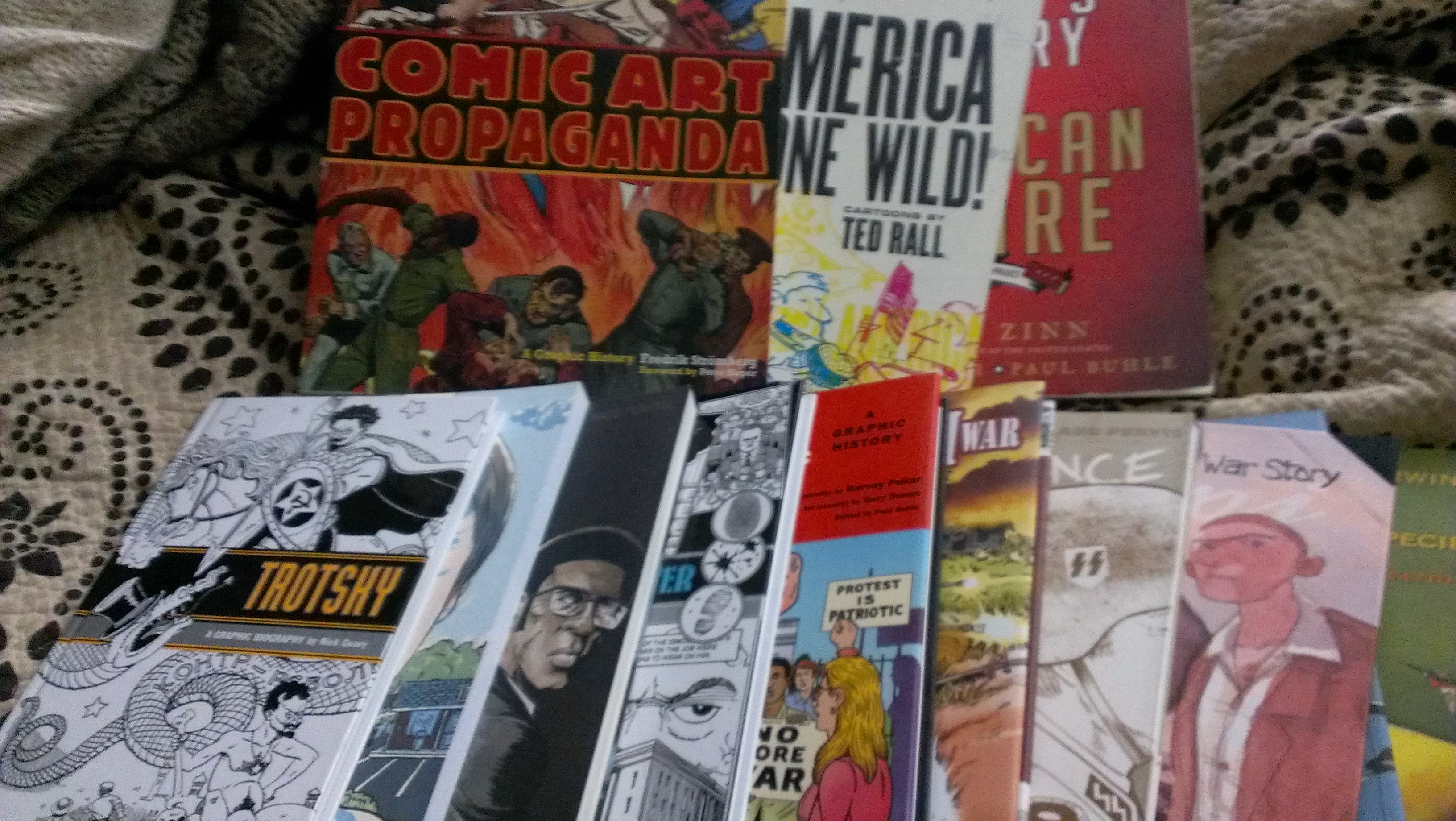
April 24 – Well, I didn’t foil a terrorist plot to derail a train in Ontario today — nor did I sternly warn North Korea to cease its reckless behavior. The big news in my world is that my very first shipment of political comic books came in the mail today.
Beginning in May, I will be tabling at a variety of cultural and political events to talk and sell political comics in Toronto. Why have I decided to launch as a distro? There are a couple of reasons… I love recommending books to folks, and I like being able to provide a way for me to pass on what I’ve read to others (the distro will include both new and used stuff), I think political comics are like most specialty comics: you can find a few at any given comic shop, but almost never a full and decent selection–I want to do this. And now for my favorite reason: activists, history buffs, and political junkies don’t go to comic shops. Comic book people go to comic shops. I want to bring political comics to folks who don’t think there’s anything for them in the medium.
If you’re in the Toronto area and have an event that you believe could benefit from such fine graphic literature, please drop me a line–thanks!
Fellow Torontonians, I hope you’ll join us on Friday May 10 for an incredible presentation on political cartooning, political comics, comics journalism, and more at Ad Astra Comix’s first event: The Political Comics of Matt Bors. Matt will be in town for the Toronto Comic Arts Festival (TCAF) happening that weekend at the Toronto Reference Library, and to promote his new book, Life Begins at Incorporation.
Here is a copy of the poster we’ll be putting up beginning this week:
In conjunction with the event, Matt has agreed to have his book distro’d by Ad Astra Comix here in Canada, which is pretty exciting. So the event is also a launch for Ad Astra to begin actively distributing political comics!
I’m also extremely grateful to the kind folks at the Comic Book Lounge for inviting us into their space. It’s so nice to have comic shops that are not only supplying me with my next fix of comics, but also see themselves as an integral piece in an active and vibrant community- and Comic Book Lounge is an enthusiastic believer in this.
In addition to a presentation, where will be a book sale and signing, a bar lovingly stocked with local beer and wine, and free snacks. I can’t emphasize enough that there will be free snacks.
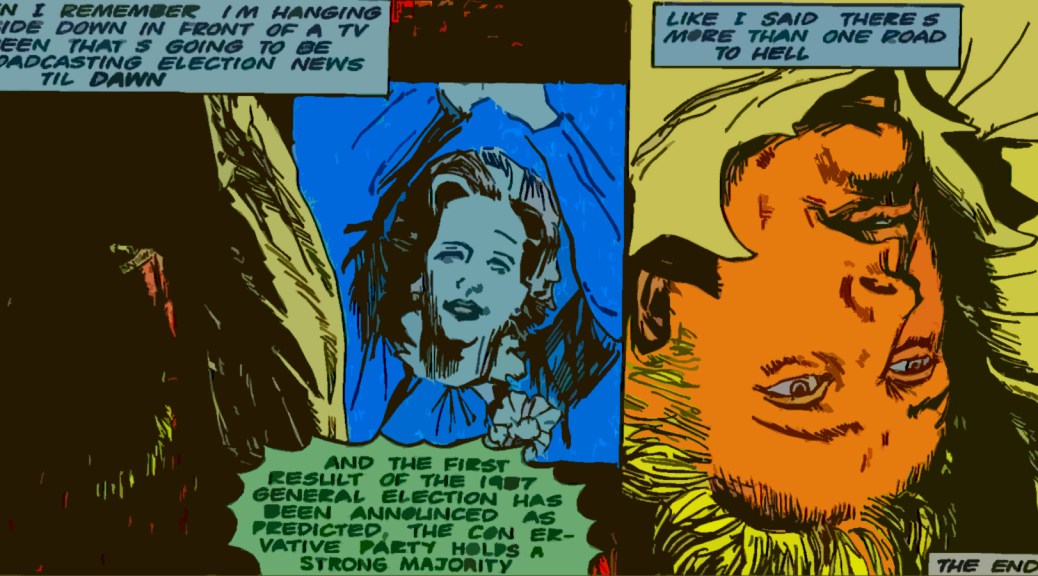
Well, I’ve barely begun my search and look at this comic rendition of Margaret Thatcher. The artist is sophisticated, from my point of view: he/she artfully portrays Thatcher in a position of victory with her arms raised, as this narrator, whose ideas are at odds with conservatism, has his own arms lowered in his captive defeat.
Nicole: Who is the group behind Black Mask Studios? Did you all know each other before Occupy? Through comics? Through activism? Through the art / music scene?
Matt: Black Mask is founded by Steve Niles, Brett Gurewitz, and me. I’ve known Brett for a pretty long time, but I’d only met Steve shortly before Occupy. We were on a horror comics panel together at San Diego Comic Con, and I accidentally insulted him during the panel… which is always the start of the best friendships. We got along pretty quick though because we both come from the punk scene and bring that sensibility to our work, both in terms of integrating social issues into the content and in terms of producing through the DiY ethic. It was a few months later that Occupy Wall Street began and I had the idea for Occupy Comics–Steve was one of the first people I reached out to about it and he helped me get the whole thing rolling. Brett was quick to help support the Kickstarter and when that was done he asked how he could help with the project as it moved forward beyond the Kickstarter. So we all met up and Black Mask was born.
N: How did Occupy seem like a movement special enough to have a comic book dedicated to it?
M: Occupy is really special because it’s a social justice movement that transcends party politics, which is particularly critical these days when bitter partisanship prevents pretty much anything at all from getting done. What excited me about Occupy is that it quickly spread to all different types of people coming from diverse backgrounds and banding together around an idea rather than an ideology. The very earliest iteration of the Tea Party was similar in that it sprang up from non-partisan populist rage, but it was quickly co-opted. I felt anything we could do in our own small way to help try and prevent Occupy from being co-opted was important because it’s a really unique movement and needs to be protected from entrenched political groups.
N: Conversely, why did comics seem like the art medium to go with for a political art project?
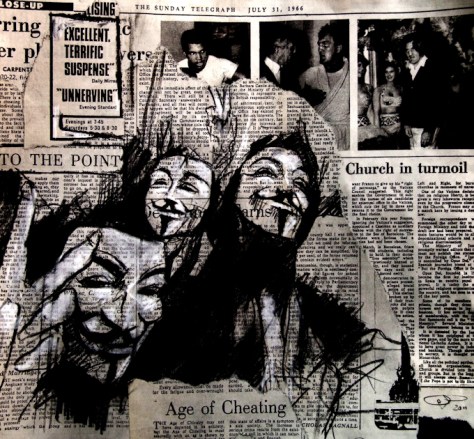
M: … Comics are a very personal, hand-crafted art form (usually created by just one or two people) and the anthology format expands that into a chorus of individual voices… which is precisely what Occupy is: a chorus of individual voices. That’s why the news media didn’t know how to cover it, the news format requires a leader or representative with a list of talking points or demands. A movement like Occupy doesn’t function that way, so comics seemed like the ideal medium to reflect it.
N: Beyond Occupy Comics… what decision brought about the larger vision of creating Black Mask as a publishing body for multiple bodies of work?
M: Well initially I didn’t want to be responsible for distributing Occupy Comics; it was enough of a colossal task to organize and produce it as a volunteer effort. I’d hoped I could then just bring the book to a publisher who would connect the dots getting it to an audience, after all the project was very hot coming off its Kickstarter. And certainly publishers were really aggressive about wanting to take it on, if for no other reason than the amazing roster and tremendous press coverage.
But, nonetheless, the offers from the publishers were all pretty awful… and I realized that if the offers were that bad for a project with people like Alan Moore, David Lloyd, Art Spiegelman, Ben Templesmith, Charlie Adlard and all the other dozens of amazing creators on the roster, then it must be nearly impossible to try and get a decent deal for anything that’s not superheroes or zombies. I’ve always been a fan of the more transgressive, confrontational, socially-conscious comics, and there’s a great history of those themes in comics, but not so much these days. So I decided I’d put the additional work in on building a pipeline for Occupy if we could sustain the pipeline and use it to support other outsider-type comics. Luckily Brett and Steve and all the awesome creators who’ve joined the team agreed with me. It’s unintentional but not by accident that every book on the initial slate [includes at least one person] who contributed to Occupy Comics. Darick Robertson on Ballistic, Matthew Rosenberg and Patrick Kindlon on 12 Reasons To Die, and Matt Miner on Liberator. The people who joined Occupy Comics all share a certain unique sensibility and that’s what holds Black Mask together.
<br.
N: And I’m sorry to be that shitty journalist, but… where are Alan Moore and Art Spiegalman fitting into all of this? I see their names getting mentioned in the press but I don’t see anything on the website…
M: Alan Moore and Art Spiegelman are both contributors to Occupy Comics. They’re both giants, of course, so they get a lot more attention than the rest of the team when headlines are being written.
N: Favourite comic book (preferably political comic book, but I can’t really force that on you) and why?
M: The obvious thing would be to say V For Vendetta or Maus (both of which are favorites), but for a deep cut that blew my mind as a kid I’d say The Realist by Joseph Michael Linsner (an Occupy [Comics] contributor as well) in Cry For Dawn #7 (1992) collected in the Image Comics trade Angry Christ Comix. It’s kind of an inversion of American Psycho, about a guy who kills corporate suits and hangs their ties on his wall. Cry For Dawn was a self-published black & white comic with gorgeous, evocative art and powerful, angry storytelling–so unique to comics. That’s the type of thing that burned a correlation between punk and comics into my young mind. For something more contemporary, I’d say I’m really looking forward to Molly Crabapple’s Shell Game, which I backed on Kickstarter–her work is just incredible.
Thanks so much Matt – looking forward to Occupy Comics and all the rest from Black Mask!
Black Mask and Occupy Comics can be found on Twitter and Facebook:
For the last 10 days of February, I put out a list of Top 10 Comics relating to Black History. I didn’t consider this a quintessential list; moreso, I wanted it to be a startting point for anyone interested in exploring the genre/medium combo.
From the get-go, I knew I could at least name 10 different titles, although I hadn’t read them all. And as research tends to do, I’ve added another few to this list, along with some notes.
Black History Comics – A Reading List
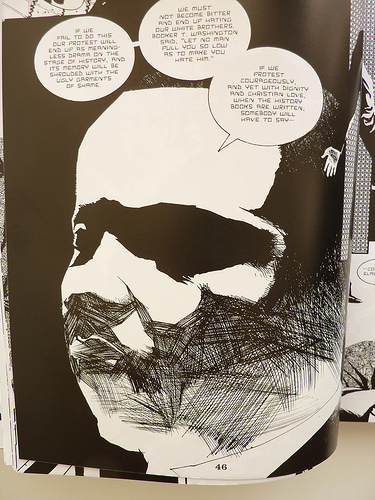
BAYOU – 2010, by Jeremy Love.
It’s the Deep South–in the deep dip of the Depression. Young Lee was already afraid of the Bayou–that was where they dumped the body of Billy Glass–and who knows how many other blacks who “hadn’t known their place”. But when Lee’s white friend goes missing and her father is suspected to be involved, Lee sets out into the Bayou, a dark place of murder and magic, to rescue the girl from whatever has taken her, and in turn rescue her father from the fate of the gallows.
Here in the “new world” we often have a hard time picturing our history as folklore and our folk lore as mythology, but that is what is at work here. Jeremy Love does a great job with this book bringing that mythology to life in the stylization of Uncle Remus and his Br’er Rabbit, Br’er Fox, et al. He even takes it a little further, with pieces of social memory that still seem a little too real, too close, to feel entirely comfortable with: flocks of “Jim Crows” that will eat you alive; monsters with the faces of minstrel characters. There is an anthropomorphic element here–lots of talking animals, stories and song that make the characters really pop. Think “Alice in Dixieland”.
Two Volumes have been released of the story so-far: I do hope that more is on the way… Published: 2010 by Zuda Comics (online arm of D.C. – now closed.) Awards: Glyph Comics Awards – Best Writer, Best Artist, Best Female Character, Best Comic Strip, and Story of the Year (2009); Best Digital Comic for the Eisner Awards – Nominee (2010); American Library Association – 1 of Top 10 Graphic Novels for Teens (2010); Further Reading: Nice Analysis over at Web Comic Overlook (although self-admittedly long.)
NAT TURNER – 2006 by Kyle Baker. Four issues bound into two volumes here tell the story of Nathaniel “Nat” Turner, leader of one of the largest slave revolts in American history. The genius of this comic is that it tells a compelling story while allowing the historical value to shine through. It uses all excepts of Nat Turner’s own words, taken from a “confession” he gave to a newspaper while in prison awaiting his execution (the word “confession” of course, is an editorialization from the newspaper of the time–however, one can hardly expect him to be remorseful for killing the men who killed and enslaved his kinfolk). We not only have a primary source, but a first-hand account of what we’re seeing depicted in pictures: the life of a 19th Century slave, the horror of life from capture, transport, sale, work, and punishment. The role of religion and prayer for slaves who survived. As a political and historical comics enthusiast, this is one of the gems. Kyle Baker looks to have taken 19th Century newspaper illustrations and breathed them full of life and human emotion. This and a nail-biting narration have practically gift-wrapped this bloody episode of American history. Published: 2006 by Kyle Baker Publishing Awards: Glyph Comics Awards – Best Artist, Best Cover, Story of the Year (2006); Glyph Comics Awards – Best Artist (2008); Further Reading: Nice review on Eye on Africa Blog
JACKIE ROBINSON, Issues 0 – 6 – Written by sports-writer Charles Dexter. Now I know nothing about this comic – save that it was published in 1950 and that it’s real. That makes it one of the earliest comic book depictions of a black historical figure (maybe the first?) and impossible to leave off this list, where I try to encourage that there is black representation, but also a note-worthy link to Black History (sorry Black Panther, Storm, Huey Freeman…)
That being said, I know nothing of the quality of this comic – the writing, the artwork. But regardless I like having this comic on my reading this for two reasons. It’s not only that it’s the sole comic that is more than 10 years old… consider the fact that a black baseball player would have difficulty finding lodging or a bar to sit in when this comic was released. Second, it’s written by a sportswriter, and I love sportswriter/political commentator cross-overs (the “Olberman” effect?). Published: 1950 – 1951 by Fawcett
Further Reading: Good luck getting yourselves a copy of this – some issues retail as high as $75 for their 16 pages. But a decent telling of Jackie’s story (and the story of African Americans in the major leagues) can be found here at Awesome Stories.com
THE SILENCE OF OUR FRIENDS – 2008, Written by Mark Long, Jim Demonakos, and illustrated by Nate Powell. This is a deceptively simple memoir of a man who moved to a small Texas town with his liberal white family in the 1960s. The town was intensely segregated, and the author remembers the stir it caused when his Dad invited a black friend and his family over for dinner. Besides political overtones and largely untold events of recent Texas history, which included protests and a serious accusation of black demonstrators firing on police–which was later determined to be false–Silence of OurFriends is a story of childhood memory that is touching, personal and honest. With a heavy emphasis on Powell’s art, the narrative re-creates the [often quiet] tension of racism, privilege, and friendship. Published: 2008, by First Second Comics / Macmillan Awards: Further Reading: I’m a huge fan of Nate Powell’s artwork, so I will take this time to direct you to his blog over here at See My Brother Dance.
MALCOLM X A GRAPHIC BIOGRAPHY – 2006, by Andrew Helfer, Randy DuBurke.
Published: 2006 by Hill and Wang
I have yet to full read this piece, but have it on my list. There is also another Malcolm X biography – by Jessica Sara Gunderson and Seifu Hayden. Neither Helfer nor Gunderson are names that I’m very familiar with in comics, so I’ve been slow to pick these titles up. However they are available for those interested.
KING: A COMICS BIOGRAPHY OF MARTIN LUTHER KING JR. – 2005, by Ho Che Anderson. Generally considered to be more comics journalism, this volume collects over 10 years of Ho Che Anderson’s work into a biography of the renowned civil rights leader. From a review on Amazing: “KING probes the life story of one of America’s greatest public figures with an unflinchingly critical eye, casting King as an ambitious, dichotomous figure deserving of his place in history but not above moral sacrifice to get there. Anderson’s expressionistic visual style is wrought with dramatic energy; panels evoke a painterly attention to detail but juxtapose with one another in such a way as to propel King’s story with cinematic momentum.” Published: 2005, by Fantagraphics (the Complete Edition)
BIRTH OF A NATION – 2004, by Aaron McGruder and Reginald Hudlin and Kyle Baker.
McGruder, Hudlin and Baker definitely have satire in their sights for this piece – that being said, it touches on black culture and history more uniquely than other books mentioned here. Aaron has admittedly used some real stories in this work, gathered by himself and friends over the years to make this comedic work ask a darkly humorous question: If East St. Louis seceded from the Union, would anyone really care? East St. Louis (“the inner city without an outer city” it says), is an impoverished town, so poor that Fred Fredericks, its idealistic mayor, starts off Election Day by collecting the city’s trash in his own minivan. (A real story is inserted here, says McGruder – some people kept their trash on their rooftops to discourage the packs of wild dogs from rummaging through it. No joke…well, yeah, I guess he kind of makes it into a joke.) But the mayor believes in the power of democracy and rallies his fellow citizens to the polls for the presidential election, only to find hundreds of them disenfranchised (this was the 2000 election, so that part is also totally believable).
“Birth of a Nation” to me, is what comics have always been about–pointed political commentary that makes you split your stomach laughing at the same time. And in doing so, it raises questions of culture and national identity. A great read. Published: 2005, by Three Rivers Press
ROSA PARKS & THE MONTGOMERY BUS BOYCOTT – 2007, by Connie Colwell Miller (Author) and Dan Kalal (Illustrator).
Part of the Graphic Library series, this book is an introduction to Rosa Parks and her involvement in the Civil Rights movement. Because the author provides a sequential and clear outline of the historical events of the time, the story of Rosa Parks and the Montgomery bus boycott is told in a meaningful and interesting way. The graphic novel is broken into four chapters, each one telling a specific part of Rosa Parks’ story. Through the content presented, readers are introduced to important figures involved in the civil rights movement, racial segregation laws, significant dates and court decisions, important events in the civil rights movement, and the political and social climate of the time. Furthermore, the author shows the impact the Montgomery Bus Boycott had on the civil rights movement and tells about Rosa s life after the boycott. Published: 2007 by Capstone Press
“STILL I RISE”: A GRAPHIC HISTORY OF AFRICAN AMERICANS – 2009, by Roland Laird (Author), Taneshia Nash Laird (Author), Elihu “Adofo” Bey (Illustrator), Charles Johnson (Foreword) Still I Rise is a lot packed into a little book: the entire history of Black America– recently updated in a new edition that includes the election of Barack Obama as the U.S.A.’s first African American president (the first edition, published in 1997, took us up to the Million Man March). I believe this work has excelled in highlighting history left out of a lot of American textbooks, for whatever reasons: including early attempts of slaves and former slaves uniting with white indentured servants, along with the rise of early black entrepreneurs and politicians in the South who were constantly attacked, broken down and weeded out. it it a solid portrayal of a lengthy question, and shows that the notion of American history as “white” history is manufactured, and deliberately dismissive of black culture. Published: 2009 by Sterling
BLACK IMAGES IN THE COMICS – 2012, Edited by Fredrik Stromberg (Introduction by Charles Johnson).
Endlessly browsable illustrated journey through comics’ history of radical portrayals both good and bad.
This book spotlights over 100 comic strips, comic books, and graphic novels to feature black characters from all over the world over the last century, and the result is a fascinating journey to, if not enlightenment, then at least away from the horrendous caricatures of yore. Fredrik Stromberg, who is from Swede, explains in the introduction that he more of less made the volume because it had not yet been made; he set out to make a comprehensive art history of (mostly) white people’s depictions of blacks: as primitive and savage–even cannibalistic, then as dim-witted clowns. Halfway through the 20th Century, this begins to change, and with the inclusion of more positive representations of blacks (mostly African Americans), we see the emergence of black writers and artists, breaking new ground once again.
What begins as a somewhat depressing window on the small-ness of humanity has something of a happy ending with this evolution. However I’m reminded of the words of Charles Johnson, who in the introduction writes, “I wait for the day when…stories in which a character who just happens to be Black is the emblematic, archetypal figure in which we — all of us — invest our dreams, imaginings, and sense of adventure about the vast possibilities for what humans can be and do– just as we have done, or been culturally indoctrinated to do, with white characters…” Published: 2012 by Fantagraphics
Some Additions:
My entire reading list is seriously lacking in the realm of arts and culture. I looked far and wide for a Hip Hop Graphic History, but am perhaps a bit early on that one – Ed Piskor’s exciting Hip Hop Family Tree comes out this October. Until then, you can preview some work on Boing Boing – or pre-order it from Fantagraphics!
Black Comix: African American Independent Comics, Art and Culture Damian Duffy (Author), John Jennings (Author), Keith Knight (Introduction) – 2010, by Mark Batty Publisher
Super Black – 2011, by Adilifu Nama. Super Black, although not a comic, it the most thorough work yet to break ground on the subject of black people in comics – their representation and significance. This also extends to blaxploitation film and art, where we see a real packaging of the ‘Black Hero’ for the first time in mainstream American culture. Available through Amazon, some university literature courses, and perhaps your more-than-average book store.
ABINA AND THE IMPORTANT MEN – 2011, By Trevor R. Getz. Read more about it on the publisher’s website at Oxford University Press.
BAYOU ARCANA – An anthology of work in a similar vein to Bayou, looking at historical roles of race and gender in the Deep South.
The MARCH TRILOGY – Coming out in August, 2013. A graphic novel memoir of former Civil Rights leader and U.S. Representative John Lewis.
THE CAMPFIRE SERIES – by Steerforth Press includes “Mohammed Ali: King of the Ring” and a “Nelson Mandela” graphic biography.
There is also a “Nelson Mandela: Authorized Comic Book” that was produced by the Nelson Mandela Foundation.
Title: CHE: a graphic biography Author and Artist: Spain Rodriguez Published: 2008 (Verso Books) Editor: Paul Buhle (also contributed an afterword on Che, co-written with Sarah Seidman)
As something of a legend in his own right, comics maker Spain Rodriguez had this Graphic Biography of Che Guevera out before the three others I have reviewed here. I wish he were still alive today, because I’d love to ask him what compelled him personally to do this piece—and furthermore, why a bunch of other people got interested in similar projects right around the same time.
Of all of the books, his has a decidedly indie style (that’s Spain for you). It was also the only work that was by a single person, not a team of writer-and-illustrator. What his visuals lack for in polish, they make up for in detail. On page 39 it shows Che getting grazed in the neck during the early days of the July 26 Movement. Nothing more is said of his wound, but there’s still a bandage on his neck by page 40, several panels later. Call me a freak but I appreciate that.
The content of the text is also excellent. Spain’s points of interest are focused, relevant, and well-argued where arguable. He goes beyond just rhetoric in quoting Che, choosing instead soundbites that let you hear the gears turning in this remarkable man’s head. This is the first book to touch on the factional disputes and internal dynamics of the July 26th Movement and the Cuban Revolution as a whole, which means that Spain believed what I believe: you can’t understand Ernesto Guevara without understanding the Cuban Revolution. If this seems too ideological, too political, well,… Try reading a biography of Thomas Jefferson without coming across the line, “We the People…” .
His narrative of the Bay of Pigs / Playa Giron is amazing—a really great piece of comic art. Great flow; not too text-heavy; educational; beautiful. There’s even a rare moment that Rodriguez is able to place himself in the story, to explain where he was and how he was feeling during the Cuban Missile Crisis. It was his generation’s take on my “Where were you on September 11th?” and I find it intriguing.
In my opinion, Spain’s Graphic Biography is the victor of this 3 week Battle of the Graphic Biographies. In all fairness, he had quite a head-start on the others. Aside from literally being the first published (which is irrelevant) he was a rebel and a leftist, a history buff, and among comic artists one of the best in illustrating the technical, from machines to military campaigns. And not to put too fine a point on it, but of all the creators involved, I don’t see evidence of anyone else having a longer relationship of admiration for Guevara. He probably had much longer to think his book through—it wasn’t just something that popped into his head after he watched The Motorcycle Dairies.
Star Rating: 4 ½ stars. Great work of political comic art.
P.S. – I will also point out that Spain tells the story of the surrender in Santa Clara much more accurately than what I’d previously read. So much for that revision of Cuban history.
Saturday, February 16
I haven’t read a book in Spanish in a long time… and I’ve never read a comic book, which has its own kinds of boundaries and flavours of language. Even when Spanish felt more or less as my proficient second language, jokes, double entendres and other palabra-play were never easy for me. I can count on one hand the number of punchlines I ever understood.
And so I kept stalling on this book, ¡Libertad! Because I can plainly see more and more, as I slowly crawl through these pages, that there is creativity here, and dedicated research–and passion for the story.
Title: ¡Libertad! Author: Marise and Jean-François Charles Artist: Olivier Wozniak, Benoît Bekaert Publishedby: Ediciones Kraken, 2009 (Spanish version only – first published in French)
This book begins where most stories of Che end– his assassination at the hands of the CIA and Bolivian military and government officials.
“They say a man’s life flashes before his eyes before he goes,” the introduction reads, explaining that this is what this short comic is aspiring to do–what else could a comic book offer of a man whose impact on history was greater than many statesmen twice his age? It is for this reason that I like the format of this comic most, of all those that I have read. It is creative, yet reasonable.
Scenes jump from miltestone to milestone, as one would expect in an abridged biographical story. It begins in 1953, when Che is in Bolivia, slowly en route to Guatamala to work as a doctor, hopefully to participate in the modest reforms of President Jacobo Arbenz. He finds the woman who will become his first wife, but struggles to find meaningful work (the medical graduate complains about selling religious trinkets in the street before a car bomb explodes outside their apartment–to which his girlfriend, Hilda notes that they “may need a doctor now.”Guatemala is also where he meets members of the July 26th Movement, so it is his stage entrance into the Cuban Revolution. Scenes are taken from what we know, what is written of, the many meaningful points in Che’s life–points that tell us something of his character and capacity for leadership. This includes scenes like that of Che grilling the Cuban guerrillas who began firing on a peasant who had taken them by surprise (“What the fuck are you doing?” he says, “The land he tills isn’t even his–it’s for these people that we’re fighting!”). The book is showing, very efficiently, how “El Commandante” the man was built. Because Spanish is my second language, it’s impossible for me to tell the exact quality of the dialogue, here, but my literal translations remind me of a decent historical fiction film.
Because the comic isn’t a documentary/biography style, with an outside narrator, I for one feel more submerged in the characters being presented: Che, Hilda, Fidel, and the minor characters that are there for pivotal moments: the Cuban who speaks with him on his way to Guatemala (in the book, he is presented as the first man to call Ernesto by the nickname “Che”), and on to the soldier who tends his wounds as he’s waiting to be killed.
The artwork is a very Tintin style, in my opinion, more common with European comics. I like the wash coloring–so much better than the digital colour randomness in the first book I reviewed. The illustrations aren’t stunning, but they’re certainly not bad, either. And there are a few compositions in the mix that give me the impression that the artist and author understood what was important to emphasize. For example, there is the rally in Havana Square at the dawn of the Cuban Revolution– you can literally count the frames of thousands of tiny Cuban people. If you see pictures, you’ll see that the magic of the moment in history was as much the masses as it was the words being spoken from the stage.
Despite the many positives of this book (especially when I compare it to other Che biographies), this work will reach few in North America. Because of its non-availability in English, and furthermore its large format, which makes it seem like a kids book) most of the comics readers I know would pronounce ¡Libertad! a lost cause before they even opened it. Where Sid Jacobson’s Che biography gets a 10 for accessibility, this book gets a 2. Very unfortunate, since the verdict on the books’ contents is, for me, the opposite.
Rating: 4 stars. Some great biographical storytelling!
This week I’m reviewing CHE: A Manga Biography by Chie Shimano and Kiyoshi Konno, published in 2008 by Penguin Books
The last Che Bio I reviewed, I referred a few times to “historical inaccuracies”. In light of this Che comic, I’d like to re-characterize that distinction as “historical bias”. After all, history is open to interpretation, and there can be several “truths” welcome in a story where conflicting interests are concerned. Perhaps my beef with the book was that it was so totally American in its bias. For example, the section on the Bay of Pigs was through the eyes of a Cold-War-stricken Kennedy, not through the millions of Cubans having their country invaded (and taken advantage of by the USSR).
In my opinion, this Che biography shows an impression of Che through other eyes in the world. Like most Manga, this book comes from Japan, and approaches Che more as a folk hero than a strictly historical figure. Like most folklore, it is a light introduction to a subject–a simplified, more-or-less linear narrative.
…But before I jump into that, it has occurred to me that I never explained my rating system. When I’m reading a political comic, I’m looking for political and historical relevance, excellent research, storytelling capacity, and overall aesthetics (layout, the relationship between words and graphics). Each star, for me, represents one of these things in a five-star points system, and most works begin with one star just for bringing a political comic book into the world.
It always kills me when I see a book released by a major publisher (Penguin, in this case) where there is a typo on the first bloody page. Where the book is originally published is irrelevant; typos in an English translation are inexcusable on a 200 page book with a list price of $20.
I also find myself wondering how much of this book would make sense if I hadn’t already experienced other Che-related movies and books. There seems to be a lot of recycling here from Motorcycle Diaries. If it’s not original, at least the book is still passionate. Sid Jacobson’s CHE: A Graphic Biography (which I reviewed last week- listed below) seemed so sterile and uninspired, I wondered why or how the man got involved in writing the book.
Chie Shimano’s personal admiration for Che Guevera becomes clear about half-way through the book, as Che (now a Cuban diplomat) is traveling around the world seeking purchasers for Cuban sugar. In a last-minute itinerary change that threw his entourage into a panic, Che decided to visit the city of Hiroshima, site of the notorious U.S. bomb drop in WWII. Of everything in the book, I found this to be a high-point in the storytelling: it reveals something about both author and subject–and a connection, a passion for humanity against injustice, that they both share.
Despite this, and much stronger wording of the U.S. relationship towards Latin America (other Che biographies take note: we know you’re trying to be “unbiased”, but you can only use the words “meddling” and “intervention” so many times. Call a spade a spade: the word is “imperialism”), there remains some unfortunate truths about this book. Mangas are now prized around the world for their accessibility and entertainment value; maybe I’m expecting too much, but the dialogue here is so terrible. So scripted and campy. Again… I am reminded that this book is made with a nod to folklore–not just academic history.
There is a bibliography, but several passages that I believe required annotation, like a poem written to the passage of the Granma ship through the Caribbean, are not clearly noted.
CHE: A Manga Biography offers some original nuggets of innovation to what has become a collective storytelling of Che’s life. As well, it rightly contrasts with other more Amero-centric biographies, like Sid Jacobson’s take on the Bay of Pigs/Cuban Missile Crisis and U.S. intervention in Latin America. But ultimately, it still is not quite a “good” comic. Too many typos, campy scenes of heroism, and poorly-scripted dialogue.
Star Rating: 2 1/2 stars – a nice try.
(Part 1/4)
Some people are entirely against everything that he embodied. Some defend everything he ever did, whole-sale. Some swear to his beliefs, and yet decry the methods by which he carried them out. And still there are others who, 40 years after his death, wear his face on a t-shirt but don’t know his name.
Che Guevera. The middle-class Argentinian med student who went on to help launch the Cuban Revolution. He re-defined the rules of modern warfare, modernized the practical application of socialism, fought battles on three continents, and died at the hands of the CIA and their Bolivian counterparts.
No matter where you stake your claim in the spectrum, there is no doubt that Che was the socialist Dos Equis “World’s Most Interesting Man” for his time. But he was no pop star… the polarization of opinions of Che Guevera and his lasting image remain a testament to how much impact his ideas and his actions really had.
As someone who has read Che’s speeches, writings, seen the movies, been to various forums and seminars about the man’s life (including several in Cuba), I say this: the offerings of a 100-pg comic book covering the epic that was his life stand to face a tall order. Fidel Castro could probably write 100 pages about Che’s fingernails. It’s a challenge, regardless of the quality of writers or the artists; a challenge that I took an interest in a few months ago when I began to notice the high number of Che comic book biographies out there.
Most of them (and all the ones I’m reviewing here) were released at the same time –2008 to 2009. It may have been in response to the popularity of Diarios de Motorcicleta (The Motorcycle Diaries) released to critical acclaim in 2004. Nonetheless, not all are equal. Of the four I’ve chosen to review (there are six in total that I have come across, but the other two are out of print / not available in Canada) they come from three different countries and use vastly different angles and resources by which to tell their story. This is part 1/4 of my findings.
“CHE: A Graphic Biography” written by Sid Jacobson with artwork by Ernie Colon, was published in 2009 by Hill & Wang (under a section called “Novel Graphics”).
What immediately strikes me about this book is its accessibility. This copy was actually a Christmas present from my parents—if they found it, they obviously didn’t need to look too hard. The cover points out that both Jacobson and Colon are New York Times best-selling authors. This is graphic novel marketing and packaging at its most efficient.
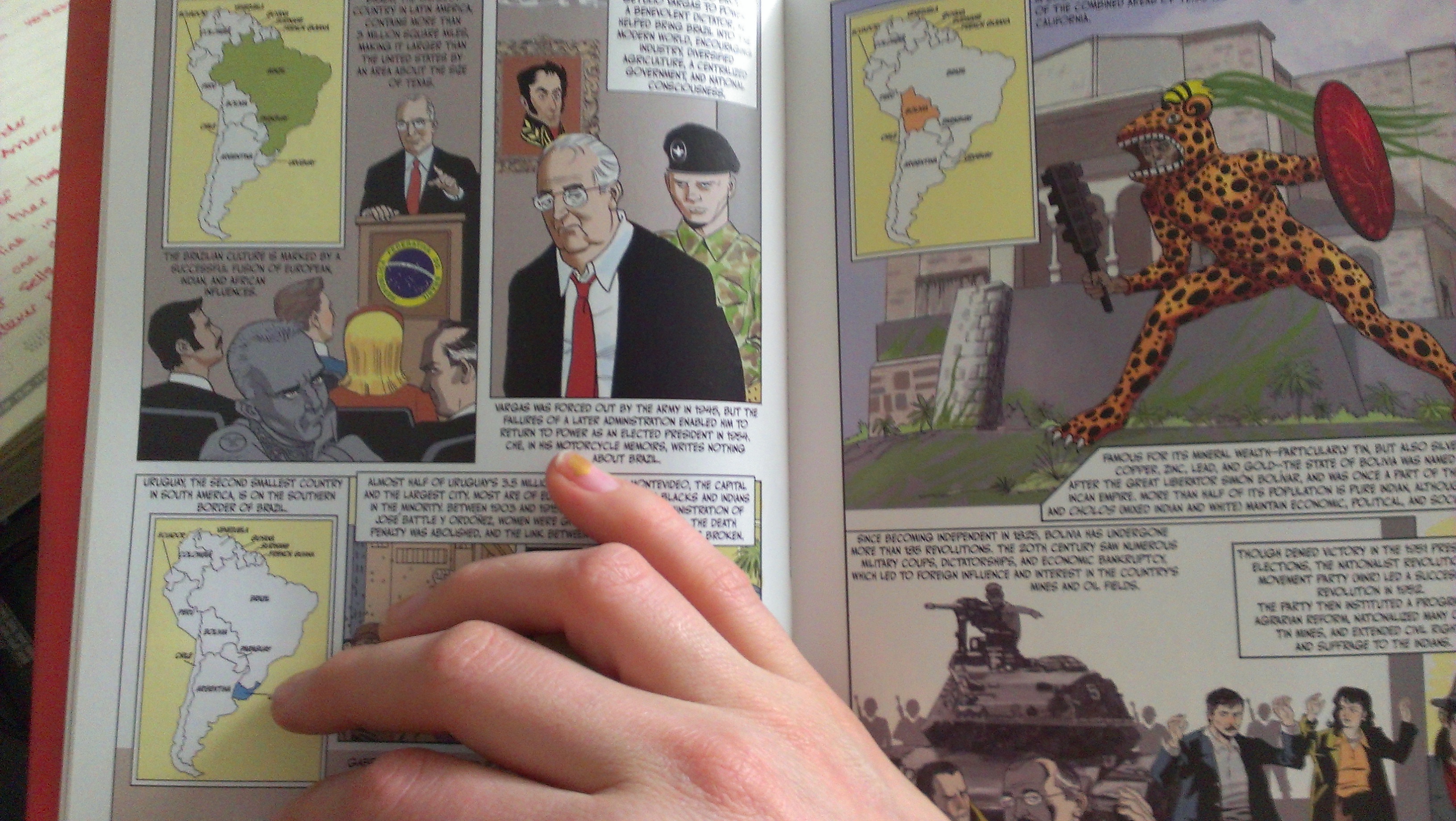
To me, the inside reminds me about that old saying of books and their covers. It’s page 6 and I’m already confused. Chronology of the events really jumps around, as the author tries to write about two different bike trips that Ernesto went on at different times in his life. Coincidentally, I quickly take note that the artwork seems a little confused as well, if only in regards to the time period: Latino motorcycle thugs from the 1930s probably didn’t sport skull decals, black leather jackets and, well, modern-looking chopper motorbikes.
A plus is that the book takes the time to illustrate the political climate, more or less, of the major Latin American states at the time of Che’s trip, which I find useful and original—yet even this unique portion of the book tends to lack in terms of overall vision and context. For example, if the recurring themes in Che’s life revolve around wealth disparity (poverty, employment, suffrage) and U.S. meddling in the continent, then why are the descriptions of countries so scattered beyond this? Who cares that in 1951, Brazil ‘s executive branch consisted of a 9-man council? Proper context would have illustrated, perhaps, that over the last hundred years of Latin America there have been a thousand men who have come to power, elected or otherwise, on promises that were always broken…a continental legacy of despotism that is of down-right mythological proportions.
I find myself riding the fence with this book, looking for merit but noting mostly detractions, until the depiction of the last major battle of the Cuban Revolution, in Santa Clara, where guerrillas attacked a train car full of Batista’s soldiers. It is misleading at best, entirely historically inaccurate at worst.
The train was not attempting to escape; it was full of hundreds of reinforcements along with a ton of ammunition. Think about it; an army doesn’t “escape” in the middle of a battle—especially when their numbers are higher. Most of the 400-odd soldiers and officers survived, and were taken prisoner after a truce.
This scene and other historical inaccuracies, combined with scattered story-telling, poor research, and some eye-sore colour and design choices make this my least favourite of the biographies, despite its flashy cover.
It was two years ago this month – on January 27, 2010, that Howard Zinn passed on. He was 87 years old. While he was arguably the most important American historian of the 20th Century and wrote a library of work–including his milestone, A People’s History of the United States–a fun fact is that the last publication he released during his lifetime… was actually a comic book.
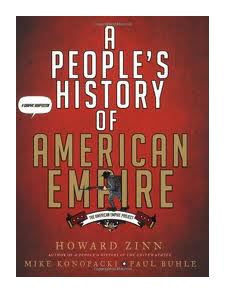
Title: A People’s History of American Empire (A Graphic Adaptation)Author: Howard Zinn Artwork: Mike Konopacki Editor: Paul Buhle Published: 2008 through Metropolitan Books
The gravity of Zinn’s legacy tends to make singular reviews of his work impossible. A review of one work necessitates a contextual understanding of his life as a radical historian who in turn, participated in making history during his own time. That being said, I will assume that readers will go elsewhere to get their crash course on Zinn, so my review stays under 10,000 words.
This book is beautifully presented. It is now available in soft- or hard-cover, and at about 12″ x 20″, is a little too big to comfortably sit in my lap as I’m reading it. My assumption is that the creators chose a larger format because the work is so text-heavy.
That text is important, because Zinn is arguing a still-contested notion, and needs as much evidence to back up his arguments as possible. It begins with the annexation of Indigenous lands across what is now North America in the later 1800’s, and takes us to the present post-9/11 era of relative global military hegemony. Zinn’s thesis is relatively clear: all of modern U.S. history is a history of empire; however, there is a parallel history of life and resistance by many. This includes poor and working people, who have played major rolls through unions, churches, and other community groups; women, students, and minorities of many stripes have all had interesting parts to play in a history that is largely told, in Zinn’s words, from the perspective of only “certain white men” (implying the rich and powerful).
Compared to A People’s History of the United States, which first appeared as a piece of academic achievement, American Empire reminds me more of a documentary film. Zinn is shown giving a lecture at an anti-war event, introducing and concluding the book’s chapters, which jump to varying times and places. Major historical figures like Black Elk, Mark Twain, and Eugene Debs are in these chapters, speaking as if to the reader, in scripts pulled largely from their real-life quotations and writings. The creators have chosen to accent this large-scale historical narrative with Zinn’s own personal history, as a young unionist, a WWII Air Force bombardier, and finally, as a young radical professor during the Civil Rights and Vietnam War eras.
What you get here is an interwoven account of his research and his own personal account of the 20th Century. It’s a moving way to look at a history that was told to most of us very differently in school.
Visually, it’s all a lot to take in, especially if you want to appreciate the illustrations as well as the text. I see this book being most appreciated when you can read it in segments. This makes it perfect for classrooms or study group. Each chapter is about 6 pages.
We are looking at a graphic adaptation of Zinn’s work. But we’re also looking at a graphic adaptation of the man as a modern-day intellectual icon. (Ex: These great little “Zinnformation” boxes pop up from time to time in the chapters, depicting a little light bulb with Howard’s tell-tale white hair-‘do.) But just because I support the work in principle doesn’t mean the review is all roses, right? I have a few critiques of the book, rooted in my perspective as a comics lover + writer, and as a history enthusiast who cannot overestimate the impact Howard Zinn has had on my education.
I’ll get right to the point:
I’m not a fan of comic book adaptations–of books, movies: anything. My experience with them has been largely that they are a lose-lose product: the comic book becomes a simplified medium for what was in its first stage a more complete and highly-developed creative product. (Insert any comic book adaptation of anything here: Game of Thrones, The Last Unicorn, Ender’s Game, etc. etc. etc.) On the other hand, the comic medium is dis-serviced by simply being a highly-saleable vessel by which to re-release something that’s already out on the market. In short, if you’re doing a graphic adaptation, you’d better be bringing something incredibly special to the table.
In this regard, I think this graphic adaptation of Zinn’s past work has both some hits and misses.
First, let’s talk about the hits.
(+) Of course, a comic book makes available a lot of the information that Zinn has, largely, buried in pages upon pages of academic text, filled with all the usual footnotes and supplementary reading. So it’s accessible, and that’s especially important to young adults or classroom settings, as I mentioned before.
(+) The book does in fact compile some new information, largely the primary sources used to assemble its “interview”-styled segments with historical figures like that of Mark Twain shown above. That and the additions of Zinn’s personal experiences make it a more colourful work than any *one* of his texty-texts.
(+) Some of the graphics that have been added to this volume, including the contemporary photographs, political cartoons and other artwork of the time does much to enrich the narrative. It’s always illuminating to have this kind of media–text is, after all, highly prone to editorialization–but a photograph or political cartoon can reveal something of an un-altered reality for the time period. Now, some of the downers.
(-) Personally, I find the cartoon-ish fashioning of the illustrations to be a little out of the mood of the book. This is a serious, often grim, telling of American history–there are many chapters that would have rightly moved me to tears, if not for drawings that look like they came out of a storyboard for Quick-Draw McGraw. I would have gone with a different overall style. Still, even if the manner isn’t to my liking, at least it’s consistent, and professionally rendered.
(-) Many graphics are modified photographs–that’s fine–but what irks me is that whoever photo-shopped them didn’t clean them up. It’s like writing a milestone book and then not bothering to format it properly. I don’t know why political comic books continue to disappoint me in this arena. It’s as if they see the quality of form and content as mutually exclusive. Or they think that readers just won’t care.
Some won’t: that’s true. But for comic book connoisseurs as well as artistically-minded comic readers, this is what ultimately determines the quality of the work… i.e. the amount of love that went into it.
In my opinion, we’re in the beginning stages of a second golden era for comic books–with political and historical comics, for the first time, being seriously included in the festivities. The last thing you want is to be invited to that party and then let people down. Think I’m making a mountain out of mole hill? Maybe. I’ll come back to this in a moment…
…first I gotta to drill into your heads, again, why Howard Zinn was (and IS) so important. Don’t worry, it won’t take 10,000 words.
As I touched on before, when A People’s History of the United States was published in 1980, the words “People’s History” were neither a mainstream term nor a methodology. Academically speaking, it was a new argument: History didn’t have to be that of kings and “great men”, or, as Henry Kissinger put it, “the memory of states”. It was revolutionary. He introduced the historical equivalent of ‘the 99%”–an overwhelming proportion of human history sits in the stories and memories of common folk–and it was right under everyone’s noses, being largely ignored.
By 2008 when this book came out, Zinn was already an icon. This book has led to countless additional volumes written or based on that first People’s History. Like supplementary reading satellites, they revolve around the foundation of that first work. Here are a few:
Howard Zinn’s (A People’s History of) The Twentieth Century
Voices of a People’s History of the United States
A Young People’s History of the United States, adapted from the original text by Rebecca Stefoff;
A People’s History of the United States: Teaching Edition
Audio renditions of his work are narrated by Matt Damon, Viggo Mortenson, and others moved by his work.
Here are a few books written by other historians, composing a “series” founded on Zinn’s original work:
Chris Harman’s A People’s History of the World
A People’s History of the Supreme Court by Peter Irons with Foreword by Zinn
A People’s History of Sports in the United States by Dave Zirin with an introduction by Howard Zinn
The Darker Nations: A People’s History of the Third World by Vijay Prashad
A People’s History of the American Revolution by Ray Raphael
A People’s History of the Civil War by David Williams
A People’s History of the Vietnam War by Jonathan Neale
The Mexican Revolution: A People’s History by Adolfo Gilly
What we are reviewing here is one of those publications. There is no other historian, mainstream of no, who can claim such a franchise, nor such a significant intellectual imprint.
What I’m trying to say is this: when I see imperfections in comic books, I think of two things:
– Creators/editors who lack experience in comic books (lots of indie/underground comics, as well as quite a few political comics, whose creators are firstly activists or academics; not comic book-makers). This often points to a lack of necessary funds and time.
– A rushed attempt to make money (most often the case in the department of “Comic Book Adaptations’… yet another reason for my distaste of the category…)
With People’s History of American Empire, with all due respect, a little may be true of both.
But it kind of doesn’t matter what I think. At the end of the day, what’s important to me is figuring out what the end user (the reader) is thinking; and that’s what I’ve tried to do here.
Why does it concern me? Because I would never want someone to read this book and find out that their lasting impression of a work was “rushed attempt to make money”–when its origins are so profoundly the opposite in motivation.
Political comics will catch on. As the importance of non-fiction comics grows, more and more investment will be put into making a product with a cause that is indistinguishable from the mainstream players. But for now, the fact that this is one of the most well-circulated political comics of the past few years shows that we’ve got a little ways to go.
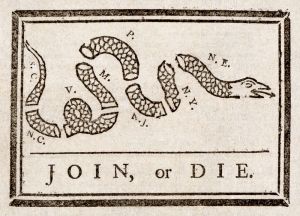
Some of you may recognize the logo that I use. Originally, it was depicted over the words, “Join or Die”, with sections of the snake labelled for the early British colonies. It is a woodcut attributed to Benjamin Franklin, circa 1754, and is widely considered to be the first political cartoon in American history.
It was altogether a cry, at least at first, for unity amongst the colonies against their enemies, the French and native nations.
But, as memes do, it was copied and re-used widely in the colonial era. Eventually, it was re-introduced in the context of uniting these ‘states’ against Britain–and became a de-facto logo for the Revolutionary War.
It is important to note that this wasn’t Franklin’s original intent. After all, one isn’t born a revolutionary–and in the days before Pop culture could depict what a revolutionary could look/act like without necessarily providing any political or philosophical substance to their identity, one wasn’t compelled toward that conclusion quickly. No, revolution was for those who had exhausted other avenues–for Ben Franklin, one of those was the Albany Plan.
“Join or Die” was printed and published first in Franklin’s newspaper, the Pennsylvania Gazette, as a push for this Plan. Largely driven by him, it proposed (among other things) a unifying Grand Council and President over the British territories of North America to address new matters of concern–namely, security and defense (including a standing army) in the wake of France’s growing alliances with many North American indigenous groups.
The Crown, sensing that this idea smelled some too much of a push for independence, did not approve. Colony representatives, from New York to Virginia, were too embroiled in their own local squabbles to really care.
With regard to the Albany Plan and its rejection, Benjamin said:
“The Colonies so united would have been sufficiently strong to have defended themselves; there would have been no need of Troops from England; of course the subsequent Pretence for Taxing America, and the bloody Contest it occasioned, would have been avoided. But such Mistakes are not new; History is full of the Errors of States & Princes.”
Despite it coming about as the banner of an essentially failed campaign, it is interesting to see how this image has lived on. One can’t help but note that ‘JOIN OR DIE’, which has survived centuries, was crafted by a man who had a knack for effecting lasting imprints .
The premise of the cartoon, by the way, is somewhat obvious but has some interesting aspects. At the time, it was apparently common superstition that a severed snake could be re-connected (and brought back to life) if the severed pieces were reattached before sunset (… the more you know!). It was a fascinating way to convey that there was precious little time to act on an urgent matter.
The pieces, of course, are the colonies, who were all separate entities. Franklin was among the first to argue that they are recognizable as something of a larger whole, distinct from England and its other world colonies. The era of colonization in America was an era of massive change, and ‘JOIN OR DIE’ was part of a budding outlook… the earliest and most rudimentary depictions of a sense of national identity.
A page from the Penn Gazette- May 9, 1754.
I’ve since seen it used for a lot of references to the Revolutionary War– Paul Giamatti’s “John Adams” series on HBO immediately comes to mind. I’ve even seen [modern day] Tea Partiers use it, somewhat to my confusion and amusement. Fundamentally, its significance isn’t so much about patriotic fervour as harnessing the sentiments of many into an idea–an idea that proposed tremendous action, which was represented with a simple symbol and but a few words.
My interest as a writer and as an activist is in connecting dots. With art as the form and history as the content, I think there are many sentiments in our world today that need harnessing–from depression to hatred, narcissism to nihilism–and media like comics can begin to make sense of it all in a way that is accessible.
A couple of weeks ago, some good friends of mine in Toronto, also Americans, invited me to join them in a trip over the border to New York to check out the exhibit of Buffalo native, Spain Rodriguez: “Rock, Roll, Rumbles, Rebels, Revolution”.
The Exhibit contains some 50 hanging pieces, in addition to original comic book copies of Spain’s work, and runs from Sept 2012 – January 2013 at the Burchfield Penney Gallery in Buffalo, NY.
Both my friends Nick and Tanya are themselves bikers, rebels, and surviving witnesses to that mythological time, the 60’s and 70’s (not to mention their occasional run-ins with Spain and folks he knew back in the days he rode with the Road Vultures and drew for now-legendary underground comic publications like Zap!). Going to the exhibit with them was as close as I would get to having Spain there to explain some of the nuances and timely political/cultural references.
Sadly, only a few days before we visited the exhibit, Spain passed away. He was 72, and had been battling prostate cancer for about six years. It became especially poignant to understand the legacy of this artist, who was a pioneer of indie comics, a pioneer of comics journalism before the term was even coined, and a pioneer for political comics and historical comics. What’s more, his career wasn’t 3 or 4 ‘golden years’ nestled in a lifetime of mediocrity. His cutting edge work ranges from the early days in underground comics, unbridled by still-McCarthy-Era censorship rules, to just before he died.
Comic book eccentric, Art school nerd, Tough-ass biker, leftist shit-disturber | Spain was an in-betweener, and these are always the folks who make incredible art. Their creativity isn’t confined to one genre, one subculture, one ideological viewpoint of the world. As a biker, Spain scared his comics compatriots and offended some of his lefty comrades: after all, these were three typically segregated subcultures within a man’s world of the 1960’s (none would even begin to include women as anything more than decoration for a few more years…a sidenote). For this overlap, we have some incredibly enlightening artwork depicting the era’s biker culture, general drug and counter-culture, and, more crucial for me and this blog, political happenings of the day.
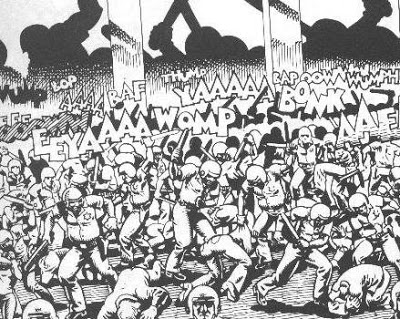
Before drawing for Zap! with Crumb in San Francisco, Spain covered the Democratic National Convention in Chicago for the East Village Other (a publication described by the New York Times as being so left-wing it made the Village Voice look like a church circular). This was the home of his other early work, Zodiac Mindwarp.
Above, we see some of the spirit of what went down.
There’s no argument that Spain was an expert brawl-drawer. From his days with the Road Vultures to his activist scuffles, the man had a talent for laying out scenes that generally pass most of us by in blurs if and when we experience them.
These illustrations, when compared to photographs or even video of the protests and police repression, give you more of the feel of the surroundings, and vividly so. I’ve postulated that he had a tendency to compile several visual records in one large frame. Taking these many single instances he saw–he not only depicts what was in front of him, but he describes the scene and tells a story with it.
Spain went on with his occasional comics journalism, and much to my liking, even delved into historical comics. The book “Devil Dog” illustrates the life of one of my favourite American military figures, Smedley Butler. My friend Nick also told me of a piece he did on the Chaco War fought by mercenary pilots in Bolivia in the 1930s that I’ve yet to see, but I can’t wait to inspect. Untold American history is the bloodstream of my own comic series, so, needless to say, this interests me. His most notable political work is probably Che: A Graphic Biography, published in 2009, which he wrote with the editorial assistance of Paul Buhle, a radical history and comic book expert (best combination–ever).
Young comic lovers should appreciate the fact that, in addition to all his other work that had given him a legendary status in indie comics, Spain never stopped paying attention to political causes around him. The exhibit even included some work depicting the Occupy Movement, that he drew mere months ago.
On November 29, comix artist Def Backderf tweeted, “On the day he died, Spain Rodriguez was inking a poster. Died with a pen in his hand. Hell yeah, amigo! You’re a legend.”
Everything else that he so wonderfully was–all aside, this fact alone commands my respect.
Good night, Spain. Your work will forever have a place in my heart.


 Title: Days of Destruction, Days of Revolt
 But what I find intriguing about Days of Destruction, Days of Revolt is the way I see their previous work illuminate these pages to reveal a truly devastating picture of the state of America. Hedges draws on a treasure trove of historical events he has personally witnessed or painstakingly researched to show how the elite of the U.S.A. may not be as invincible as they think; Sacco’s trademark illustrations immediately recollect visions of a street in Gaza—and yet, I’m not looking at a street in Gaza here; I’m looking at a street in Camden New Jersey or Immokalee, Florida.
 Each chapter is an article written by Hedges, documenting their travels to a particular site. Locals are interviewed and are the subjects of most of Sacco’s illustrations in the book (his work is typically either a landscape for an area, or a person talking of their experiences.) Within this format, Hedges makes invaluable use of his time as a foreign correspondent, drawing on that experience to show how these regions are being treated much the same as third-world countries under foreign occupations, domestic dictatorships, or the suffocating yoke of international debt. This is contrasted with his written descriptions (and Sacco’s visuals) of the people who inhabit these areas: most are simple people whose definitions are blurred, sometimes completely overtaken by the hardship around them. Hedges and Sacco point out strength and sacrifice in those they interview, as much as they profile individuals who, understandably, in the words of Hedges, are “living lives in which tenderness and security are grabbed in desperate snatches.”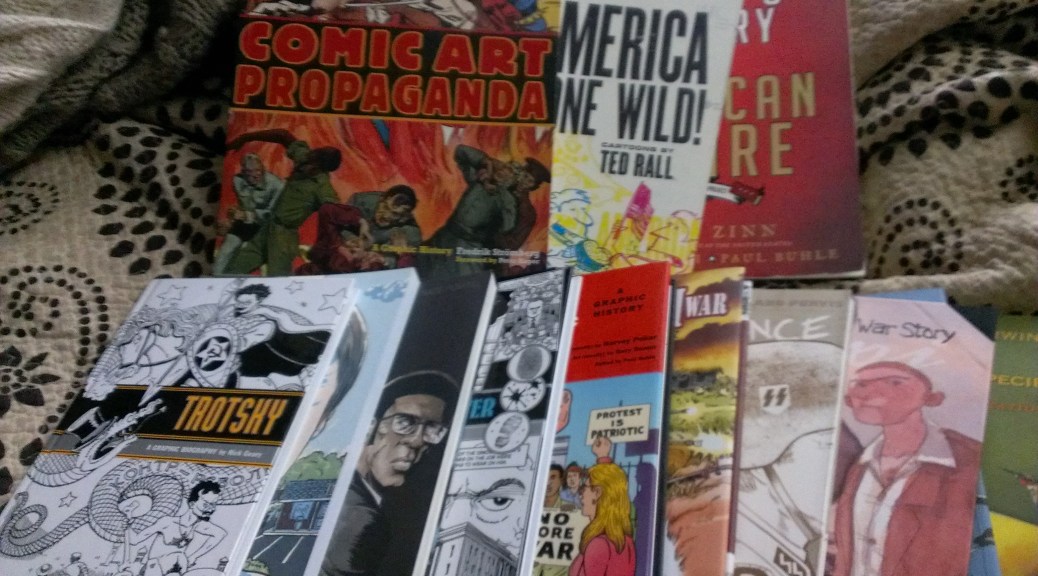



 N: Conversely, why did comics seem like the art medium to go with for a political art project?
 BAYOU – 2010, by Jeremy Love.
 NAT TURNER – 2006 by Kyle Baker. Four issues bound into two volumes here tell the story of Nathaniel “Nat” Turner, leader of one of the largest slave revolts in American history. The genius of this comic is that it tells a compelling story while allowing the historical value to shine through. It uses all excepts of Nat Turner’s own words, taken from a “confession” he gave to a newspaper while in prison awaiting his execution (the word “confession” of course, is an editorialization from the newspaper of the time–however, one can hardly expect him to be remorseful for killing the men who killed and enslaved his kinfolk). We not only have a primary source, but a first-hand account of what we’re seeing depicted in pictures: the life of a 19th Century slave, the horror of life from capture, transport, sale, work, and punishment. The role of religion and prayer for slaves who survived. As a political and historical comics enthusiast, this is one of the gems. Kyle Baker looks to have taken 19th Century newspaper illustrations and breathed them full of life and human emotion. This and a nail-biting narration have practically gift-wrapped this bloody episode of American history.
 JACKIE ROBINSON, Issues 0 – 6 – Written by sports-writer Charles Dexter. Now I know nothing about this comic – save that it was published in 1950 and that it’s real. That makes it one of the earliest comic book depictions of a black historical figure (maybe the first?) and impossible to leave off this list, where I try to encourage that there is black representation, but also a note-worthy link to Black History (sorry Black Panther, Storm, Huey Freeman…)
 KING: A COMICS BIOGRAPHY OF MARTIN LUTHER KING JR. – 2005, by Ho Che Anderson. Generally considered to be more comics journalism, this volume collects over 10 years of Ho Che Anderson’s work into a biography of the renowned civil rights leader. From a review on Amazing: “KING probes the life story of one of America’s greatest public figures with an unflinchingly critical eye, casting King as an ambitious, dichotomous figure deserving of his place in history but not above moral sacrifice to get there. Anderson’s expressionistic visual style is wrought with dramatic energy; panels evoke a painterly attention to detail but juxtapose with one another in such a way as to propel King’s story with cinematic momentum.”
 BIRTH OF A NATION – 2004, by Aaron McGruder and Reginald Hudlin and Kyle Baker.
 “STILL I RISE”: A GRAPHIC HISTORY OF AFRICAN AMERICANS – 2009, by Roland Laird (Author), Taneshia Nash Laird (Author), Elihu “Adofo” Bey (Illustrator), Charles Johnson (Foreword)
 Title: CHE: a graphic biography
 In my opinion, Spain’s Graphic Biography is the victor of this 3 week Battle of the Graphic Biographies. In all fairness, he had quite a head-start on the others. Aside from literally being the first published (which is irrelevant) he was a rebel and a leftist, a history buff, and among comic artists one of the best in illustrating the technical, from machines to military campaigns. And not to put too fine a point on it, but of all the creators involved, I don’t see evidence of anyone else having a longer relationship of admiration for Guevara. He probably had much longer to think his book through—it wasn’t just something that popped into his head after he watched The Motorcycle Dairies.

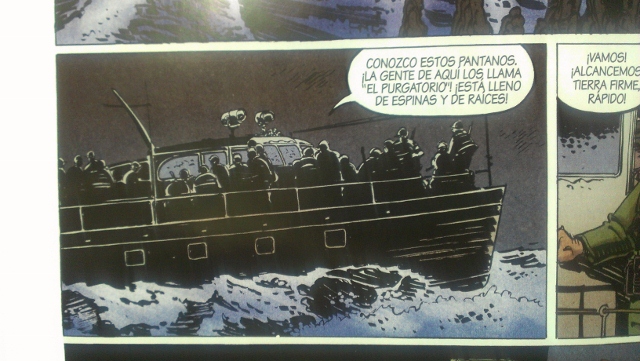
 Because the comic isn’t a documentary/biography style, with an outside narrator, I for one feel more submerged in the characters being presented: Che, Hilda, Fidel, and the minor characters that are there for pivotal moments: the Cuban who speaks with him on his way to Guatemala (in the book, he is presented as the first man to call Ernesto by the nickname “Che”), and on to the soldier who tends his wounds as he’s waiting to be killed.
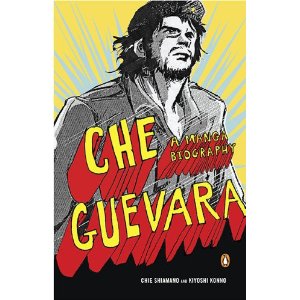 This week I’m reviewing CHE: A Manga Biography by Chie Shimano and Kiyoshi Konno, published in 2008 by Penguin Books







 It was altogether a cry, at least at first, for unity amongst the colonies against their enemies, the French and native nations.



 adastracomix.com