All posts by adastracomix

We produce, publish and promote comics with social justice themes! Visit www.adastracomix.com for more.

The Art of a Comic with a Cause: Interview with “BRANDED” Author Rodrigo Caballero

Rod_Babs_VanCAF_2013
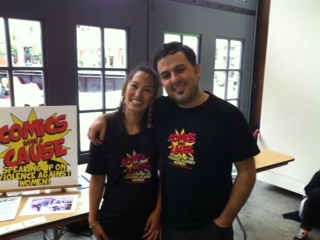
Comics With a Cause co-founders Rodrigo Caballero and Babette Santos

Ad Astra: You’re in the final stretch of your Indiegogo campaign! How would you describe the experience so far?

Rodrigo: Running my first Indiegogo campaign has definitely been a huge learning curve, especially for someone like myself whose knowledge (not to mention enthusiasm!) for the ins and outs of social networking platforms is not always up to par. Definitely my eyes have been opened to the idea of crowd funding- there is so much potential for doing advocacy and charitable work on the Internet, but so much time and effort to be invested as well. The sheer diversity of initiatives and ideas being funded right now through crowd funding, however, is mind-blowing and it’s exciting times for people with new and innovative ideas. I very much see our indiegogo campaign as the humble first steps taken in a longer path of development.

AA: The concept of a web comic about a subject matter like domestic abuse must have been new for some people.

R: Yes, definitely new, although it seems that’s been a positive thing for most people learning about the project, especially for those already working in the field of violence against women in a supportive capacity. There seems to be a thirst for new approaches to raising awareness of the topic. Violence against women is a very difficult subject to broach because it makes most people uncomfortable and it’s not the sort of thing one hears brought up in day-to-day conversations. For the most part, there’s been an unwritten code of silence that underlies the topic of violence against women in society. I think comics and graphic novels have a lot of potential, because if you can’t confront people directly about it at first, you can at least have them read about it in a format other than news reporting or statistics and if the story is compelling enough, they can and hopefully will talk about it with others. Expressing the subject in the form of a story allows for discussion in a manner that’ s a little less direct but hopefully still engaging. That’s the theory anyway!

AA: And what kind of spectrum of feedback have you gotten?

R: The feedback I’ve received on through our CWAC campaign has been overwhelmingly positive and for the most part people (including individuals working for organizations) have demonstrated a lot of enthusiasm for the idea. There seems to be a notion that a comic series addressing violence against women has a lot of educative potential as well (i.e. lots of comments about using this in the classroom and with younger audiences). I’m flattered by this sentiment and indeed part of me hopes “BRANDED” does one day make it to classrooms but admittedly there is also a small part of me that is wary of it. And that’s because there may be an assumption underlying this that comics/graphic novels is something for kids. Of course, audiences already familiar with the medium know that this limiting stereotype was broken a long time ago and that many of the most successful graphic novels have handled very serious or political subjects in  very unconventional yet compelling ways and in a manner that is unique to the medium. The other thing is that when we slap the word ‘education’ on something, it can carry a lot of baggage with it, just as the term ‘entertainment’ can. This comes from outmoded ways of thinking that equate learning with textbooks and grading and entertainment with passive consumption. I think there’s a lot of room for unpacking these terms and exploring comics as more of a liminal space.

AA: Let’s go back a bit. Where did the idea of “BRANDED” originate from? Were you inspired by other comic books already out there? What about the subject matter?

R: Like many others, the clincher for me in terms of what comics are capable of accomplishing was reading Art Spiegelman’s Maus and works by Alan Moore and Marjane Satrapi. Regrettably, in terms of raising awareness of violence against women, my familiarity with the phenomenon (also like many others) comes from knowing someone who has experienced sexual assault and having an intimate understanding of the traumatic and dispiriting effects that accompany it.

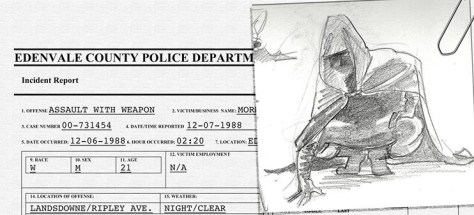
My idea for writing “BRANDED” in particular came from attending a panel on National Day of Remembrance and Action on Violence Against Women last December. Part of the event featured an installation where about a hundred black cut-out silhouettes of women were positioned everywhere and each one featured a short real-life account of a woman’s experience with male violence. These were collected by crisis line workers over the period of a single month. There was something about the immediacy of these stories that I found staggering and that spoke to just how obscured the phenomenon of violence against women is– here were all of these horrendous real-life accounts of violence against women, and the majority of them never reach public consciousness. During the subsequent panel discussion, the question was also raised, “What is the role of men in ending violence against women?” That was very much my own personal call to action and for whatever reason, the idea entered my mind– I’m going to make a comic series addressing violence against women–and I just knew from that point onwards this was something that I was going to have to do. From there, the premise and most of the characters basically spilled out of me in one brainstorming session shortly afterwards.

CWAC2

CWAC3

AA: “BRANDED” includes a figure known as “The Brander”. Comics have expanded so much since the first
days of caped crusaders. What inspires you to continue on with the inclusion of a ‘caped’ hero–someone with a secret identity and extraordinary abilities?

womeninrefrigeratorsR: Well, the first thing is that I don’t really consider “BRANDED” to be a superhero story per se, nor will The Brander have any extraordinary abilities (although the secret identity trope is very much a part of the character). That’s because she or he is very peripheral to the story and only gets minimal page time. Instead, most of the story centers on a group of characters whose lives are impacted in different ways by The Brander’s actions, which are at best controversial and morally not so easy to justify. Readers familiar with the “women in refrigerators” phenomenon (sparked by Gail Simone a number of years ago) will be familiar with the argument that too often in comics, we see female characters maimed, raped, incapacitated or killed off ruthlessly and abruptly, usually in order to provide a motivation for the protagonist/superhero. “BRANDED” eschews such shock-value devices and instead depicts women as survivors (not just victims) of male violence and its consequences. The presence of The Brander–a vigilante who has decided to seek redress for women survivors of male violence because the law has been deemed incapable of providing this-is meant to provoke readers into thinking about what sort of factors would actually drive somebody to adopt such a role. In real life, it’s estimated that only a fraction of sexual assault incidents are reported to the police by survivors and of these statistically only a fraction result in a conviction or imprisonment, so I think this theme of absence of redress or lack of justice is a very real one for many survivors of violence. My idea was to have a vigilante who went around branding the faces of perpetrators of sexual violence in order to expose them and place the burden of shame and stigma on them rather than the survivor, which is what we tend to see too often in real life. The Brander, despite only having a minor role in the story, is meant to embody the response (albeit a dramatic one) to this absence of redress and there’s a certain inevitability to the character’s appearance that I hope comes across when we bear the statistics in mind. When we recall the example of the vigilante group “Anonymous” and their intervention in the recent Rataeh Parsons case, The Brander isn’t too far a stretching of reality.

AA: What advice would you have for others fundraising for projects with a similar interest?

R: It’s important to build a community around your cause or project. For me, even though I decided to go ahead and launch an Indiegogo campaign for “BRANDED,” I’m still very much in the formative stages of building a community or audience for the comic. This can only happen over time but I think when it does, the comic will really start to take on a life of its own. Also, for any men becoming involved with speaking up on violence against women, such as myself, it’s important to inform yourself to the best of your ability and remain ever sensitive to your position relative to the phenomenon of violence against women while not adopting the role of someone speaking on behalf of survivors. Too often in so many spheres the voice of women is marginalized and the last thing we need is for this to happen in raising awareness of violence against women. I can’t pretend to have fully learned how to negotiate this dynamic, but I can certainly
remain cognizant of it.

AA: After your Indiegogo drive is over, what can supporters expect to see from Comics with a Cause in the months ahead? 

R: The if-everything-goes-according-to-plan picture is: We will finish finding the funding to produce about 85 pages of script to be illustrated by Reetta Linjama, our current illustrator, and hopefully hire somebody who can colour all the pages too. Our aim is to start releasing the comic series episodically (perhaps weekly) beginning early September and I would like to take it right up to December 6 which is the National Day of Remembrance and Action on Violence Against Women. This will depend though on how much funds we can raise for the project. Right now the best way to help out is through our Indiegogo campaign which ends June 22, but we may try and figure out a way to allow people to keep donating after that, ideally on a new website dedicated to the comic series. In the meanwhile, any news and updates can be found on our Facebook Page.

Of course, the other question people always bring up is, when do we see the printed or graphic novel edition? Like most comic artists/writers, I’m all for that! But let’s get the thing made first…

AA: Thanks, Rodrigo! Best of luck as these final days!

CWAC1

Preview: Liberator #1

Some of you will remember when I blogged about Liberator during its Kickstarter campaign. Looks like that money went to some good use – holy smokes, that artwork in this is amazing. Congratulations to writer Matt Miner and the Liberator team.

Brett's avatarGraphic Policy

Liberator #1

Writer: Matt Miner
Pencils/Inks: Javier Sanchez Aranda
Colors: Joaquin Pereyra
Edits/Letters: Vito Delsante
Publisher: Black Mask Studios

Standard Cover: Tim Seeley, with Rod Reis colors

A hard-edged vigilante series about two young heroes who avenge the torture of animals, created by writer and real-life dog rescuer Matt Miner (Occupy Comics).

All of Miner’s personal share of profit goes to dog rescue work.

There’s a release-day signing event at JHU Comic Books in NYC, June 19th at 6PM, https://www.facebook.com/events/133499776849210/

Liberator-iss1-cover1a

View original post

Sneak Peek at Additional Content for 100 Year Rip-Off

After confirming the project with the work’s artist, Bob Altwein, I am now set to begin reprinting 100 Year Rip-Off within the next two weeks!

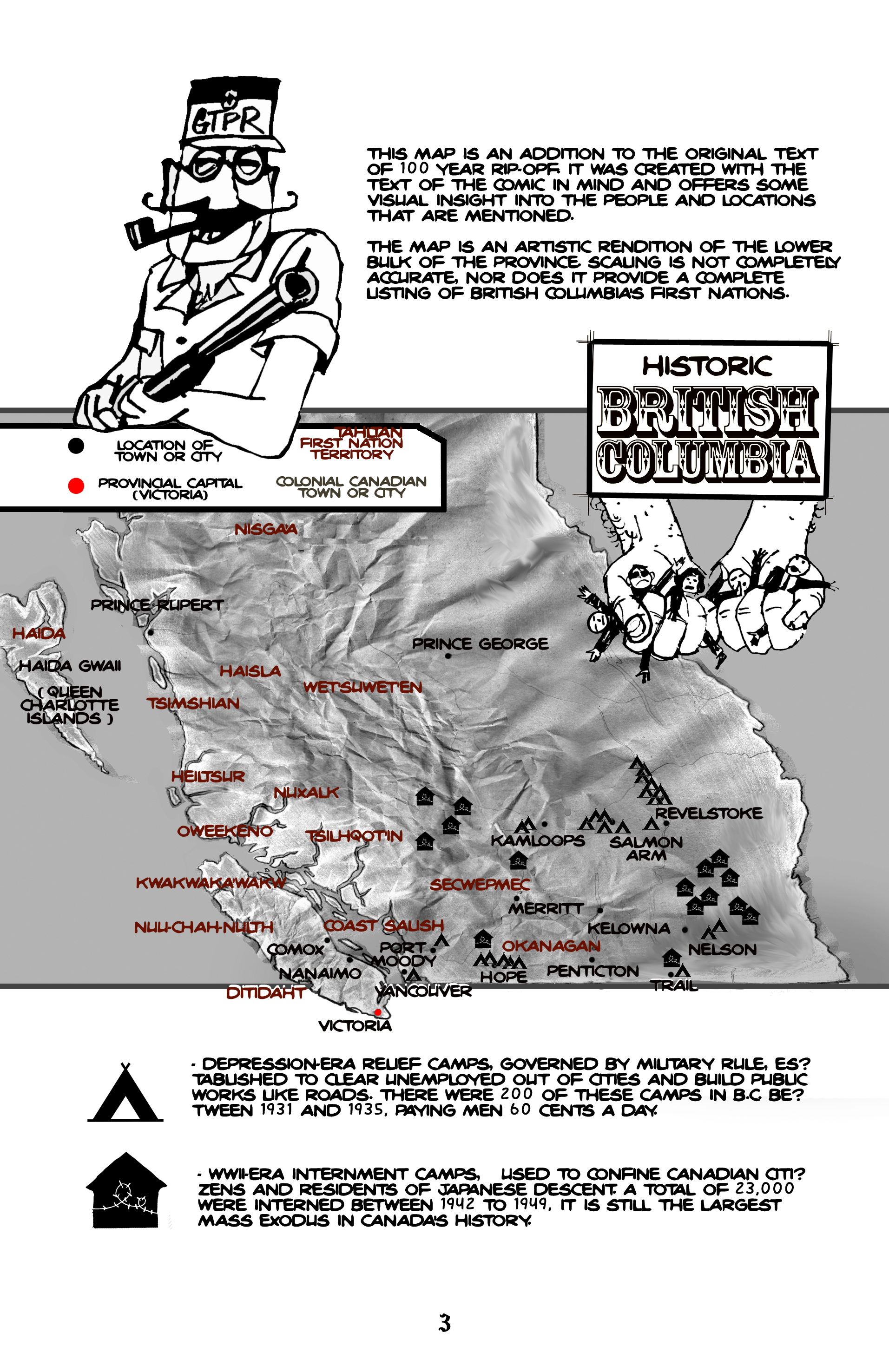
An exciting add-on to this momentous occasion (my first experience with “printing”/”publishing”) is some supplementary information that I’m providing within this graphic history of British Columbia.

Click to enlargeRFP page 3 MAP_v2


Posted here is  an “Historic” Map of B.C. that I’ve drawn. It includes the territories of First Nations in the province; relief camps during the 1930’s, which were hotbeds of squalor and social unrest;  and finally, the locations of B.C.’s 15 WWII-era internment camps, where thousands of Canadian citizens and residents of Japanese descent were held against their will. It was the largest mass exodus in Canada’s history.

Needless to say, I was a bit surprised that even this basic information (the numbers and locations of these camps around B.C.) necessitated several hours at the Toronto Reference Library. You think everything is on the internet… until you want to investigate history in detail.

While the map is located on page 3 of this 30-page comic book, I have also added a glossary of names and terms to the back, for those outside of B.C. who may not immediately understand that B.C. Hydro is our public electricity company, or that the I.W.W. stands for Industrial Workers of the World.

I look forward to your feedback! If this is up your alley, then stay tuned – #100Year Rip-Off will be available for purchase as a 30-page comic book in July 2013!

Symbolia Magazine Showcases Comics Journalism

At the Toronto Comic Arts Festival this year, I posed a question to a number of comics creators: Why has Comics Journalism taken hold so well in comics, but so poorly as a quote-unquote “legitimate” form of journalism?

The response of many was that, to the contrary, no one has said that comics journalism isn’t legit.
My response in turn, was that we still can’t open up 99% of our printed media in North America to find an example of this incredible genre. 99% is probably generous. 99.9%.

Symbolia Magazine had a rebuttal for me.

symbolia logo

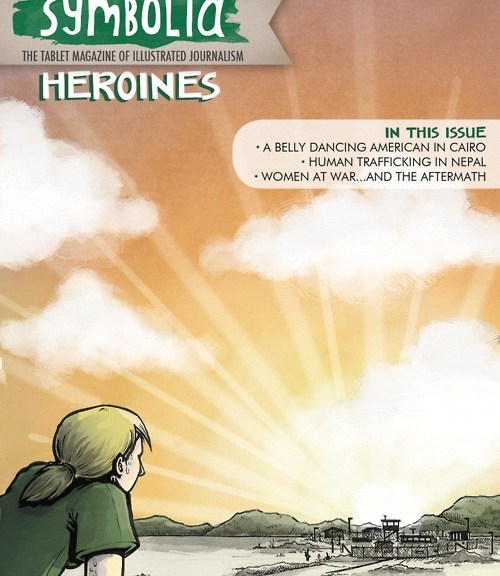
Here is a magazine that is entirely devoted to Comics Journalism, or Cartoon Journalism. The publication is a pay-per-issue or by annual subscription, available for online viewing through interactive PDF’s. Another term for interactive is best thing ever.

symbolia_guantanamo bay

There is such a huge variety of work available here, from artistic style to focus of journalistic investigation. Whereas most of the work (that I’ve read thus-far) does not include the journalist in the story, there is a strong sense of personalization nonetheless through the images that depict the subject of the accompanying words. Subjects range from war to the story of an artist who wanted to build the world’s first museum devoted to insect genitalia. 

The focus isn’t politics or making stories personal. The focus is simply comics journalism, which lends itself to exploring a wide variety of topics from the beginning to the end of each issue.

Definitely check out Symbolia, if you haven’t already. I plan on continuing my subscription and reviewing individual pieces as they come up.

Their website is: http://www.symboliamag.com

Follow on Twitter: @SymboliaMag
Or on Facebook

IBEW Turns to Comics to Teach About Unions

Having been a member of the IBEW for a short while back in Vancouver, I find this to be very interesting… Take a look!

Brett's avatarGraphic Policy

Comics345_000Though comics might be known for their spandex and capes, they have a long tradition of being used for political and educational purposes though. The International Brotherhood of Electrical Workers (IBEW) has turned to comics to tell the story of the hero of the “union men and women who made the American middle class.”

Local union chapter Local 1245 in Vacaville, California earlier this year published First Day. It’s a 20-page comic that goes over the history of Local 1245 and the labor movement. It’s given to all new members in their orientation packets and so far the reaction has been positive.

The comic was created by the communications director of the local union Eric Wolfe and artist Tom Christopher.

“First Day” tells the story of a new employee at California utility PG&E. The worker tells his son about the IBEW and all the good benefits…

View original post 176 more words

Whistle-Blowers and War Resisters: Phase 1

Destination this weekend: Ft. Meade, Maryland, where hundreds/thousands are gathering to protest the continued imprisonment of whistle-blower Bradley Manning. June 1st marks the beginning of his 4th year in prison- over a year of which has been in solitary confinement–and his trial has only just begun.

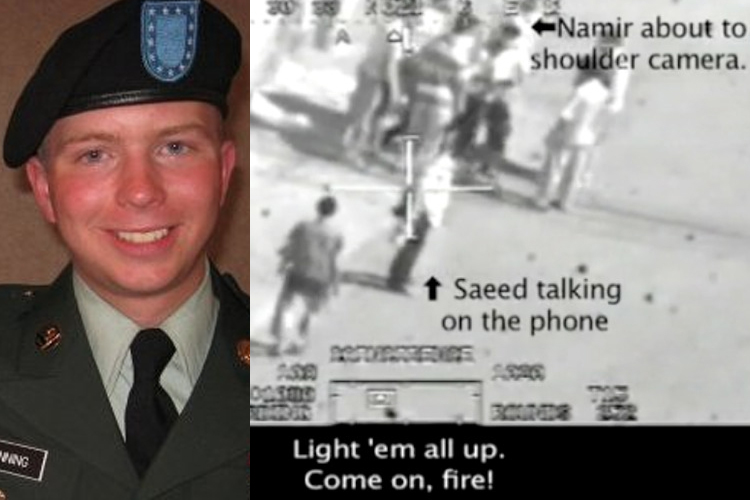
Private FirstClass Bradley Manning pictured left, alongside a video clip of the now-notorious military footage that he released to the world -"Collateral Murder" - which shows U.S. soldiers firing on civilians, including journalists, in Iraq.
Private FirstClass Bradley Manning pictured left, alongside a video clip of the now-notorious military footage that he released to the world -“Collateral Murder” – which shows U.S. soldiers firing on civilians, including journalists, in Iraq.

My plan: to cover the rally and the case of whistle-blowers and war resisters from a comics journalism perspective. Who are whistle blowers and war resisters within the current framework of the Global War On Terror? What are the historical precedents? What compels them to face jail time, potentially life sentences for standing up / speaking out / leaking classified information?

Obviously, I will be biased in my investigation. My husband is a former U.S. 82nd Airborne Paratrooper who served a 15 month tour of duty in Afghanistan–and would be arrested the minute he stepped back into the United States on grounds of desertion, as his contract was being extended to include a second tour. As his partner and someone who has heard intimately on his time in the military, I feel confident in saying that the injustices he witnessed were first-hand; stuff not of a “necessary evil” or “duality of man” that resigns one to complacence. I believe he and Bradley Manning share a story–a story shared, in one way or another, by all whistle-blowers, war resisters, and veterans who have decided to make a stand, and I’d like to share that story with all of you.

I bring with me the 5 P’s:

Pencils
Pens
Paper
Paints
Phone (Voice recording / camera / Internet)

Wish me luck.

For more information on the Ft. Meade rally and the case of Bradley Manning, check out http://www.bradleymanning.org

“Not The Israel My Parents Promised Me” by Harvey Pekar and JT Waldman

120807-pekar-cover

“Every ethnic group thinks they are the chosen ones. … ”
–Harvey Pekar

Title: Not The Israel My Parents Promised Me
Author: Harvey Pekar and JT Waldman
Epilogue: Joyce Brabner
Published: in 2012 by Hill and Wang (Novel Graphics)

Learning about Israel and Palestine can be intimidating. It seems that anyone with any time vested in research of the subject  has an extremely confident opinion that their view is the correct one. But what is the controversy, anyway? What is the historical basis of the conflict with Palestine—and exactly when did it begin? Harvey Pekar’s Not the Israel My Parents Promised Me delves into that history (which many argue began anywhere between 46 and 2000 years ago…) and provides the reader with a glimpse of multiple perspectives by way of an “insider’s” criticism.

Perhaps one of the ways this otherwise dry narrative can get away with being a bit boring (it does cover 2000 years, more or less, in 165 pages) is its feel of exclusivity. Not only is it an interview with a man born and raised through the founding and early years of the Jewish state; it’s an interview with one of the comic book world’s most celebrated writers.

Harvey Pekar is probably best known for American Splendor. It was through this and other work, in a career that would span more than 3 decades, that Pekar pushed the envelope of comics, driving the idea of the medium’s abilities in the realm of autobiography and literature (enter: the graphic novel). Keep in mind that this trail-blazing began in the 1970s (American Splendor the series was first illustrated by Robert Crumb) and was almost unheard of for its time. He had said a motivation for making comics was that they “could do anything that a movie could.” How ironic that American Splendor became a movie in 2003.

Harvey Pekar was, as much as anyone else, given plenty of reasons to love Israel (his father, a Talmudic scholar, gave him the religious reasons; his mother, a communist, the political arguments). While the title demonstrates a certain sense of faith lost, this book is half historical intrigue; half autobiographical narrative of a man’s awakening to a world outside of his community, culture, and its decidedly unwavering ethos.

Certainly, it’s not the only way to talk about Israel (not even close to being the only comic about the subject), but it is unique. It’s history and autobiography; boilerplate language and the spontaneity of an interview (JT Waldman co-authors the book by way of interviewing Harvey). In this way, a comic book about this highly polarized topic finds balance, and a fresh perspective.

EXHIBITION: Gender Through Comic Books (#SuperMOOC) Student Work

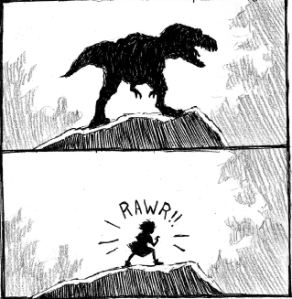
The following is a little exhibition of the top student comics of the “Gender Through Comic Books” Massive Open Online Course (Codename: #SuperMOOC), which ran on Canvas.Net from the beginning of April to Mid-May of 2013. In a class of 7200, there were over 800 comic submissions, and these were the finalists. The top three are listed in order of the student body’s popular vote, beginning with #1 – Girls Don’t Like Dinosaurs…. ! Enjoy!

girls dont like panel
Girls Don’t Like Dinosaurs!


Girls Don’t Like Dinosaurs

by Natasha Alterici
For my story I blended together a few real-life anecdotes from my childhood; my mother trying futilely to make me dress like a young lady, the neighbor boy who told me “Girls don’t like dinosaurs!”, the exploration, and of course the dinosaur role playing. As a kid I was completely fascinated by dinosaurs, but I was also completely aware that this was not “normal” for girls. Looking back I think this is because dinosaurs are gendered toward boys and this is probably because they’re essentially a science-based play. Dinosaur-play involves lots of learning, about biology, natural history, geology, forensics, etc. If a girl is interested in animals or science they can play Barbie Veterinarian, but this isn’t a science-based toy, it’s just another form of dress up. You aren’t given opportunities to learn about how to care for animals, you’re given an outfit (sexy lab coat) and accessories (sickly baby animals).

small and waiting small
Small and Waiting

Small and Waiting
by Nicole Marie Guiniling
In grade school I was told that a good essay was like a hamburger. You had a beginning and an end that reflected each other, with a meaty middle. (I even had a teacher go so far as to say that your thesis should be a “crisp, green line towards the top.”)  Then I went to college, where another, arguably better Literature Professor threw that out the window and said that none of that mattered. A decent essay, he said, should look like Beyonce—an hourglass shape with a “KA-POW!” ending, so to speak. This definitely got some gasps and laughs when I first heard it in class 6 years ago. I thought it would be a little ironic to apply that method (if I can call it a method) to an assignment in a class on gender.
“Small and Waiting” is about me growing up, learning about gender roles, coping with the trauma of the worst aspects of that role (including eating disorders, body image issues, and assaults by men), and overcoming those challenges with a higher understanding of gender and systemic oppression in our society.

video game girl
Working in Games

Working in Games
By Shivaun Robinson
This is my comic. There are many like it but this one is mine. It was also my first attempt to make a comic after many decades of only reading them. I hope you enjoy it! Feel free to find me on Twitter @shivaundingo or support my latest effort as I play video games for 24 hours for charity at: http://www.extra-life.org/index.cfm?fuseaction=donordrive.participant&participantID=46567

childs play
Child’s Play

Child’s Play
by Jacinda Contrerras
This is my brother and me when we were kids. He always wanted to hang out with his older sister and be like her, as he told me years later. Getting to wear a dress with a black towel wrapped around his head while poppin’ wheelies in our neighborhood was just a bonus.

My family consisted of one set of grandparents, my mom, 2 aunts, and 3 uncles.  They grew up as migrant workers and believed that teaching children survival skills and street smarts outweighed raising proper little ladies and gentlemen.  These hardworking adults were more concerned with the cost of clothes than whether they were buying pink for girls or blue for boys. So, I didn’t think of my toys as being girls’ toys or his as boys’. I owned the books, Hot Wheels & Tonkas that I allowed him to play with when he wasn’t annoying me, my brother owned the Atari and Star Wars action figures that he allowed me to play with when we were on good terms.
Eddie Blake did a great job with the art and inks, this story comes alive because of that.

daughter
Daughter

Daughter
by Anthony Sweet

w: www.handwrittengames.com
e: anthony@handwrittengames.com
fb: Handwritten Games
tw: @handwrittengame

walkinaftermidnight
Walkin’ After Midnight – NOTE: This file is a Microsoft Word .docx file!

Walkin’ After  Midnight
By Angela Staiger

E-mail: angela.staiger@gmail.com
Twitter: @anjuhluh

sexy legs
Sexy Legs

Sexy Legs
Written by Ross O’Dell
Drawn by Raylene Winkel

insert title here
“Insert Title Here”


Insert Title Here

By Greg Marcus
In high school (class of 1995) I was the staff cartoonist for the newspaper. In that time I managed to pick up some awards for my work. This strip in particular is a complete reworking of a strip that won an award from the Palm Beach Post. I rewrote it updating outdated ideas and things that are not accurate for my current age (Teacher crushes, mentions of things that were understood in 1995 but not today) I then redrew the entire strip using Adobe Illustrator.
All of the things mentioned in the strip are accurate, just not necessarily to the person saying them. I did test androgynous and have been known to loofah, but most of the things my friend said should be attributed to my wife. Although, I do enjoy a good mud mask from time to time.

cosplay
Gosplay Genius

Cosplay Genius
By Shawn Proctor

Website: http://shawnproctor.com/

Shawn Proctor’s writing has been nominated for Best New American Voices and published in several literary journals and anthologies, including Storyglossia, Think Journal, and Our Haunted World: Ghost Stories from Around the Globe.

He holds an MFA in Creative Writing from Rosemont College, and earns geek cred by blogging on Nerd Caliber, Geekadelphia, and CultureMob.

He recently completed a superhero novel, featuring former college classmates who must fight for their lives when the world’s only superhero is murdered.

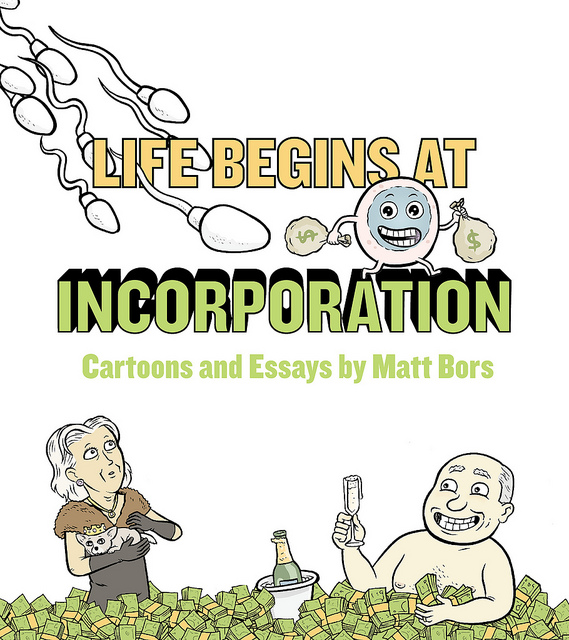
“Life Begins At Incorporation: Cartoons and Essays” by Matt Bors

mattbors_lifebeginsatincorporationMatt Bors prides himself (perhaps reluctantly) on being “The Last” nationally-syndicated editorial cartoonist in the United States of America. While the rest of the “sequential arts” are in the midst of their own Comic Renaissance, political and editorial cartoons are withering away with printed newspapers—now used with more satisfaction for fireplace starter and nesting material for gerbils than reading.

Despite this, Matt has built a decent following through cartoons and commentary that are consistently present and politically poignant. What do I mean by “present”? Outside of his regular publishing in regional newspapers near his home in the Pacific Northwest, his website archives all of his comics—which, from the perspective of social media (which have been steadily replacing print as our chief news sources for the past decade) are all very “share-friendly”. The first piece I ever saw of Matt’s got passed along in my Facebook feed, I believe, by the The Occupy Wall Street Page:

steve jobs

Web comic celebrity Matt Inman once put it a few years back, “With The Oatmeal, I wanted to create something where the viral marketing itself was the product, rather than trying to put it on something else.” I would argue that, er, Matt B. essentially does the same thing except with politicians instead of cats wearing ties (which does hurt his stats a little bit). In the realm of politics, though, Bors’ drawn conclusions are successfully competing with mainstream news media, (and they downright Haretsukan others in the domain of editorial cartooning). While the medium of the comic panels is almost defined by its accessibility, as Matt Inman hints at, the content of said panels remains a refreshing escape hatch from the suffocation usually associated with mainstream political discourse. It’s a pretty impressive balance.

For how long have you waited for an editorial cartoon–with mainstream accessibility–to point out the following:

(Check all that apply)

[ ] Most high-profile homophobes are probably gay (Matt keeps a list that’s about 2-score long)

[ ] The path to the Middle Class in America is arguably longer and harder than the path to citizenship

[ ] Despite being elected as the “anti-war candidate” against the GOP, Obama has continued the War on Terror, surged the troops in Afghanistan, NOT closed Guantanamo, and fully ushered in the era of drone-based warfare, currently occupying half a dozen countries in the Middle East / Central Asia.

[ ] Millenials, as a generation, aren’t “lazy”: they’re fucked (link goes to this gem of an essay, included in Matt’s book, posted on Matt’s website).

[ ]  Occupy wasn’t a bunch of hippies sitting in a drum circle, and “I am the 99%” wasn’t just an incredibly meaningful slogan thought up in between bong hits.

811

At this point you may be thinking, “Isn’t this supposed to be a book review?”

The book is Matt in 200 pages. It’s everything that he offers as a political cartoonist in both form and content. It’s editorial cartoons and comics journalism, satire and commentary, covering women’s rights, marriage equality, Iraq, Afghanistan, Guantanamo, gun control, elections, debates and popular [mis]conceptions about all of these things. It’s a powerful and enjoyable showcase that makes you wonder why NO ONE else is doing it like Matt is doing it. Matt made fun of me, more or less, when I described him like that before–I guess I just don’t know how else to say it.

Is there anything I disagree with Matt on?

His cartoon about Julian Assange, which focuses on the allegations of rape against the Wikileaks founder, to me, is like looking at Obama’s foreign policy today and trying to focus on the 2012 Benghazi Attack. My point? That’s it’s sooooo not the point. And yea, I’m a woman and I know all about non-consensual sexual encounters; and yea, there’s an American diplomat to Libya out there, listening to Steve King or Lindsay Graham, going, “Give me a fuckin’ break!”

One cartoon not doing it for me, out of a thousand, is acceptable.

Matt’s book, Life Begins at Incorporation, can be purchased online through Matt’s website.

If you’re like me and live in Toronto, you can find it through the Ad Astra Comix Distro, The Beguiling, The Comic Book Lounge, Hairy Tarantula, and The Silver Snail.

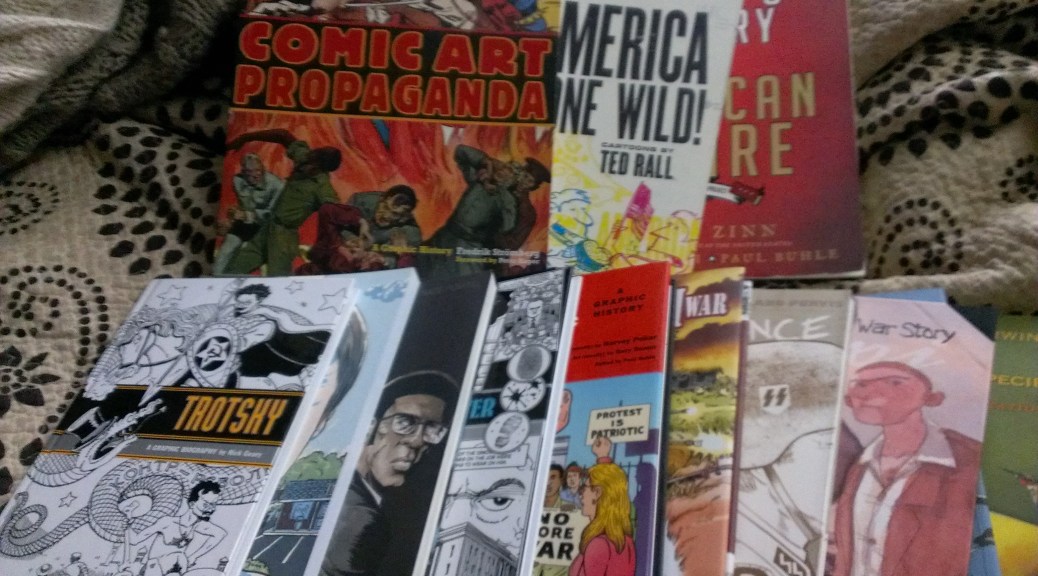
Complete Up-To-Date Stock List

Last Updated: August 19, 2013.

America Gone Wild!
Creator: Ted Rall
Published: 2006 by Andrews McMeel Publishing
Details: Softcover


Bayou (I, II)
Creator: Jeremy Love
Published: 2010 by DC Comics
Details: Softcover. Parts 1 and 2 of a 3-part series (last book is yet to be released). Review available.


The Bush Junta: 25 Cartoonists on the Mayberry Machiavelli and the Abuse of Power
Creator: (Various – Anthology)
Edited by: Mach White and Gary Groth
Published: 2004 Fantagraphics Books
Details: Softcover. Includes work by Seth Tobocman, Ted Rall, Peter Kuper, Spain Rodriguez, Steve Brodman, Lloyd Dangle, Carol Swain, Ted Jouflas, and Ethan Persoff


Che: A Graphic Biography
Creator: Spain Rodriguez
Edited: Paul Buhle
Published: 2008 by Verso Books
Details: Softcover. Review available.


Che: A Graphic Biography
Writing: Sid Jacobson
Art: Ernie Colon
Published: 2009 by Hill and Wang
Details: Hardcover. Review Available.


Che: A Manga Biography
Writer: Kiyoshi Konno
Artist: Chie Shimano
Published: 2010 by Penguin U.S.A. (Originally published in Japan
Details: Softcover English translation.Review available.


Comic Art Propaganda
Writing: Fredrik Stromberg
Art: Various
Published: 2010 by Ilex Press Limited.
Details: Softcover. Forward by Peter Kuper.


Dark Rain: A New Orleans Story
Writing: Mat Johnson
Art: Simon Gane
Published: 2010 by Vertigo Comics
Details: Hardcover. Review available.


SOLD OUT –Devil Dog: The Amazing True Story of the Man Who Saved America
Writing: David Talbot
Art: Spain Rodriguez
Published: 2010 by Simon & Schuster
Details: Hardcover. Review Available.


Edible Secrets: A Food Tour of Classified U.S. History
Writing: Michael Hoerger and Mia Partlow
Art: Nate Powell
Published: 2010 by Microcosm Publishing
Details: Softcover. Review available.


Extraction! Comix Reportage
Creator: Various
Published: Cumulous Press
Details: Softcover. No longer in print. Review available.


FLOOD! by Eric Drooker
Creator: Eric Drooker
Published:
Details: Softcover. No longer in print. Review available.


SOLD OUT —Footnotes in Gaza
Creator: Joe Sacco
Published: 2009 by Joe Sacco
Details: Softcover. Review available.


The Hammer& The Anvil: Frederick Douglas, Abraham Lincoln, and the End of Slavery in America
Writing: Dwight Jon Zimmerman
Art: Wayne Vansant
Published: 2012 Hill and Wang
Details: Hardcover. Forward by James M. McPherson


Hyena in Petticoats: The Story of Suffragette Nellie McClung
Creator: Willow Dawson
Published: 2011 by Puffin Canada
Details: Softcover.Review Available.


J. Edgar Hoover: A Graphic Biography
Creator: Rick Geary
Published: 2008 by Hill and Wang
Details: Hardcover


Liberator: Issues 1 – 4
Creator: Matt Miner and Joel Gomez
Published: 2013 (Black Mask Studies)
Details: Single issues available with protective board/bag. Review available.


Life Begins at Incorporation
Creator: Matt Bors
Published: 2013 (self-published)
Details: Softcover. Review available. Author website here: http://www.mattbors.com


Louis Riel
Creator: Chester Brown
Published:
Details: Review available.


Mayday: A Graphic History
Creator: The Graphic History Collective
Published:
Details: Interview with comic makers available.


Not the Israel My Parents Promised Me
Words: Harvey Pekar
Art: JT Waldman
Published: 2012 by Hill and Wang
Details: Hardcover. Review available.


Notes for a War Story
Creator: Gipi
Published: 2007 by First Second
Details: Hardcover. Collector’s Edition.


SOLD OUT—-A People’s History of American Empire: The Graphic Adaptation
Creator: Howard Zinn, Paul Buhle
Published: 2010
Details: Softcover. Review Available.


Trotsky: A Graphic Biography
Creator: Rick Geary
Published: 2009 by Hill and Wang
Details: Hardcover. Part of Geary’s Hill and Wang Graphic Biography series.


The Silence of Our Friends
Creator: Mark Long, Jim Demonakos, Nate Powell
Published:2012 by First Second
Details: Softcover. Review available.


Students for a Democratic Society: A Graphic History
Writer: Harvey Pekar
Art: Gary Dumm
Editing: Paul Buhle
Published: 2008 by Hill and Wang
Details: Additional text by SDS Members; additional art by Josh Brown, James Cennamo, and others. Hardcover.


Take What You Can Carry
Creator: Kevin C. Pyle
Published: 2012 by Henry Holt
Details: Softcover.


SOLD OUT—UNeducation Volume 1: A Residential School Graphic Novel
Creator: Jason Eaglespeaker
Published: 2012 (self-published)
Details: Author website here: http://www.eaglespeaker.com. Review available.


V for Vendetta
Writer: Alan Moore
Art: David Lloyd, Steve Whitaker, Shiobhan Dodds
Published: 1988 by Vertigo Publishing
Details: Softcover. Definitely not a first edition. Review available.


The Vietnam War: A Graphic History
Writing: Dwight Jon Zimmerman
Art: Wayne Vansant
Published: 2009 by Hill and Wang
Details: Hardcover.


Who is Ana Mandieta?
Creator: Christine Redfern and Caro Caron
Published: 2011 by The Feminist Press
Details: Hardcover. Review available.


World War 3 Illustrated
Creator: Various (Anthology)
Details:  America’s longest-running anthology of radical comics. Published quarterly in New York City. Currently on #44 – “The Other Issue”. Review available.