110 Comics Workers Sign Petition / Bondoux Refuses / Op-Ed by Organizers In French Newsweekly
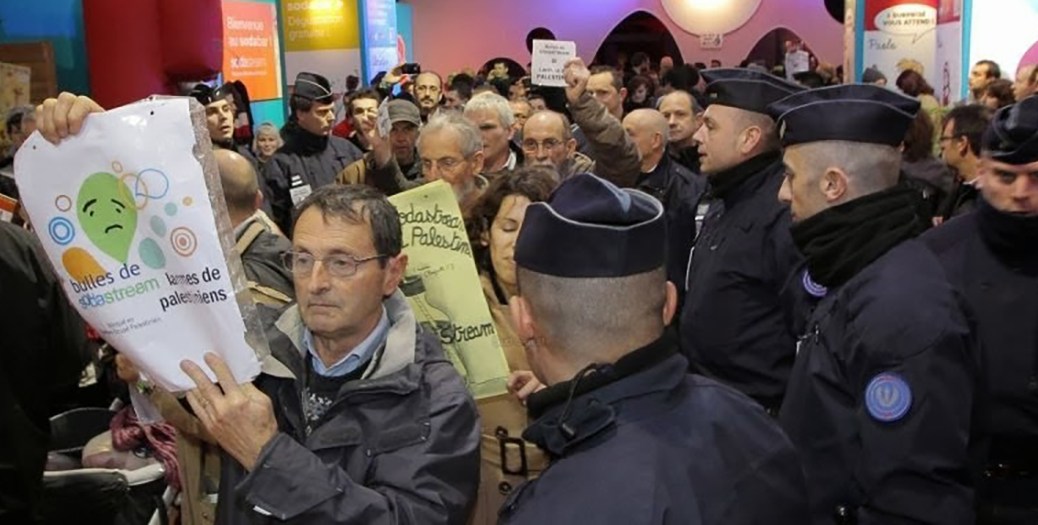
An open letter addressed to the head of the of the Angouleme International Comics Festival and the broader comics industry demanding an end to “business as usual” with Israel has reached 110 signers as the Festival opened on January 29th, including Alison Bechdel, Jaime Hernandez, Ben Katchor, 2013 Grand Prix winner and Charlie Hebdo contributor Willem, 2012 Grand Prix winner François Schuiten, 2010 Grand Prix winner Baru, 1984 Grand Prix winner Mézières, Canadian cartoonist Guy Delisle (author of Jerusalem and special guest at the 2014 Palestine Comics festival), and Lucille Gomez, the cartoonist hired to draw comics by Sodastream at the 2014 Festival.
The full letter and updated list of signatories can be found here.
The letter specifically calls out the Angouleme Festival’s relationship with the Israeli company Sodastream, which operates manufacturing plants in the Palestinian Occupied Territories and in the Naqab desert region of Israel. Franck Bondoux, the director of the Festival, who in 2014 denied that Sodastream operated in the Occupied Palestinian Territories, this week shifted his defense and claimed it was inappropriate to talk about Palestinian rights due to recent events in France. He was quoted in the French newspaper Sud Ouest on January 23:
“We are no longer in the same situation as last year,” remarked Bondoux, whom we reached last night. “SodaStream announced in 2014 that the factory under discussion will be moved. This means that the problem is in process of being resolved and has been understood.” The executive director of the festival further believes that the letter “moves into a broader proposal with terminology that goes much farther in its call for a boycott.” “We have moved from a discussion where one speaks of a specific problem to a total generality.” “This is an incitement to a stronger, more militant form of resistance.” Bondoux refuses to “judge” or “comment” if only to say “that in the current situation [reference to Charlie Hebdo and Kosher supermarket attacks], I’m not certain whether this is a time to welcome such proposals.”
Organizers of the open letter, Ethan Heitner (NYC) and Dror Warschawski (Paris) published a response to Bondoux in the French newsweekly Le Nouvel Observateur.
You understand science. Or more accurately, you could understand science. Although there’s no denying it can be difficult, I’ve too many times heard people exclaim that while they love science, they simply can’t wrap their heads around it. Instead, a love of science expresses itself as a fetish, with obscure facts, like how often a fly poops, being touted around as worthwhile knowledge.
When it comes to the biggest environmental issue of all time for the human species, climate change, you see alarming headlines that mix alarming (and sometimes misleading) facts without actually informing you on how it’s happening, and how your behaviour influences it. This is the gap Climate Changed by Philippe Squarzoniv attempts to fill.
Title: Climate Changed:A Personal Journey through the Science Author: Philippe Squarzoni Illustrator: Philippe Squarzoni Published: 2014 (Abrams Comic Arts) Pages: 480 Dimensions: 16.5 x 3.2 x 23.5 cm Get Your Copy: In the Online Shop
Squarzoni’s book is as thick as a textbook, though far less dense and plodding. Its pages mix images of the author’s personal life with interviews and charts that make up much of the evidence for climate change. Though not as slick as a high budget movie, it walks the problem forward from the beginning, and then thoroughly examines the issue in a level-headed way.
Squarzoni found himself in a position many others share, a believer in climate change who only knew it was something to worry about. His journey through the research walks each reader through not only the changes we might be seeing, but how they’re happening. The way his life is juxtaposed with the research brings the science home, making it a journey that doesn’t just make you reflect on scary factoids, but genuinely try to understand them in the context of your own life.
It may be that being presented in a comic makes the subject far less intimidating, yet still gives you the chance to dwell on each page. Instead of a movie or TV documentary, you can linger on each page, rereading points that flow so easily off the tongue of an expert, better acquainting yourself with a trickier point. You can also take time to understand a graph or see the small changes in an image of landscape. You likely won’t finish it in one sitting, but it doesn’t take too much effort to keep it out of your shameful pile of unfinished books.
As excellent as it is, the book does have a few flaws. Some of the research, particularly the section on nuclear power, was a bit thin. For instance, a statement on nuclear waste taking decades to decompose with no solution to that in sight, when it’s been reduced to years, is misleading. Although small errors like that one inadvertently demonstrate one of the other great joys in science: being sceptical. If there’s one more thing a reader might take away from this book, it’s how to look at science not as something to be passively received, but something to actively engage with and attempt to understand personally.
By looking at the issue from so many angles, a reader can begin to grasp just what climate change means both scientifically, and in their own life. It makes science something that isn’t a fun curiosity, but rather a pursuit that belongs to all of us. One of the great limitations of science is how too easily people assume it’s a pursuit for the intellectual elites. Though scientists sometimes fail in communicating their ideas, it’s time people started making greater efforts in understanding it. It’s a knowledge base that belongs to everyone, and books like Climate Changed help bring it to us, if you make the effort in picking it up first.
Unlike most histories from above or below, Fluid Prejudice stands out as one that doesn’t provide a coherent narrative. Instead, it’s a dream-like journey through Australian history, haunted by the violence of colonization. Single-image cartoons jostle with longer stories, and well-known figures sit side-by-side with personal stories. Some characters recur in different forms across stories, shifting from the foreground to the background. This jumble creates a more radical approach to history which leaves questions and contradictions unanswered, rather than offering the reader an easy vantage-point.
Title: Fluid Prejudice Creators: Sam Wallman, Aaron Manhattan, Safdar Ahmed, Katie Parrish, and others (50 contributors in total) Editor: Sam Wallman Published: Self-published in 2014 Page Count: 175 pages Other Specs: Softcover, black and white interior with colour cover Purchase: In the Ad Astra Comix online store
While it may be tempting for many white activists to dissociate themselves from Australian racism, the collection doesn’t allow the reader to imagine that they can be outside processes of colonization. In one comic, two environmentalists engaging in direct action query whether this is part of the continuing white colonization of the forest. In another, white Occupy protesters pause to consider the irony of following the chant “Always was, always will be, Aboriginal land” with “Whose streets? Our streets!”
“Memory from Occupy”. Contribution by Sam Wallman.
Similarly, we never get to wholly lose identification with the middle-class Australians who are so often the target of activist derision. For example, a comic about the destruction of old growth forests is followed by another in which a man looks at a newly-opened suburb, daydreaming about a home there. While the image hints at typical narratives of suburbia as a site of ecological destruction and bland whiteness, there’s also an element of sympathetic identification.
Australia’s history as a penal colony, too, is treated through a overlapping stories which never quite settle into a single perspective. Fluid Prejudice focuses on stories of escape, with convict William Buckley reappearing several times throughout the collection. Mary Bryant, a transported thief, escapes and is later pardoned. However, the optimism of these stories is balanced by the stark list of different convict occupations in 1847 Tasmania, and the subtle reminders that convicts also played a role in the violence of colonization.
Both cities and the landscape become haunted sites. The Tasmania tiger, hunted to extinction as a part of the effort to impose a European approach to agriculture, reappears throughout the book stalking the supposedly-tamed undergrowth. Within the city, state and social control is undermined by a lesbian beat, working-class resistance to restrictions on free speech, and an underground city of train station platforms and graveyards which remain below the streets. No place is more authentically a site of struggle than others.
Contribution by Karina Castan
Fluid Prejudice rejects the erasure of the violence Australia was built on, but it also highlights moments of solidarity and hope. One comic reminds us that the only known protest against Germany’s persecution of Jewish people following Kristallnacht came from the Australian Aborigines’ league in 1938. In another, people run over rooftops and onto the top of trams as part of attempts to escape police crackdowns on public speech. We’re reminded of a period when unions were more radical, and prepared to down tools to save public space and support other struggles.
As well as these more overtly political stories, many of the notes of optimism and humour in this collection touch on the politics of gender and sexuality: Percy Haynes is followed by a policeman and charged for wearing women’s clothes, only to have the magistrate decide that since women can wear pants, there’s no reason men can’t wear dresses if they choose. Zeki Müren, a Turkish singer, performed in drag in Sydney in 1974 to an enthusiastic crowd of homesick Turkish immigrants.
Part of the beauty of this collection is the inclusion of mundane scenes and lives that would not usually reach the history books. There are fragmentary scenes of an Aboriginal embassy, passengers on a tram, a trip to Healesville sanctuary, even a dumpster. We learn about Rosaleen Norten, the witch of King’s Cross, and then about cartoonist Ruby Knight’s mother. Arlene Textaqueen replaces the front cover of conservative newspaper The Australian with responses to the question, ‘Where are you really from?’
Through the combination of explicitly political and more personal stories, resistance is written through many different forms and spaces. This is a helpful alternative to the ‘one true way’ approach to activism, in which a single set of tactics and strategies is the only way to be radical enough (or, conversely, polite enough).
Fluid Prejudice, as we might expect from an alternative history, undermines the myths Australia is built on, from heroic stories of settlers eking out a living in the bush to the ongoing erasure of the violence against Aboriginal people and other marginalized groups. However, it also encourages more critical reflection on our positions as activists and the ways in which we do—or don’t—identify with others within Australian society.
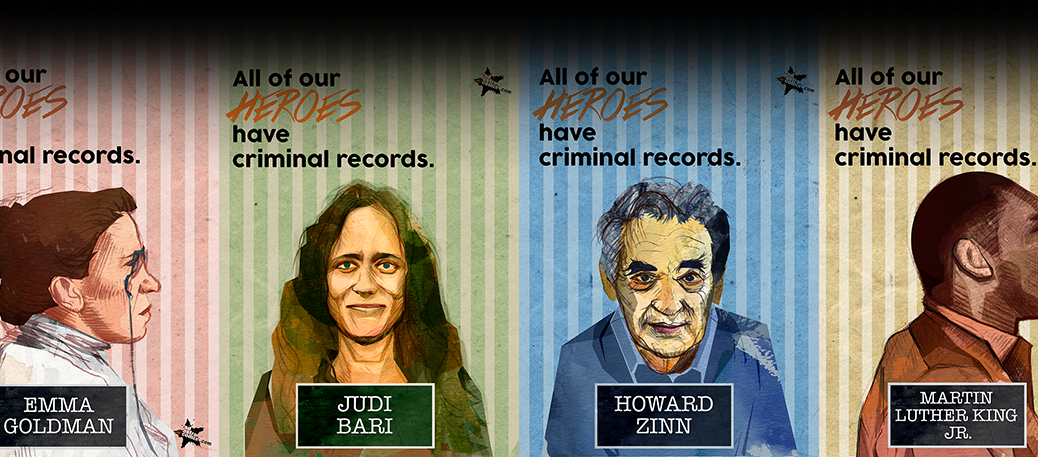
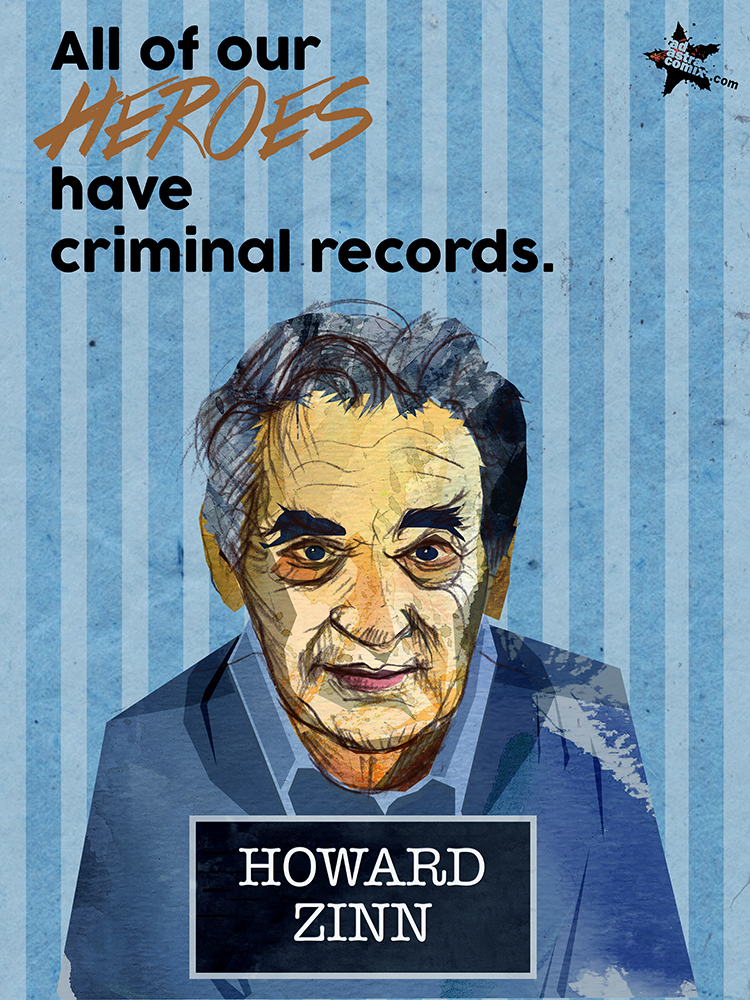
We are very pleased to be re-releasing our poster series, encouraging readers young and old to consider a different kind of hero than we normally think of when reading comics. These four posters boldly claim, “All Our HEROES Have Criminal Records“.
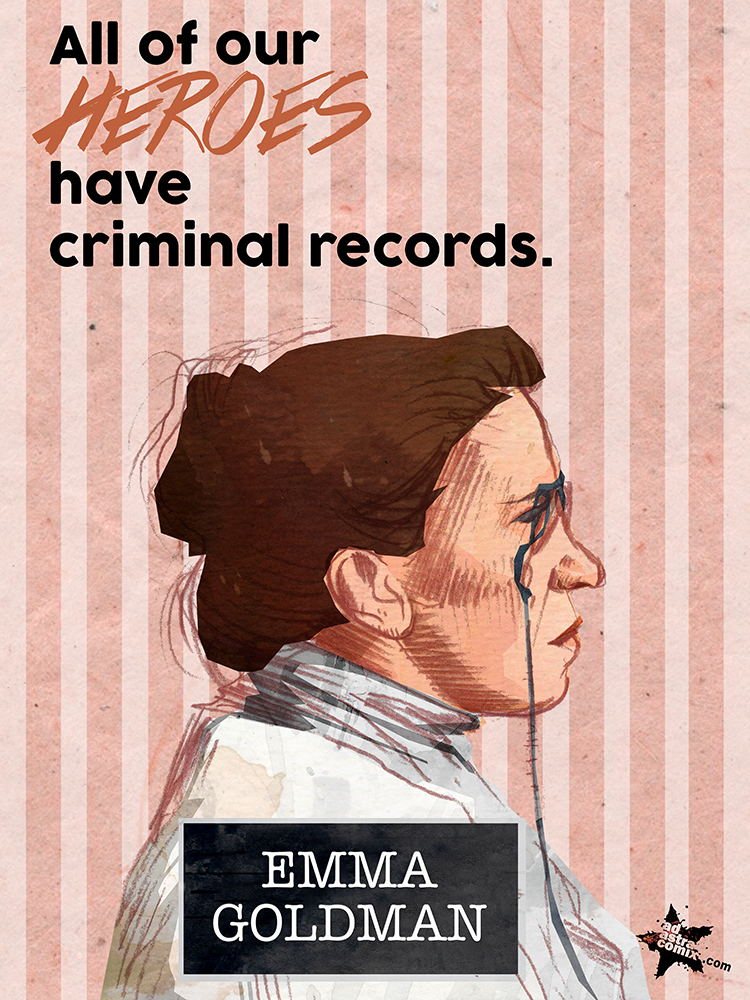
This visual campaign is inspired by the lives of four people who have been arrested for their grassroots organizing and/or activities of civil disobedience: Martin Luther King, Jr., Howard Zinn, Emma Goldman, and Judi Bari. They reflect a healthy variety of political backgrounds (civil rights, environmentalism, anti-war, people’s history, feminism, and anarchism) – and each has appeared, at least once, in comic form. All artwork by Sean Richman.
We’re excited to be making these posters available for sale! Visit the Ad Astra Online Shop to get your favorite, or collect all four. Numbers are limited for this printing, so if you don’t get one – stay tuned!
EMMA GOLDMAN (Booking #23178) Goldman was an anarchist and feminist known for her political activism, writing, and speeches. She played a pivotal role in the development of anarchist political philosophy in North America and Europe in the first half of the 20th century. Arrested in 1917 with Alexander Berkman for conspiring to “induce persons not to register” for the newly instated WWI military draft.
Emma Goldman appears in A Dangerous Woman : The Graphic Biography of Emma Goldman, Sharon Rudahl; edited by Paul Buhle. Published by New Press in 2007 (ISBN 3: 9781595580641)
HOWARD ZINN was an historian, author, activist, WWII veteran, and commentator on American politics and history. By the end of the 1960s, as a result of Zinn’s campaigning against the Vietnam War and his influence on Martin Luther King, Jr., the FBI designated Zinn a high security risk to the country, a category that allowed them to summarily arrest him if a state of emergency were to be declared. The FBI memos also show that they were concerned with Zinn’s repeated criticism of the FBI for failing to protect blacks against white mob violence. Zinn’s daughter said she was not surprised by the files; “He always knew they had a file on him”. — with Howard Zinn.
Howard Zinn appears in A People’s History of American Empire: The Graphic Adaptation, by Howard Zinn, Mike Konopacki and Paul Buhle. It was published by Metropolitan Books in 2008 (ISBN#: 978-0805087444).
JUDI BARI was an American environmentalist and labor leader, a feminist, and the principal organizer of Earth First! campaigns against logging in the ancient redwood forests of Northern California in the 1980s and ’90s. She also organized efforts through Earth First! – Industrial Workers of the World Local 1 to bring timber workers and environmentalists together in common cause. On 24 May 1990, in Oakland, California, the vehicle used by Bari and Darryl Cherney was blown up by a pipe bomb planted in it. Bari was severely injured by the blast, as the bomb had been placed under her seat; Cherney suffered minor injuries. Bari was falsely arrested for transporting explosives while she was still in critical condition with a smashed pelvis and other major injuries. The FBI took jurisdiction of the case away from the Bureau of Alcohol, Tobacco, Firearms and Explosives, saying it was a terrorism case.
Judi Bari’s story appears in WOBBLIES! : A Graphic History of the Industrial Workers of the World by Mike Alewitz, Sue Coe, Sabrina Jones, Paul Buhle and Nicole Schulman. It was published by Verso Books in 2005.
Martin Luther King, Jr. (Booking #:7089) MLK was an American pastor, activist, humanitarian, and leader in the African-American Civil Rights Movement. He is best known for his role in the advancement of civil rights using nonviolent civil disobedience based on his Christian beliefs. Arrested in 1962, 1963, and 1965 while demonstrating for civil rights in the American South.
The story of Martin Luther King Jr. can be found in many titles at this time. The first appeared in 1958, called Martin Luther King and the Montgomery Story (written by Alfred Hassler and Benton Resnik, produced by the Fellowship of Reconciliation) , and has been re-released by Top Shelf Productions.
Another is KING, a three-part biography by Ho Che Anderson, published by Fantagraphics between 2003-2005.
Title: UNDOCUMENTED: The Architecture of Migrant Detention Author: Tings Chak Illustrator: Tings Chak Published: Self-published as a 3-part zine in August 2014; published by in September 2014 Purchase: In the Ad Astra Comix Online Store For more info: www.tingschak.com
Architecture has been described as a synthesis of life’s components in materialized form. Its proponents describe it as the mother art, or the soul of a civilization, and one in which we have historically defined our understandings of home, safety, comfort. It is an art form that can seem invisible and yet cannot possibly go unnoticed. But what happens when buildings are not, as architect Stephen Gardiner describes it, ‘good people making good buildings by good design’? What if the desired architecture is one of discomfort, isolation, and transience?
Prisons, detention centres, and other “holding facilities” are the subject explored artfully in this premiere work by Tings Chak, an artist, activist, and former architecture student. “Undocumented” is a jarring 3-part exploration the intimate relationship we have with the spaces around us. By examining their physical, emotional and psychological toll when occupied, “Undocumented” posits that their architecture is ill-designed and of ill-intent, meaning it mirrors the economic and political architecture of global neo-liberal policy.
Part One: Landscape
What first strikes the reader in the comic’s first pages is the invisibility of migrant detention in countries like Canada. From the outside, prisons and holding facilities are often nested inconspicuously in suburbs and bedroom communities. Locals think little of their impact but as a source of jobs in increasingly desperate economic times. Despite their underwhelming appearance, their intent, by design, is diametrically opposed to all the buildings around them.
The construction of prisons and other involuntary holding facilities turns architecture on its head, and we experiences a sense of conceptual vertigo. Space and inhabitants alike are compartmentalized. The comic illustrates what inmates describe as a sense of isolation so intense that they feel they are becoming one with the walls in their cell. Aesthetically, this feeling is aided by the compartmental nature of comics as a “sequential” art form.
Part Two: Building
“Undocumented” steps beside the realm of a comic with a linear narrative and into a category of ‘statistics illustrated’. The cold delivery of information brings home the point that these detention centres are, in so many ways, an impediment to the human narrative of their captives. Each individual, in their life journey through spaces and other individual lives, is suspended and infringed upon. Here, life is devoid of free will. Schedules are fixed and micro-managed. Interpersonal interaction is withheld and restricted. In order to understand the stories that escape from these hellish conditions, one must acknowledge the adversities they have overcome.
Looking over the grounds and conditions of a series of holding facilities in Ontario, they seem underwhelming, banal where we might expect that they be ominous. In other words, they are deceptive, and intentionally so. By design and locale, they seem to embody the 19th century French “oubliette”: a dungeon where people are placed with the intention of being forgotten. Modern prison architecture shows that little has changed: rehabilitation, correction or even punishment are beyond the essential purpose of these facilities.
Confinement, historically: Pictured here from the larger french atlas, Civitatis Orbis Terrarum, Bedlam, circled in blue, was a holding facility for those deemed mentally ill or otherwise unfit for 16th century civilization. Despite it being officially identified as a place of support and assistance, according to a writing in 1591, “Bedlam was an oubliette in all but name–a place for forgetting, where the insane were locked up with those interred by their own families on some trumped-up charge simply to be rid of them.”
Part Three: Resistance
Here, the work takes a decidedly more human tone. We go from the vital statistics of carceral facilities to the descriptions of the lives of migrant detainees: precarious, vulnerable, and fearful. Quotes from men, women and children held in detention reveal a profound isolation – from spouse, sun and seasons – an example of the emotional trauma inflicted by confinement. Shine the light a bit further down this rabbit hole, and we consider the subject of solitary confinement, euphemistically termed “administrative segregation” by Corrections Canada. Here, a detainee could spend up to 23 hours completely alone, in what has been regarded by human rights activists for years as a criminal act that jumps the fenced definition of torture by any decent definition.
Ultimately, “Undocumented” is a look at architecture not as a thing of author-less objectivity, but as the physical legacy of accomplices to an agenda of discipline and exploitation. It helps us connect the economic policies of neo-liberalism that impoverish and displace populations to the detention centres they are confined in when they try to escape. With a cold, empirical lens, it demonstrates that the blueprints of migrant detention centres are drawn with the intent to isolate, agitate, and demoralize their human occupants.
Frank Lloyd Wright described architecture as a component in the construction of a civilization’s soul. What, then, can be said of the civilization responsible for these gaps in our urban landscapes that neither light nor hope can penetrate?
“Undocumented: The Architecture of Migrant Detention Centres” is launching as a published book this week, and if you’re in Toronto, you are invited! RSVP for the event here, on Facebook.
July 30, 1905: Daniel Corbin, a Washington railway entrepreneur, gazed upon an 80-metre thick seem of high-grad bituminous coal in southeastern British Columbia. This find led to the formation of the town of Corbin, where, in 1935, workers would wage a long and bitter strike that culminated in the writing of “a page of unparalleled police brutality in Canadian history.” (Quote from Ralph Wootton, official for United Mine Workers of Canada, April 30 1935)
‘Coal Mountain’ illustrated by Nicole Marie Burton and produced by the Graphic History Collective, is about the Corbin Miners’ Strike of 1935. The story remains relatively unknown outside of academic circles.
Nestled in the Rocky Mountains of eastern British Columbia, Corbin was a company town of 600 in its first years. There was no power and now plumbing, and the only way in or out of the town was the railway.
Soon, families joined the miners. Miners without families stayed in the company boarding house for about a dollar a night – incredibly expensive housing costs for the time.
On the morning of April 17, 1935, the Corbin miners strike came to a head with a massive confrontation of miners, their wives, and Corbin Collieries company men, accompanied by B.C. provincial police.
Miners’ wives formed a front-line human shield ahead of the strikers. Linking arms, they refused to allow the company men to re-open the mines that had been closed for months.
The company, assisted by baton-waving police, lurched forward, slamming their way through the strikers and their wives. The brutality exerted on the miners’ wives prompted their husbands, behind them, to rush forward, making it impossible to clear the crowd.
Today marks the centennial of the beginning of World War I. For those looking to comics for a quick and easy fix to explain how WWI started, there is indeed a comic for that. But for those looking to take advantage of the medium’s great ability to disseminate a deeper understanding of the conflict’s human impact, there are some exceptional titles available this year. These include anthologies like Above the Dreamless Dead and To End All Wars, as well as re-releases of classics like Charley’s War and It Was a War of the Trenches, to name a few.
Today we’re taking a look at Above the Dreamless Dead (First Second, 2014), an anthology of comics written and drawn to WWI poetry and song. Contributions are made by Peter Kuper, Garth Ennis, Sarah Glidden, Hunt Emerson, Eddie Campbell, and many more.
From the poem “Channel Firing,” by Thomas Hardy, adapted by Luke Pearson.
The space between a human being, their pen, and a piece of paper is a place not for patriotism any more than any other compulsory thought. In a time when you could have been arrested for resisting a war that saw thousands die for every mile of ground gained, poetry gave precious creative room for soldiers and non-combatants alike to process the trauma and stress of a life at war. Counting the years both during and after the conflict (1914-1918), World War I poetry, has grown to become a huge body of literary work. It is within this section of 20th century literature that dozens of comics creators have put together a creative and aesthetically varied collection for Above the Dreamless Dead.
“I Don’t Want to Be a Soldier,” a WWI soldier song, adapted by Hunt Emerson
Soldier songs, like those illustrated by British cartoonist Hunt Emerson, satirize and make light of the harsh everyday of the soldier–whereas Eddie Campbell’s piece, illustrating an episode of Patrick MacGill’s “The Great Push”, plunges head-first into the darkest corners of the human soul. Still others transcend the ultimately subjective spectrum of human emotion, and attempt to seek solace in the naturalist truth that regardless of man’s follies, the earth will continue to be as it always has.
A scene from “All the Hills and Vales Along”, a song by Charley Sorley, adapted by Kevin Huizenga
Within the larger category of WWI poetry is the subcategory of trench poetry. Noteworthy space is given to the most well-known of these poets, namely Wilfred Owen, Isaac Rosenberg and Siegfried Sassoon. Bearing witness to some of the most hellish of situations imaginable, trench poetry takes the reader to another world of blood, mud, and pain, at one both impending and uncertain. The stress induced by the battlefield lent itself well to art, where soldiers could perhaps hold on to their sanity by airing their demons.
In Isaac Rosenberg’s “The Immortals“, adapted here by Peter Kuper, we get a real taste of the fear and paranoia of the gunner who is tasked to shoot at an enemy that seems immune to death. The feeling of this unending hoard of soldiers leads Rosenberg to feel that he is fighting not a massive army, but the same undying soldiers over and over again.
“The Immortals” by Isaac Rosenberg, adapted by Peter Kuper.
The aesthetic diversity of the art presented in Above the Dreamless Dead is a reminder that WWI poetry is in fact a huge genre–and one that the book doesn’t even illustrated to its fullest, in my opinion. Above the Dreamless Dead focuses mostly on the poets proper of the era, and in doing so missed an opportunity to take a critical look at the growing argument for sexual and racial diversity of World War I poetry.
Focusing on young white men in documenting the First World War is obviously the norm, whether you’re interested in comics, poetry, or history in general. But historian Dr. Santanu Das (King’s College, London) states that our understanding of the war’s poetry is changing as we come to recognize the diversity of the work written at the time and on the subject. “Today, no serious anthologist can ignore the poetry of non-combatants, civilians or women, such as the poetry of Thomas Hardy, or Rudyard Kipling, or Margeret Postgate Cole.” Note that neither Thomas Hardy nor Rudyard Kipling were enlisted, let alone combatants, yet they both appear in this anthology. Margaret Postgate Cole, a wonderful poet, was not, although it is arguable that she was more personally affected by the war as a socialist and activist (her brother was jailed for refusing military orders, after his application for CO status was rejected).
Das continues, “We also must move beyond Europe, because there was war poetry being written in Turkey, India, and Eastern Europe. We cannot just limit ourselves to a narrow, Anglo-centric definition of First World War poetry. We should embed First World War literary memory in a more multiracial framework by investigating, recovering, and translating First World War poetry that’s being written often in non-European languages.” Suffice to say that there is no poetry here from a non-white or non-English-speaking perspective, in addition to there being no women poets.
This criticism could surely be echoed for most graphic interpretations of World War I, but it is a point worth noting from the perspective of our mandate (see Harlem Hellfighters below, for the ONE exception to this rule that we could find!). As 2014 invites us to meditate on the “War to End All Wars” we encourage our readers to keep a lookout for examples, comics or otherwise, of marginalized perspectives/histories of the World War I.
We hope that you pick up and enjoy your own copy of Above the Dreamless Dead, or any of the other WWI titles following!
World War I in Comics: A Reading List
Title: Above the Dreamless Dead: World War I in Poetry and Comics Poets: Rupert Brooke, Wilfrid Wilson Gibson, Robert Graves, Thomas Hardy, Rudyard Kipling, Francis Edward Ledwidge, Patrick MacGill, Wilfred Owen, Isaac Rosenberg, Siegried Sassoon, Osbert Sitwell, Charles Sorley, Edward Thomas
Creators: Eddie Campbell, Sarah Glidden, Garth Ennis, Simon Gane, Luke Pearson, Hunt Emerson, Sammy Harkham, Kevin Huizenga, Peter Kuper, Isabel Greenberg, George Pratt, Hannah Berry, Phil Winslade, Stephen R. Bissette, Kathryn & Stuart Immonen, Lilli Carré, Pat Mills, David Hitchcock, Liesbeth de Stercke, Danica Novgorodoff, James Lloyd, Carol Tyler, and Anders Nilson Edited by: Chris Duffy Published: 2014 by First Second Dimensions: 21.7 x 15.9 x 1.7 cm, 144 pages Purchase: Ad Astra Online Store
Title: The Great War Creator: Joe Sacco Published: 2013 by WW Norton Dimensions: 21.8 x 29 x 3 cm, 54 pages Purchase: Ad Astra Online Store
Launched on July 1, 1916, the Battle of the Somme has come to epitomize the madness of the First World War. Almost 20,000 British soldiers were killed and another 40,000 were wounded that first day, and there were more than one million casualties by the time the offensive halted. In The Great War, acclaimed cartoon journalist Joe Sacco depicts the events of that day in an extraordinary, 24-foot- long panorama: from General Douglas Haig and the massive artillery positions behind the trench lines to the legions of soldiers going over the top and getting cut down in no-man s-land, to the tens of thousands of wounded soldiers retreating and the dead being buried en masse. Printed on fine accordion-fold paper and packaged in a deluxe slipcase with a 16-page booklet, The Great War is a landmark in Sacco s illustrious career and allows us to see the War to End All Wars as we’ve never seen it before.”
Title: The Harlem Hellfighters Author: Max Books Illustrator: Caanan White Published: 2014 by Broadway Books Dimensions: 23.5 x 15.5 x 1.6 cm, 272 pages Purchase: Ad Astra Online Store
In 1919, the 369th infantry regiment marched home triumphantly from World War I. They had spent more time in combat than any other American unit, never losing a foot of ground to the enemy, or a man to capture, and winning countless decorations. Though they returned as heroes, this African American unit faced tremendous discrimination, including from their own government.
Title: To End All Wars : The Graphic Anthology of The Great War Creators: Brick, Jonathan Clode, Michael Crouch, Steven Martin, Sean Michael Wilson, John Stuart Clark, Ian Douglas, Petri Hänninen, Bex Burgess, Stuart Richards, Lotte Grünseid, Chris Colley, Lex Wilson, Susan Wallace, Dan Hill, Faye Turner, Joe Gordon, Russell Wall and James Guy, Colm Regan, Andrew Luke, Sean Fahey, Pippa Hennessey, Steve Earles, Gary and Warren Pleece, and Selina Lock. Edited by: John Stuart Clark and Jonathan Clode Published: 2014 by Soaring Penguin Press Dimensions: 26 x 17 x 2.5 cm, 320 pages Purchase: from their blog!
An omnibus of 27 short graphic narratives based on actual events, characters, circumstances, incidents, myths or consequences of the Great War WWI. £2 for every copy of this publication sold will be donated to Medecin Sans Frontieres. Featuring the four theatres of war (land, sea, air and the home front), spanning four continents and drawn from both sides of the conflict, the stories range from 4 to 16 pages, each by a different author and/or illustrator from the world of independent comics.
Title: Charley’s War Author: Pat Mills Illustrator: Joe Colquhoun Published: August, 2014 by Titan Books Dimensions: 26.8 x 20 x 2.4 cm, 320 pages Purchase: Through a few places on Seven Penny Nightmare
Arguably the most well-known WWI comic of all time. From renowned UK comics writer Pat Mills and legendary artist Joe Colquhoun comes a truly classic piece of British comics history, by turns thrilling, humorous and horrifying. From its initial publishing in the 1970s and 80s, it was widely considered to be anti-war.
Title: Line of Fire: Diary of an Unknown Soldier August – September 1914 Illustrated by: Barroux Translated by:Sarah Ardizzone Published: 2014 by Phoenix Yard Books Dimensions: 25 x 18.2 x 1 cm, 96 pages Purchase: Available soon!
One winter morning, Barroux was walking down a street in Paris when he made an incredible discovery: the real diary of a soldier from the First World War. Barroux rescued the diary from a rubbish heap and illustrated the soldier’s words. We don’t know who the soldier is or what became of him. We just have his words, and in his own words and Barroux’s extraordinary pictures
Title: Tardi’s WWI: It Was The War Of The Trenches/Goddamn This War! Illustrated by: Barroux Translated by:Sarah Ardizzone Published: 2014 by Phoenix Yard Books Dimensions: 25 x 18.2 x 1 cm, 96 pages Purchase: Available soon!
Jacques Tardi is responsible for two acknowledged graphic novel masterpieces about World War I: It Was the War of the Trenches and Goddamn This War! To honor the 100th anniversary in 2014 of WWI, Fantagraphics has now released a two-volume boxed set collecting these two perennial classics. The first book, It Was the War of the Trenches, focuses on the day to day of the grunts in the trenches, bringing that existence alive as no one has before or since with some of his most stunning artwork. His second WWI masterwork, Goddamn This War!, is told with a sustained sense of outrage, pitch-black gallows humor, and impeccably scrupulous historical exactitude, in masterful full color.
Title: Trenches Creator: Scott Mills Published: 2002 by Top Shelf Productions Dimensions: 21.1 x 17.5 x 1 cm, 176 pages Purchase: Ad Astra Online Store When Lloyd and David Allenby arrive in the trenches of the Western Front, they have no idea of the misery and violence that awaits them. Can an aloof Major be the father figure and guiding force in their desperate battle for survival? Or will the estranged brothers be swallowed up before they can come to terms with each other, trapped in the clutches of the Great War? Trenches is about the beautiful stories that come out of dark times.
Title: The Ghosts of Passchendaele Creator: Ivan Petrus For more info: Check out his website!
Launched in 2014, this is the third book of a graphic novel trilogy by Ivan Petrus featuring Belgian, British and French soldiers and their true stories from the First World War. Painted in bold, dark, muddy colours, his art powerfully invokes the iconic post-war Passchendaele landscape. Petrus said: “My first graphic novel was about Nieuport, my second about Furnes and Pervyse, so the battle of Ypres in 1917 at Passchendaele was the next logical step. It was an iconic battle for the British and Anzacs troops. Plus, 1917 was the wettest year imaginable. Passchendaele is all about courage and fighting spirit – in deep mud.”
Who doesn’t read that quote and not feel some bitter kernel of truth in the words? Such energy, and no direction! Such curiosity, burned on idleness and errant adventure alike! DANGEROUS adventures, at that. One can’t help but think of their own moments of hilarity and embarrassment when considering the folly of youth (I myself was almost blown up by a gasoline explosion when I was 12). Whether we look at child’s play from previous eras or to distinctly modern activities like social media and cell phones, the grievances of the old to the frivolities of youth reveal a full spectrum of conflicting impulses. On one hand, parents and adult community members wish to lovingly guide and protect. On the other, there exists a perennial fear of and intolerance to the unfamiliar hobbies and technologies ushered into social acceptance by the youth of the day. These manifestations of adult anxiety are the basis for the content of this landmark comic book.
Title: Bad For You: Exposing the War on Fun! Authors: Scott Cunningham & Kevin C. Pyle Illustrator: Kevin C. Pyle Published: 2014 by Henry Holt Length: 180 pages Other Specs: Includes a glossary of terms, and a resource listing of kids’ rights organizations. Written with young readers in mind (10+ yrs.)
‘Bad For You: Exposing the War on Fun’ is an impressive collection of information with a unique intersection of all that is bad for baby adults. In doing so, it invites the reader to ask interesting questions: What is bad for kids, and why?
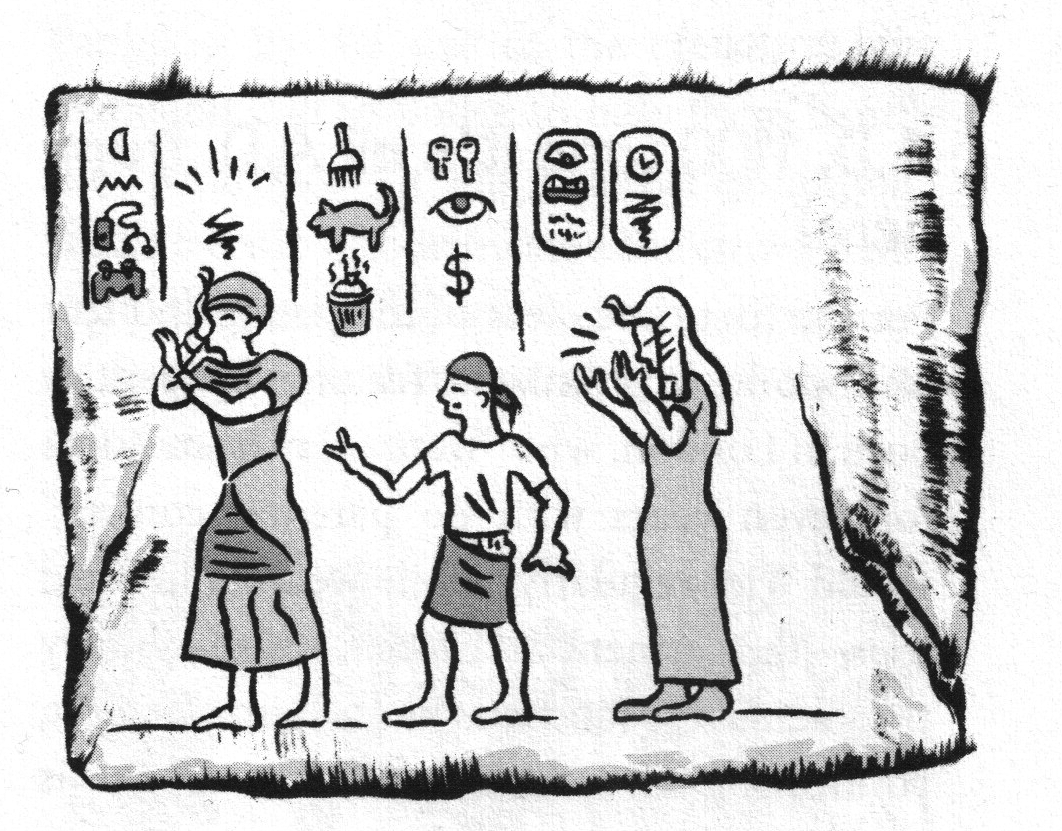
This panel depicts a quote from an Egyptian tomb dated to be nearly 6000 years old: “We live in a decaying age. Young people no longer respect their parents. They are rude and impatient. They frequently inhabit taverns and have no self-control.”
The table of contents reads like an index to modern moral panics: comic books, digital technology, games of all kinds (“idle hands are the devil’s playground”, or so the saying goes), –even playgrounds have an intriguing entry. All of the aforementioned have had a history of being attacked and scapegoated as “bad” or “dangerous” for our youth until an acceptably sterilized pattern can been adhered to, or until enough kids and their allies can fight back. Noteworthy elements include graphs and narratives that help to distinguish science from pseudo-science, beginning with an introduction to the scientific method in the first chapter. The book offers a timeline beginning in the ancient world to demonstrate that the mistrust of youth is one of the most predictable social patterns throughout history. The book points out that there is even a term for this pattern: ephebiphobia, or a “fear and loathing for the young”.
Using statistical data and historical perspective, the book is prepping an entire readership of kids to be a bunch of real smart assess, and an entire crop of adults to rethink their own phobias. For the book’s primary audience, young readers can use the reading to get acquainted with concepts that are highly relevant
to their generation, including the ‘factory model’ school system, ageism, the criminalization of youth, the notion of civil and political rights, and the power of protest. The book is packed with inspiring instances of young people challenging (and making gains at odds with) the cobweb-thick thinking of older generations. Everyone can agree that winning and the all-around sense of achievement it brings is an important experience to have while growing up; naturally, these successful kid-powered push-backs are explored at length in the book’s final Chapter, aptly titled, “Good for You”.
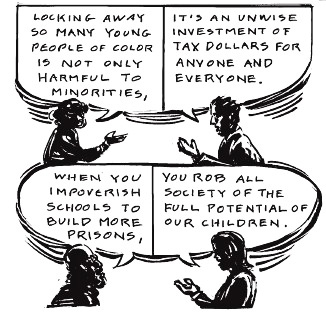
Part of a larger chapter on “Thought” that points to the alarming reduction in time and funding for the arts and social sciences in public schools.
Not surprisingly, we in 2014 have reached a point where fear and loathing of the young now requires its own brand! For the past few years, all challenges under the age of 25 have been invalidated by the fact that they come from a generation known as the Millennials (Did TIME Magazine call them the “ME ME ME Generation” because Tom Wolfe had already distinguished the Baby Boomers as the “Me Generation” and they just ran out of ideas?). Here are we, yet again, being dished the patronizing script of youth as lazy, self-indulgent, and playing hard and fast with their finances and futures. While the modern era has its own particularities, ‘Bad For You’ is good to point out that these are the dysfunctions attributed to every new generation of young’uns.
What this book truly brings to the table is empowerment for young minds. Notably, it critiques the status quo way of life for young people in North America as becoming largely devoid of educational lessons. It notes the ways in which young people are unheard and underrepresented, and offers intellectual and practical solutions for children and young adults alike to overcome obstacles. Overcoming the fractured–and in some ways obsolete–social systems imposed upon youth, in its own right, can and has become an important rite of passage for critical-thinking minds as they enter adulthood.
And to the reader who looks upon youth or childhood as that time in which they were simply a dumber, less reasonable, and more naive version of the person they are today: my condolences–that attitude is your loss. But it may mean that you have the most to gain from ‘Bad for You’. Learning to see our youth as a time in our lives that requires neither fear nor shame is exactly what this book is about.
If all great truths begin as blasphemies, as George Bernard Shaw put it, we in Canada find ourselves living in a theocracy. Certainly even Adam and Eve would wonder at the spectacular efforts to preserve the innocence of ignorance undertaken by our present government. It has taken a valiant stand against sex education so we may uncover our nakedness. In seeking to dismantle the National Archives, they will free us from knowledge of good and evil. Thanks to the government’s destruction of the integrity of census data, we are free from even the prospect of acquiring knowledge.
But to be sure we are safe from it, they are throwing whole libraries into the trash, and forbidding the wicked among us from sharing their dangerous truths with the press.
So we are nearly free of blasphemy, and what greater expression of piety than prisons? At a time when American districts are turning away from the tough on crime approach, Canada embraces it enthusiastically. If books are not totally passe at this point, I should recommend to the Justice Minister and any higher powers to which he might answer a thorough reading of ‘Race To Incarcerate.’
Title: Race to Incarcerate: A Graphic Retelling Created by: Sabrina Jones and Marc Mauer Forward: Michelle Alexander Preface: The Sentencing Project Published: 2013 by The New Press
‘Race To Incarcerate’ practically bursts its bindings with relevant historical, sociological and economic data. It doesn’t shrink from statistics either, as it outlines the growth in prison populations, corrections spending and the prevalence of private prisons. Exploring public attitudes towards morality, the dishonesty of elected representatives and the role played by the War on Drugs, this expressive tome shines light onto critical questions in one area of public policy where high-minded moralizing has long reigned supreme.
The comic traces the evolution of America’s obsession with getting ‘tough on crime’ from its beginnings in the 1970s through to the second Bush administration. Along the way it explores the impact of the War on Drugs, changes in social attitudes towards crime and the role of racism in expanding the prison-industrial complex. On the political file, the crass electoral motives of successive legislators are exposed. Clinton and George W. Bush are particularly held up as hypocrites, promising to reform the system while allowing prison spending and populations to grow in tandem.
The comic does an excellent job of outlining the role played by racism in incarcerating black and Hispanic Americans at a disproportionate rate. Racism, and underlying white cultural anxieties, are ably exposed as the culprits for rates of black incarceration. The usual apologies for the racial composition of the prison population are handily debunked. The proverbial fig leaf is pulled away, and the naked truth is not a pretty thing to behold.
If there is a flaw in ‘Race To Incarcerate’, it is in the conclusion. After spending the majority of its pages identifying the endemic racism in American society, it proposes a coalition of business, academic leaders, communities of colour and families of addicts to tackle the problem by lobbying the government. The book persuasively argues that the rich and powerful have a vested interest in maintaining the current system. It then proposes the problems be solved through a coalition made up in part by the rich and powerful appealing to the very politicians whose dishonesty it has exposed. Some business leaders may feel compelled to oppose the prison industrial complex, but it is a drop in the bucket to a system that has been constructed–designed–in the interests of corporate profits.
Furthermore, the book is right to suggest the involvement communities of colour, but missed the opportunity to highlight one of the most important groups of all – prisoners and ex-convicts themselves. Prisoners and ex-cons not only deserve the right to tell their stories, their voices should be at the forefront of a prison abolition movement. Regardless of the accuracy of the book’s conclusion, the information in it can help persuade regular people that prisons don’t work.
Canadian or American prison? Can’t tell? They’re about to get even more similar…
But the truth, we are told, shall set us free. The Conservative government is hot to bring many of the measures described in ‘Race To Incarcerate’ up to Canada, including mandatory minimum sentences and private prisons. The message of ‘Race To Incarcerate’ is clear: prisons don’t work. But more than that, they are dangerous to a degree that should alarm us. Indigenous people make up about 4% of Canada’s population, but 23% of its prison population – and the rates are climbing. In Canada, prisons are looking more and more like another form of genocide.
The facts in ‘Race To Incarcerate’ won’t liberate those prisoners, but they can free the rest of us from the moralizing naiveté that justifies mass imprisonment. Liberated from our ignorance, we can turn our attention to prying open the bars of the prison industrial complex.





![IMG_20140920_185756[1]](https://i0.wp.com/adastracomix.com/wp-content/uploads/2014/09/img_20140920_1857561.jpg?w=248&h=331&ssl=1 "IMG_20140920_185756[1]")
![IMG_20140920_185811[1]](https://i0.wp.com/adastracomix.com/wp-content/uploads/2014/09/img_20140920_1858111.jpg?w=218&h=164&ssl=1 "IMG_20140920_185811[1]")
![IMG_20140920_184241[1]](https://i0.wp.com/adastracomix.com/wp-content/uploads/2014/09/img_20140920_1842411.jpg?w=218&h=163&ssl=1 "IMG_20140920_184241[1]")


 Title: Above the Dreamless Dead: World War I in Poetry and Comics
 Title: The Great War
 Title:
  Title:
  Title: Charley’s War
 Title:
  Title:
  Title: Trenches
 Title: The Ghosts of Passchendaele





 adastracomix.com