“Clearly New York was a dangerous place where terrible things could happen, but also a place that could turn ordinary people into superheroes.”
Kuper’s recently published work is building on the available literature making an argument for “graphic biographies” – not for people, but for places. Cities. Something attracts us to these massive collections of social activity that take on a life and personality all their own, and actually change us in the process. Radical artist (and former New Yorker) Eric Drooker postulates in the beginning of the book that people move to NYC as much to find careers and connections as they come to find themselves. Drawn to New York is a dedication to that power.
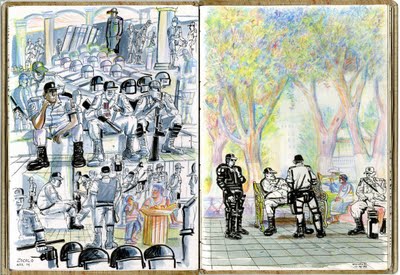
The book is a mash-up of a few different categories of work. There’s an intimacy in the quick sketches that are clearly drawn in the moment, on the subway, in cafes, (which conversely make you feel as close as you can be to that original scene, while also conveying that this book is really allowing you to peruse someone’s private journal/sketchbook –which is just the best thing in the world). As you peruse these pages, your eyes taking in a mesmerizing quantity of geometric shapes (so many right angles, so many windows!), a section of sketches will be punctuated with a longer piece of sequential art that tells a short story. As you read, the work more or less gets better and better; I can only assume this is because it is ordered chronologically, but I’m not sure.
The power of Kuper as a “New York artist” really shines in his highly-detailed stencil comics (made with multiple layers of stencils and spray paint), like the collection of New Yorker facial expressions, or his 2am trip to the top of the Brooklyn Bridge, or his commentaries on gentrification and crime.
Beyond the actual aesthetic of his work, the variety of perspective here is pretty broad, and is perhaps a part of Kuper himself being a New Yorker and an outsider (he’s originally from Cleveland–which oddly enough, has its own amazing graphic biography by Harvey Pekar.) His work goes from feeling like a love letter to an observation by an anthropologist of a place that is completely his “other”.
Towards the end his work has gotten pretty sophisticated, with pieces of comics journalism coming in about major NYC events, like his strip, “The Wall”. This piece, and every other, seems set in its conveyance that this great city is great for the same reasons it is so unstable: it is constantly in movement.
Or in Kuper’s words:
“This city is change. That’s its glory – it’s a perpetually unfinished canvas, offering up possibility to each successive wave of artists.”
A showcase of city and artist, with an interesting interplay between the two. That is, Peter Kuper is now, undeniably, a “New York artist”… the city shaped him. And in return, Kuper continues to pay tribute by making art that adds to the city’s ever-evolving mythos.
For more information about Peter Kuper, check out Peter’s book page in the PM Press store site.
Full Book Information:
Title: “Drawn to New York: An Illustrated Chronicle of Three Decades in New York City” Artist: Peter Kuper Introduction: Eric Drooker Published: May 2013 by PM Press Format: Hardcover only at this time Size: 10.5 by 8 Page count: 208 Pages Subjects: Art-Illustration, History-New York City, Regional-New York City List Price: $29.95
It’s safe to say that this past week was one of the busiest for me in recent memory. On top of working a 40 hour week at my day job (in 4 days), the Toronto Comic Arts Festival was in full swing and I was pulling together what I’d hope would be two kick-ass events for the weekend.
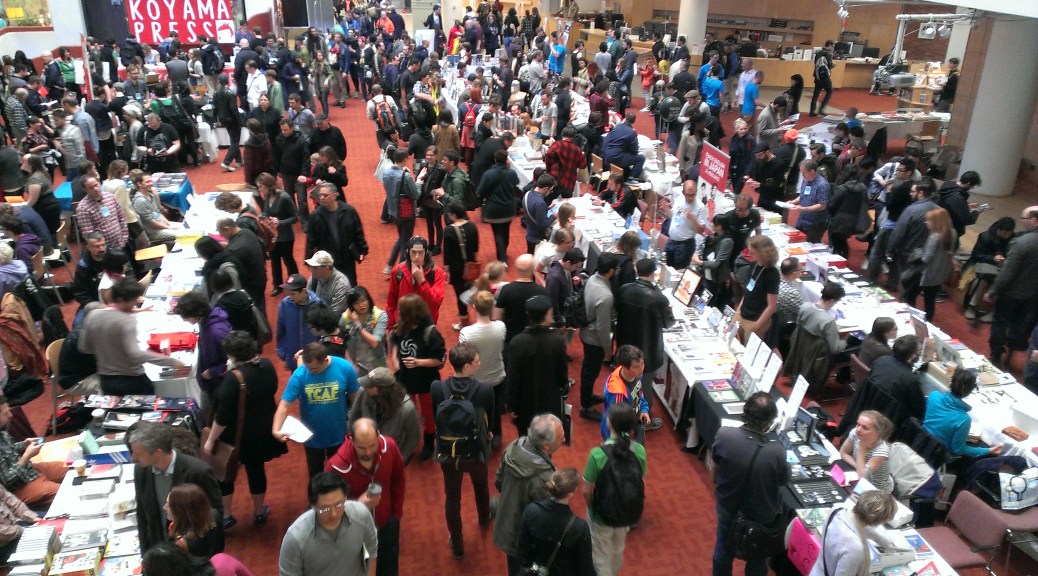
TCAF breaks records every year–has since I’ve been attending at least. If this year didn’t reach fire-code-breaking capacity at the Toronto Reference Library (in addition to several off-site satellite locations), and to be sure, they’re still still waiting on the official numbers, then it was awfully close. More notably there was an insane amount of talent at the show: Art Spiegelman and Francoise Mouly of RAW Magazine / MAUS / New Yorker fame. Jaime + Gilbert Hernandez, Tagame, Matsumoto, Chester Brown, Seth, David B… the list goes on.
Unlike my previous years at the festival, I saw a notable rise in interest (as well as work available) pertaining to political comic books. This is despite the skiddishness that remains around the term “political”. But whatever people want to call it, I found much more to chew on over the weekend than in years past.
Before I go into some books, a note on Comics Journalism.
If there’s one way to get people to talk comfortably about political comics and their viability, it’s Comics Journalism. I think it’s seen as a happy medium for a lot of different interest groups, whether it’s non-comic folk looking for some different non-fiction, or comic fans looking for a different type of page to turn. In turn, the sub genre doesn’t effect the topic. Joe Sacco really birthed the term, from his thumb-to-index-finger loins, with work like Palestine and Safe AreaGoražde, using comics to take on some pretty acceptable topics of intrigue in the journalism community… but since, really, you could do a comics journalism piece on just about anything and it would have the potential to be amazing. I look forward to seeing more and more come to maturity in this genre over the coming years.
…And secondly, a brief note about Art Spiegelman’s MAUS. I did not include MAUS in this list, because 1) I think it’s deserving of a little more commentary than one paragraph, for all it has done to influence the world of political comics… and comics in general. 2) It was put out 20 years ago. I feel like it’s a bit silly to put it among a list of up-and-comers with newly released works. (In other words, there will be more on MAUS as a specific work to come soon on Ad Astra!)
OK. To the books.
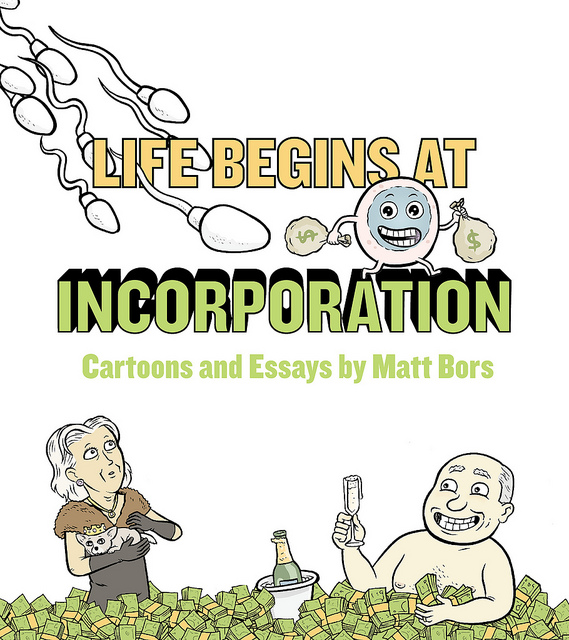
LIFE BEGINS AT INCORPORATION by Matt Bors – I’ve never considered myself a fan of editorial cartoons, so when I decided to back Matt’s Kickstarter campaign, that really just meant that I liked his work more than I cared to admit. After a bit of discussion and a lot of planning on both ends, Matt was able to make it up to Toronto to promote his book at TCAF, in the midst of some type of Eastern-Time-Zone-only book tour.
The book is a collection of political cartoons and essays spanning years of wonderful American political drama- from the gay marriage debate that is still somehow being discussed, to the continuing occupation of Afghanistan and the reality that war-time simply seems to be the perpetual reality for Americans, post-9/11. I have plenty to say about this book and have already uttered plenty of niceties here. My recommendation over reading my book-length review is just to buy the book. It’s better.
From left to right: Rutu Modan (Jerusalem), Matt Bors (Portland), Sarah Glidden (vagabond drifter), Josh Neufeld (New York City)
I will add, however, that Matt gave a great presentation to an engaged crowd at the Comic Book Lounge on May 10, the night before TCAF–despite monsoon thunderstorms and a competing 10th Anniversary TCAF party down the road (we had this shit scheduled MONTHS ago. We’re not the splinter group. THEY’RE the splinter group!). Attendees included at least one other fellow Kickstarter backer, which was great to see.
On Saturday evening, Matt and I shared a table with comic creators Josh Neufeld, Sarah Glidden, and Rutu Modan to discuss “Comics & Politics” at TCAF to a great crowd who asked lots of questions–from comics journalism to comics activism, free speech and “to draw or not to draw” (discussing the Mohammed cartoon), stereotypes, backlash for work done… it was great. And what’s more, it shows a genuine interest in political comics from a variety of entry points.
HOW TO UNDERSTAND ISRAEL IN 60 DAYS OR LESS by Sarah Glidden – Right in there on the topic of Comics Journalism. Sarah Glidden went to Israel on a Birthright trip and came out of it with How to Understand Israel in 60 Days or Less. Not only is it a journalistic piece about the country, it is journalism of herself experiencing it. The artwork is very much a European comic book style, with simple, expressive line work and really nice coloring (these are pretty much the first two things I think about when someone says European Comics). It’s packed with a thousand little stories that maybe tell us more about an American’s viewpoint on Israel than Israel itself, in all its historical and political turmoil. But I like the frankness that Glidden gave when describing the outcome of the book while at the TCAF panel (at the risk of seeming “wishy-washy”), when she said that this place became real when she traveled there, and the people in it became human beings. While I may not agree with Sarah on her political conclusions (and I’ve yet to see, as I’ve yet to finish the book!), it hardly seems relevant when we’re talking about a work of art that is depicting a personal experience.
A.D. NEW ORLEANS by Josh Neufeld – This book has been on my list to pick up for some time, and it was a pleasure to share a stage with Josh and talk to him about this project. I’ve yet to fully pinpoint my thoughts on this, but there is something to be said about a writer’s perception of an experience, and a visualist’s perception of the same thing. Neufeld seems to pick up on details of the Hurricane Katrina disaster that go missing in other accounts–and it’s not just a matter of mainstream vs. independent media. The wreckage, the crowds, the sweat, the loss of cherished items… all pulls at you differently when you are immediately able to absorb the information through a drawn depiction, without the filter or process of language. I particularly like the variety of people interviewed and their respective color palettes in the book’s pages. This will be a great one to finally read cover to cover.
I also got two other books that were illustrated by Josh Neufeld – The Influencing Machine: Brooke Gladstone on the Media, and Stowaway, written by Tori Marlan. Both works of comic journalism, although entirely different.
BEST OF ENEMIES by Jean-Pierre Filiu et David – When I first eyed this book at TCAF last year, I’d already spent all my money. Good thing I have a better job this year. Best of Enemies explores the long and complex history of U.S.-Middle East relations. It is part 1 of 3: 1783-1953, and so incredibly fascinating. David B.’s illustrations are absolutely addictive; despite history typically being considered a dry subject matter, he ads enough art and style to the panels to keep even the subject’s most un-enthused reading on. In my limited French comprehension, David had to tell me in English that he and Jean-Pierre, an historian and former diplomat, are busy working on the next book, despite their own crazy schedules traveling around the world. I look forward to reading this one, as well as the coming two.
THE HOMELAND DIRECTIVE by Robert Venditti and Mike Huddleston – One of the few works of fiction that I picked up over the weekend, this self-described ‘political thriller’ is available through Top Shelf Productions, one of my favorite publishers. I always worry about books that look like this one… I don’t want to read a comic book version of the Bourne Identity, although the plot to this one sounds a bit more like the BBC TV show, Utopia. What pushed me over the fence with this one was the attention to detail that I can see–the stylistic and color scheme differences in the artwork as the pages change scenes, the elaborate plot that all ties together at the end (according to the dude from Top Shelf…. who I believe, cause they’re usually believable). Great cover art, too. I will get to this one, albeit a little later than some of the others. Suspicion ensues….
HARVEY PEKAR’S CLEVELAND with art by Joseph Remnant – In hindsight I’m trying to remember the reason I purchased this comic. It may have been the incredibly detailed pen and ink cross-hatch artwork, or the wonderfully vivid content of working class history in the Midwest, or the introduction by Alan Moore. All are good takers; combined, they won me over. It looks like a great read that most people would greatly under estimate.
SEVEN STORIES PRESS at TCAF
Was so psyched to see Seven Stories Press –traditionally not a comics publisher–at TCAF this year. What a great addition to the exhibitors list. Tons of historical and political comics to choose from. I would place them as pretty much the only contenders to have stocked radical comics at the festival. Kudos to them coming and to TCAF for welcoming change and getting them on-board!
THE BEGINNING OF THE AMERICAN FALL by Stephanie McMillan – Yet another work of comics journalism, documenting the nature and relevance of the Occupy Movement in the U.S. This book was the 2012 winner of the RFK Center for Justice & Human Rights Journalism Award – not an award that I’m familiar with, but impressive nonetheless for a type of journalism not yet fully grasped. I am particularly interested in this because it is a political comic that isn’t afraid to take a side- it clearly sees its prerogative as educating a broader audience about the Occupy Movement and inciting a greater level of political participation in the world around us. Can’t wait to read.
AS THE WORLD BURNS by Derrick Jensen and Stephanie McMillan – Also at the Seven Stories Press table was this title, also one that I’d never heard of. This book teams McMillan up with notorious deep ecology activist Derrick Jensen to make satirical play on the impending environmental and ecological crises of out time. While it is fictional (perhaps allegorical?) it is undeniably meant to shock people at just how close we’re getting to a great collapse. Looking forward to the read.
PARECOMIC by Sean Michael Wilson and Carl Thompson – Also by Seven Stories Press, about Michael Albert and his development of Participatory Economics. I will probably pair this one up with another comic I plan to review about capitalist economics and see how many of you are still awake at the end. Introduction by Noam Chomsky. See, now you have to buy it.
CANADIAN POLITICAL COMICS at TCAF
If political comics can be construed as typical, then it is assumed that the great bulk of them at the festival would be from the U.S. Despite TCAF being a Canadian event, there’s just more of everything coming from the U.S. in comics. But to my delight I was able to find some great work available through Conundrum Press, a publisher based out of Nova Scotia.
THE HERO BOOK by Scott Waters – Not so much a graphic novel or comic as an illustrated memoir (it says that right on the cover), The Hero Book is an artistic yet journalistic look at the culture and psychology of Canadian soldiers. At least, that’s as far as I can tell. Sorry, I was too busy looking at the ABSOLUTELY JAW-DROPPING artwork to read any more than a couple of sentences. Holy shit, this book is beautiful. And from what I can tell, the content is right up my alley. Looking forward to the read.
CHIMO by David Collier – While dealing with the topic of Canadian soldiers like the work above, Chimo appears to be much more comic book-y. As a part of the Canadian Forces Artists Program (seriously, I was surprised as well to hear that such a thing existed), Collier actually went through basic training to be able to write this book. As far as I know, he was in his early 40’s at the time. Impressive, David! It makes drawing out 100 pages sound pretty damn easy!
PAUL JOINS THE SCOUTS by Michel Rabagliati – This book fascinates me. The folks at Conundrum described it to me as something from their ‘Young Adult’ section, but pointed out that it covers a lot of the FLQ crisis in Quebec during the 1970s. What an interesting combination! I love the idea of mixing political and non-political plot lines (isn’t that more like real life?). Paul is the author’s semi-autobiographical character, so it would appear that the work draws from a lot of first-hand experience. Looks like a great piece – can’t wait to pick it up.
Hey Y’all – It’s official. I will be moderating a panel of incredible artists on at the Toronto Comic Arts Festival (TCAF) – this next weekend. The panel is a presentation and discussion on Political Comics, and features Matt Bors, Josh Neufeld, Sarah Glidden, and Rutu Modan. Here are the deets:
Political Comics Panel Saturday, May 11 at the Marriott Hotel 90 Bloor St. East (Around the corner from the Toronto Reference Library) 5pm – 6pm
Let’s Meet the Panelists!
MATT BORS is a nationally syndicated editorial cartoonist and editor based in Portland, OR. He was a 2012 Pulitzer Prize Finalist for his political cartoons, which appear regularly in The Sacramento Bee, Portland Mercury, Pittsburgh City Paper, and on Daily Kos.
In the summer of 2010, Bors traveled to Afghanistan to draw comics and serves as the comics journalism editor for Cartoon Movement where he is currently editing a project on reconstruction efforts in Haiti.
In 2012, Bors was the recipient of the Herblock Prize and the Society of Professional Journalists’ Sigma Delta Chi Award for his editorial cartooning. His first graphic novel, War Is Boring, a collaboration with journalist David Axe, was published in 2010. His latest book is a collection of cartoons and essays title Life Begins At Incorporation.
SARAH GLIDDEN’s first full-length book, a graphic-memoir was How to Understand Israel in 60 Days or Less, based on a Birthright trip she took and was published in 2010 by DC Vertigo.
She is currently working on her second book, a work of graphic journalism following reporters into Iraqi Kurdistan, Lebanon and Syria. Her short pieces of graphic journalism have been published on Cartoon Movement, Ha’aretz, and the Jewish Quarterly. You can find more of her work at sarahglidden.com.
JOSH NEUFELD is a comics journalist known for his graphic narratives of political and social upheaval, told through the voices of witnesses. He is the writer/artist of the best-selling non-fiction graphic novel A.D.: New Orleans After the Deluge (Pantheon). In addition, he is the illustrator of the best-selling graphic non-fiction book The Influencing Machine: Brooke Gladstone on the Media (W.W. Norton). He is currently a 2013 Knight-Wallace fellow in journalism at the University of Michigan. Neufeld is a Xeric Award winner, and his work has been nominated for a number of other awards, including the Eisner and the Harvey. Usually based in Brooklyn, N.Y., he currently lives in Ann Arbor, Michigan, with his wife and daughter.
RUTU MODAN was born in Tel-Aviv in 1966 and is now one of Israel’s best known cartoonists. She graduated from art school in 1992 and quickly established herself drawing strips for Israeli daily newspapers. In 1994 she was offered to job of editing an Israeli edition of MAD magazine with her classmate, Yirmi Pinkus, featuring reprints of US material supplemented with local originated material. The magazine shut down after 14 issues, but undeterred, Rutu and Yirmi founded Actus Tragicus in 1995, an internationally acclaimed collective and independent publishing house for alternative comic artists, including Batia Kolton, Mira Friedmann and Itzik Rennert. Rutu has worked as an illustrator for magazines and books in Israel and abroad, and has taught comics courses in Israel. She currently lives in Sheffield, England.
Modan’s newest work, The Property, is debuting from Drawn & Quarterly at TCAF this year.
For more information about TCAF 2013 – including a full list of all the kick-ass artists coming to town – head on over to http://www.TorontoComics.com
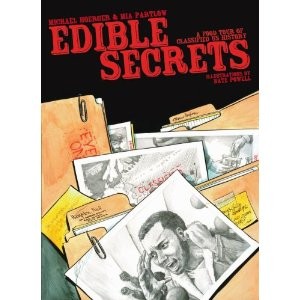
Title: Edible Secrets: A Food Tour of Classified U.S. History Authors: Michael Hoerger and Mia Partlow Illustrations: Nate Powell Published: 2010 by Microcosm Publishing
As pointed out in its introduction, food is as good a filter as any for relating to government secrecy: both are ever-present realities of life that we swallow without much further thought. This book is a creative one, in that it ties a lot of things together. It’s a history book, a comic, a zine, …and a reproduction of declassified government documents. All relating to food, either as a code word or as a coincidental element in major geo-political events (Black Panthers leader Fred Hampton was framed for robbing an ice cream truck at age 19; U.S. officials tried to assassinate Fidel Castro by spiking his milkshake with poison).
It’s a quirky take on a lot of different things that I enjoy reading about: history, secrecy, art, and food. I think it may take a special interest in the subject matter for the reader to really get down with this book, in my opinion—but I freakin’ love it. Nate Powell’s illustrations are the icing on the cake here: the first chapter’s title page shows Fred Hampton, dressed as Robin Hood, passing out ice cream to the neighborhood children. He hands a small boy a popsicle in the shape of a Black Power fist. Seriously, it doesn’t get any better than this. Original, political, historical, shocking, artistic: awesome.
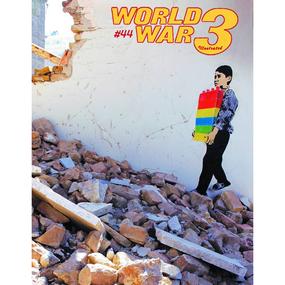
World War 3 is America’s longest-running radical comics anthology. While I’ve never reviewed an issue for Ad Astra, a lot of radical comic artists (including those I’ve featured here) have graced their pages. This issue took on the idea of “the other” – when ideas and people are perceived as alien, even opposite or in conflict with the given norm.
Issue #44 includes:
“Alien Europe” by Ganzeer – An exploration of cultural differences across time and space. This appears to be based on a lecture, or perhaps just a thought process of the author, but he shows how all culture is, in short, a homogenization of converging cultures.
“Single Lens Reflex” by Sandy Jimenez – Autobiographical piece about gentrification, photography, and class dynamics in artistic interpretation. That description makes it sound stuffy and academic, but it is extremely personal and heartfelt. I think this is an amazing story that is told very well. Sandy Jimenez has a great understanding of memoir narrative–looking back on a feeling that he had over a period of years and identifying how it developed, how he came to understand and overcome it, and what remains. A gem – one of my favourite contributions to the issue.
“Kemba Smith” by Sabrina Jones and Marc Mauer – part of a larger book called Race to Incarcerate: A Graphic Retelling about the U.S. prison system (available as of April 2013 from The New Press). “Kemba Smith” tells the story of a 24 year old college student with no previous record, who was sentenced to 24 years in prison for her connection to her drug-dealing boyfriend.
“Charest, Dehors! Inside Quebec, Out in the Streets” – by Jesse Staniforth and Dan Buller. Great personal account of the massive student protests in Quebec – a story that we’ve yet to fully unravel and appreciate in the rest of Canada/North America in general. Great illustrations from Dan Buller, mostly from photographs from the protests, accompanied with reproductions of some of the protest/street art that appeared over the course of the action.
“Baddawi” – A comic memoir by Palestinian American comic artist Leila Abdul Razzaq, who has illustrated her family history from Israel’s 1948 ethnic cleansing campaign, to her father living as a child in a refugee camp, to her own modern-day self. Making her debut in this issue of WW3, Razzaq focuses on her family, showing how her grandmother survived Al Naqba at the age of 17, and how her father became the most successful marble tycoon of their family’s refugee camp.
Further notes: Razzaq’s style is very simple. My first impression was that it reminded me of Satrapi’s Persepolis for its simple line work and good use of contrast. But on further inspection I see some interesting and original details–garments with designs that are distinctly Palestinian, imagery of invading soldiers coming out of the ocean. I think Razzaq probably faced/faces the challenge of having content in her stories that is so powerful, it can overshadow or overpower her artwork. It’s a good challenge, and I can’t wait to see how her work develops and evolves with her storytelling.
“A Real Hero” by Tom Keough – A personal memory of the artist and two friends sticking up for a man who was getting beaten to death by a group of men in the street.
“One Rainy Night” – Peter Kuper’s enactment of a conversation with a once-rich and beautiful woman. This one-page piece is part of a larger body of work entitled, Drawn to New York: An Illustrated Chronicle of Three Decades in New York City.
“One City, One People, One Planet” – The legendary Seth Tobocman makes some inspiring observations about the human response to Hurricane Sandy.
“Nap Before Noon” by Barrack Rima – translated from Arabic and read right-to-left, tells the story of the authors first trek into Europe as an immigrant.
Title: Devil Dog: The Amazing True Story of the Man Who Saved America Author: David Talbot Illustrator: Spain Rodriguez Published: 2010 by Simon & Schuster (Pulp History Series)
It’s almost impossible to fathom the life of Smedley Darlington Butler. He began his military career at 16 (in 1898, in response to the supposed Spanish attack on the U.S.S. Maine off the coast of Cuba), and spent the next 34 years rucking and getting shot at in China, the Philippines, Central America and the Caribbean. He would also serve in WWI, being deployed in France.
If that were not enough, consider that in Butler’s final years he was among the country’s most decorated veterans and fiercest critics. Just 5 years before he died, he wrote a book called “War is a Racket” about the nature of the U.S. military industrial complex—a slogan that still gets used today in the anti-war movement.
Unfortunately Smedley Butler’s incredible story fades with each generation. The idea that “War is a racket” became at risk of becoming just another dusty and out-dated slogan of protest.
What “Devil Dog” brings to the table is a remix on a story that’s too good to forget in the past and too important to leave on the fringes.
Staying true to the look and feel of its “Pulp History” series, Devil Dog is actually a book of prose dotted with vibrant comic art by the wonderful Spain Rodriguez, in addition to press clippings and other contemporary visuals- art, photographs, etc.–all of which lends to the “Pulp” nostalgia that the series is shooting for. It is, much to my pleasant surprise, a very artfully written piece—you can tell Talbot is engaged by the story and wants you to feel it, too—with each chapter feeling like its own self-standing story of adventure, suspense, romance. Spain’s illustrations, especially with the Technicolor palette choice, really give the book the feel of an old pulp adventure comic.
More importantly, Smedley’s anti-imperialist politics aren’t editorialized by the book’s creators. In fact David Talbot goes out of his way to illuminate much of Butler’s military adventures (even prior to his anti-war awakening) as campaigns of corporate adventurism. He has probably taken a cue from Butler’s own memoir-styled book, where he is looking back on everything that he did with mature hindsight.
I would recommend this work to anyone interested in American war / anti-war history: it truly is a gem. The narrative is one that works well for being told aloud—if it weren’t for a few passages of sex and violence, it would be an amazing story to read to kids.
If you want to know more about the work, S&S actually made a trailer for their Pulp History series- and you can check that out here:
Between May 9 – 11, political cartoonist Matt Bors will be in Toronto showcasing his new book, Life Begins At Incorporation: Cartoons and Essays. In addition to exhibiting his work at the Toronto Comic Arts Festival (TCAF) May 10 – 11 at the Toronto Reference Library, Bors will be presenting his work on Friday evening, May 10 at 7:30PM at the Toronto Comic Book Lounge.
Matt Bors is a nationally-syndicated political cartoonist, editor, and writer based in Portland, Oregon. In 2007 at the age of 23, he was the youngest nationally-syndicated cartoonist in the United States. Since then his work has graced the pages of WIRED Magazine, The Los Angeles Times, Village Voice, and The Nation.
Life Begins at Incorporation is Matt Bors’ second book. It received 170% funding on the website Kickstarter in 2012, and was released to funding backers and pre-orders in April 2013. It features cartoons and essays on a variety of topics, from gun control, women’s rights, and the environment to the Global War on Terror (a segment of Bors’ talk is devoted to his trip as a comics journalist to Afghanistan in 2010).
In 2012, Bors was both a Pulitzer Prize Finalist for Editorial Cartooning and the first alternative-weekly cartoonist to win the Herblock Prize for Excellence in Cartooning. At a time when political cartooning is widely considered to be a ‘dying art’ by the journalism industry, Bors’ cartoons have received significant mainstream political traction. In 2012, one of his works was presented by U.S. Congressman John Larson during a house floor debate on the Affordable Care Act, while another piece about Osama Bin Laden’s driver, Salim Hamden, was smuggled to him while he served as a detainee of the Guantanamo Bay Detention Camp.
Bors is available to interview in-person during his stay in Toronto May 9-11, or by phone at the interviewer’s convenience.
Interested parties can find examples of his work and more information on his website, www.MattBors.com. A .PDF copy of Life Begins At Incorporation is available for review upon request.
“The Political Comics of Matt Bors,” is organized by the website Ad Astra Comix, which reviews, researches, promotes and distributes political and historical comic art.
What People Have Said of Bors’ Work
(Quotes From the Back Cover of Life Begins):
“Life Begins at Incorporation is equal parts maddening and hilarious. Matt Bors reminds us that in an unjust world, laughter is an absolute necessity. The only disappointment in this book is that despite my wishes to the contrary, ‘The Avenging Uterus’ is not in fact real.” – Jessica Valenti, founder of Feministing.com & author of The Purity Myth
“Bors embodies the highest virtues of political cartoonists: fearless, provocative satire and cutting, acerbic insights. He’s also unfailingly funny.” – Glenn Greenwald, columnist for The Guardian
“Able to eviscerate a target with a single panel. You never want to end up on the wrong side of his pen and ink!” – Markos Moulitsas, Publisher, Daily Kos
“Bors has the right stuff and then some.” – Christopher Hitchens, author of God Is Not Great
“A bunch of cunty liberal garbage.” – Person on the Internet
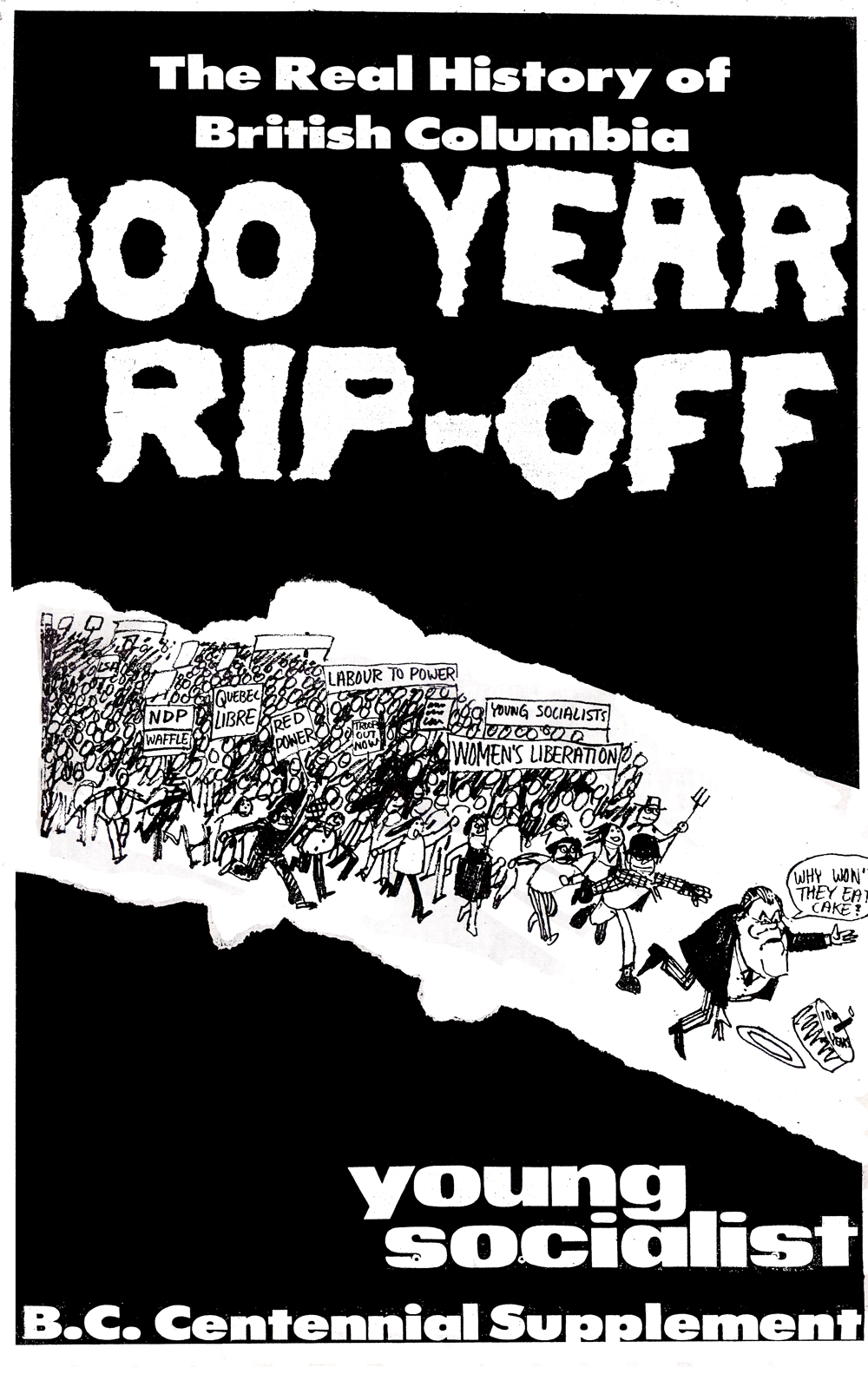
Some time ago now, I was more deeply submerged in socialist literature than comic books. Luckily, when I received an old, shoddy copy of this tabloid-sized piece, I kept it.
Originally released in 1971 for the Centennial commemoration of B.C. joining Canada, a group called Young Socialist released this tabloid-sized comic history as a reading supplement. Despite a few out-of-date depictions (a short section on Chinese migration building the B.C. railways is crudely stereotyped), the work is stylistic and well-researched, in addition to lending insight into labour tensions (particularly the BC Fed vs. rank and file workers) in the province at that time.
I am now at the point where, as much as I want to review every new political comic release that is coming out, I too want to dig for those historic gems that were far more ahead of the times than they ever could have imagined. Who would have thought that in the last decade alone, the category of “educational comics” ranging from history and economics to science and the arts would be in a scramble for an exploding market? “Graphic histories” have popped up like weeds on every subject and personality; they are now the bread and butter of a middle school classroom.
My copy of 100 Year Rip Off is in good condition, but is the copy of a copy that wasn’t. I haven’t been able to find another copy online, and can only assume that other remaining copies in the country are most likely in personal collections. I have scanned it onto my computer and plan to spend the next few weeks re-mastering the images, to have it available as a downloadable .PDF file. It’s a wonderful piece of Canadian radical history, and I look forward to seeing it the way it was when it first came out.
View the comic as a PDF file in both English and Spanish.
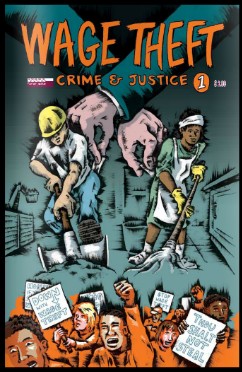
This is an interesting new comic that’s just been brought to my attention. It’s called Wage Theft: Crime & Justice (1# – will there be a series?), and is more or less an educational pamphlet that details interviews with low-income earners (including migrant and undocumented workers) who are experiencing illegal cuts to their pay checks from their employers. The project appears to have been launched by a group called Interfaith Worker Justice out of Texas, with grant support from a couple of different church groups.
Wage Theft is written by Jeffry Odell Korgen and illustrated by Kevin C. Pyle (whose work includes Take What You Can Carry, Blindspot, and Prison Town. He is also a former co-editor of World War 3, America’s longest-running radical comics anthology.)
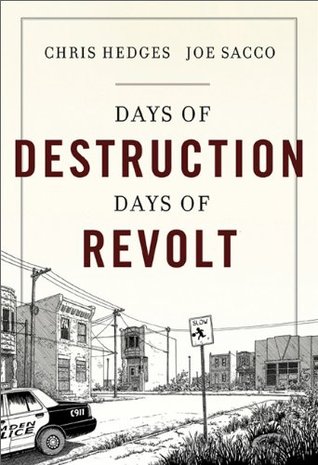
Title: Days of Destruction, Days of Revolt Written by: Chris Hedges, Joe Sacco Illustrations by: Joe Sacco Published: 2012 through Knopf Canada (a division of Random House Canada) List price: $29.95 CAD
Chris Hedges was trained to be a minister, and Joe Sacco is known to draw comics. Both, however, have made their strongest marks within the realm of journalism: Hedges as a foreign correspondent reporting from Central America, the Balkans, the Middle East, and Africa. Joe Sacco made comics journalism a concrete category with works like Palestine, Safe Area Gorazde, The Fixer, and others.
It seems only natural that the two would work together. They have overlapped each other’s geographical locations of coverage on a few occasions, particularly with Israel/Palestine and areas in the Balkans. Both understand the complexity of what they investigate and the need for empirical as well as historical inquiry.
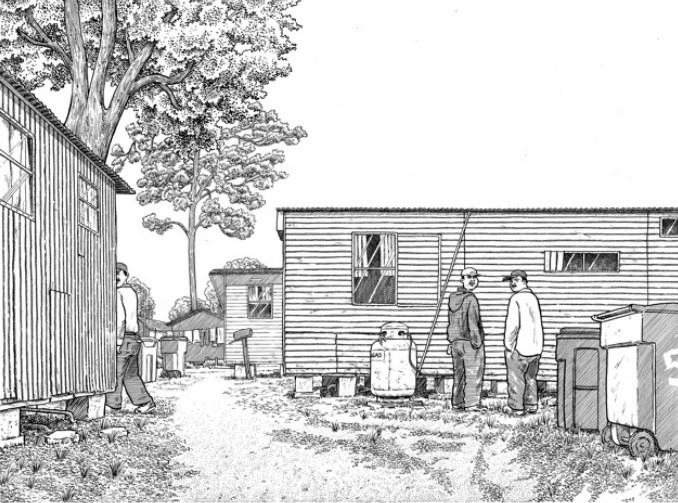
But what I find intriguing about Days of Destruction, Days of Revolt is the way I see their previous work illuminate these pages to reveal a truly devastating picture of the state of America. Hedges draws on a treasure trove of historical events he has personally witnessed or painstakingly researched to show how the elite of the U.S.A. may not be as invincible as they think; Sacco’s trademark illustrations immediately recollect visions of a street in Gaza—and yet, I’m not looking at a street in Gaza here; I’m looking at a street in Camden New Jersey or Immokalee, Florida.
To be clear, the book is about a little more than destruction and revolt. Those two points are the focus of two separate chapters. Others include:
Days of Theft: Pine Ridge, South Dakota
Days of Seige: Camden, New Jersey
Days of Devastation: Welch, West Virginia
Days of Slavery: Immokalee, Florida
Days of Revolt: Liberty Square, New York
What is recounted in these pages isn’t sensationalism. Sensationalism would imply that truths were stretched, or quotes taken out of context. What it amounts to is a gallery of some of the worst places to live in the United States today—regions termed by Hedges to be “the sacrifice zones” of unfettered capitalist exploitation. And therein lies the fundamental trouble with DDDR which digs at you through your read of it: that is, from cover to cover, it’s all true.
Each chapter is an article written by Hedges, documenting their travels to a particular site. Locals are interviewed and are the subjects of most of Sacco’s illustrations in the book (his work is typically either a landscape for an area, or a person talking of their experiences.) Within this format, Hedges makes invaluable use of his time as a foreign correspondent, drawing on that experience to show how these regions are being treated much the same as third-world countries under foreign occupations, domestic dictatorships, or the suffocating yoke of international debt. This is contrasted with his written descriptions (and Sacco’s visuals) of the people who inhabit these areas: most are simple people whose definitions are blurred, sometimes completely overtaken by the hardship around them. Hedges and Sacco point out strength and sacrifice in those they interview, as much as they profile individuals who, understandably, in the words of Hedges, are “living lives in which tenderness and security are grabbed in desperate snatches.”
This work is truly a testament to those most voiceless in America today—from West Virginians dying of the coal industry’s carcinogenic air, to the millions of Latin Americans living a modern-day slavery Hell in the American South. Their stories are illuminated with Sacco’s artwork, and their finds profound historical, philosophical, even moral depth with Hedges’ words.
It will disgust and anger you, but it is a must-read.


“Clearly New York was a dangerous place where terrible things could happen, but also a place that could turn ordinary people into superheroes.”
















 adastracomix.com